
A single reel schedule can easily span a 2.7× diameter range. One documented cable distribution project listed 22 reel types from Ø737 mm to Ø2,007 mm, with reel weights of roughly 500–3,000 kg and reel widths inside a listed range of 610–1,118 mm. A rack that puts every reel on one fixed level cannot serve that list: set the level for the Ø2,007 mm drum and most of the volume above the small drums is dead space; set it for the Ø737 mm drum and the large drum cannot be loaded at all.
The layout used in that project was not one shelf height but two rack groups drawn from the same frame family — a diameter band split. Below: how the reels were grouped, what changes between a two-level band and a single-level band, why an auxiliary frame is not a free-standing rack, and how the 100 mm hole pitch on the upright is used to set reel support height. Every figure quoted here is a reference value of that one documented design, not a universal Carack rating.
Why one shelf height cannot cover a 737 mm to 2,007 mm reel list
A cable drum takes vertical space equal to its own diameter, plus the clearance a forklift needs to set the drum on the reel support and lift it off again. Between Ø737 mm and Ø2,007 mm the height demand moves by about 1,270 mm, which is more than a whole usable level on a rack of this class. That is why the documented project did not standardise one level height: the reel list was split first, and support positions were then set per group. Two other columns of the same list matter as much as diameter. Reel weight — about 500–3,000 kg across the list — drives support and base selection. Reel width — 610–1,118 mm in the listed range — decides how much of the frame depth one drum occupies and how close two positions can sit.
How to group cable drums into diameter bands
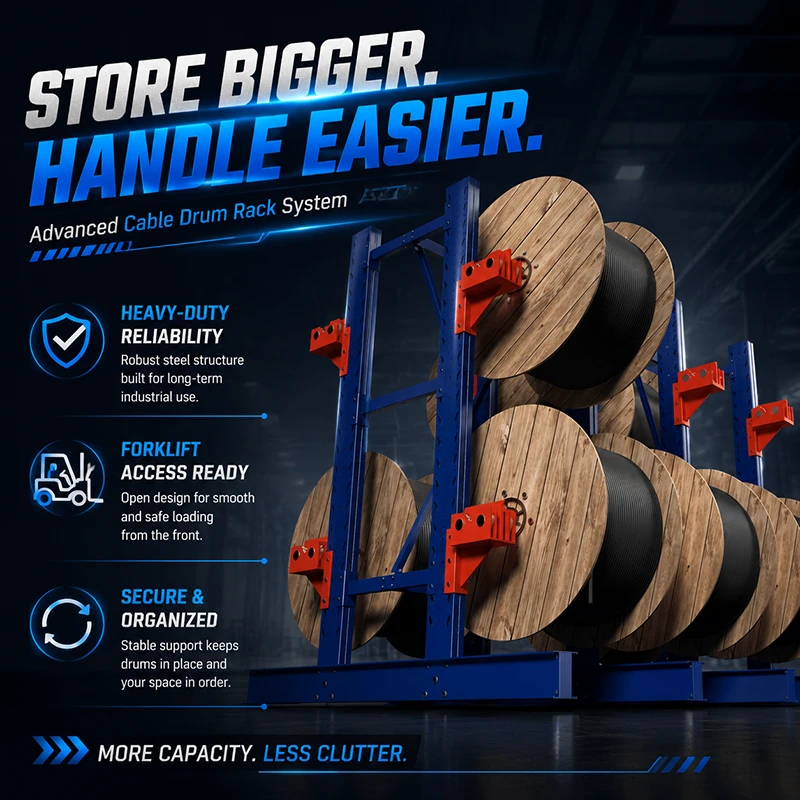
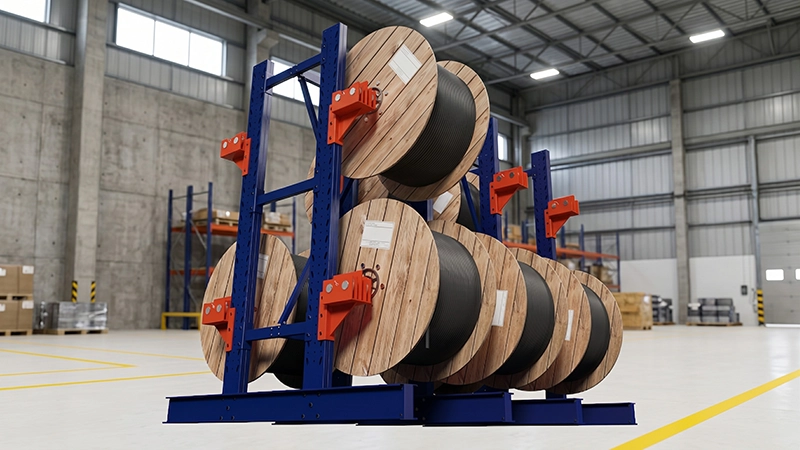
Grouping starts from the reel list, sorted by diameter, with weight and width carried alongside. The working rule is simple: a band is valid when every reel in it can sit on the same support spacing, with the same forklift entry, without the level above interfering. If one reel in a band forces the level higher or the position wider, that reel belongs in the band above it. On the documented 22-reel list the split produced two groups. The two-level group carried four reel positions per frame unit for the smaller diameters. The single-level group carried two reel positions per frame unit for the larger diameters. Both reference designs stood about 3,002 mm high. Reference main and auxiliary frame weights were 638 kg and 368 kg for one group, 690 kg and 360 kg for the other. Those numbers describe that project’s two designs; a different reel list produces different bands, different positions per frame unit and different frame weights.
What changes between a two-level band and a single-level band
The two-level band is the space-efficient side of the split: smaller drums are stacked, four positions per frame unit on the documented design, and the frame height is used twice. The single-level band gives the large drum the full level — two positions per frame unit, no upper support to interfere with loading, and no attempt to squeeze a second level under the frame top. Note what does not change: the single-level group is not a taller rack. Both reference groups were about 3,002 mm high, so what moved was the support layout on the same frame height, not the frame height itself. When the two groups are compared, compare positions per frame unit and the aisle the forklift needs, not the outline of the rack.
Why an auxiliary frame cannot be installed on its own
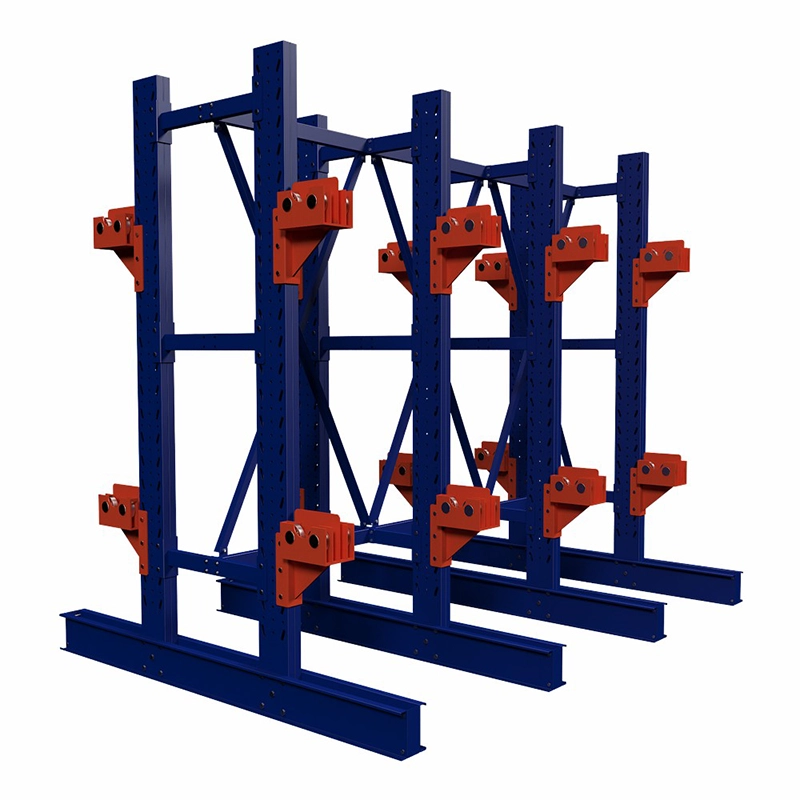
A Carack bay is built as a main frame plus optional auxiliary frames. In that arrangement the auxiliary frame has no independent support of its own: it relies on the main frame’s upright and is tied into the same braced assembly. In the documented multi-bay design one main frame plus two auxiliary frames formed the rack; the auxiliary frames added reel positions, they did not add a free-standing column. Two practical consequences follow. An auxiliary frame cannot be quoted as a standalone rack for a separate island of storage — that island needs its own main frame. And the auxiliary frame’s position, base connection and bracing have to be designed together with the main frame, not added after the rack is standing. The reference frame weights point the same way: in the documented designs the main frame was about 638 kg and 690 kg, the auxiliary frame about 368 kg and 360 kg.
How to use the 100 mm hole pitch on the upright
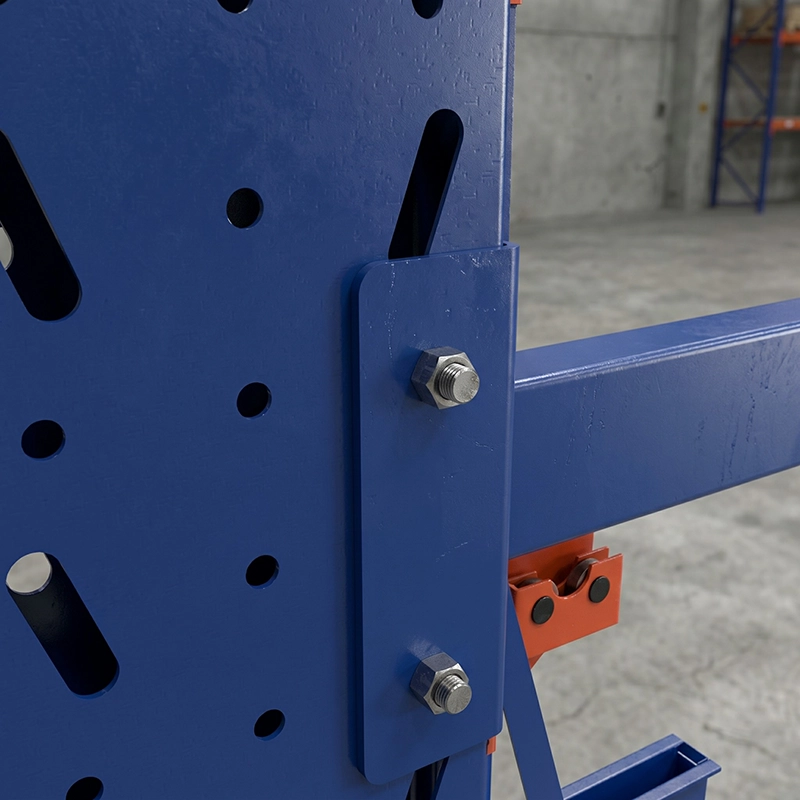
The dedicated upright profile is punched with installation holes at 100 mm intervals, and that pitch is the adjustment step for reel support height. The sequence is: fix the diameter band first; find the lowest hole that gives the band’s largest drum the diameter clearance and the forklift entry it needs; then set the same position across every position in that band so the group stays level. The pattern is a fixed 100 mm pitch, not continuous adjustment, so a support lands on the nearest valid hole rather than on an exact calculated millimetre. That is normally sufficient, because the level is designed around a band and not around a single reel. The same upright also carries both levels of a two-level band, which is why the pitch is a frame feature rather than an accessory. If the reel list changes, supports can be re-set on the same upright; the frame does not have to be replaced.
Where the diameter-band approach does not apply
The split described above is a planning method with clear limits, and they are worth stating before a reel list is sent for quotation.
- Bands are built from a list. If the inventory turns over every few weeks, the bands go stale and have to be re-checked before ordering.
- If cable must run off the drum in place, that is a roller-bearing support decision with its own clearance requirement, separate from the band split. Carack is a fixed steel storage structure, not an automated cable carousel, cable winding machine or roll-out cantilever rack.
- If a drum is to be taken out of the rack and transferred to a mobile trolley, the fork clearance and support geometry for that movement have to be confirmed, not assumed.
- Outdoor storage needs a corrosion-control finish agreed with the quotation and an operating decision on rain exposure; the rack is not automatically an outdoor product.
- No universal load capacity, steel grade, safety factor or anchoring requirement should be read into this article. Capacity, finish and anchoring are confirmed for the specific configuration in the quotation or drawing.
Where this rack layout fits
- Cable distribution centre whose reel list mixes small and large diameters
- Cable factory buffer storage between production, testing and dispatch
- Power and electrical equipment warehouse with a defined reel list and forklift access
- Long warehouse row where one main frame is extended with auxiliary frames
- Outdoor cable yard, where a corrosion-control finish is specified for the configuration
Frequently asked questions
How do I know how many diameter bands my reel list needs?
Sort the list by diameter, then test two limits: what fits between two support levels, and what needs a level of its own. On the documented 737–2,007 mm list that produced exactly two bands — a two-level band with four positions per frame unit and a single-level band with two positions per frame unit. The band count follows the list; there is no fixed number. The test for each band is whether its largest drum still clears the support above it and still leaves usable forklift entry.
Can I order only the auxiliary frame and use it as a separate rack?
No. The auxiliary frame relies on the main frame’s upright for support and is part of the same braced assembly, so it is an extension of a main frame rather than a free-standing unit. If you need a second, separate island of storage, price that island with its own main frame.
Does the 100 mm hole pitch let me move the support height by 100 mm whenever I want?
Support positions are set in 100 mm steps because that is the pitch of the installation holes. That is enough to set a level for a defined diameter band and to re-set it later if the reel list changes, but it is not continuous adjustment, and it does not by itself guarantee clearance. Drum diameter, drum width, support geometry and forklift entry still have to be checked for the configuration.
Send the reel list — diameter, weight and width for each drum — together with the handling equipment and the aisle you have, and the band split, positions per frame unit and frame combination can be worked out for your site instead of borrowed from the reference design above.
Need a Custom Storage Solution?
Speak directly with our technical engineers. We offer free structural designs, heavy-duty catalog evaluations, and quick B2B price quotations.
Request a Quote Now →