
Ein leerer Drahtgittercontainer reist nicht kostenlos. Auf dem Rückversand von Autoteilen werden die Container als eigenständige Fracht zum Werk zurücktransportiert, und genau dort spalten sich zwei Verpackungswege. Der eine ist Stretchfolie plus Umreifung: ein gefaltetes Bündel, das mit Folie und Bändern zusammengehalten wird und die Verpackungsrechnung kaum erhöht. Der andere ist eine Holzkiste: eine starre Holzummantelung, die nach Oberflächenpreis berechnet wird, mit einem Projektpreis von etwa CNY 90 pro Quadratmeter im Datensatz 13967. Die Frage ist nicht, welche Variante günstiger in der Anschaffung ist. Es geht darum, welche weniger kostet, wenn die Container entladen und die Lackoberfläche geprüft wird.
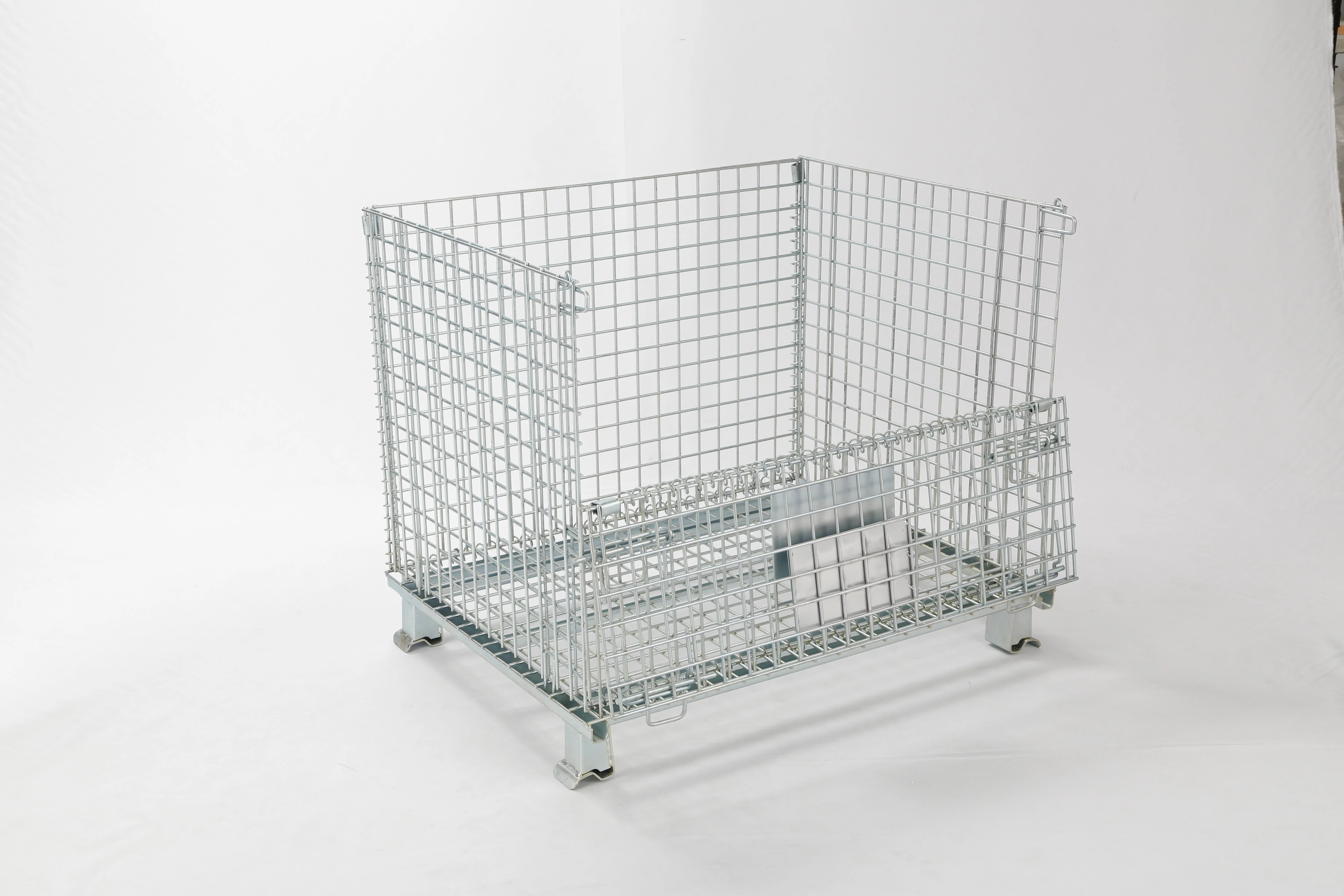
Dieser Artikel geht beide Wege anhand der dokumentierten Konfiguration 13967 durch – einen klappbaren Stahlkäfig mit den Maßen 800 × 1200 × 890 mm, der auf eine Höhe von 190 mm gefaltet wird, gebündelt zu zehn Einheiten pro Stapel mit den Maßen 1240 × 1240 × 1600 mm – und zeigt, was jede Option schützt, welches zusätzliche Gewicht und Volumen sie mitbringt und wo der Kistenpreis neu kalkuliert statt nur übernommen werden muss.
Wie verpackt man leere Drahtgittercontainer für den Export?
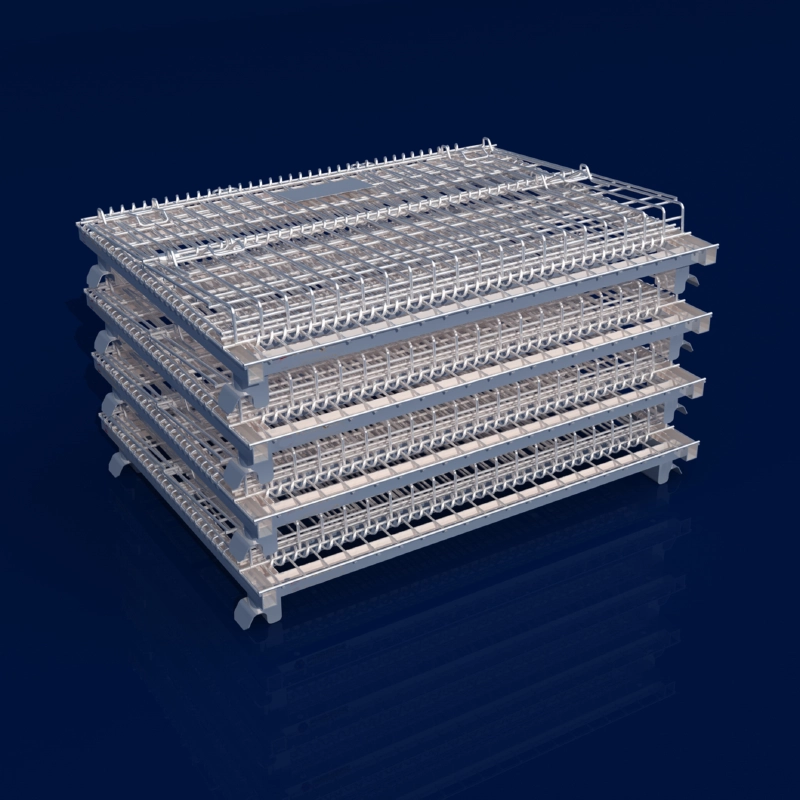
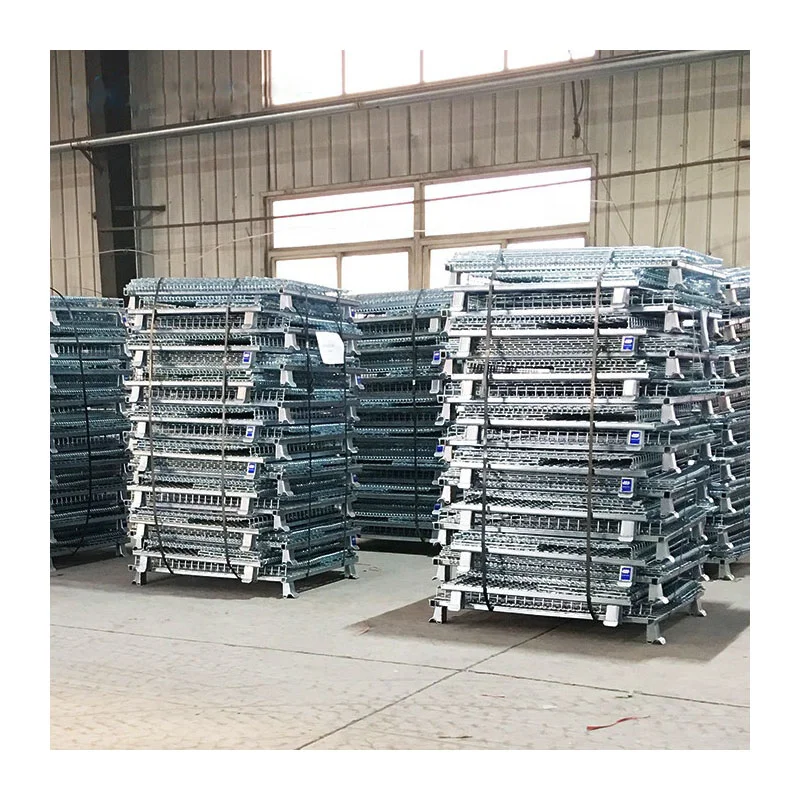
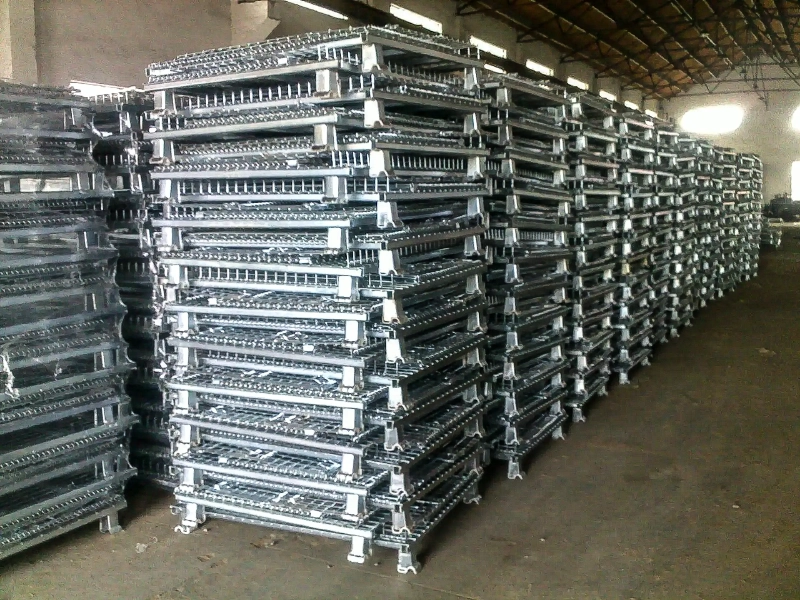
Die Leerverpackung beginnt mit dem Falten, denn das gefaltete Bündel – nicht der einzelne Käfig – ist die Einheit, die Sie kalkulieren, umreifen, verladen und für die Fracht abrechnen. Im Datensatz 13967 reduziert sich der klappbare Käfig auf eine Falthöhe von 190 mm, und zehn gefaltete Einheiten werden zu einem Stapel mit den Maßen 1240 × 1240 × 1600 mm gebündelt.
From this stack, the two routes diverge. Route one wraps the bundle in stretch film and closes it with strapping, PET or steel, so that the folded panels cannot open in transit. Route two builds a wooden crate around the bundle, or around an assembled container if the cages are shipped erected.
Regardless of the route chosen, the packaging plan must be based on the final drawing, not on a catalog image. Folded height, stacking area, strap positions and forklift access are based on the cage dimensions actually ordered, and cage sizes vary between projects. A packaging plan created for one order cannot readily be transferred to the next.
Stretch film and strapping: what they do and what they do not
Film and strapping are the low-cost option and are generally the standard choice for recurring export runs. The film holds the folded panels together and protects the outer surfaces to a certain degree from dust and road spray. The strapping gives the bundle its shape and prevents the stack from opening during handling.
What this option does not do is create a rigid shell. There is metal-to-metal contact between the folded panels, and a tensioned strap presses directly on the galvanized surfaces. Under road vibration and repeated handling, this contact can damage the coating. This is a real risk with any bundle, and that is why we do not promise scratch-free arrival with the film and strapping option. Where arrival condition matters, treat this option as the one that requires additional care—interleaving between the panels, controlled strap tension, edge protection under the straps—not as the option that requires no special care.
In puncto Kosten addiert diese Variante nur den Folien- und Bandverbrauch. Es fallen kein Kistenmaterial, kein Kistengewicht und kein Kistenvolumen an.
Holzverpackung: Was ein Quadratmeterpreis tatsächlich bringt
Holzkisten werden anders kalkuliert, nämlich nach Oberfläche. Im Datensatz 13967 wird für den frühen Kostenvergleich ein Wert von etwa CNY 90 pro Quadratmeter angesetzt. Betrachten Sie dies als Planungsgröße, nicht als festen Preis. Die Kistenkosten variieren je nach Kistengröße und Brettstärke, der Holzqualität, den Bestimmungen des Empfangslandes hinsichtlich hitzebehandeltem und gekennzeichnetem Holz sowie der Bestellmenge. Kalkulieren Sie diese Position anhand Ihrer eigenen Käfigmaße und des Bestimmungsortes neu, bevor sie in die Landed-Cost-Berechnung einfließt.
Was das Geld bringt, ist Trennung. Eine Kiste hält Handlingsgeräte, andere Fracht und die Containerwand vom Käfig fern und ermöglicht es, die Ladung im Inneren so zu fixieren, dass sie nicht verrutscht. Die Nachteile sind Gewicht und Volumen auf jedem Transportabschnitt sowie auf dem Rücktransport: Eine Holzkiste ist normalerweise ein Einwegartikel. Wenn die Kisten nicht zurückkommen, ist der Quadratmeterpreis ein Kostenfaktor pro Sendung, nicht pro Containerlebensdauer.
Ein Aspekt entscheidet die Wahl häufiger als der Preis: Die Kiste muss so verpackt werden, dass sich der Käfig darin nicht bewegen kann. Ein starrer Kasten um ein loses Bündel überträgt Stöße weiterhin durch das Holz.
Stretchfolie vs. Holzkiste: Direkter Vergleich
| Entscheidungskriterium | Stretchfolie + Umreifung | Holzkiste |
|---|---|---|
| Was hinzugefügt wird | Folienwicklung und Bänder um ein gefaltetes Bündel | Eine starre Holzschale um das Bündel oder den montierten Käfig |
| Preisgrundlage | Nur Folien- und Bandverbrauch | Nach Fläche kalkuliert; Projektreferenz ca. 90 CNY pro Quadratmeter, pro Projekt neu kalkuliert |
| Schutz vor Abrieb | Gering: gefaltete Paneele und Bänder berühren die Beschichtung direkt | Higher: the cage is isolated from external contact if it is fixed inside |
| Additional weight and volume | Least of both | Increases dead weight and volume on each section |
| Return cargo | Film and straps are removed; the container is reused | Single-use unless return cargo is paid for |
| Typical use | Repeated round trips where freight costs per container dominate | One-way or long ocean freight legs where arrival condition outweighs packaging cost |
How much volume do folding and stacking save?
Folding decides whether the return freight is profitable or not. In record 13967, an assembled cage measures 800 × 1200 × 890 mm, approximately 0.85 cubic meters. Ten assembled cages side by side require about 8.5 cubic meters. The same ten units folded and bundled form a stack measuring 1240 × 1240 × 1600 mm, about 2.46 cubic meters. That is roughly 71 % less volume for the same ten containers.
Two limitations matter. First, this is a calculated figure based on recorded values, not a freight quote: how much of the saving is actually realized depends on the container type, the arrangement of the stacks, and the remaining empty space. Second, the footprint of the folded stack is wider than the footprint of a single assembled cage—so the saving lies in height and total volume, not in floor area. Plan loading accordingly.
Which packaging method suits your return shipment?
- Film and strapping are suitable for recurring round trips where the containers return to your own plant, the coating is not a customer-visible surface, and freight cost per container dominates the decision.
- Wood packaging is suitable for one-way transport, high-value containers, long ocean routes, and all shipments where arrival condition is worth more than the packaging bill.
- Choose wood packaging for mixed loads where other cargo can shift against the cages.
- Before booking freight, check folding height, stacking area, and strap positions against the final drawing for the ordered cage size.
- Calculate the crate price based on a new project calculation and the cost of film and strapping based on consumption, not on a catalog value.
Häufig gestellte Fragen
Can stretch film and strapping guarantee that the containers arrive without scratches?
No, and we will not claim that. Film and straps hold the bundle together; they do not prevent contact between folded panels or between tensioned straps and galvanized surfaces. Interlayers, controlled strap tension, and edge protection reduce the risk, but the film/strapping variant is the one that carries the risk of coating marks—not the one that eliminates it.
Is the price of 90 CNY per square meter for the wooden crate binding?
It is a project reference for an early cost estimate in record 13967, not a fixed quote. The actual price depends on crate size, wood specification and thickness, whether treated and marked wood is required at the destination, and the order quantity. Send the cage dimensions and the destination, and the crate price will be recalculated.
How many folded containers make one bundle?
In record 13967, ten folded cages are bundled into a stack measuring 1240 × 1240 × 1600 mm, with a folding height of 190 mm. Other project records in this container family use different cage sizes, so treat the bundle count and stack size as configuration data that you should confirm against your own drawing.
Stbox is the foldable steel wire mesh container behind these figures: a flat-foldable, stackable cage for parts storage, line-side buffering, and empty-return logistics, with galvanizing, lids, liners, and casters selected per project. If you are calculating an empty return, send the cage size, the units per shipment, and the destination, and the packaging method can be worked out with you. The starting point is the product page: Foldable wire mesh container (Stbox).
Benötigen Sie eine individuelle Lagerlösung?
Sprechen Sie direkt mit unseren technischen Ingenieuren. Wir bieten kostenlose Strukturplanungen, Bewertungen von Hochlast-Katalogen und schnelle B2B-Preisangebote.
Jetzt Angebot anfordern →