
An empty metal mesh container does not travel for free. On an automotive parts return leg, containers come back to the plant as cargo in their own right, and that is where two routes split. One is stretch film plus strapping: a folded bundle secured with film and banding, which adds almost nothing to the packaging bill. The other is a wooden box: a rigid wooden shell priced by area, quoted against a project reference of roughly CNY 90 per square meter in record 13967. The question is not which is cheaper to buy. It is which costs less once the containers are unloaded and the paint finish is inspected.
This article examines both routes in the registered configuration 13967 — a foldable steel cage of 800 × 1200 × 890 mm that folds to a height of 190 mm, in a stack of ten units with a footprint of 1240 × 1240 × 1600 mm — and sets out what each option protects, what it adds in weight and volume, and where the box price should be re-quoted rather than assumed.
How are empty metal mesh containers packed for export?
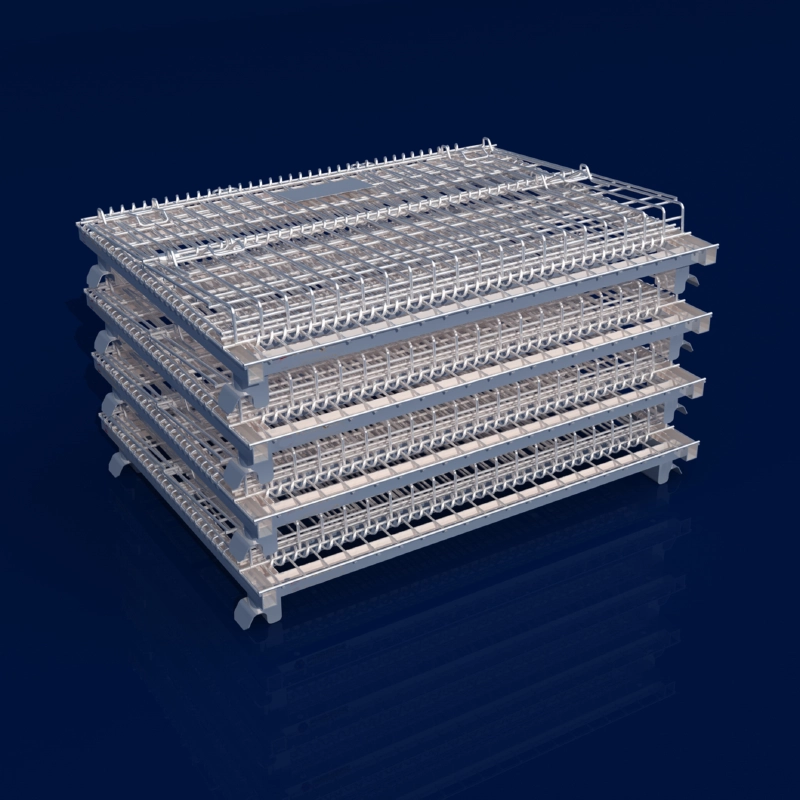
Empty return packaging starts with folding, because the folded bundle — not the individual cage — is the unit you quote, strap, load, and pay freight on. In record 13967, the foldable cage drops to a folded height of 190 mm, and ten folded units are grouped into a stack with a footprint of 1240 × 1240 × 1600 mm.
From that stack, the two routes diverge. Route 1 wraps the bundle in stretch film and closes it with strapping, PET or steel, so the folded panels do not open in transit. Route 2 builds a wooden box around the bundle, or around an assembled container if the cages are shipped assembled.
Whichever route you take, the packaging plan has to be built on the final drawing and not on a catalogue image. The folded height, the stack footprint, the strap positions, and the forklift entry follow the dimensions of the cage you actually ordered, and cage sizes vary between projects. A packaging plan made for one order will not serve the next.
Stretch film and strapping: what it does and what it cannot do
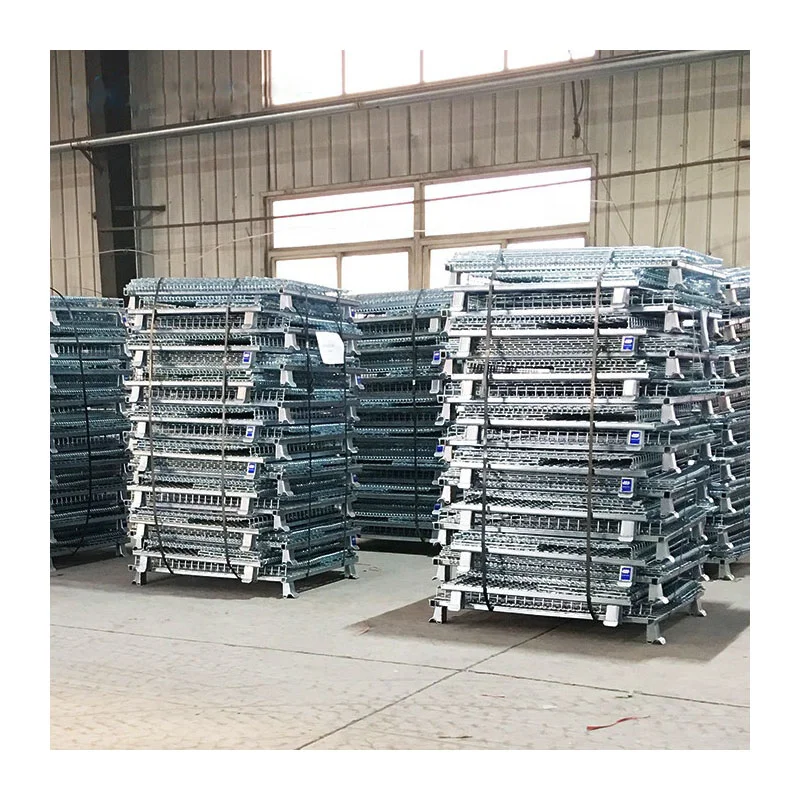
Film and banding is the low-cost route, and in a repeated export loop it is usually the default option. The film holds the folded panels together and, to some extent, keeps dust and road spray off the outer surfaces. The strapping shapes the bundle and stops the stack from opening during handling.
What this route does not do is create a rigid shell. Between the folded panels there is metal against metal, and a strap tightened directly over galvanized surfaces. Under road vibration and repeated handling, that contact can mark the coating. It is a real risk on any bundle, and it is why we do not promise scratch-free arrival with the film-and-strap route. Where the finish on arrival matters, treat this option as the one that needs extra care — interleaving between panels, controlled strap tension, corner protection under the straps — not as the option that needs no care at all.
As for cost, this route adds only the consumption of film and strapping. There is no box material, no box weight, and no box volume to carry.
Wooden box: what a price per square meter actually buys
The wooden box is quoted the other way round, by area. In record 13967, the figure used for an initial cost comparison is roughly CNY 90 per square meter. Read that as a planning number, not a fixed price. The box cost varies with the size and thickness of the panel, the wood specification, whether the destination requires heat-treated and marked wood, and the order quantity. Re-quote it against your own cage dimensions and destination before it goes into a landed-cost sheet.
What the money buys is separation. A box keeps handling equipment, other cargo, and the container wall away from the cage, and it lets you secure the load inside so it does not slide. The downsides are weight and volume on every leg, and the return leg: a wooden box is normally single-use. If the boxes do not come back, the price per square meter is a cost per shipment and not a cost per container lifetime.
One point decides the choice more often than price. The box has to be packed so that the cage cannot move inside. A rigid box around a loose bundle still transfers impact through the wood.
Stretch film vs. wooden box: direct comparison
| Punto de decisión | Stretch film + strapping | Wooden box |
|---|---|---|
| What it provides | Film wrap and strapping around a folded bundle | A rigid wooden shell around the bundle or the assembled cage |
| Price basis | Only the consumption of film and strapping | Quoted by area; project reference of roughly CNY 90 per square meter, re-quoted per project |
| Protection against abrasion | Limited: the folded panels and the straps contact the coating directly | Greater: the cage is separated from external contact, provided it is secured inside |
| Added weight and volume | The lowest of the two | Adds tare and volume on every trip |
| Return leg | The film and strapping are cut; the container is reused | Single-use unless return freight is paid |
| Typical fit | Repeated loops where the freight cost per container is dominant | Single-use legs or long sea routes where the condition on arrival weighs more than the shipping cost |
How much volume is saved by folding and stacking?
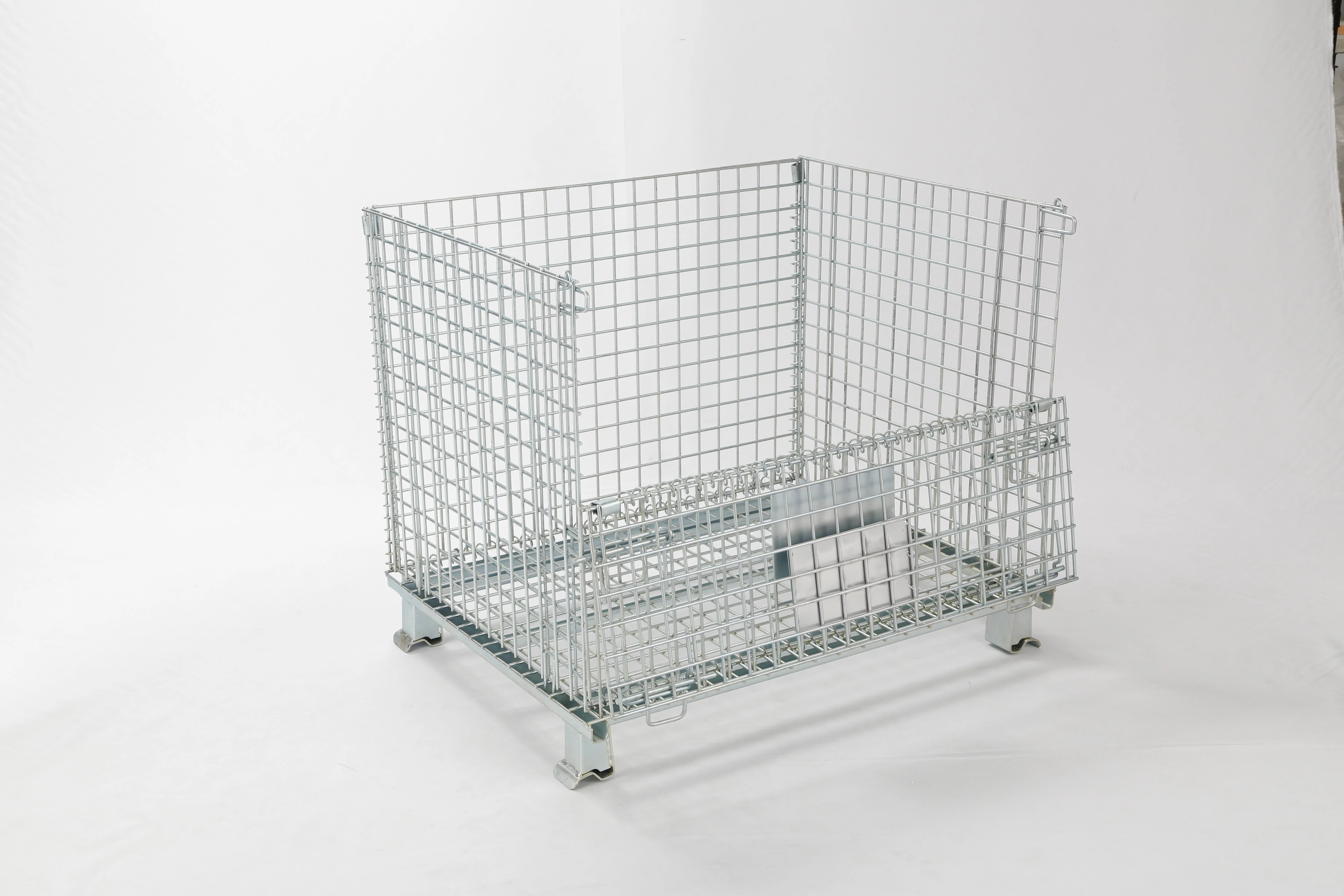
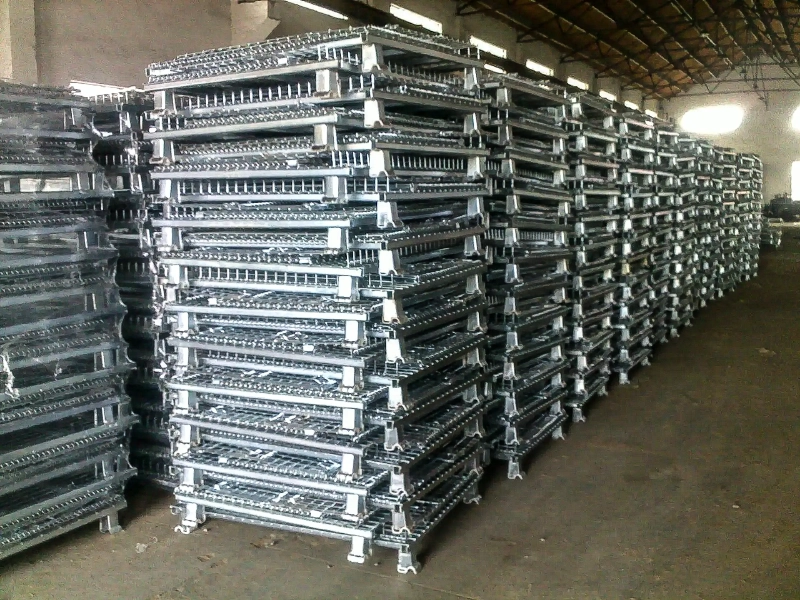
El plegado es donde se gana o se pierde el trayecto de devolución. En el registro 13967, una jaula montada mide 800 × 1200 × 890 mm, aproximadamente 0,85 metros cúbicos. Diez de ellas montadas ocupan unos 8,5 metros cúbicos. Las mismas diez unidades plegadas y agrupadas ocupan una pila registrada con 1240 × 1240 × 1600 mm, unos 2,46 metros cúbicos. Eso es aproximadamente un 71% menos de volumen para las mismas diez jaulas.
Dos matices importan. Primero, esto es aritmética sobre cifras registradas, no una cotización de flete: cuánto del ahorro se traduce en beneficio depende del tipo de contenedor, de cómo se distribuyen las pilas y de cuánto espacio muerto quede. Segundo, la superficie de la pila plegada es más ancha que la de una jaula montada individual, por lo que el ahorro está en la altura y la porción cúbica total, no en el ancho de suelo. Diseñe el plan de carga en consecuencia.
¿Qué opción de embalaje se adapta a su envío de retorno?
- El film y los flejes son adecuados para bucles repetidos en los que los contenedores vuelven a su propia planta, el revestimiento no es una superficie visible para el cliente y el coste de flete por contenedor domina la decisión.
- El empaquetado en madera es adecuado para tramos de un solo uso, contenedores de alto valor, rutas marítimas largas y cualquier envío en el que el estado a la llegada valga más que la factura del embalaje.
- Elija el empaquetado en cargas mixtas donde otra mercancía pueda desplazarse contra las jaulas.
- Antes de reservar el flete, confirme la altura plegada, la superficie de la pila y las posiciones de los flejes con el plano final del tamaño de jaula que ha pedido.
- Presupueste el precio de la caja a partir de una recotización del proyecto y el coste del film y los flejes a partir del consumo, no de una cifra de catálogo.
Frequently asked questions
¿Pueden el film estirable y los flejes garantizar que los contenedores lleguen sin arañazos?
No, y no lo afirmaremos. El film y los flejes mantienen unido el paquete; no detienen el contacto entre los paneles plegados ni entre los flejes tensados y las superficies galvanizadas. La protección intercalada, la tensión controlada de los flejes y la protección de las esquinas reducen el riesgo, pero la opción con film y flejes es la que asume el riesgo de marcas en el revestimiento, no la que lo elimina.
¿Es firme el precio de la caja de madera de CNY 90 por metro cuadrado?
Es una referencia de proyecto utilizada para una comparación inicial de costes en el registro 13967, no una cotización fija. El valor real depende del tamaño de la caja, de la especificación y el grosor de la madera, de si el destino requiere madera tratada y marcada, y de la cantidad del pedido. Envíe las dimensiones de la jaula y el destino y se recotizará el precio de la caja.
¿Cuántos contenedores plegados van en un paquete?
En el registro 13967, diez jaulas plegadas se agrupan en una sola pila registrada con 1240 × 1240 × 1600 mm, con una altura plegada de 190 mm. Otros registros de proyecto para esta familia de contenedores utilizan tamaños de jaula diferentes, así que trate el número de jaulas por paquete y el tamaño de la pila como datos de configuración a confirmar en su propio plano.
Stbox es el contenedor plegable de malla de acero que está detrás de estas cifras: una jaula plegable y apilable para almacenamiento de piezas, almacenamiento intermedio junto a línea y logística de retorno vacíos, con galvanizado, tapas, liners y ruedas seleccionados por proyecto. Si está valorando un trayecto de retorno vacío, envíe el tamaño de jaula, las unidades por envío y el destino, y la opción de embalaje podrá estudiarse con usted. Comience desde la página del producto: contenedor plegable de malla metálica (Stbox).
¿Necesita una Solución de Almacenamiento a Medida?
Hable directamente con nuestros ingenieros técnicos. Ofrecemos diseños estructurales gratuitos, evaluaciones de catálogos para cargas pesadas y cotizaciones de precios B2B rápidas.
Solicitar un Presupuesto Ahora →