
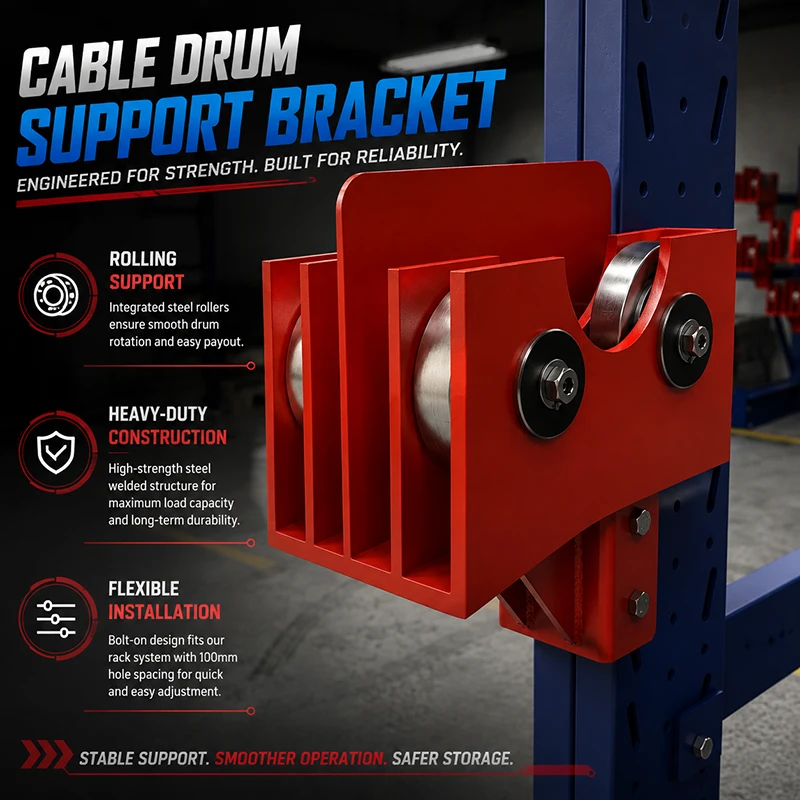
A cantilever rack that is already in your warehouse looks like the cheapest way to get cable drums off the floor. The arms are there, the uprights are there, the base plates are already bolted down. The problem is that a cantilever is designed to carry long goods resting on it, while a cable drum must be held on a spindle or on rollers and that load must be directed through a bracket into the upright and down to the floor. These are different load paths.
The retrofit kit offer that we calculate for this type of conversion is deliberately kept small: support tubes with Ø60 mm, a support bracket with 500 mm projection and a designated working area for drums up to Ø1,000 mm. These figures come from a documented retrofit process and apply only if the existing rack connection has been checked. They are a reference scope for a conversation, not approval to drill into any frame you happen to own.
What the retrofit accessory kit actually contains
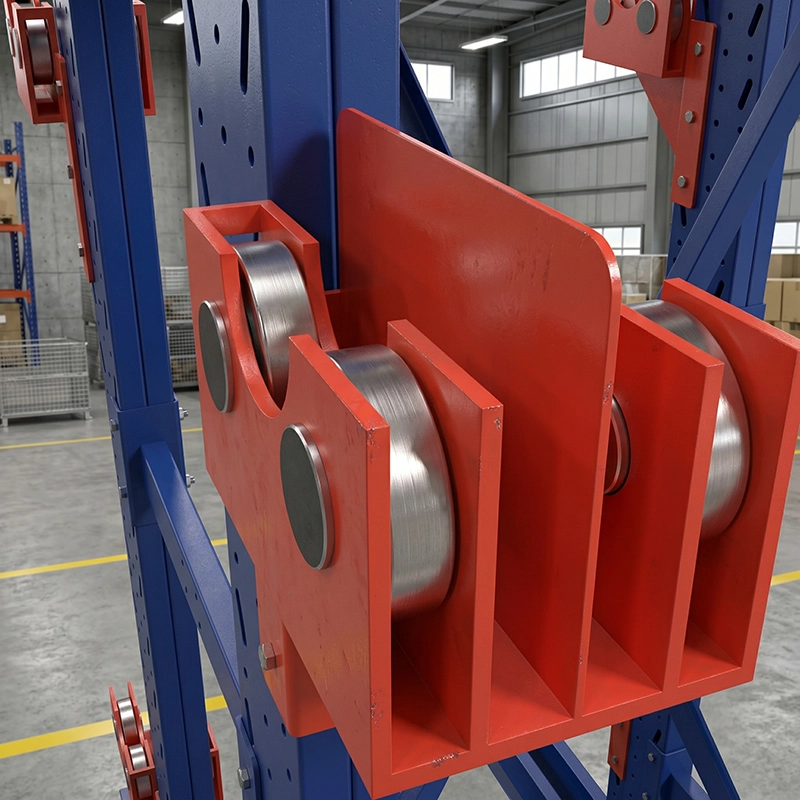
The conversion hardware consists of a support tube and a bracket that projects from the existing structure and carries the drum. In the documented process, the tube is Ø60 mm, the bracket projects 500 mm from the rack face, and the reference quantity was stated as either 20 or 100 units at about 32 kg per set. That is the physical scope of the accessory-side work. Everything that determines whether the conversion is safe lies outside this scope—in the condition and geometry of the rack you already have.
Die 500 mm Ausladung sind der Wert, der Käufer am häufigsten überrascht, weil er von der bestehenden Regalfront nach außen gemessen wird. Wenn Ihre Gangbreite auf die alte Regal-Außenkante ausgelegt war, schrumpft der nutzbare Gang um diese Ausladung auf jeder Seite einer Regalreihe. Bei einer zweiseitigen Anordnung sitzen die Trommelpositionen auf beiden Seiten, daher muss die Gangbreitenberechnung neu durchgeführt werden, bevor irgendetwas bestellt wird.
Preliminary checks that must be completed before any cutting or drilling
Treat this as a measurement checklist, not a formality. Each point can stop the project on its own.
Anschlussgeometrie
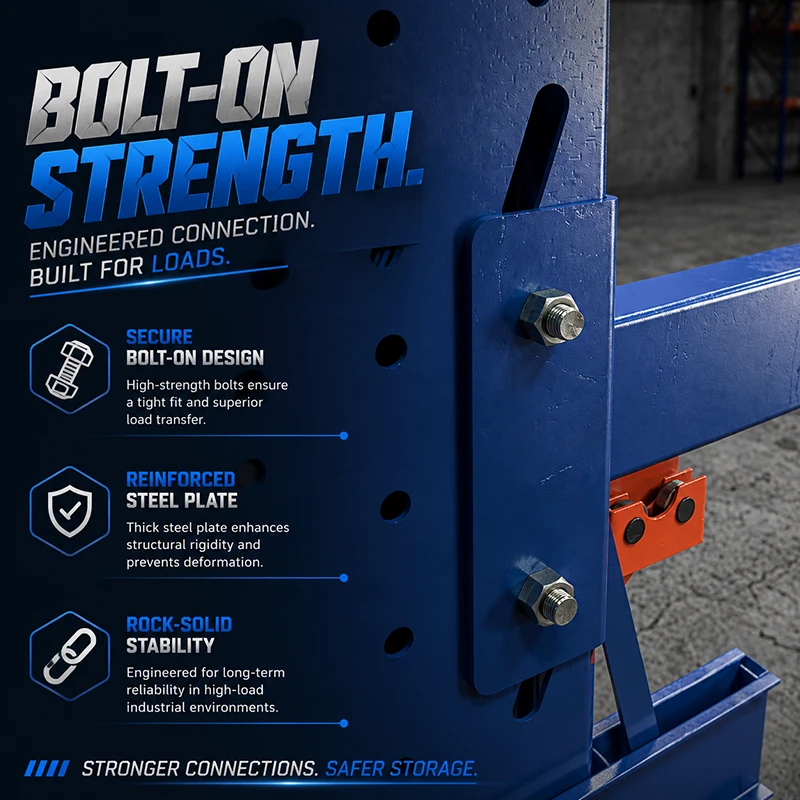
Record the upright profile, the hole pattern and hole spacing, the sheet thickness at the connection point, and whether a through-bolt can be inserted at exactly the height the drum requires. In the documented retrofit process, the connection dimensions were still subject to confirmation at the time the quote was prepared—that is the normal position: the accessory is defined, the interface is not, until someone measures it. A rack with a proprietary or unknown hole pattern, or one where the original drawings are lost, cannot be confirmed from a photo.
Lastpfad und vorhandene Tragfähigkeit
The drum load must reach the upright and the floor. The original arm load capacity is irrelevant here because the drum does not sit on the arm the way the rack was designed for. Check what the rack was originally designed for, how many levels are loaded today, and whether the base plate anchoring and the base plate are still sufficient for the new load picture. If the rack is already loaded to its original design basis, the conversion adds load instead of replacing it.
Standsicherheit und Schwerpunkt
The transition from long goods resting on arms to drums carried on projecting brackets changes the tipping moment—especially with double-sided rows and with racks that are stable only via base plates. Check the condition of the base plates, the condition of the anchoring, and whether the row is connected to anything else.
Zustand der Ständer
Look for bent or twisted flanges, cracked welds, impact damage from forklifts, elongated or ovalized holes, and corrosion with measurable cross-section loss. Any of these features makes the upright unverifiable as a support for a new bracket.
Drum size, support height and forklift accessibility
The support height is not continuously adjustable. The dedicated upright profile for cable drums in this product family has mounting holes on a 100 mm grid, so the support position of the drum is fixed in 100 mm increments around the actual drum diameter. An existing cantilever upright has its own grid, and that grid determines which drum diameters can be supported at a sensible height. If the available positions put a small drum too high or a large drum on the floor, retrofitting is not the right approach.
Die Gabelstaplerzugänglichkeit ist die zweite Hälfte desselben Problems. Eine Trommel muss hereingebracht, auf der Stütze positioniert und wieder herausgehoben werden, ohne dass die Gabeln die Konsole oder den Ständer treffen. Prüfen Sie die Anfahrrichtung, die Gabelbreite und die Entnahmefreiheit gegen die tatsächliche Gangbreite, nicht gegen die Zeichnung. Wo Bediener zusätzlich Kabel von einer Trommel abwickeln müssen, während sie an Ort und Stelle bleibt, muss die Stützung als Rollenlager-Ausführung und nicht als statische Ablage ausgeführt sein; das ist ein anderes Zubehör als ein einfaches Stützrohr und sollte auch so spezifiziert werden.
Which existing racks should not be converted
Some racks fail the preliminary check before any calculation is done. Do not convert:
- Racks whose upright hole pattern and connection details cannot be measured or confirmed, or for which no original documentation exists and whose frame has been modified since.
- Racks with deformation, cracks at welds, impact damage or corrosion with cross-section loss on the uprights or base plates.
- Light-duty, roll-formed cantilever frames sold for light long goods; their uprights were never designed for a cantilevered drum beam that must carry a drum of several hundred kilograms or more.
- Freestanding rows without sufficient base plate anchoring or rows standing on a base plate whose condition and load-bearing capacity are unknown.
- Rows that already carry their original design load and to which the drum positions would additionally be attached.
- Rows where the 500 mm beam overhang cannot be accommodated in the existing aisle or where the aisle cannot be re-planned without blocking an escape route or a forklift turning area.
Where the reference values no longer apply
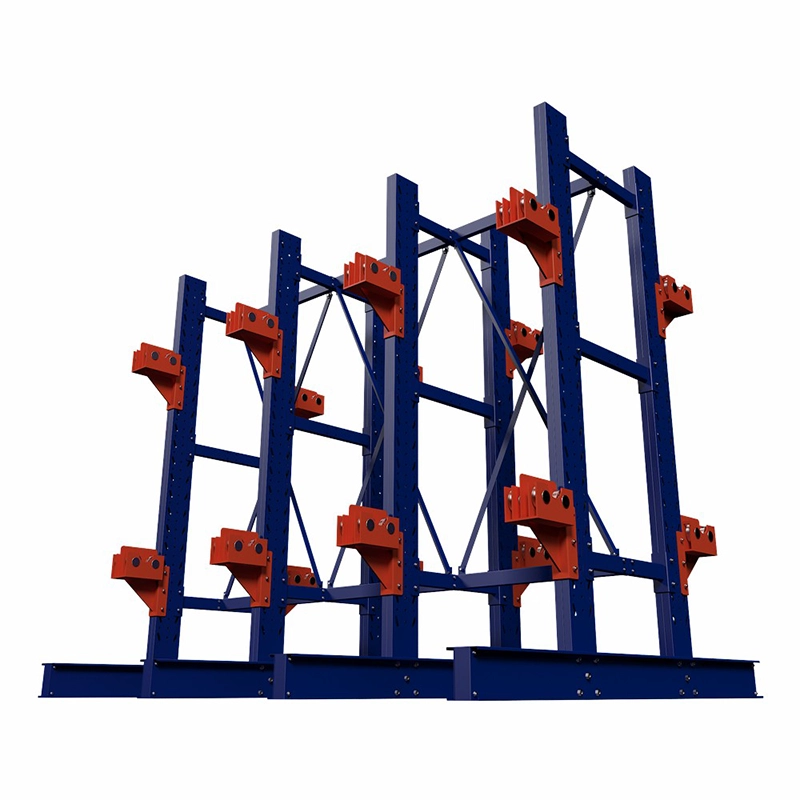
The Ø1,000 mm drum limit, the 500 mm beam overhang and the Ø60 mm tube belong to a documented retrofit configuration. They are not a general load-bearing capacity specification for cantilever racks. If your drums are larger than the reference range or heavier than the drum list behind this record, or if you require multi-level arrangements, the answer may be a purpose-built cable drum rack with main and auxiliary frames instead of a retrofit.
Be equally careful with the frame family itself: in this product family, the auxiliary frames are not independent units. They are supported on the main frame upright, so an accessory count cannot simply be multiplied by a number of frames that were never designed as a set.
Finally, surface treatment and location are decisive. For open storage, a corrosion protection specification must be established before the work is carried out, and the operating limits of the facility, including forklift threading and lifting practice, regular inspection of beams and welds, and protection against standing water, belong in the handover document and not in an oral briefing.
What a verified retrofit package should contain
- Measured upright profile, hole spacing and connection detail, recorded on site at the rack.
- Drum list with diameter, width and weight per drum, as well as cable type and information on whether the drum remains in place during payout.
- Beam overhang and support height positions, confirmed against the actual aisle and the actual drum diameters.
- Roller bearing support explicitly specified when the cable is paid out from the drum located in place.
- Floor anchoring, floor condition and stability re-checked for the new load pattern.
- Surface and corrosion protection specification coordinated with the actual storage location, indoors or outdoors.
Häufig gestellte Fragen
Can any cantilever rack be converted into a cable drum rack?
No. The retrofit depends on a verifiable connection between the existing upright and the drum beam as well as on the rack still having sufficient structural load-bearing capacity and stability for the new load path. Where the hole pattern is unknown, the uprights are damaged or the frame was only ever designed for light long goods, the honest answer is a purpose-built rack instead.
What should I measure first?
Start with the upright: profile, hole pattern and hole spacing, sheet thickness at the connection point and the height range in which a support can actually be bolted. Without these figures, the accessory set cannot be matched to your frame, and the reference values Ø1,000 mm and 500 mm cannot be confirmed as applicable.
Does a retrofit enable drum rotation for cable payout?
Only if a roller bearing support is specified. A simple support tube holds the drum in position; on its own it does not provide controlled rotation to pay out cable from a drum remaining in the rack. State clearly during the inquiry phase whether the drum is fully stored and removed or whether the cable is paid out from it in place.
Will I lose aisle width?
Yes, by the beam overhang on each loaded side. In the documented configuration, this overhang is 500 mm, so a row loaded on both sides requires 1,000 mm more aisle than the rack alone. Check the aisle, the forklift turning area and the escape route before committing.
Nächster Schritt
Send photos of the existing rack, the measured upright hole pattern and connection detail as well as your drum list with diameters and weights. We will tell you whether the frame can be verified for a drum beam retrofit, which of the two answers applies, or whether the location requires a purpose-built cable drum rack instead. If the retrofit route is confirmed, the accessory set and the beam overhang can be offered against your own frame rather than against a reference drawing.
Benötigen Sie eine individuelle Lagerlösung?
Sprechen Sie direkt mit unseren technischen Ingenieuren. Wir bieten kostenlose Strukturplanungen, Bewertungen von Hochlast-Katalogen und schnelle B2B-Preisangebote.
Jetzt Angebot anfordern →