
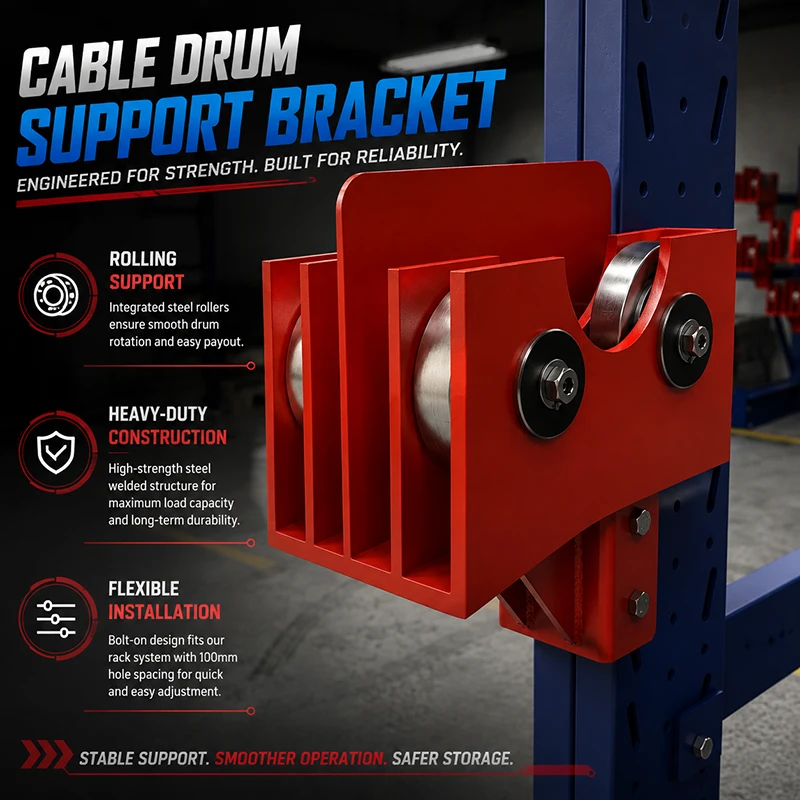
Uma cremalheira cantilever já instalada no seu pátio parece ser a forma mais económica de tirar as bobinas de cabos do chão. Os braços estão lá, os montantes são veios, as placas de base já estão aparafusadas. O problema é que um braço cantilever foi concebido para suportar mercadorias longas que assentam sobre ele, enquanto uma bobina de cabos tem de ser segurada num eixo ou em roletes, e essa carga tem de passar por um suporte para o montante e depois para o chão. São caminhos de carga diferentes.
The retrofit kit we budgeted for this type of conversion is deliberately small: Ø60 mm support tubes, a bracket that projects 500 mm, and a stated working envelope for coils up to Ø1,000 mm. These values come from a documented retrofit record and apply only when the existing rack connection has been verified. They are a reference set for a conversation, not an authorization to drill into the structure you happen to have.
What the Retrofit Accessory Set Actually Contains
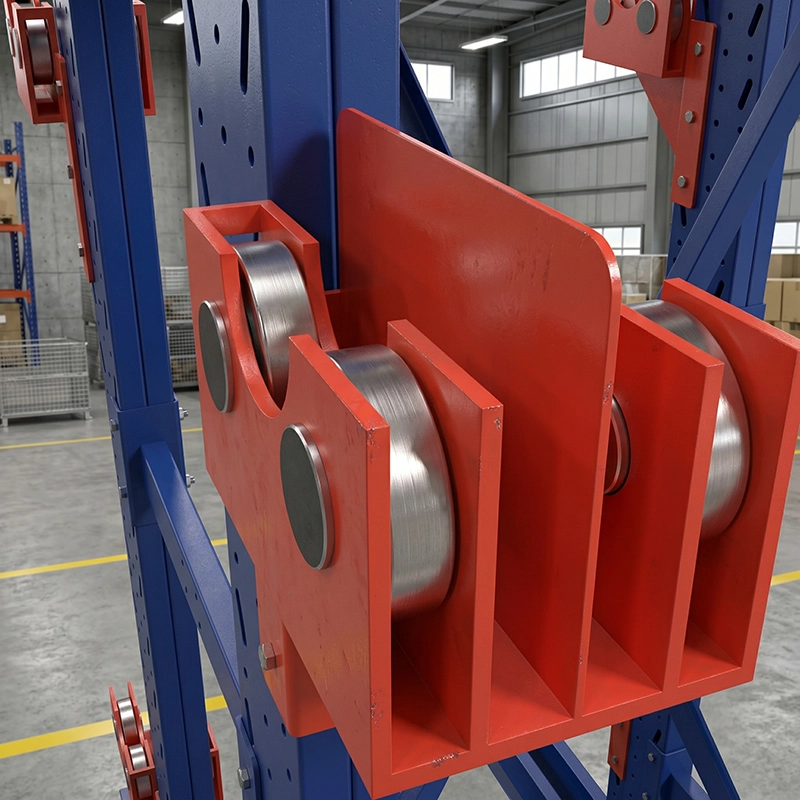
The conversion hardware is a support tube plus a bracket that comes off the existing structure and carries the coil. In the documented record, the tube is Ø60 mm, the bracket extends 500 mm from the rack face, and the reference quantity was budgeted as 20 or 100 pieces at about 32 kg per set. That is the physical scope on the accessory side of the job. Everything that decides whether the conversion is safe sits outside that scope, in the condition and geometry of the rack you already own.
The 500 mm projection is the value that surprises buyers most, because it is measured outward from the existing rack face. If your aisle was planned against the old rack layout, the usable aisle shrinks by that projection on each side of a row. In a two-sided installation, coil positions sit on both faces, so the aisle calculation has to be redone before anything is ordered.
Pre-Checks That Must Be Completed Before Any Cutting or Drilling
Treat this as a measurement checklist rather than a formality. Each item can stop the project on its own.
Geometria da conexão
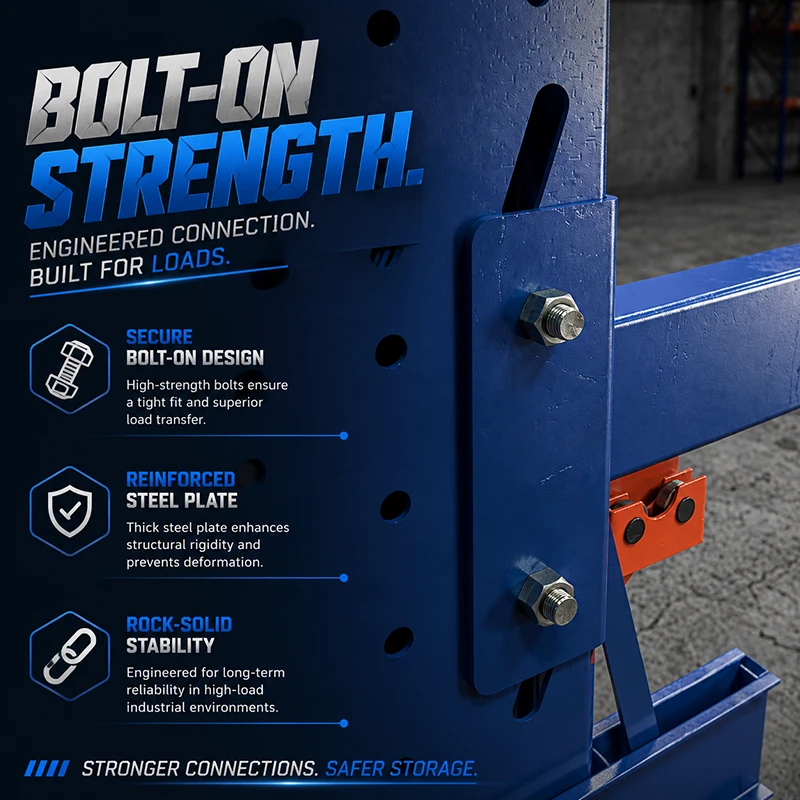
Record the upright profile, the hole pattern and pitch, the plate thickness at the connection point, and whether a through-bolt can be installed at the exact height the coil requires. In the documented retrofit, the connection dimensions were still subject to confirmation at the budgeting stage, which is the usual procedure: the accessory is defined, the interface is not until someone measures it. A rack with a proprietary or unknown hole pattern, or one where the original drawings have been lost, cannot be confirmed from a photograph.
Caminho de carga e capacidade existente
The coil load must reach the upright and the base. The arm's original capacity is irrelevant to this question, because the coil is not supported on the arm in the way the rack was designed for. Check what load the rack was originally rated for, how many levels support load today, and whether the base plate anchoring and the floor slab are still sufficient for the new load pattern. If the rack is already loaded to its original design criterion, the conversion adds load rather than replacing it.
Estabilidade e centro de gravidade
Changing from long goods supported on arms to projecting surfaces alters the overturning moment, especially in double-sided rows and in racks that rely only on base plates. Check the condition of the base plate, the condition of the anchors, and whether the row is tied to anything else.
Condição do montante
Look for bent or twisted flanges, cracked welds, forklift impact damage, ovalized or deformed holes, and corrosion with measurable section loss. Any of these makes the upright unverifiable as support for a new bracket.
Coil Size, Bracket Height and Forklift Access
A altura do suporte não é contínua. O perfil dedicado do montante para bobinas de cabos utilizado nesta gama de produtos tem furos de instalação em intervalos de 100 mm, pelo que a posição do suporte da bobina é definida em passos de 100 mm em torno do diâmetro real do tambor. Um montante cantilever existente terá o seu próprio passo, e esse passo decide quais os diâmetros de bobina que podem ser suportados a uma altura razoável. Se as posições disponíveis colocam uma bobina pequena demasiado alta ou uma bobina grande ao nível do chão, o retrofit não é o caminho certo.
O acesso do empilhador é a segunda metade do mesmo problema. Uma bobina tem de ser trazida, posicionada no suporte e levantada novamente sem que os garfos batam no suporte ou no montante. Confirme a direção de abordagem, a distância entre garfos e a altura livre de remoção em relação ao corredor real, e não em relação ao desenho. Quando os operadores também precisam de puxar cabo de uma bobina enquanto esta permanece no lugar, o suporte tem de ser do tipo com roletes e não uma estrutura estática; este é um acessório diferente de um simples tubo de suporte e deve ser especificado como tal.
Quais racks existentes não devem ser convertidos
Alguns racks reprovam na verificação prévia antes que qualquer cálculo seja realizado. Não converta:
- Racks cujo padrão de furos dos montantes e detalhes de conexão não possam ser medidos ou confirmados, ou onde não haja documentação original e o quadro tenha sido modificado desde então.
- Racks que apresentem deformação, soldas trincadas, danos por impacto ou corrosão com perda de seção nos montantes ou nas placas de base.
- Estruturas cantilever de aço laminado leve que foram vendidas para mercadorias longas leves; seus montantes nunca foram dimensionados para um suporte de bobina em balanço carregando uma bobina de várias centenas de quilogramas ou mais.
- Fileiras autoportantes sem ancoragem adequada na placa de base, ou fileiras apoiadas sobre uma laje de piso cuja condição e capacidade sejam desconhecidas.
- Rows that already support the original design load, to which the reel positions would be added on top of that load.
- Rows where the 500 mm bracket projection cannot be accommodated within the existing aisle, or where the aisle cannot be re-planned without obstructing a fire route or a forklift maneuvering area.
Where the reference numbers are no longer valid
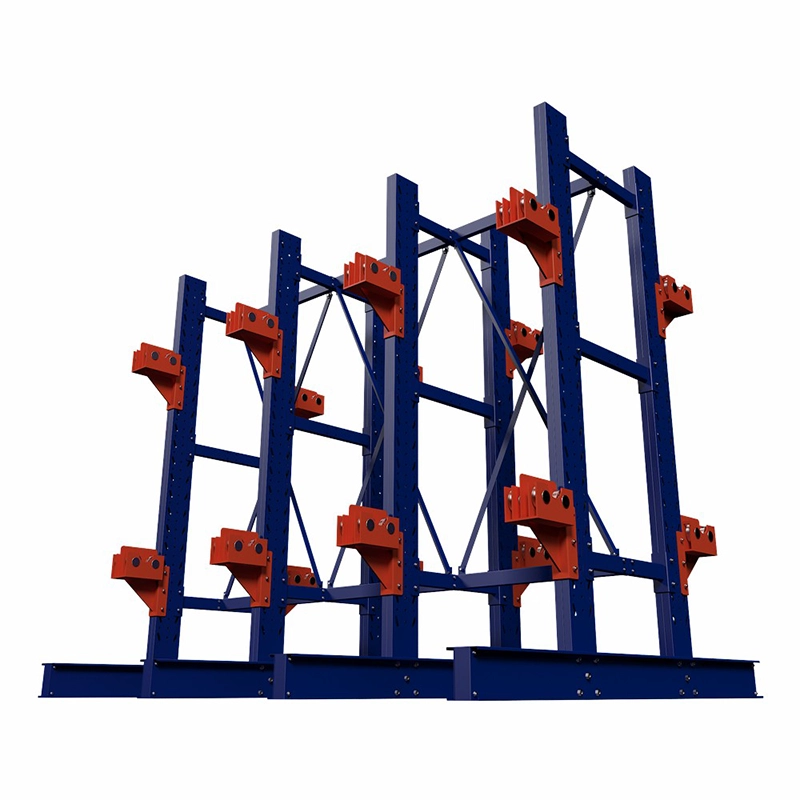
The Ø1,000 mm reel limit, the 500 mm bracket projection and the Ø60 mm tube belong to a documented retrofit configuration. They do not constitute a general rating for cantilever racks. If your reels are larger than the reference envelope, or heavier than the reel list behind that record, or if you need multi-level configurations, the answer may be a purpose-built cable reel rack, with main and auxiliary frames, rather than a conversion.
Take the same care with the frame family itself: in this product family, the auxiliary frames are not standalone units. They depend on the main frame upright for support, so an accessory count cannot simply be multiplied along a row of frames that were never designed as a set.
Finally, finish and location matter. Outdoor yards need an agreed corrosion control specification before work is executed, and the operating limits of the installation, including forklift insertion and lifting practices, periodic inspection of brackets and welds, and protection against prolonged standing water, belong in the handover document, not in a verbal briefing.
What a verified retrofit package should include
- Measured upright profile, hole pitch and connection detail, taken from the rack on site.
- Reel list with diameter, width and weight per reel, plus the cable type and an indication of whether the reel stays in place during cable payout.
- Bracket projection and bracket height positions confirmed against the actual aisle and the actual drum diameters.
- Bearing bracket explicitly specified when the cable is paid out with the reel staying in place.
- Base anchorage, floor condition and stability re-assessed for the new loading pattern.
- Finish specification and corrosion control defined for the actual storage location, indoor or outdoor.
Perguntas frequentes
Can every cantilever rack be converted into a cable reel rack?
No. The conversion depends on a verifiable connection between the existing upright and the reel bracket, and on the rack having sufficient structural capacity and stability for the new load path. Where the hole pattern is unknown, the uprights are damaged, or the frame was sized only for light long goods, the honest answer is a purpose-built rack.
What should I measure first?
Start with the upright: profile, hole pattern and pitch, plate thickness at the connection point, and the height range where a bracket can actually be bolted on. Without these numbers, the accessory set cannot be matched to your frame, and the Ø1,000 mm and 500 mm reference values cannot be confirmed as applicable.
Does a retrofit give me reel rotation for cable payout?
Only if a bearing bracket is specified. A plain tubular bracket holds the reel in place; it does not, by itself, provide controlled rotation for paying out cable from a reel that stays on the rack. State clearly, at the enquiry stage, whether the reel is stored and taken away whole, or whether the cable is pulled from it on site.
Do I lose aisle width?
Yes, by an amount equal to the bracket projection on each loaded face. In the documented configuration, that projection is 500 mm, so a row loaded on both sides takes up 1,000 mm more of the aisle than the unloaded rack. Re-assess the aisle, the forklift maneuvering path and the fire route before proceeding.
Próximo passo
Send photographs of the existing rack, the measured upright hole pattern and connection detail, and your reel list with diameters and weights. We will say whether the frame can be verified for a reel bracket conversion, which of the two answers applies, or whether the site needs a purpose-built cable drum rack. If the retrofit route is confirmed, the accessory set and bracket projection can be quoted against your own frame, not against a reference drawing.
Precisa de uma Solução de Armazenamento Personalizada?
Fale diretamente com nossos engenheiros técnicos. Oferecemos projetos estruturais gratuitos, avaliações de catálogos de alta capacidade e orçamentos rápidos para B2B.
Solicite um Orçamento Agora →