
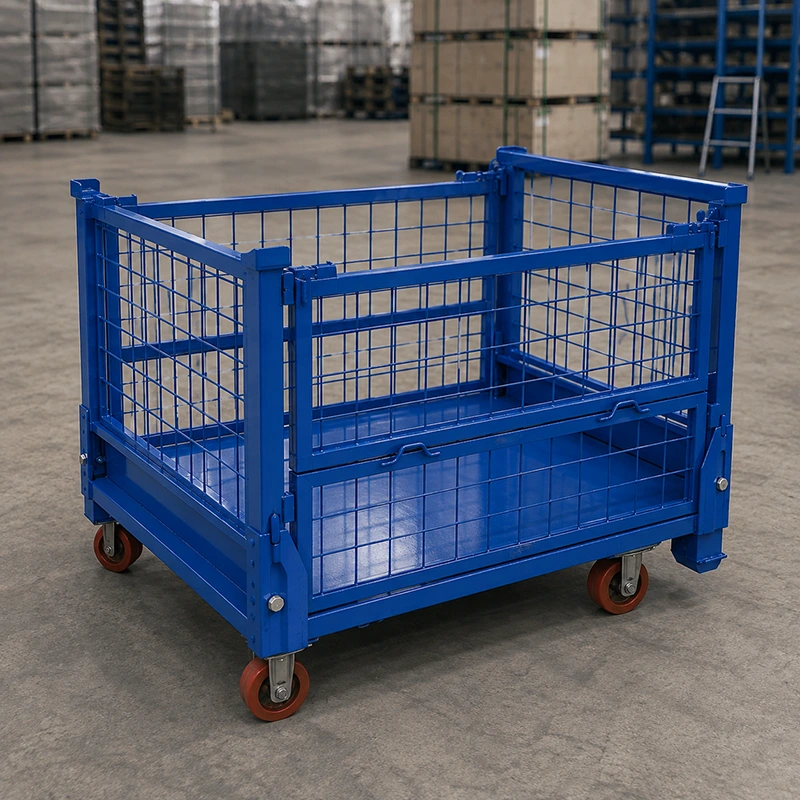
An empty container is not a neutral object in a closed loop. Every box that returns loaded from a station has to travel back empty, and it is on the empty leg that floor space, trolley trips and extra handling quietly accumulate. If the empties are kept mounted, air is being stacked in the aisle. If they are moved elsewhere, a second handling step has been added to a loop that was supposed to have only one.
A collapsible container removes that trade-off: the empty unit folds down and is then stacked, with or without wheels, so that storage next to the line and the return leg use the same container and the same handling equipment. Nothing in the product requires rebuilding the line: the volume changes, not the process.
Why the empty leg costs more than it looks
The loaded leg of the loop is defined by the parts. The empty leg is defined by the container, and that is where the cost usually sits. A mounted 1000×800×840 mm container occupies approximately 0.67 m³ of volume whether it carries a full load of machined parts or nothing at all. Twenty empty units waiting for the next shift occupy the same floor area and the same height as twenty full units.
Line teams respond to this in three predictable ways, and each one has a cost:
- Parking the empties at the end of the aisle, which turns every return into a second trip.
- Sending the empties to a distant warehouse and handling them again when the next load is released.
- Buying additional containers so that the loop never runs short, which increases the number of assets for the same throughput.
Folding addresses the cause rather than the symptom: an empty unit stops being an object the size of a container.
How folded stacking fits into the space next to the line you already have
Plegar no reduce la superficie de apoyo. Una variante montada de 840 mm se pliega a 1000×800×335 mm, de modo que la unidad sigue apoyándose sobre el mismo cuadrado de pallet de 1000×800, simplemente baja a unos 335 mm de altura. La ganancia es vertical: cinco unidades plegadas apiladas alcanzan unos 1675 mm, una columna que puede colocarse junto a un puesto de trabajo o contra una pared donde cinco vacíos montados habrían bloqueado el pasillo.
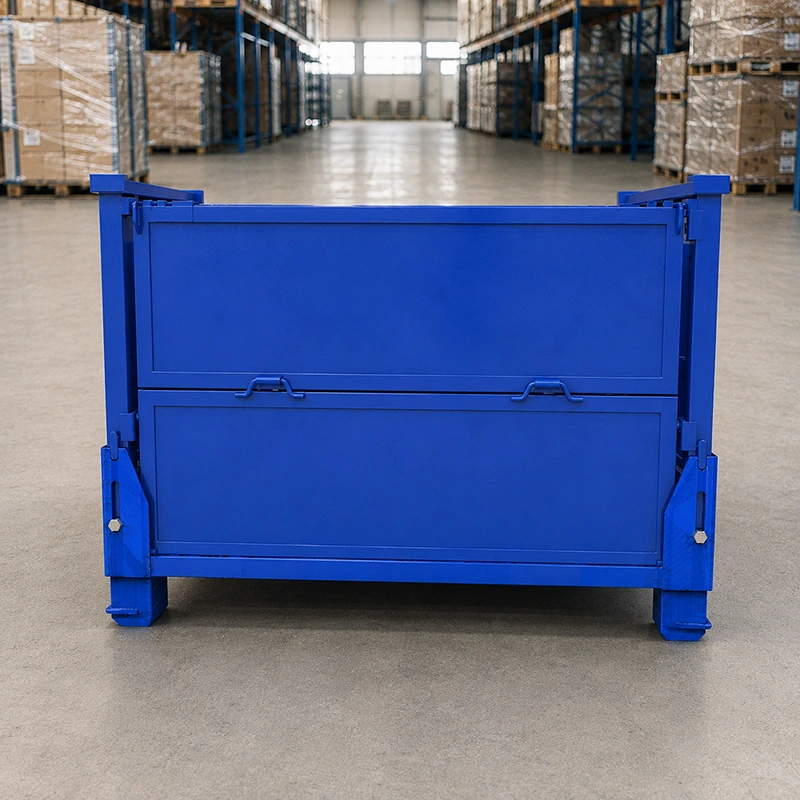
Esa geometría es la razón por la que una columna plegada encaja en unレイアウト existente. Los pies del pallet y los bolsillos para horquillas se mantienen donde la carretilla los espera, la base se mantiene suficientemente rígida para ser el fondo de una pila, y la columna ocupa una zona de suelo marcada en vez de una posición en estantería. La altura plegada, el límite de capas y la carga sobre el suelo siguen viniendo del plano aprobado para su referencia: las cifras anteriores describen una variante de 840 mm, no toda la familia.
¿Hace falta rediseñar la línea para la manipulación de vacíos?
Nada en el contenedor cambia una máquina, un transportador, una estación o un tiempo de ciclo. El pliegue es una propiedad de la caja: la puerta frontal se abre y cae, los paneles laterales se pliegan sobre la base, y la propia base es la plataforma que se apila. Así que no, la manipulación de vacíos no es un proyecto de rediseño de línea.
Lo que sí hay que decidir es la ruta propia del trayecto en vacío, y eso es una cuestión deレイアウト que su equipo de ingeniería resuelve en planta:
- Dónde se sitúa la columna plegada: una zona marcada, despejada del pasillo de horquillas, no un carril de paso.
- Quién pliega y en qué extremo del circuito: en el punto de recogida cuando salen las últimas piezas, o en el punto de llenado antes de cargar.
- Cuántos pliegues por turno genera el circuito, ya que el plegado es trabajo manual y esa mano de obra es el coste honesto del espacio que se recupera.
- Qué equipo mueve la columna plegada: la misma carretilla o transpaleta que mueve las cajas cargadas, o ruedas para movimientos manuales cortos.
No prometemos que unレイアウト de línea concreto funcione sin cambios, y comprar un contenedor no modifica los equipos de producción. El ancho de pasillo, el estado del suelo, el espacio libre para la entrada de las horquillas y la altura de apilamiento que su planta permita deciden si una columna plegada cabe en el sitio que tiene en mente. Esos puntos se comprueban frente a suレイアウト antes de un pedido, no se asumen a partir de un catálogo.
Con ruedas o sin ruedas: un pliegue, dos rutas en vacío
El mecanismo de plegado y la base son decisiones independientes. Las bisagras, la puerta y los paneles laterales se pliegan igual tanto si la unidad va sobre pies de pallet normales como si va sobre ruedas, por lo que con ruedas y sin ruedas son ambas configuraciones plegables. Lo que cambia es cómo se desplaza la unidad vacía.
Sin ruedas, la columna plegada se manipula como cualquier otra carga paletizada: entrada de horquillas bajo la base, una sola carretilla para ambos trayectos del circuito, sin equipo extra en el suelo y sin nada extra que mantener. Esto conviene a circuitos en los que ya hay una carretilla o transpaleta en la estación y la distancia de retorno en vacío es de pocos tramos.
Con ruedas, la unidad vacía puede empujarse manualmente a cortas distancias junto a la línea, de modo que un operario no espera a una carretilla para retirar una columna plegada, y se pueden acumular varias unidades antes de una sola elevación. Las ruedas conviennent a recorridos cortos en suelo llano, finales de pasillo estrechos y estaciones donde las visitas de la carretilla son poco frecuentes. La capacidad de las ruedas, el tipo de rueda y los requisitos del suelo son específicos de la configuración y se confirman en el plano.
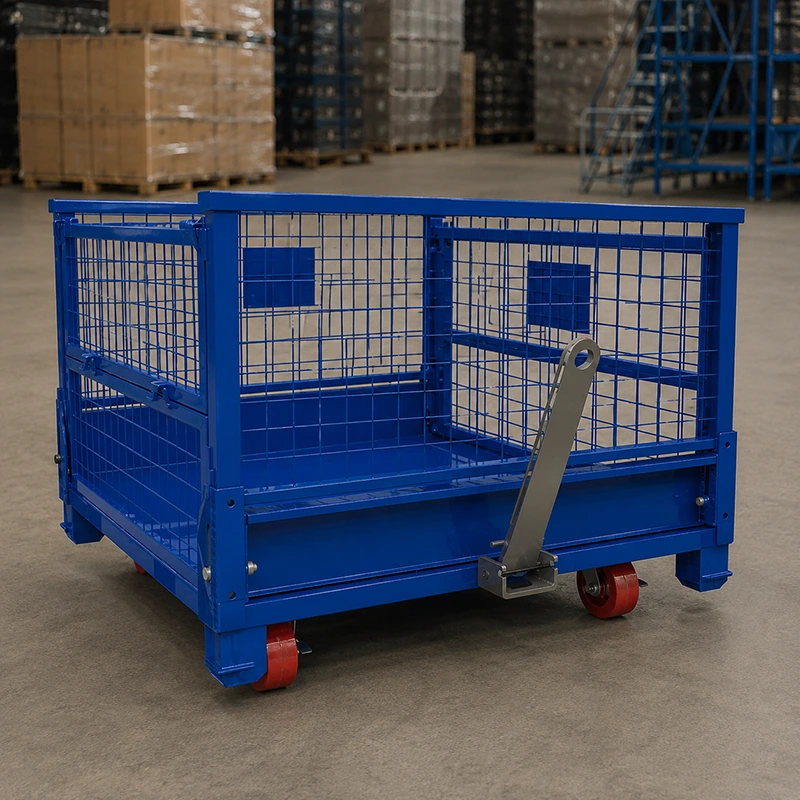
A third option appears in illustrated configurations: wheels plus a tow bar, so that one traction unit can move several units together instead of one at a time. If your loop already runs a train of traction units, it is worth quoting this as such rather than as an accessory, but train length and tow arrangement are defined per project.
A point to define before specifying the wheels: whether the loaded unit will also rest on its wheels inside a stack, or whether the wheels are only for the empty trip. That answer changes the base detail and belongs on the approved drawing, not on an assumption.
Where the empty folded state pays off
- Empty buffer next to the line: folded columns replace upright empties in the aisle, so the space next to the station holds containers waiting instead of air.
- Closed-loop return within the plant: the unit that leaves a machining cell loaded comes back folded, and the same truck carries it both ways.
- Loops between plants and with suppliers: folded units reduce the volume of the empty return trip, which is the trip that is paid for and never sold.
- Storage of empty units and container loading: folded containers are stacked and loaded as a dense column; registered schemes for this family place between 56 and 70 units in a 20GP depending on the variant, with the final count fixed in the approved packing plan.
- Work-in-process (WIP) buffer at changeovers: a folded unit can stand empty at the station during a changeover and be opened only when the next batch is released.
What to confirm before specifying
- External size upright and clear internal space for your largest part, plus the folded height of the exact variant.
- Load base: uniform distributed load versus impact load when heavy parts are deposited.
- Number of layers and stacking height allowed by the floor, the racking system and local regulations — documented figures differ between variants.
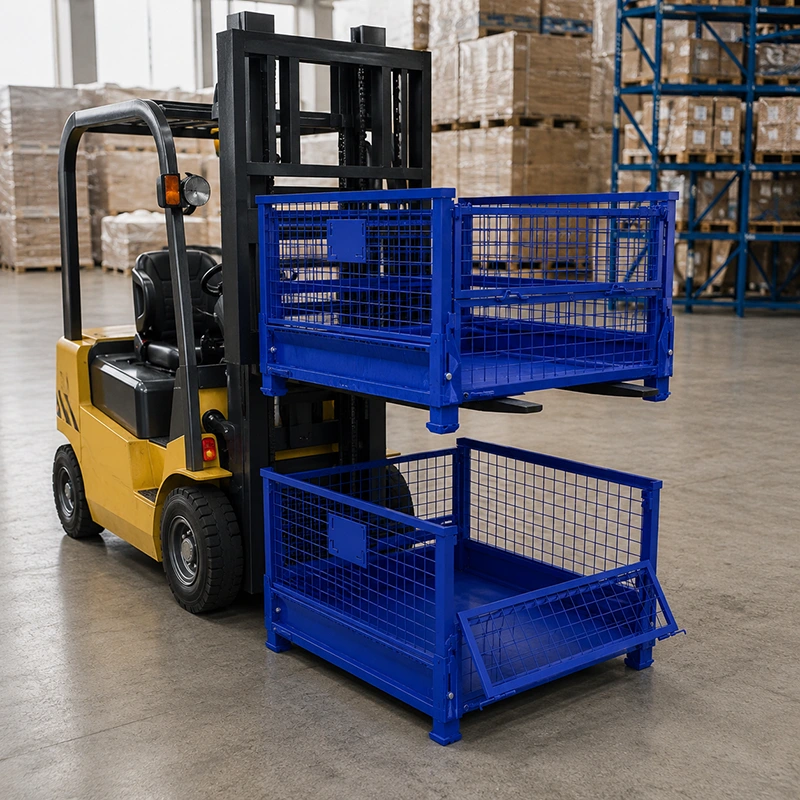
- Door arrangement: half-drop front door for picking from a stack, side doors for access from the forklift side.
- Panel type: wire mesh for visual inventory, solid sheet for small parts, chips and oil residue.
- Base: smooth pallet feet, wheels, or wheels with tow bar — and whether the loaded unit stacks on its wheels.
- Folding labor: the folding time at your station and who performs it.
Frequently asked questions
Can the box be folded and stacked at the station, or must empties go to a storage area?
Both options work. Folding on site means the empty column stands at the station and the next load is filled from it without an extra trip. Folding at a central point means fewer people fold and columns are managed in one place, at the cost of a short extra movement of the empty unit. The unit folds to the same 1000×800 footprint in both cases, so the decision depends on labor and traffic, not on the container.
Does the wheel option change how the unit folds?
No. The wheels sit on the base; the hinges, the door and the side panels fold in the same way. The wheels change the empty transport route and the envelope of the unit in motion, not the folding itself. Whether the loaded unit stacks on wheels or on feet is a base detail decision confirmed on the drawing.
Do I have to remove doors or panels to fold it?
No tools are needed for the folding sequence in the standard welded configuration: the front door opens and lowers, and the side panels fold onto the base. Some variants are described as bolted, removable assemblies for transport, so the exact sequence and any removable parts are confirmed for your particular SKU, rather than generalized.
How much space does a folded column really save?
Height, not floor area. At 335 mm folded, five units form a column of about 1,675 mm on a 1000×800 footprint; the same five upright at 840 mm would need approximately 4,200 mm of stacking height if the floor and site regulations allowed it. Its real value depends on the layer limit, the floor and where a column can legally be located.
Two ways to move forward. Read the storage scheme next to the line for collapsible steel pallet boxes and see how folded columns are zoned around a station, or present your line layout — station sequence, aisle widths, empty return distance, the trucks and traction units you operate, and your stacking limit — and we will come back with a folded-column plan and the configuration that fits it, including whether wheels earn a place in your loop.
¿Necesita una Solución de Almacenamiento a Medida?
Hable directamente con nuestros ingenieros técnicos. Ofrecemos diseños estructurales gratuitos, evaluaciones de catálogos para cargas pesadas y cotizaciones de precios B2B rápidas.
Solicitar un Presupuesto Ahora →