
The outbound leg gets all the attention: how many metal pallet boxes fill the container, how much each loaded one weighs, how the forklift picks it up at the far end. The return leg is where closed-loop plans usually break down, because it is the leg you pay for with the empty box. If the empty container volume is never planned, the loop ends up silently costing the same as a one-way shipment.
For the Sebox foldable cage pallet with the 1000 × 800 mm base, the folded profile is approximately 1000 × 800 × 335 mm versus about 840 mm assembled. That single folded figure — not the load capacity or the mesh pattern — is what a return plan is built from. This article turns it into a container count, a stacked column height, and a cost comparison that will survive a budget review with your finance team.
First decide which empty-leg option you are actually buying
Three different return strategies are sold as if they were the same. A fixed steel container returns at its full height, so every empty trip costs the same cube as the loaded trip. A flat-foldable body, like this foldable pallet box, returns as a flat package at a 335 mm pitch. A knock-down body — bolted panels and dismantled posts, or posts pulled from the base — returns as a set of panels plus a base plate, which is even flatter per piece, but requires more handling time at both legs.
Sebox documentation describes both flat-foldable bodies and bolted knock-down assemblies for transport, so the purchase order has to state which one you are quoting. The following plan assumes a flat-foldable body in the 1000 × 800 × 335 mm folded configuration. If your supplier quotes a removable-post variant, the column height and the container count change, and so does the labor line.
What determines the choice is not the catalog page. It is how many return cycles the loop runs per year, who pays the return freight, and whether the same container can be rescheduled instead of operating on a fixed schedule. Below about two cycles per year, folding rarely justifies its hinges and latches; with weekly or biweekly cycles, the empty-leg cube becomes the largest single line in the logistics budget.
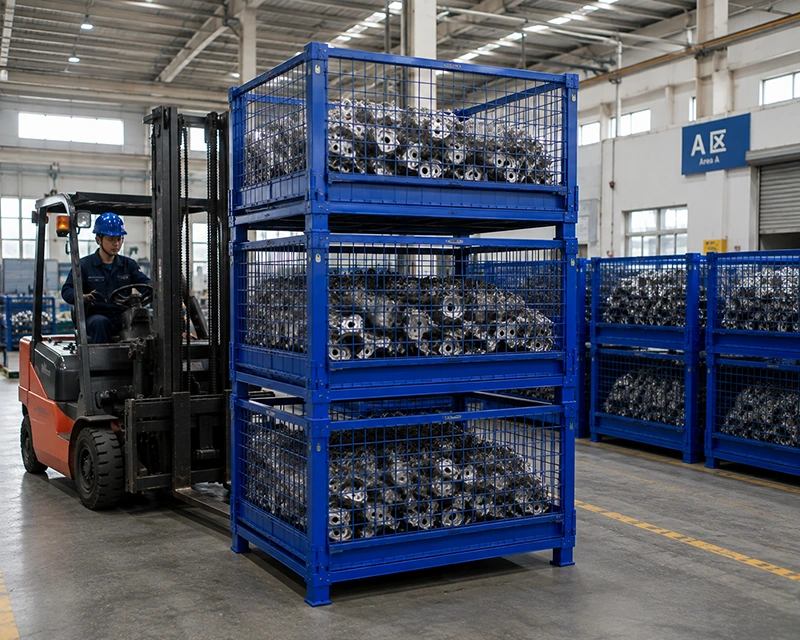
Turning the 1000 × 800 × 335 mm folded boxes into a container count
The calculation is simple geometry, but the assumptions must be stated or the figure is useless in a negotiation. Do it in five steps and keep the assumptions next to the result.
- Step 1 — footprint. A folded box occupies 1.00 × 0.80 = 0.80 m² of the container floor.
- Step 2 — columns across the width. A container offers approximately 2,350 mm of internal width. Two 1,000 mm columns occupy 2,000 mm and fit; the remaining ~350 mm carry nothing, because they are narrower than the 800 mm base.
- Step 3 — rows along the length. Approximately 5,900 mm of internal length gives 7 rows at 800 mm per row in a 20GP; approximately 12,000 mm gives 15 rows in a 40-foot high cube.
- Step 4 — columns per layer. 2 columns × 7 rows = 14 columns in a 20GP; 2 × 15 = 30 columns in a 40HQ.
- Step 5 — levels. A folded column reaches about 2,150 mm, the height analyzed in the next section. Against about 2,390 mm of internal height in a 20GP that is one level, not two, and the door opening matters as much as the internal height.
Multiply step 4 by the units per column and you get the first calculation: about 98 folded boxes in a 20GP and about 210 in a 40HQ, before load losses, inner packaging, and any mixed loading. Plan with 90 to 98 for a 20GP until your freight forwarder has verified the loading sequence, and treat each of these figures as an estimate within the approved loading plan rather than a booking promise.
One rule matters more than the arithmetic: do not carry figures between variants. Our own files record loading examples of 56 units in a 20GP for a larger base and 70 units for another, and those figures belong only to those bases. The 1000 × 800 × 335 mm folded box is calculated with its own dimensions, and a figure copied from another variant is the reason buyers come up short at the container door.
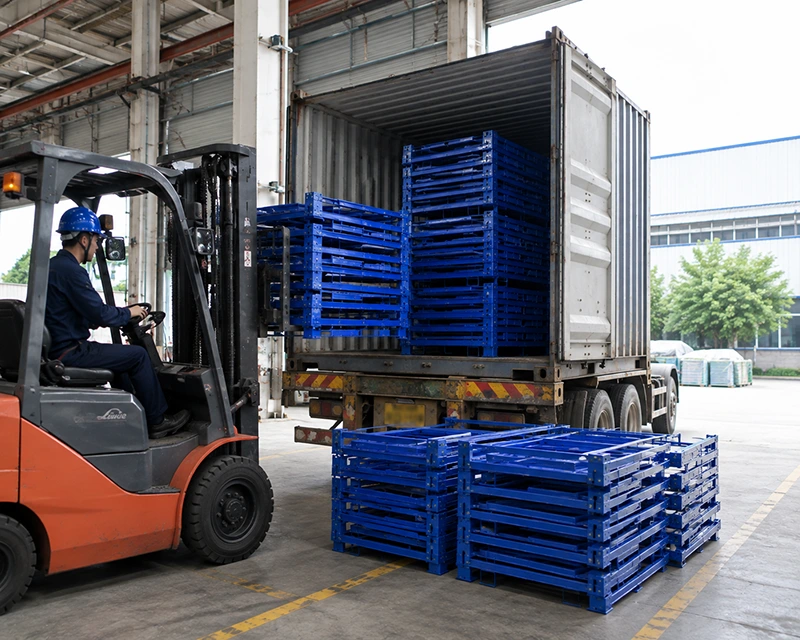
Seven folded boxes as a column of about 1000 × 800 × 2150 mm
The practical planning unit is not a single flat package; it is a strapped column. A column of seven units measures approximately 1000 × 800 × 2150 mm, which is the figure used in the container calculation above. It is worth checking the arithmetic behind it, because it shows where the risk lies: seven units at 335 mm each add up to 2,345 mm, not 2,150 mm. The shorter figure is only met if the folded frames nest into one another by about 30 mm at each interface and the strapping compacts the column.
That 195 mm difference is not a detail. If nesting is confirmed on the approved drawing, a 2,150 mm column passes through a 20GP door opening of approximately 2,280 mm and sits comfortably within the 2,390 mm internal height. If nesting is not confirmed, the column stays at 2,345 mm, which barely exceeds the internal height and will not fit through the door standing up. In that case, the honest options are six units per column (about 2,010 mm) or laying the column down horizontally, losing the stacking advantage entirely.
La estabilidad de la columna plegada depende de tres prácticas y no de la caja en sí. Cada unidad entra en la columna con la misma orientación de plegado, de modo que los bordes del bastidor, y no la malla, transmiten la carga a lo largo de las pilas. Dos flejes de acero por columna con protectores de esquina mantienen las interfaces cerradas durante el transporte por carretera; un solo fleje permite que las unidades superiores roten. Las alturas de las columnas se mantienen iguales en todo el contenedor para que la carga esté nivelada, y las columnas se arriostran contra las paredes del contenedor o con madera de embalaje, en lugar de dejarlas sueltas.
No lo confunda con una capacidad de carga apilada. Las 3 a 4 capas recomendadas para esta variante se aplican a cajas montadas y cargadas, y el patrón de plegado bajo una caja vacía es una estructura distinta. Una altura de columna plegada de unos 2.150 mm es una cifra de embalaje, y el límite de aplastamiento del bastidor plegado debe confirmarse antes de que nadie apile algo encima.
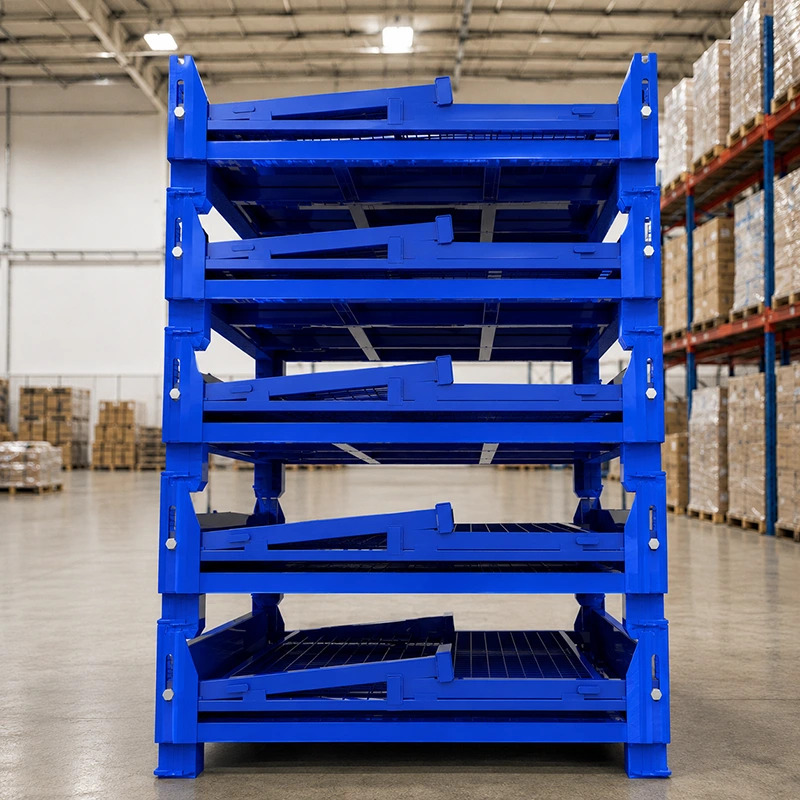
El cálculo del coste de devolución para presentar a Finanzas
Los ahorros por devolución suelen presentarse como un porcentaje, lo que oculta las hipótesis. Reconstruya la cifra en cuatro líneas y cada hipótesis quedará visible.
- Línea 1 — paso efectivo plegado. Altura de la columna ÷ unidades por columna: 2.150 mm ÷ 7 ≈ 307 mm por caja, o 335 mm por caja si el anidamiento no está confirmado.
- Línea 2 — volumen de devolución por caja. 1,00 × 0,80 × 0,307 ≈ 0,25 m³ plegada, frente a unos 0,67 m³ para la misma caja montada a 840 mm.
- Línea 3 — ratio de devolución. 307 mm ÷ 840 mm ≈ 0,37, por lo que la caja vacía ocupa entre un 60 y un 63 por ciento menos de volumen que el cuerpo montado. Nuestros propios archivos fuente mencionan una banda del 60 al 80 por ciento para la familia; esa banda abarca distintas alturas de caja, y a 840 mm montada la geometría no puede alcanzar el 80 por ciento, para lo que haría falta un paso de unos 170 mm. Utilice la cifra calculada para esta variante, no la parte superior del rango.
- Línea 4 — viajes y coste unitario. Volumen plegado total ÷ volumen útil por contenedor da los viajes; viajes × flete por viaje, más manipulación y flejado, dividido por las unidades en el bucle, da el coste de devolución por unidad. Compárelo con la línea base de contenedores fijos y reste las horas de trabajo adicionales de plegado y flejado.
Dos efectos deciden si el porcentaje llega al presupuesto. El peso no se reduce: esta variante pesa unos 57 kg por unidad, por lo que un 20GP de cajas plegadas está limitado por volumen en unas 5 a 6 toneladas y la carga útil no es la restricción —confírmalo con tu transitario para tu ruta—. Y el volumen solo se convierte en dinero cuando el tramo de devolución es la restricción vinculante. Si un camión o contenedor ya circula por debajo de su capacidad con una frecuencia semanal fija, el plegado libera sitio, pero no quita un viaje, y el ahorro solo aparece cuando el volumen supera el siguiente umbral de contenedor.
Cuándo un plan de devolución plegada no es la respuesta correcta
- Pocos ciclos de rotación. Por debajo de unos dos ciclos de devolución al año, el hardware de bisagras y cierres y el tiempo extra de plegado cuestan más que el volumen que recuperas.
- Un tramo de devolución que no es la restricción. Si el tramo de vacío ya opera con una frecuencia fija y con espacio libre, la reducción de volumen mejora el orden, no el coste.
- Virutas, aceite y sanciones. Los cuerpos de malla dejan pasar partículas pequeñas y refrigerante; los cuerpos de panel sólido los retienen, pero añaden peso y puntos de bisagra. En cualquier caso, la altura de la columna debe recalcularse para el conjunto de paneles que elijas.
- Rutas con limitación de altura. Una columna de 2.150 mm más la madera de embalaje deja poco margen bajo la altura interior de un 20GP, y la apertura de la puerta —no la altura interior— es lo que detiene a la columna más alta no multiplicada en línea recta.
- Celdas de carga automatizadas. Cuando un robot o una pinza dedicada carga el contenedor, a menudo se requiere un cuerpo rígido durante todo el ciclo y el paso de plegado se traslada a una estación manual.
- Flotas mixtas. Las columnas plegadas y los contenedores fijos no pueden compartir el cómputo de un mismo contenedor. Calcula cada tipo por separado y suma los totales de contenedor.
What we need to build your return load estimate
We can calculate the column layout, container count and folded-to-assembled ratio for your loop, but it has to be done on your box, not copied from another variant. Send us the box variant and per-unit load, the number of units in the closed loop, annual return cycles, lane and carrier, the container type you can actually book, panel and door configuration, and how much labor you have for folding and strapping. If the return leg can be re-planned rather than run at the existing frequency, tell us — that answer changes the result more than any other input.
Return logistics questions buyers ask
How many folded 1000 × 800 × 335 mm boxes fit in a 20GP?
On this folded footprint the geometry allows 14 columns per floor layer at seven boxes per column, roughly 98 boxes, so plan 90–98 until the loading sequence and dunnage are confirmed. The count is specific to the 1000 × 800 × 335 mm folded configuration and is not transferable to the larger variants in the family.
Can seven folded boxes really be stacked in a single column?
Yes, as a planning unit of about 1000 × 800 × 2150 mm, provided the frame fit reaching 2150 mm height is confirmed on the approved drawing. Each column needs two straps with corner protectors, one uniform folding orientation, and the same height as its neighboring columns. Without a confirmed fit, plan six boxes at about 2010 mm or straight stacking at 2345 mm.
How do I calculate the savings on the empty return leg?
Divida la altura de la columna entre las unidades por columna para obtener el paso plegado, multiplíquelo por la huella de 1000 × 800 mm para obtener el volumen cúbico de devolución por caja, y compárelo con el volumen montado a 840 mm. Para esta variante, la ratio es aproximadamente 0,37, es decir, entre un 60 y un 63 % menos de volumen cúbico. Luego convierta el volumen cúbico en viajes según el volumen útil de su contenedor, multiplique por el flete y la manipulación por viaje, y reste la mano de obra adicional de plegado y correas.
¿Necesita una Solución de Almacenamiento a Medida?
Hable directamente con nuestros ingenieros técnicos. Ofrecemos diseños estructurales gratuitos, evaluaciones de catálogos para cargas pesadas y cotizaciones de precios B2B rápidas.
Solicitar un Presupuesto Ahora →