
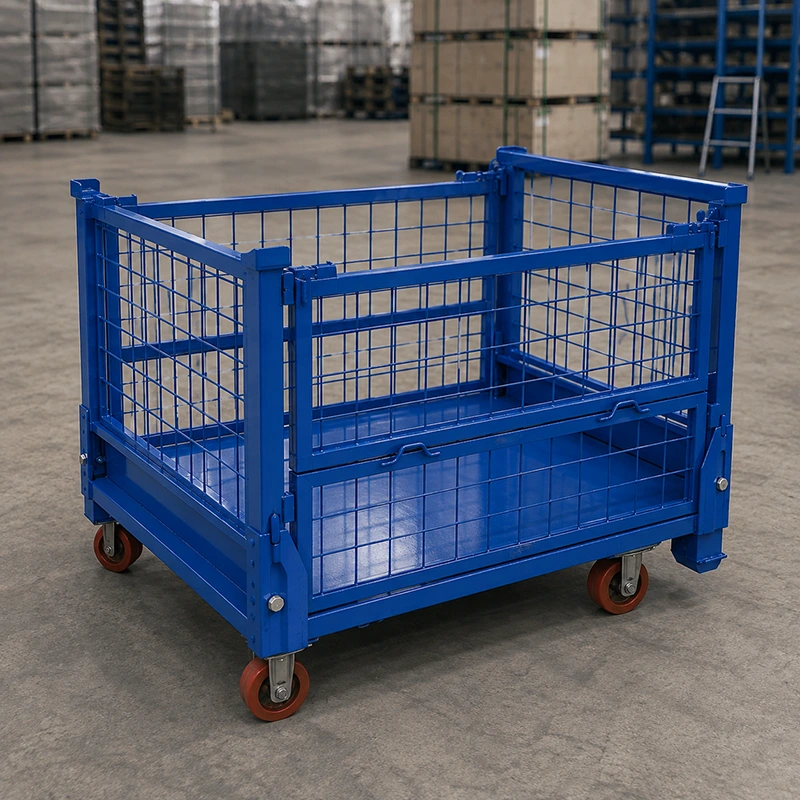
An empty container is not a neutral object on a closed loop. Every box that comes back from a station loaded has to travel the other way empty, and the empty leg is where floor space, truck trips and extra handling quietly accumulate. Keep the empties erected and you are stacking air in the aisle. Move them somewhere else and you have added a second handling step to a loop that was supposed to have one.
A collapsible stillage removes that trade-off: the empty unit folds flat and then stacks, with or without casters, so line-side storage and the return leg use the same container and the same handling equipment. Nothing in the product asks the line to be rebuilt — the volume changes, not the process.
Why the Empty Leg Costs More Than It Looks
The loaded leg of the loop is defined by the parts. The empty leg is defined by the container, and that is where the cost usually sits. An erected 1000×800×840 mm stillage encloses roughly 0.67 m³ of volume whether it carries a full load of machined castings or nothing at all. Twenty empties waiting for the next shift take the same footprint and the same height as twenty full ones.
Line-side teams answer that in three predictable ways, and each one carries a cost:
- Park the empties at the end of the aisle, which turns every return into a second trip.
- Send empties to a remote store and re-handle them when the next load is released.
- Buy extra containers so the loop never runs short, which raises the asset count for the same throughput.
Folding attacks the cause instead of the symptom: an empty unit stops being a container-sized object.
How Folded Stacking Fits the Line-Side Space You Already Have
Folding does not shrink the footprint. One 840 mm erected variant folds to 1000×800×335 mm, so the unit still stands on the same 1000×800 pallet square — it simply drops to about 335 mm high. The gain is vertical: five folded units stack to roughly 1,675 mm, a column you can place beside a workstation or against a wall where five erected empties would have blocked the aisle.
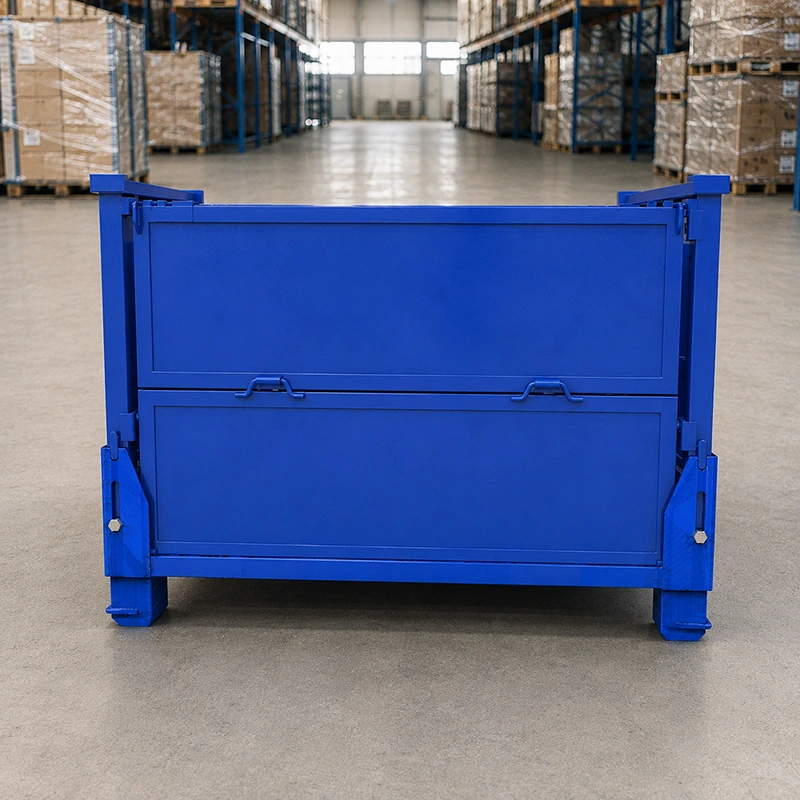
That geometry is why a folded column drops into an existing layout. The pallet feet and fork pockets stay where the truck expects them, the base stays rigid enough to be the bottom of a stack, and the column occupies a marked floor zone instead of a rack position. Folded height, layer limit and floor loading still come from the approved drawing for your SKU — the figures above describe one 840 mm variant, not the whole family.
Does Empty Handling Need the Line Reworked?
Nothing in the container changes a machine, a conveyor, a station or a takt time. The fold is a property of the box: the front gate opens and drops, the side panels fold onto the base, and the base itself is the platform that stacks. So no, empty handling is not a line-rebuild project.
What does need deciding is the empty leg’s own route, and that is a layout question your engineering team settles on site:
- Where the folded column stands — a marked zone clear of the fork aisle, not a passing lane.
- Who folds and at which end of the loop — at the pick-up point as the last parts come out, or at the fill point before loading.
- How many folds per shift the loop creates, since folding is manual work and that labour is the honest cost of the space you recover.
- Which equipment moves the folded column — the same forklift or pallet truck that moves the loaded boxes, or casters for short manual moves.
We do not promise that a given line layout will run unchanged, and buying a container does not modify production equipment. Aisle width, floor condition, fork entry clearance and the stack height your site permits decide whether a folded column fits the spot you have in mind. Those are checked against your layout before an order, not assumed from a catalogue.
Caster or No Caster: One Fold, Two Empty Routes
The folding mechanism and the base are separate decisions. Hinges, gate and side panels fold the same way whether the unit sits on plain pallet feet or on casters, so casters and no casters are both folding configurations. What changes is how the empty unit travels.
Without casters, the folded column is handled like any other palletized load: fork entry under the base, one truck for both legs of the loop, no extra equipment on the floor and nothing extra to maintain. This suits loops where a forklift or pallet truck is already at the station and the empty return distance is a few bays.
With casters, the empty unit can be pushed by hand over short distances at line-side, so an operator does not wait for a truck before clearing a folded column, and several units can be gathered before one lift. Casters suit short level floor runs, tight aisle ends and stations where truck visits are infrequent. Caster capacity, wheel type and floor requirements are configuration-specific and are confirmed on the drawing.
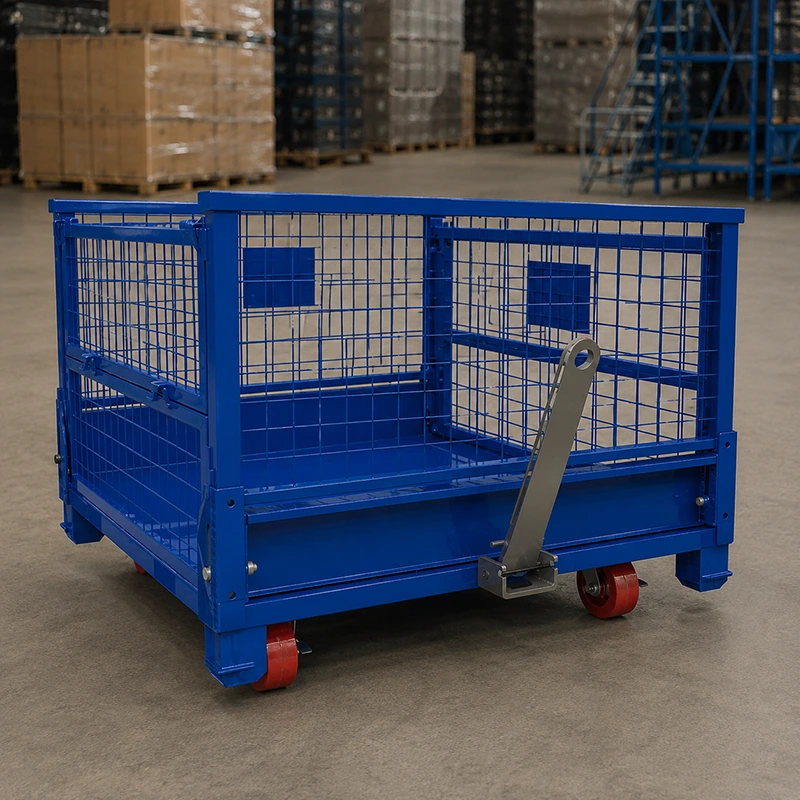
A third option appears on pictured configurations: casters plus a tow arm, so a tugger can move several units together instead of one at a time. If your loop already runs a tugger train, that is worth quoting as a route rather than as an accessory — but train length and towing arrangement are set per project.
One point to settle before specifying casters: whether the loaded unit will also stand on its casters inside a stack, or whether casters are only for the empty leg. That answer changes the base detail, and it belongs on the approved drawing rather than in an assumption.
Where the Folded Empty State Pays Off
- Line-side empty buffer: folded columns replace erected empties in the aisle, so the space next to the station holds waiting containers instead of air.
- Closed-loop return inside the plant: the unit that leaves a machining cell loaded comes back folded, and the same truck carries it both ways.
- Inter-site and supplier loops: folded units cut the volume of the empty return leg, which is the leg you pay for and never sell.
- Empty-unit storage and container loading: folded stillages stack and load as a dense column; recorded schemes for this family put 56 to 70 units in a 20GP depending on variant, with the final count fixed on the approved packing.
- WIP buffering at changeover: a folded unit can stand empty at the station through a changeover and be opened only when the next batch is released.
What to Confirm Before You Specify
- Erected external size and internal clearance for your largest part, plus the folded height of the exact variant.
- Load basis: uniform distributed load versus impact load when heavy parts are dropped in.
- Layer count and stack height your floor, racking and local rules allow — documented figures differ between variants.
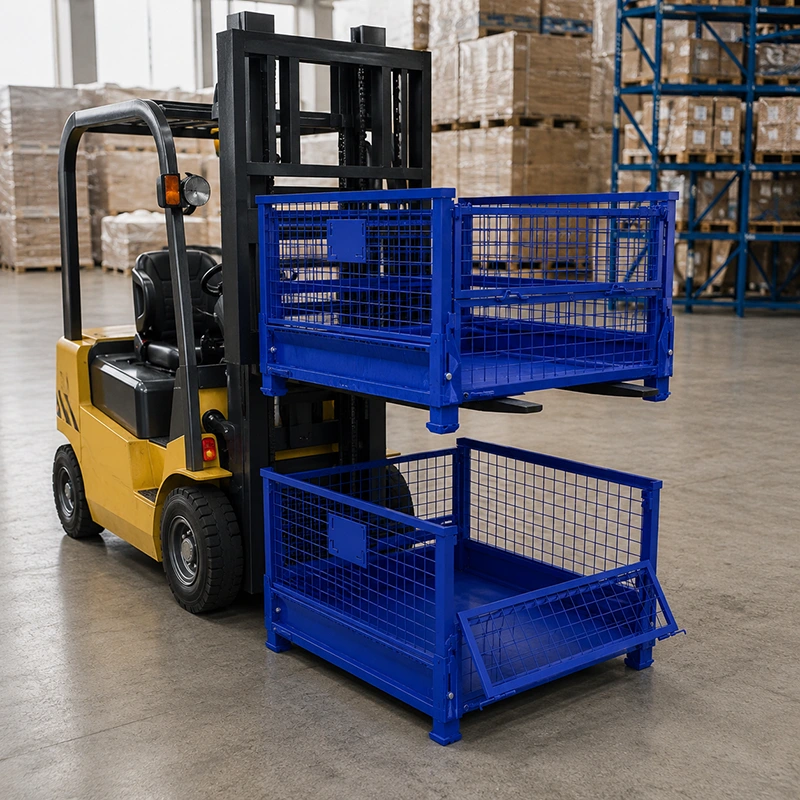
- Gate arrangement: half-drop front gate for picking from a stack, side gates for forklift-side access.
- Panel type: wire mesh for visual inventory, solid plate for small parts, swarf and oil residue.
- Base: plain pallet feet, casters, or casters with a tow arm — and whether the loaded unit stacks on its casters.
- Fold labour: the fold time at your station and who performs it.
FAQ
Can the box be folded and stacked at the station, or must empties go to a storage area?
Both work. Folding on the spot means the empty column stands at the station and the next load is filled from it without a trip. Folding at a central point means fewer people fold and the columns are managed in one place, at the cost of one short empty move. The unit folds to the same 1000×800 footprint either way, so the decision is about labour and traffic, not about the container.
Does the caster option change how the unit folds?
No. Casters sit on the base; hinges, gate and side panels fold the same way. Casters change the empty transport route and the envelope of the moving unit, not the fold itself. Whether the loaded unit is stacked on casters or on feet is a base-detail decision confirmed on the drawing.
Do I have to remove gates or panels to fold it?
No tools are needed for the folding sequence on the standard welded configuration: the front gate opens and drops, and the side panels fold onto the base. Some variants are described as bolted, detachable assemblies for transport, so the exact sequence and any detachable parts are confirmed for your SKU rather than generalised.
How much space does a folded column actually save?
Height, not floor. At 335 mm folded, five units make a column of about 1,675 mm on a 1000×800 footprint; the same five erected at 840 mm would need roughly 4,200 mm of stack height if the floor and site rules allowed it at all. Your real figure depends on the layer limit, the floor and where a column can legally stand.
Two ways to take this further. Read the line-side storage scheme for collapsible steel pallet boxes to see how folded columns are zoned around a station, or submit your line layout — station sequence, aisle widths, empty-return distance, the trucks and tuggers you run, and your stack limit — and we will come back with a folded-column plan and the configuration that fits it, including whether casters earn their place on your loop.
Need a Custom Storage Solution?
Speak directly with our technical engineers. We offer free structural designs, heavy-duty catalog evaluations, and quick B2B price quotations.
Request a Quote Now →