
In this sample project, the choice of packaging changed both container density and packaging cost. Bubble film plus tie-down straps kept the load compact at 52 units per 40-foot container, while a wooden crate at 90 RMB per square meter reduced the quantity to approximately 30 units.
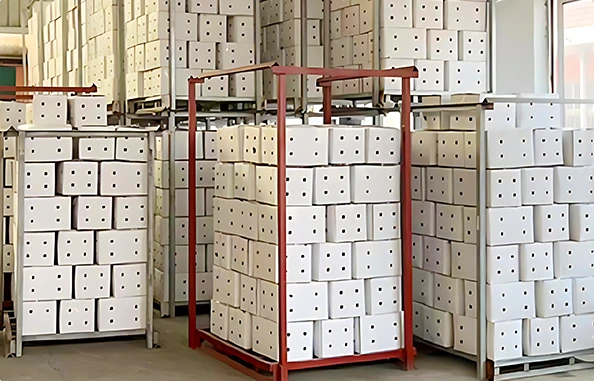
Container loading is a packaging decision, not just a freight matter
For export buyers, a 40-foot container is only economical when the load cube is well utilized. With stackable racks, the packaging method can decide whether the shipment stays dense and stable or becomes a bulky load that wastes freight space. In this example, the inverted nestainer rack was specified with an internal size of 1300 x 900 x 1900 mm, an overall size of 1400 x 950 x 1980 mm, a handling clearance of 100 mm, and a unit weight of approximately 60 kg. Those numbers matter because they define what can be protected by the frame itself and what still needs external packaging.
The image shows the rack in a warehouse storage condition, but the export logic is the same: the more cleanly the frames nest, stack, and align, the more pieces can be moved per container. That is why packaging is not an afterthought. It directly changes how many units leave the port in a single booking.
Bubble film plus tie-down straps: the lightest package wins on cube utilization
In the sample project, bubble film plus tie-down straps delivered 52 units in a 40-foot container. That is the main reason many exporters prefer this route for nestainer rack shipments: the rack structure already supports the load, so the package only needs to protect edges, paint, and contact points. No full wooden enclosure is needed around each unit if the shipment is already stable, uniform, and handled with predictable fork movement.
For exporters, this works best when the product is repeatable, the finish is not extremely fragile, and the route does not require a fully closed crate. It is also attractive when the buyer wants a lower packaging invoice and a higher unit count per container. In this example, switching from crate packaging to strap-wrapped film increased the container count by approximately 22 units, or about 73% more capacity compared to the crate option.
Wooden crates protect more, but they consume more and carry fewer units
The wooden crate option in the example was valued at 90 RMB per square meter. That means packaging cost is not a fixed fee. It grows with the crate surface area, plus the labor and fastening work required to build it. Once you convert a rack shipment into a crated shipment, you add board material, assembly time, and additional external volume. The result is not just a higher packaging line item. It is also lower packing density in the container.
In this example, the wooden crate route reduced the load to approximately 30 units in a 40-foot container. That is a serious trade-off. If the load needs a full enclosure due to long transit time, rough transshipment, dust control, or stronger surface protection, the crate can still be justified. But if the buyer compares only the cost per shipment, the crate reduces both the number of pieces loaded and the freight efficiency of the route.
How to calculate packaging cost against purchase price
The cleanest way to evaluate packaging is to treat it as part of the procurement math, not as an afterthought. Start with the purchase price of the rack, then add the packaging cost according to the chosen method. For strap-wrapped film, packaging cost is usually a small variable amount tied to consumables and labor. For a wooden crate, the calculation is closer to a second product: crate surface area multiplied by the 90 RMB per square meter rate, plus construction labor, plus any waste or repair margin.
That is why two quotes can look close on paper and then diverge sharply at the port. The crate may offer more protection, but it also raises the cost per unit and reduces container density. The wrap route may cost less and load more units, but only if the rack geometry and export handling conditions are stable enough to support it. For procurement teams, the right answer is to compare the total packaging cost per unit shipped, not just the package material price.
When each option makes sense
- Choose bubble film plus tie-down straps when the rack geometry is stable, the finish can tolerate light contact protection, and maximum container density matters.
- Choose a wooden crate when the route is difficult, the product surface is more vulnerable, or the buyer requires a fully closed export package.
- Do not choose a crate just because it feels safer if it destroys container utilization and inflates the packaging budget.
- Do not choose the light package if the shipment will face repeated transshipment, high puncture risk, or prolonged storage under uncertain handling conditions.
What the example tells exporters
The real lesson is simple. A Nestainer rack is not just a rack. It is a shipping unit, a handling unit, and a packaging unit all at once. If you want lower freight costs, you must design for container load from the start. In the sample project, the lighter package made the shipment denser and raised the count to 52 units in a 40-foot container. The wooden crate increased protection, but it also increased packaging expense and reduced the count to approximately 30 units.
For export trade, overseas plants, and cross-border procurement, that is the decision point: protect the rack enough so it arrives intact, but do not overpackage it into a freight problem. If you define the shipment correctly, the container will carry more, the packaging bill will stay under control, and the entire export cycle will be easier to budget.
¿Necesita una Solución de Almacenamiento a Medida?
Hable directamente con nuestros ingenieros técnicos. Ofrecemos diseños estructurales gratuitos, evaluaciones de catálogos para cargas pesadas y cotizaciones de precios B2B rápidas.
Solicitar un Presupuesto Ahora →