🏭 Steelpallet · Factory Direct · OEM Available

Mybox Four-Side Access Cage Pallet for Faster Picking
Mybox

Mybox four-side access cage pallet for high-frequency spare-parts picking. Pick from the nearest side, keep stacked units in place, and specify the right half-drop, folding or removable door design.

100%
Steel Quality
Heavy
Duty Rating
Custom
Sizes Built
Mybox Four-Side Access Cage Pallet for Faster Picking

Pick from the side that is closest to the work

When a fixed door forces an operator to walk around the cage, Mybox can be configured with access on all four sides so parts can be picked from the nearest working position—even in a stacked storage layout.

The Mybox four-side access variant is a collapsible steel stillage for spare-parts stores, small-parts warehouses and line-side replenishment. Its steel-tube frame, mesh or steel-panel enclosure, stacking feet and hinged access panels keep the load in one handling unit while allowing the picking side to match the aisle, workstation or trolley position. The access design is configurable: a side may use a half-drop panel, a folding door, a removable door or another engineered arrangement. “Four-side access” does not mean every face is an unrestricted full-opening panel; the final door travel, latch position and clearance are confirmed against the load, stack interface and surrounding equipment. For the standard Mybox family, dimensions, load rating, stacking height and door clearances are project inputs rather than one universal specification. <a href="/mybox-collapsible-steel-stillage/">See PDP-01 for the core collapsible Mybox platform</a>, then send the picking layout for a four-side access review.
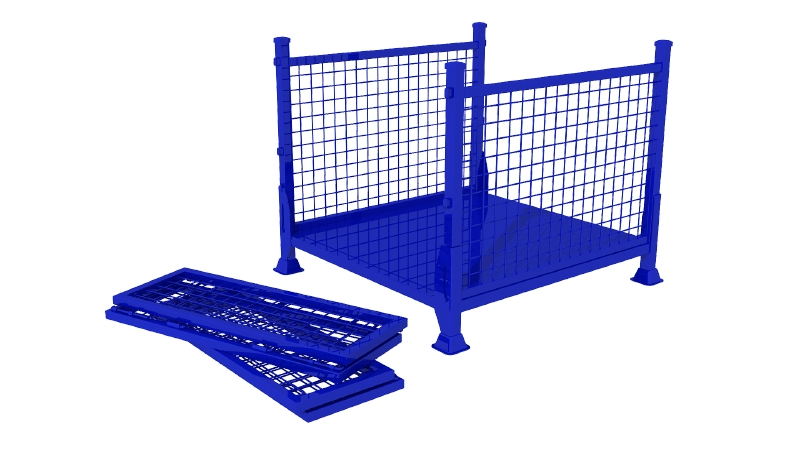
Collapsible wire mesh container with folded panels and assembled unit

  • Access can be planned on the front, rear, left and right sides for near-side picking.
  • Hinged, folding or half-drop panels keep the cage assembled; the exact opening travel is defined by the selected door design.
  • Stacking feet and the steel frame support project-specific stacked storage; the load, number of tiers and floor conditions must be verified before use.
  • The cage can be folded for empty return and storage after the doors and side posts are released in the specified sequence.

Choose the door layout around your picking route

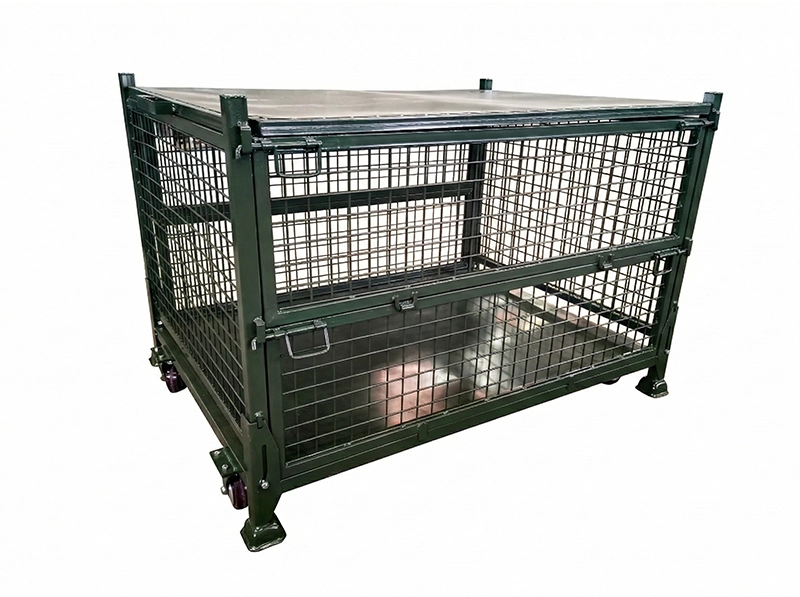
Lidded dark green steel mesh container with half-drop gate and casters

Four-side access configuration

Best for a parts store or line-side route where operators approach the same inventory unit from changing directions. Each side is engineered with its own clearance and latch arrangement; confirm whether each side is half-drop, folding or removable rather than assuming four full openings.

Lidded dark green steel mesh container with half-drop gate and casters

Front half-drop gate

A practical option when the picker normally works from one aisle and needs lower access to the front of the load. It reduces the reach over the wall, but it does not create full access to every face; use side access only if it is included in the drawing.

Collapsible wire mesh container with folded panels and assembled unit

Folding side doors

Suitable when a side must open away from the container to expose more of the load while the cage remains in position. Check the folded-panel envelope against adjacent cages, rack uprights and forklift aisles.

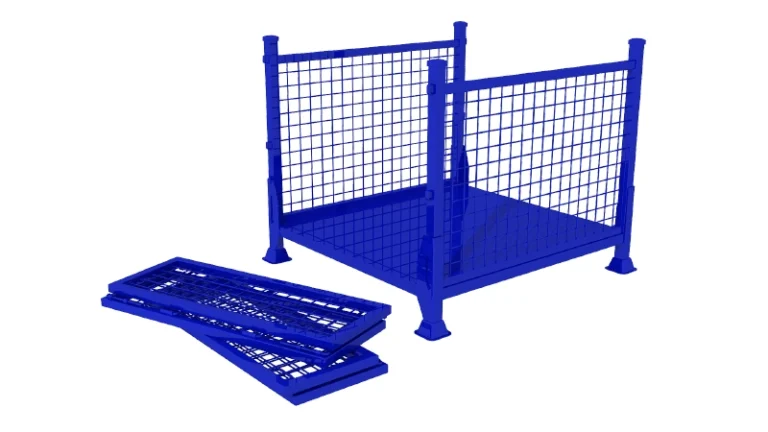
Collapsible wire mesh container with folded panels and assembled unit

Removable or full-opening panel

Use where the process requires a wider transfer opening and the panel can be safely handled outside the picking cycle. A removable panel adds a handling step and must be secured before stacking or moving the loaded unit.

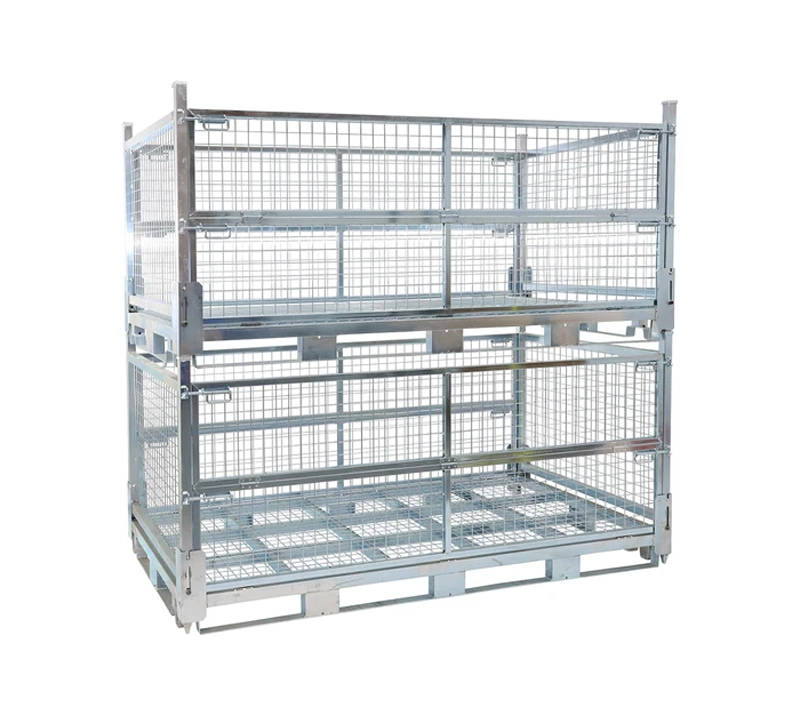
Two-tier stacked galvanized steel wire containers on white background

Stacked or rack-compatible storage version

For slower-moving reserve stock, use the stacking feet and project-approved stack arrangement. For high-frequency bottom-level picking, a rack-compatible base can keep the unit in its assigned beam position instead of requiring the upper unit to be moved; rack dimensions and load checks are required.

Why four-side access is different from a single-door cage

Shorter path to the part

A single fixed door makes the operator walk around the cage or reposition the unit when the working side changes. Four-side access lets the picking point follow the nearest aisle or workstation, reducing unnecessary walking and turning during repeated order picking.

Access without dismantling the stack

The four-side variant is developed so an approved access panel can be operated while the unit remains in its stacked arrangement. The upper cage should not be removed just to reach the lower one. Actual operation still depends on door clearance, stacking-foot engagement, load distribution and the final safety review.

One handling unit from storage to line side

Parts stay contained in the same steel cage while the operator picks, replenishes or moves the unit by forklift, pallet jack or an optional braked caster set. This avoids repeatedly transferring small parts into temporary totes when the workflow needs a larger reusable unit.

More adaptable than a standard wire cage

Compared with a basic single-door warehouse cage, Mybox adds a steel-tube structural frame and a configurable combination of mesh or steel panels, doors, lid, casters and rack-location features. This is a configuration advantage, not a universal load comparison: both designs must be checked under the same load and stacking conditions.

A picking flow built around the nearest access side

  1. 1. Map the approach sides

    Mark the aisle, rack beam, workstation and replenishment approach on the layout. Identify which sides need routine access and which sides must remain clear for forklift or pallet-jack movement.

  2. 2. Define the door action

    Select front, rear and side access as half-drop, folding, removable or another agreed door arrangement. Confirm hand clearance, open-panel envelope, latch location and whether a lid, caster or rack upright interferes.

  3. 3. Match the unit to the load

    Provide the part dimensions, unit weight, full-box weight, centre of gravity and whether the load is loose, boxed or stored in inner bins. Engineering then confirms the internal dimensions, base, mesh or plate enclosure, frame and project load case.

  4. 4. Confirm stacking or rack operation

    If boxes are stacked, verify the stacking feet, tier count, load distribution, floor flatness and access clearance. If the unit sits in pallet racking, provide beam height, beam width, clear height, location load and the required positioning method; rack compatibility is not automatic.

  5. 5. Run the repeat pick

    At the assigned location, the operator approaches the closest planned panel, releases the latch and picks without walking around the cage. For a half-drop or folding door, keep within its designed opening; close and latch the panel before the unit is moved or stacked.

  6. 6. Move, replenish and fold empty units

    Use a forklift, pallet jack or braked casters according to the approved configuration. When the cage is empty, release the doors and side posts in the specified sequence, fold it flat and prepare it for return or compact storage.

Questions warehouse teams ask before specifying four-side access

How does four-side opening work?

The Mybox frame is designed with access panels and latch points on the front, rear, left and right sides. Depending on the selected drawing, a panel can be a half-drop gate, folding door or removable/full-opening panel. The phrase four-side access describes the available access directions, not a promise that every face opens completely or at the same angle.

Can the doors still be opened after Mybox units are stacked?

Yes, the four-side picking concept is intended to allow an approved access panel to be operated while the cages stay stacked, so the upper unit does not have to be removed for every pick. Before production, the door travel, panel clearance, stacking-foot engagement, load centre and operator position must be checked for the specified box size and stack height. Do not open a door if the adjacent unit, rack or load blocks its designed movement.

What is better than a single-door storage cage?

A single-door cage works when every pick is made from one unobstructed aisle. Four-side access is better when the operator approaches from changing sides, when the unit serves several workstations, or when stacked lower-level stock must be reached without moving the upper cage. The trade-off is a more involved door and clearance design, so it should be specified from the actual layout rather than selected as a blanket upgrade.

Which door types can I choose?

Available design directions include a front half-drop gate, folding side doors, removable panels, full-opening panels where the layout allows them, or a four-side combination. The final choice depends on the load, hand access, surrounding aisle, lid, caster, stacking and rack requirements. Half-drop and folding doors are specific design features; they should not be described as any-face full opening.

What picking process is this Mybox suited to?

It suits high-frequency spare-parts and small-parts picking where the same reusable container is accessed from multiple aisle or workstation sides. It can support reserve storage, line-side replenishment and mobile picking when the caster option is approved. If the process needs a sealed dustproof container, a permanently fixed single location or only light manual picking, compare a steel-panel/lid version, a standard cage or an ergonomic trolley before choosing four-side access.

Can I use the same box on a pallet rack and in a stack?

Some Mybox variants are designed with a rack-compatible base while retaining stacking features, but rack compatibility is project-specific. Beam dimensions, clear height, location load, bottom positioning and forklift approach must be checked against the rack system. A stacked wire container image demonstrates a stacked arrangement, not the load approval for another box size.

What information is needed for a quotation?

Send the part dimensions and weights, required internal size, full-box load case, access sides, door action, stacked tier count, rack or aisle drawing, forklift or pallet-jack details, caster requirement, mesh or steel-panel preference, lid, surface treatment and delivery quantity. Mybox has project variants rather than one universal load, dimension or stacking rating; the final drawing controls.

Where can I compare the broader Mybox platform and the planning guidance?

Use <a href="/mybox-collapsible-steel-stillage/">PDP-01</a> for the core collapsible steel stillage, <a href="/blog/mybox-collapsible-steel-stillage/">BLOG-01</a> for the warehouse-use discussion, and <a href="/warehouse-storage-solutions/">PAGE-01</a> for the wider storage planning context. If those routes are being revised, confirm the live destination with your Steel Pallet contact before circulating the link.

Request Pricing Details


    Request Quote List

    Your quote request list is empty.

    Unlock Professional Blueprint Drawings

    Please provide your business contact information to retrieve original CAD/DWG drawings and engineering calculations.