
Mytrack Demountable Post Pallet for Irregular Industrial Parts
Mytrack
Mytrack demountable post pallet helps manufacturers organize irregular industrial parts for forklift handling, planned stacking and foldable empty-rack return. Share the part outline, weight and centre of gravity for a configuration review.
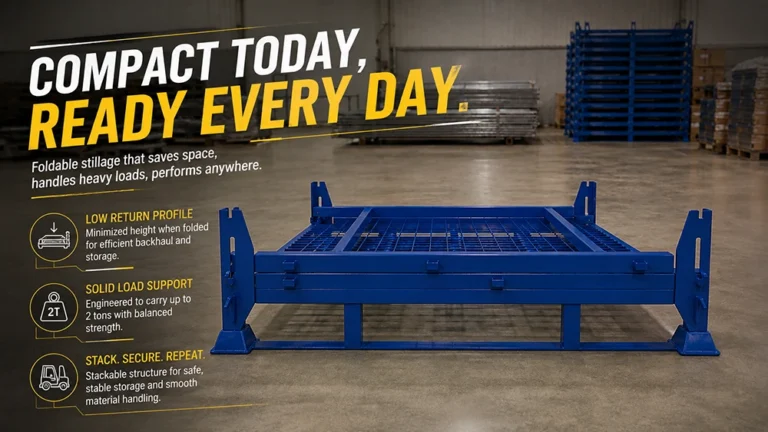
Give irregular industrial parts a defined handling unit
A flat steel pallet works only when the load already has a stable footprint. Mytrack lets the handling unit be planned around the load envelope, centre of gravity, locating points and protection needs.
For an irregular part, the loading route is agreed before production: confirm the maximum outline and weight, position the load within the base, define the posts or restraints that control movement, and leave a clear forklift approach. Where the selected design uses demountable posts, the posts can be lifted out and folded inward for loading access or empty-rack return, subject to the approved configuration and operating instructions.
- Open loading envelope: use a post layout that leaves room for the part’s actual profile instead of forcing it onto a standard flat pallet.
- Mechanical handling base: the steel base provides a defined unit for forklift entry, lifting and controlled placement.
- Stacking interface: align the upper frame’s feet with the lower frame’s posts before leaving a stacked load unattended.
- Return-volume planning: fold the posts inward when the approved design permits, then plan empty-rack stacking for the return journey.
Choose the handling logic before choosing the steelwork
OPEN POST LAYOUT
Defined footprint for forklift handling
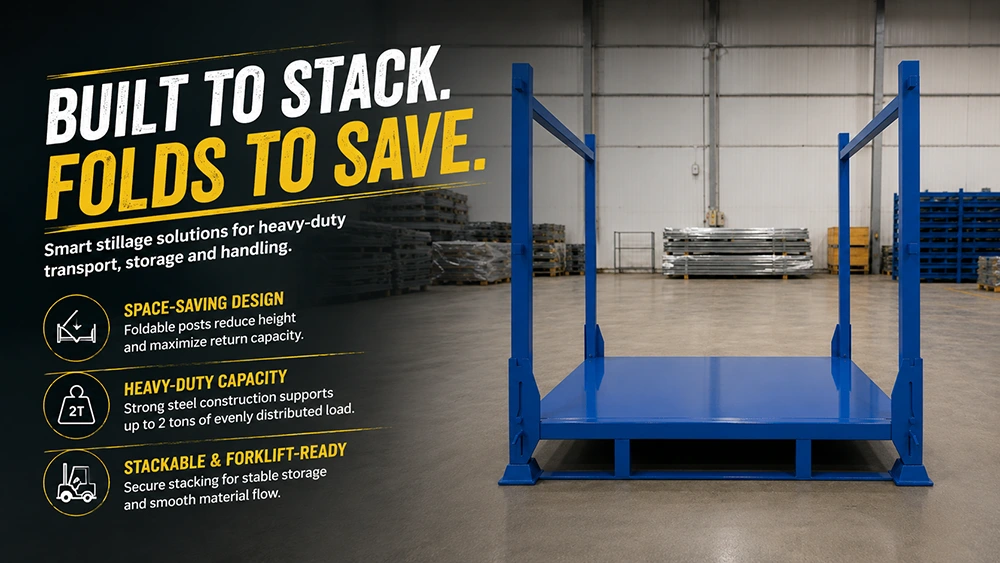
Use the base and four-corner post concept when the part can be loaded from above or within an open frame. The post positions, clearances and support points are set from the actual cargo drawing.
Confirm: envelope, centre of gravity, load path
FOLDABLE RETURN
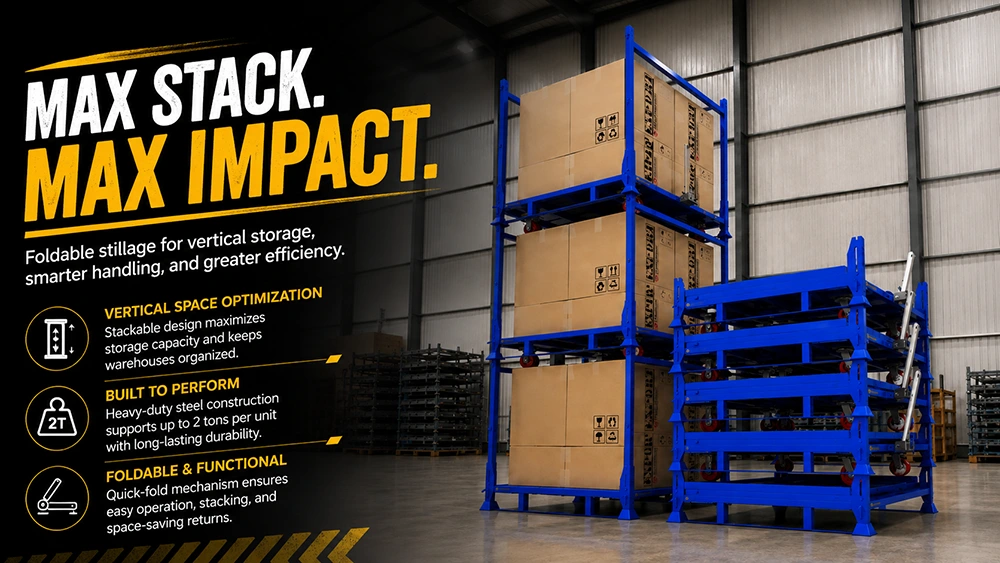
Stack loaded units, fold empty units
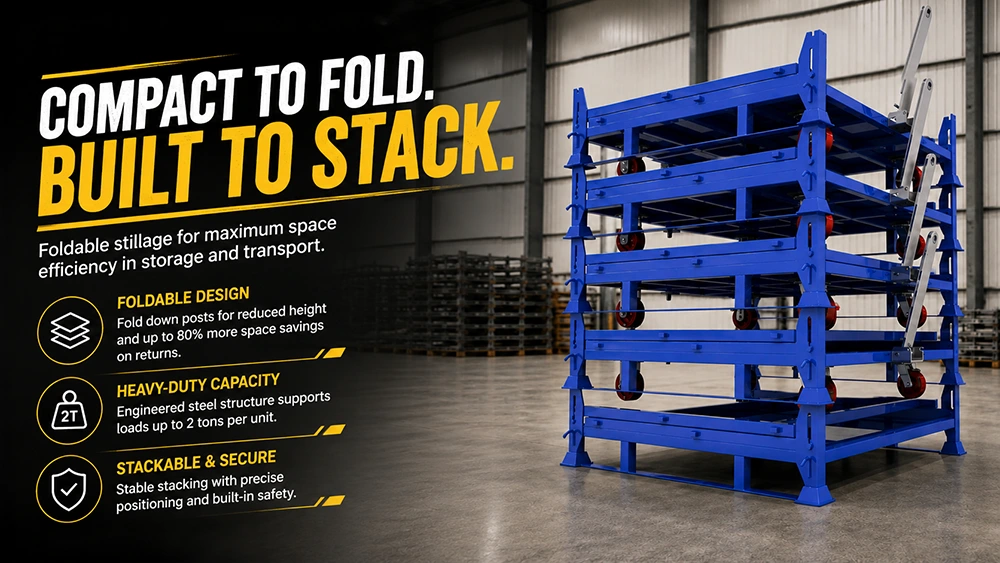
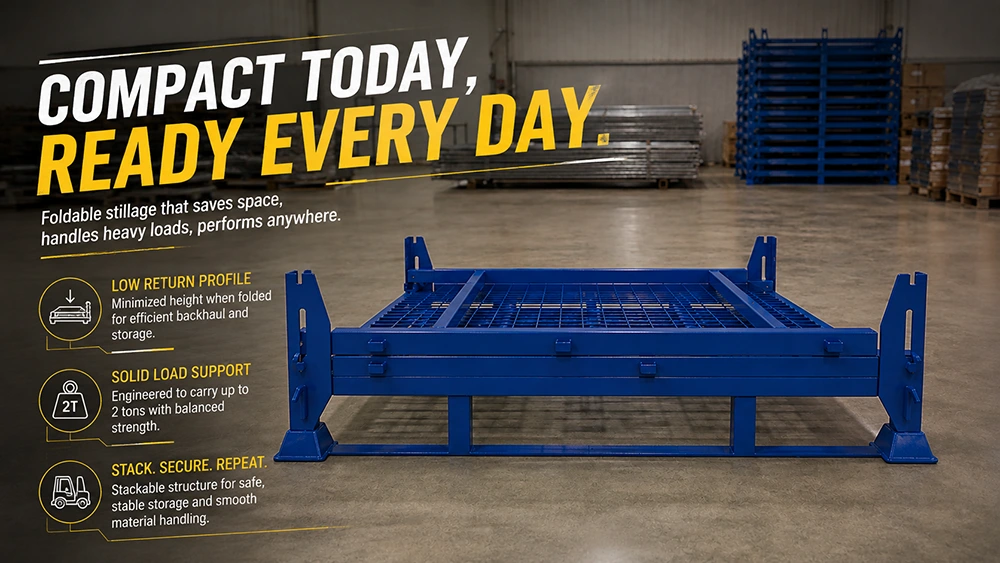
For closed-loop logistics, the expanded rack supports planned vertical storage while the empty rack can be folded and nested or stacked according to the approved design. This reduces return volume without turning a project figure into a universal capacity claim.
Confirm: folding method, stack height, floor and route limits
ENGINEERED RESTRAINT
Protect the part without assuming accessories
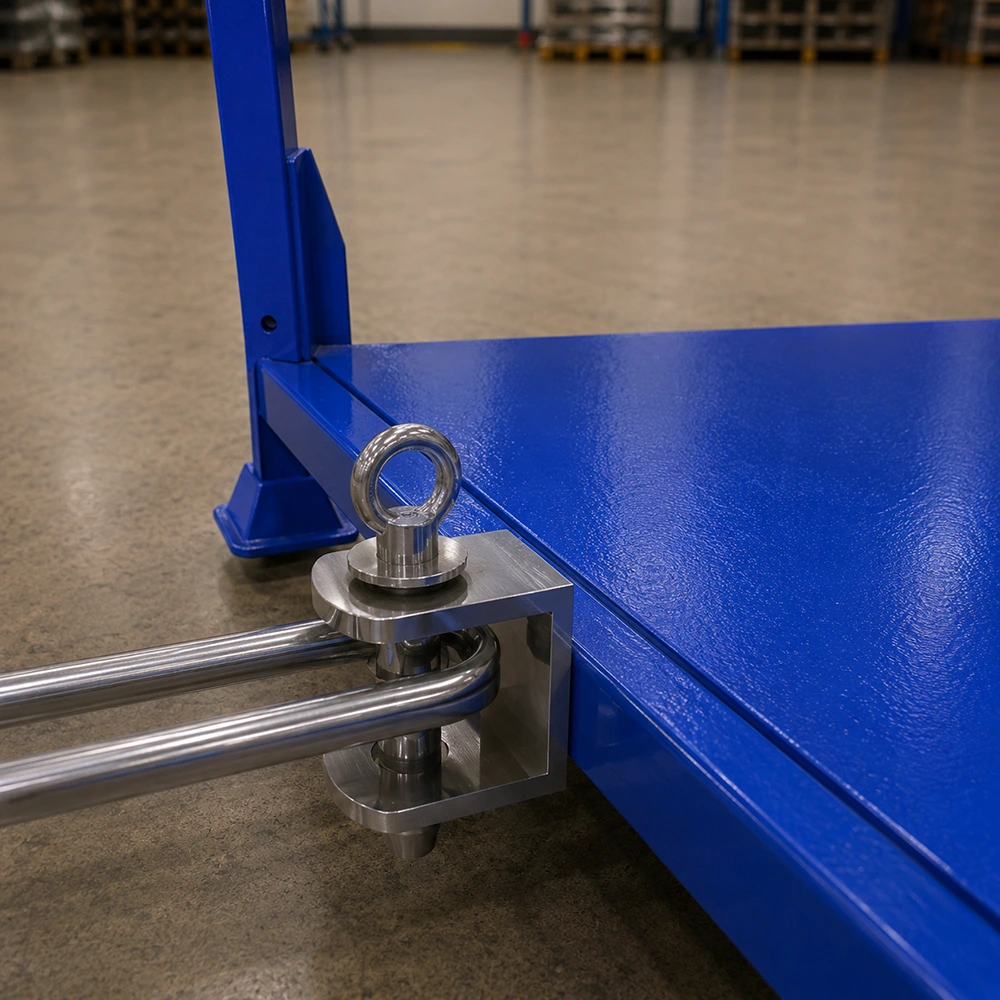
Special supports, removable rails, pins, wheel or profile locations, rubber contact protection, side access and tie-down points can be reviewed when the cargo needs them. They are not included as standard features merely because they appear in a reference image.
Confirm: restraints, contact protection and handling test
Turn a hard-to-position part into a planned unit
Posts can move out of the loading path
In the recorded foldable design, the posts are lifted out and folded inward. That creates access for a defined cargo profile; the exact lock and operating sequence must follow the approved build.
Forklift access is designed into the base
Forklift pockets or entry openings make the rack a mechanical handling unit rather than a loose floor bundle. Fork spacing, entry direction and truck capacity still need to be checked for the order.
Stacking is a placement decision
Posts and feet provide a repeatable stacking relationship. Safe stacking depends on the final load, centre of gravity, approved layer count, level floor and operating rules—not on the image alone.
Protection is specified with the cargo
For painted, machined or easily marked parts, contact surfaces, restraints and packing can be added only after reviewing the load. A standard flat deck is not a universal anti-damage fixture.
A practical route for non-standard cargo
Map the load
Send the maximum length, width, height, weight, centre of gravity, contact areas and any overhang or fragile surface.
Set the boundaries
Define forklift entry, fork dimensions, stack height, floor conditions, transport restraints and whether loaded or empty units will be stacked.
Review the configuration
Confirm post positions, removable or folding operation, supports, access rails, contact protection, packaging and the required verification plan.
Operate as approved
Load within the agreed envelope, secure the part, insert the forks evenly, move at controlled speed and inspect posts, base, welds and locks before reuse.
Is Mytrack suitable for your irregular part?
How do irregular parts go onto Mytrack?
Start with the part’s outer envelope, centre of gravity, support surfaces and movement risks. The base, post positions and any restraints are then reviewed around those inputs. Do not load an irregular part onto a generic frame until the clearances, load path and protection method have been confirmed.
Can the posts be removed?
The recorded Mytrack foldable design allows the posts to be lifted out and folded inward. Whether a particular order uses that arrangement, and how it is locked or operated, must be confirmed on the approved drawing and delivery instructions.
How is Mytrack moved by forklift?
The base includes forklift-entry space in the shown and recorded configurations. The operator should insert the forks fully and evenly in the approved direction, check the loaded centre of gravity and truck capacity, lift smoothly, and keep people clear of the travel path.
Is every Mytrack frame rated at 2,000 kg?
No. A 2-ton value appears as a project requirement and in promotional imagery, but the available source does not establish a universal certified safe working load. The required load, test basis and final rating must be confirmed for the specific design.
When is Mytrack not the right starting point?
It is not ready for a generic promise where the load data, centre of gravity, restraint method, forklift conditions or stacking environment are unknown. A standard flat steel pallet may be simpler for a stable, regular footprint; a fixed rack may be more appropriate for permanent storage. We can review the alternatives with your handling cycle.
What should be included in an enquiry?
Send the cargo drawing or maximum outline, unit weight, centre of gravity, contact and protection requirements, target quantity, forklift details, stack plan, transport route and packaging expectations. These inputs allow a demountable post pallet proposal to be checked rather than guessed.