
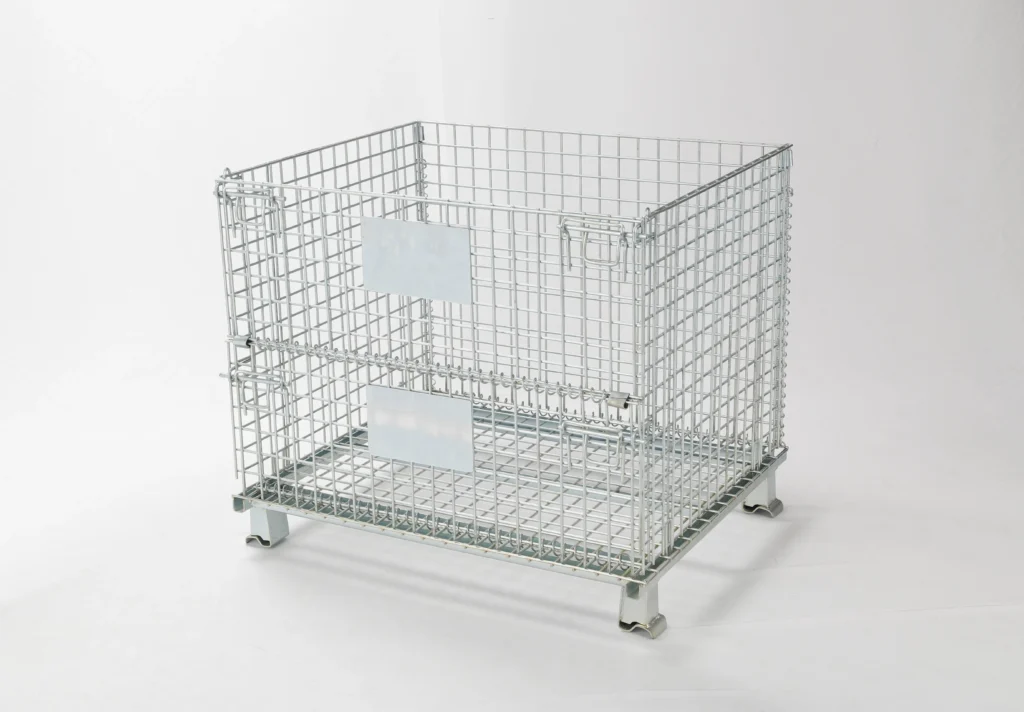
Most folding container inquiries arrive as one line and one photo. A trader forwards a picture taken in a customer yard, adds “need 500 of this cage”, and asks for a price. The photo may show a mesh cage, a frame box, a pallet cage with a lid, or a folded unit resting on top of a stack. The sentence uses a word that describes the shape but not the product. If the quotation is drawn from that line alone, the drawing that follows belongs to whichever product the reader happened to picture first.
The fix is procedural, not technical. Confirm two things before a drawing is released: which product the photo actually shows, and which operating conditions the unit has to survive. Everything below is about that order — product identity first, then load, reuse cycle, stacking and handling, then price.
Why “cage” and “folding box” resolve to different products
In this product family, both a collapsible mesh cage and a square-tube folding box can honestly be called a foldable storage box. The two are not interchangeable, but the everyday vocabulary treats them as one. Our comparison material for the cage and tube-frame products records two recurring inquiry patterns. In the first, a buyer who needs the heavier square-tube box describes the requirement as a “hamster cage”, and the request is read as a mesh cage. In the second, a buyer who needs the mesh cage attaches a photo of the square-tube box, and the supplier responds with a quote for the product in the picture. In both cases the supplier answered exactly what was asked and still sent the wrong product.
The same risk sits inside single words. “Cage” can mean a mesh-sided industrial container, a stacking pallet cage, a security cage, or a display bin. “Folding box” can mean a mesh body with folding side panels or a tube frame with folding panels between fixed uprights. “Stillage” in one plant means a mesh container on feet and in another means a welded post pallet. None of these words carries the structural fact that decides the quote: whether the load travels through welded mesh panels or through a square-tube frame with square-tube stacking uprights.
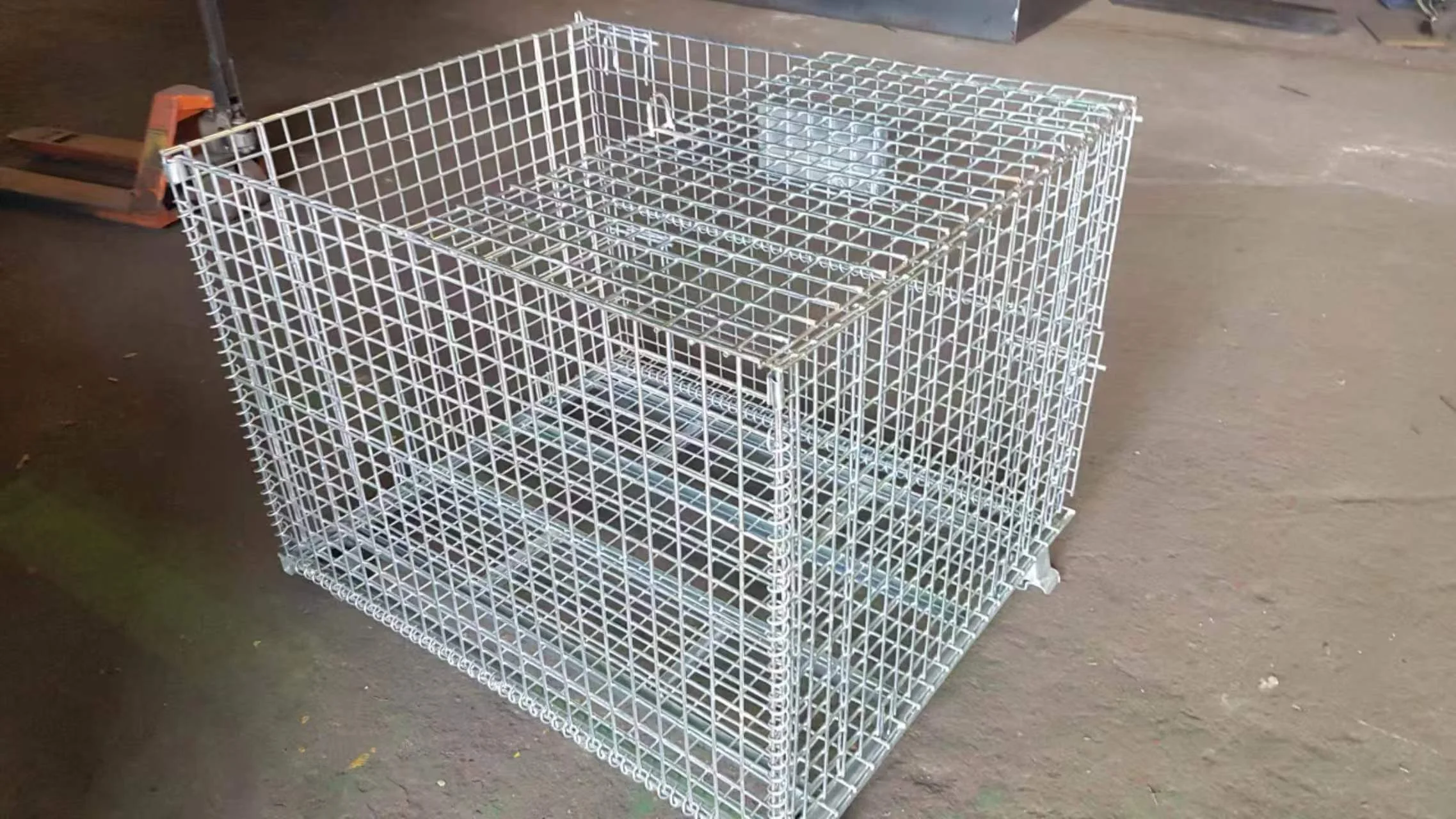
The image above also shows why a nameplate is not a solution on its own. The plate is blank until it is stamped, and the plate on the customer’s existing unit frequently carries their internal asset number rather than a product name. Identification therefore has to come from the structure in the photograph plus a written term that both sides accept, not from the label.
What a photograph can settle, and what it cannot
A photograph is the fastest way to separate the two structural directions, because the difference is visible. On a mesh-bodied collapsible cage, the enclosure is welded wire mesh panels with their edge members, the base carries channel reinforcement, and the stacking support is a formed foot at each corner sitting on the corner of the unit below. On a square-tube folding box, the mesh panels are retained inside a square-tube frame, the stacking columns are square tubes, and the fold happens inside that frame. Once you know which of those you are looking at, the load direction, the stacking behaviour, the folded height and the container quantity all follow.
Ask for the photo set rather than one photo: the assembled unit from a front angle, the same unit folded, the gate or door open, a close-up of the underside or base frame, and one corner where the unit above meets the unit below. Those five views answer the identification question in a single reply. A single flattering photo of a loaded container answers almost nothing, because the load hides the base and the stacking interface.
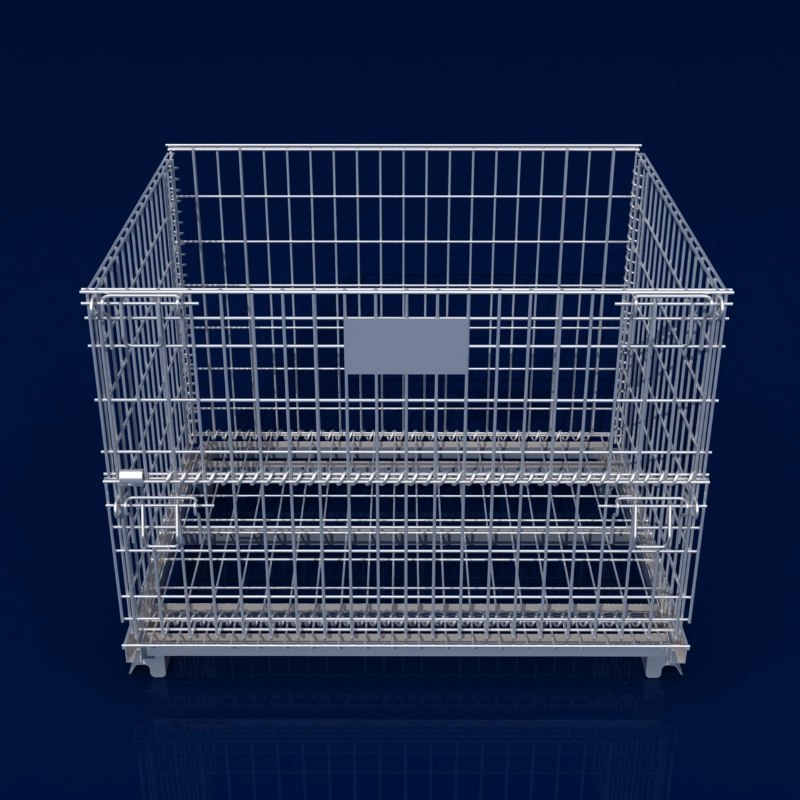
The limits are just as important. No photo shows the rated load, whether a figure is static or dynamic, the wire diameter tolerance, the coating process, the zinc thickness, the weld inspection standard, or the permitted stacked load. Those are document facts and must be written into the quotation, not read off a picture. A photo can tell you that the unit is a mesh cage; it cannot tell you that this mesh cage is rated for the load your customer intends to put in it.
Load, reuse count and stacking condition as filters
Load per unit is the first structural filter. Our comparison material treats roughly one tonne as the practical working limit for the mesh-bodied cage, and states plainly that the figure is a selection guideline from the comparison, not a certified rating. In the same material, loads clearly above one tonne, variable loads and uncertain loads point to the square-tube frame instead. For a project, the number that matters is the actual maximum normal load including handling shock, not the nominal capacity printed in a catalogue. Published ratings also need their definition checked: the three cage project records we hold differ in both value and definition, so they are quoted against their own drawing rather than merged into one figure.
Reuse count is the second filter, and it is the one buyers most often omit. A cage that travels out with one delivery and leaves the site is bought for delivered cost. A cage that returns to the workshop through hundreds of cycles is bought for service life. The comparison record frames this as cost per use: purchase cost plus freight allocation plus handling cost plus expected replacement cost plus maintenance, divided by the number of expected uses. That arithmetic changes the answer more often than the unit price does, because the mesh cage is lighter and folds lower, while the square-tube frame is built for repeated turnover.
Stacking condition is the third filter, and it is the one that produces the worst errors. Empty stacking and loaded stacking are different conditions. In an empty stack the unit above rests on the folded or upper structure with no payload; in a loaded stack the payload of every level above passes through the lower unit. The controlling figure is the combined payload above the bottom unit, not the per-unit rating applied to each level. A three-level stack with 400 kg in each upper level puts 800 kg on the bottom unit; with 500 kg per upper level it reaches the approximate limit with no margin left. Our project records also carry their own upper-tier limits, which differ from record to record and are not transferable between drawings.
What to record before the drawing is released
The confirmation record does not need to be long, but it does need to be written. Every field below changes either the structure or the freight, and a field that is left open becomes an assumption inside the drawing.
- The customer’s own words, restated verbatim in the quotation, next to the official product term you are quoting.
- The product image you are quoting, so the picture and the term travel together through the order.
- Maximum normal load per unit, with static or dynamic confirmed, plus load distribution and centre of gravity where it matters.
- Number of expected use cycles, and whether the unit leaves the site with the goods.
- Whether loaded units will be stacked, the number of levels, and the maximum combined payload above the bottom unit.
- Assembled dimensions and folded dimensions, with the fold direction and the door or gate orientation.
- Indoor, covered or open-air exposure, with the finish process and coating thickness written in rather than assumed.
- Forklift or pallet-jack handling, entry directions, and the equipment actually available at the site.
- Liner, lid, locking, caster and other accessories, each with its own size, rating and fixing method.
- Shipping destination, packing method and the container-loading plan that the quantity was calculated from.
Two habits make this record effective. First, put the product photo into the quotation itself, on the same page as the price, so the customer approves a picture and a number together. Second, keep the customer’s terminology and the official term side by side instead of replacing one with the other. Where the two disagree, resolve the disagreement in writing before the drawing starts, because that is where drawing, sampling, manufacturing and freight rework enters the project.
The photo and terminology confirmation flow
Step 1 — Restate the request
Repeat the inquiry back in the customer’s own words, add the official product term you intend to quote, and ask them to confirm both. This single step catches most of the misrouting recorded in our comparison material, because it forces the everyday term and the catalogue term into the same sentence.
Step 2 — Collect the photo set
Request the assembled view, the folded view, the open gate, the base frame and the stacking corner. Where the customer is replacing an existing unit, ask for one photo of the failed part as well; a deformed foot, a bent mesh panel or a torn weld tells you which structure has to change.
Step 3 — Confirm the operating conditions
Collect load, reuse count, stacking, exposure, dimensions, handling and destination from the list above. These are the inputs that decide whether a mesh cage, a square-tube frame box, or a different container concept belongs in the quotation.
Step 4 — Quote with the picture attached
The quotation should carry the image of the exact configuration being offered, the confirmed load figure with its definition, the reuse cycle assumed, the stacking condition, the selected finish, and the terminology that was confirmed. If any of those is still open, mark it open in the quotation instead of filling it in.
Step 5 — Carry the identification into the order
Use the same product image and the same confirmed term on the purchase order, the packing list and the unit nameplate where a plate is fitted. Identification errors that survive into production are usually errors that were never written down at the quotation stage.
When this approach says the cage is the wrong product
Confirmation is not a formality that ends in a yes. The mesh-bodied collapsible cage is the right direction when the load stays inside its approved limit, the cycles are limited, stacking loads are calculated rather than assumed, and the priority is compact folded shipment and low delivered cost. It is the wrong direction when the combined payload above the bottom unit exceeds the approved figure, when loaded stacking is a permanent operating condition, when hundreds of turnover cycles are expected, or when the containment requirement is really dust-tightness, security or scratch protection that only a liner, lid or a closed container can provide. In those cases the honest answer is to change the product direction before a drawing exists, which is cheaper than changing it afterwards.
Questions buyers ask at this stage
Can you quote from a photo alone?
A photo can identify the structural direction of the product, and it should always be included. It cannot confirm load, finish, coating thickness, stacking limit, dimensions or container quantity, so a price based on the photo alone is a price for an assumption. Send the photo together with the operating conditions and the quotation becomes comparable.
Which single number decides the product?
The maximum normal load per unit, including handling shock, is the first deciding number. Above the practical working limit of the mesh-bodied cage, the square-tube frame direction becomes the correct one. The second deciding number is the combined payload above the bottom unit if the units will be stacked loaded.
Is the one-tonne figure a certified rating?
No. In our comparison material it is a practical working guideline for the mesh cage, and it is deliberately not written as a certified capacity. The rating for an actual order comes from the approved drawing and the project’s own verification, which is exactly why the load figure and its definition have to be confirmed in writing before the drawing is released.
Download the photo and specification confirmation checklist
The checklist used above is a one-page working document for traders, sales support and purchasing: the five-photo set, the ten fields to confirm, and the wording that keeps the customer’s term and the official product term in the same sentence. Use it before the drawing is released, attach it to the inquiry, and pass the same sheet to the customer with the quotation so the confirmation is signed against a picture rather than against a product name. It is designed to sit alongside the product page and the brand overview, so a buyer who starts from a photo ends up on the same specification the factory is working to.
Precisa de uma Solução de Armazenamento Personalizada?
Fale diretamente com nossos engenheiros técnicos. Oferecemos projetos estruturais gratuitos, avaliações de catálogos de alta capacidade e orçamentos rápidos para B2B.
Solicite um Orçamento Agora →