

A return buffer is normally argued over with one number: the folded height quoted for one unit. That number rarely answers the question the loop actually asks. The limit that decides whether empties can be parked in the reserved floor is the outer profile of the whole folded stack, measured in the position it will stand in — including the stacking feet of the base, the way the panels land, the casters if they stay on, and the lid if it ships strapped to the pack.
Mybox is a collapsible steel pallet box platform, not one fixed size, so there is no single folded height to look up. Project records in our files show folded heights of roughly 330, 340, 342, 365 and 370 mm across different builds, and a folded stack of more than one unit is a separate figure again. This note sets out how to measure the return-stack envelope, and what changes when the clear height is short.
One folded box and a folded stack are two different heights
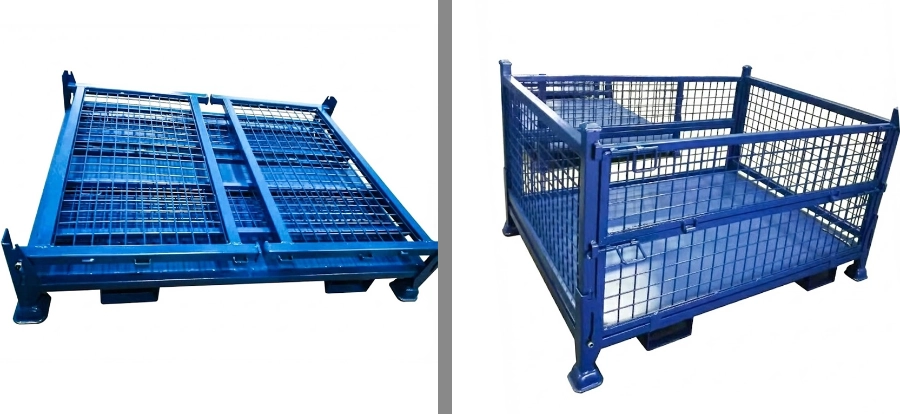
When a Mybox unit is folded, the side panel columns are lifted out of their sockets and laid down, and the folding gates are removed. The deck and its base frame stay as they are — and the base frame is where the stacking feet live. That is the first reason a stack does not simply multiply: an upper unit is not resting on a flat plate, it is landing on the feet and column heads of the unit below, so the pitch between layers is the folded profile plus whatever the interlock adds.
The second reason is packaging. Folded units that travel or sit as a bundle are wrapped, strapped or corner-protected, and the bundle block is what sits on the floor. Our files record a 3000 × 2000 × 1500 mm build folding to 3000 × 2000 × 340 mm, with a stacking reference of 4 folded units reaching roughly 1300 mm. Four layers of a 340 mm profile would be 1360 mm on paper; the recorded block is about a metre three, so the interlock does not behave like a simple sum either way. Treat any stacked figure as a measurement, not arithmetic.
What the measurement has to cover
Measure the stack the way it will be stored, from the floor or from any timber bearer it stands on, to the highest point of the top unit. Include the stacking feet, any folded gates laid on the deck, casters left on the base, lids shipped with the pack, and film or strapping that adds height. Also measure the footprint of the stack, not just one box, because a taller allowance is often impossible while the bundle still has to clear a rack beam or a door lintel.
Recorded folded profiles from our project files, for orientation only — each belongs to the build named and none is a series value:
| Recorded build | Erected size (mm) | Folded profile (mm) | Condition recorded |
|---|---|---|---|
| Base folding box scheme | 1100 × 885 × 950 | 1100 × 885 × 330 | No casters in the record |
| Wheeled standard variant | 1300 × 900 × 900 | 1300 × 900 × 330 | 200 mm casters, stated without wheels |
| Wheeled high-frequency variant | 1200 × 1200 × 1100 | 1200 × 1200 × 330 | No caster allowance stated |
| Small wheeled variant | 1000 × 1000 × 1012 | 1000 × 1000 × 370 | Recorded with wheels removed |
| Lidded four-side-gate variant | 2500 × 1300 × 1220 | 2500 × 1300 × 342 | 4-unit folded stacking used as a logistics reference |
| Large folding box | 3000 × 2000 × 1500 | 3000 × 2000 × 340 | 4-unit folded stack of about 1300 mm |
Where a build carries casters and the wheels are not removed for the return leg, our general product description puts the folded transport profile near 400 mm rather than the 330–370 mm band. That single line is often the difference between a stack that fits the reserved floor and one that does not, and it has to be confirmed for the actual build rather than assumed.
Gates decide whether the panels land flat at all
Folding depends on the side panel being able to lie down inside the footprint of the base. In our files, project 14896 is recorded as not foldable at 1200 × 400 × 1000 mm: the side panel is taller than the base is wide, and the proportion is unstable. A narrow box like that is a fixed box or a re-proportioned box, and no folded-return measurement should be planned for it. The same check catches custom extra-long builds whose gate height was fixed by the load rather than by the fold.
Gate type changes the top surface of the folded pack. A half-drop gate, a full-drop gate, a removable gate and a four-side-gate build do not leave the same stack of panels, and the removed gates need somewhere to lie during the return leg. Our files describe the folding sequence — release the gate pins, take the folding gates off, lift out the side columns and lay them down — but they do not record a standard stowage position for the detached gates, and they do not record a folded height measured with the gates laid on the deck. That is an item to confirm on the drawing and then measure on the first unit, not to copy from another project.

Castors and lids add height after folding, not before
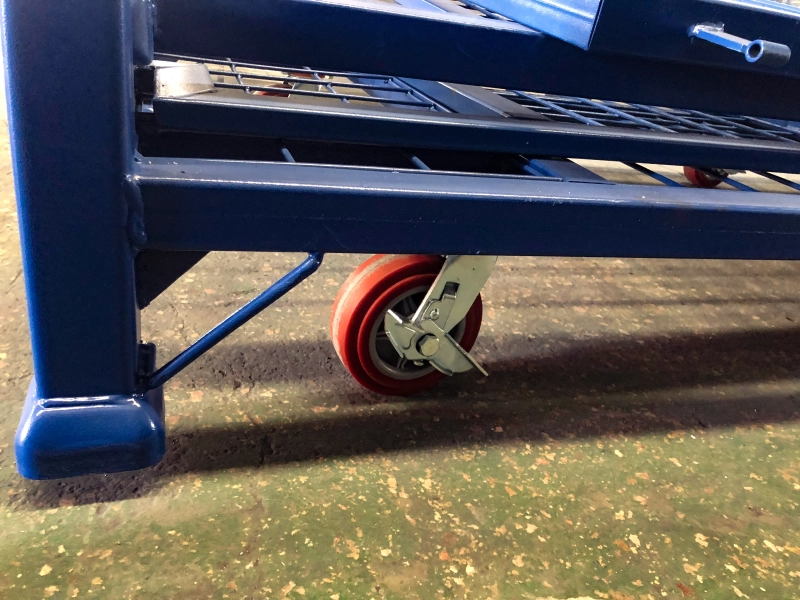
A caster stays bolted to the base plate when the box is folded, so the wheel assemblies sit below the deck and add to the profile that faces the ceiling of the buffer. On the small wheeled variant the folded 370 mm is recorded with the wheels off; the build carries four 125 mm polyurethane wheels with a side brake. Removing them is a real operation with a real sequence: the unit is jacked or blocked, the wheels come off, the fasteners and any shims go into a labelled kit per box, and the wheels are refitted and checked before the box goes back into a loaded cycle. Nothing in our files assigns a torque or an inspection interval for that refit, so it has to be written into the loop procedure.
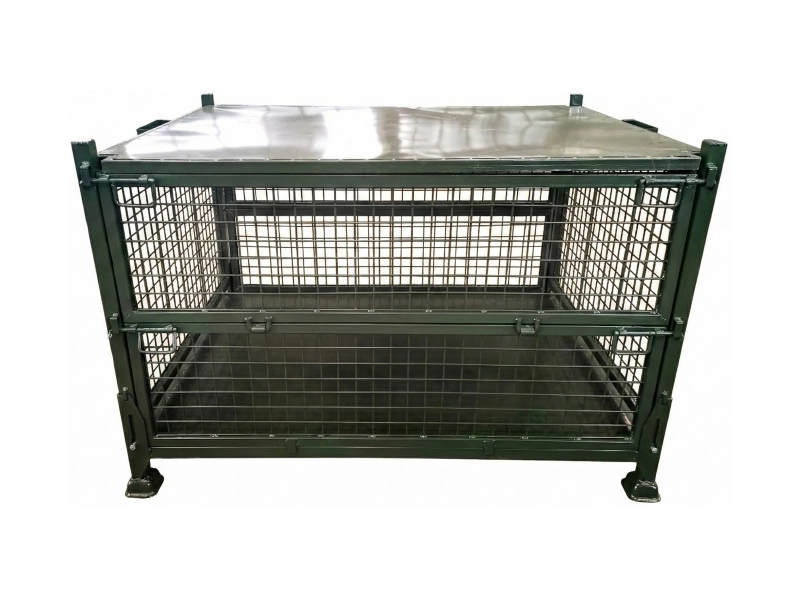
A lid is worse behaved still. The lidded builds in our records are described by their erected configuration — lid, half-drop gate, casters — and no folded profile is recorded with the lid in place. A lid kept on the folded pack adds its own depth plus the strapping that holds it; a lid stored separately needs its own floor, rack or trolley position, and lids of different sizes do not nest reliably with each other. Either way the lid has to be counted in the return envelope or given a home of its own.
When the clear height is short: fixed buffer or caster removal
A clear height that cannot take the measured stack leaves four options. They are not interchangeable, and each has a condition that disqualifies it:
| Option | What it uses | What it costs | Where it does not suit |
|---|---|---|---|
| Fixed transit buffer for erected empties | Floor and aisle for boxes standing open, at erected height | Loses the fold gain entirely; gains no fold/unfold labour | Long return dwell, tight floor, or any place empties must travel back loaded |
| Remove casters before stacking | Lower folded profile, recorded as 370 mm with wheels off on the small wheeled build | Wheel kit, tools, refit and check labour per box; forklift-only handling while stripped | Boxes that are moved by hand at the line, or where refit control cannot be enforced |
| Fewer units per stack, more stacks | Same folded profile, lower block | More floor, more stacking feet positions to keep level | A buffer sized for one block on a fixed footprint |
| Change the build proportion | A base plan and gate height that fold within the limit | New drawing and sampling; load and internal volume reviewed | Existing fleet already delivered, or loads that fix the internal height |
Two checks decide between them. The first is the lowest clear point on the entire route the folded stack travels — rack beam, door lintel, truck roof, mezzanine soffit — not the buffer ceiling alone. The second is who handles empties: if they are pushed by hand, caster removal takes away the only transfer method the loop has, and a fixed buffer or a re-proportioned build is the honest answer instead.
Inputs for an envelope check
- The folded quantity to be parked, and whether it is one block or several stacks.
- The clear height available at every point on the return route, in millimetres, with the lowest point named.
- Caster status for the return leg: kept on, removed, or undecided; wheel diameter and brake type if known.
- Lid status: shipped on the pack, stored separately, or not used; and gate type, including whether gates are detached during folding.
- Base and packaging: deck type, timber bearer or pallet under the stack, film, strapping or corner protection.
- The build itself: outside and inside size, load per box, loaded stacking layers, and the project reference if a drawing already exists.
Perguntas frequentes
Can we use the folded height from one project for a different size?
No. Folded height follows the ratio of panel height to base width, the gate arrangement, the base frame and the caster position, and our files record 330, 340, 342, 365 and 370 mm on different builds. The number has to come from the drawing of the build you are ordering, and the stack figure has to be measured on the first unit.
Does a folded stack need the same floor as a loaded stack?
The floor pressure is far lower, but the stability question is different. Folded units are flat, light per layer and their stacking feet are what keep the block located, so the floor has to be level and the block has to be built square. A stack on an uneven patch or on casters that are not locked is not a parking position.
Which figure should we give our warehouse planner?
The measured outer profile of the folded stack, with the caster and lid condition stated, plus its footprint. If the loop is still being planned, give the limit height and the folded quantity instead, and ask for the envelope to be checked against a drawing — the same way loaded stack height is checked separately in how loaded stack height is determined for stackable metal pallet boxes.
Get the folded envelope checked against your height limit
Send us the folded quantity, the clear height available on the return route, and the attachment status of the boxes — casters on or off, lid or no lid, gates detached or not. We will check the folded stack profile and footprint against your limit and tell you which of the four options actually closes the gap for your loop, including the case where the answer is a fixed buffer or a re-proportioned box rather than a fold. A companion note covering the loaded leg follows the same logic from the other direction.
Precisa de uma Solução de Armazenamento Personalizada?
Fale diretamente com nossos engenheiros técnicos. Oferecemos projetos estruturais gratuitos, avaliações de catálogos de alta capacidade e orçamentos rápidos para B2B.
Solicite um Orçamento Agora →