
Two folding containers land on the same quotation sheet: a collapsible wire mesh cage and a square-tube folding box. The cage shows the higher unit price per piece. The comparison usually stops there, and it usually stops in the wrong place.
Unit price answers one question only: what one unit costs before shipping. It says nothing about how many times that unit will be loaded, moved, stacked and returned before it leaves service. In our STBOX and MYBOX product comparison presentation, the mesh cage is recorded at a higher unit price than the square-tube box, so price cannot be the reason either product wins a given application. The controlling number is the expected use count, followed by load, stacking condition and freight volume.
Start with the use count, not the price
Before comparing anything, write down three numbers per unit: expected uses per year, expected total uses over the period you are budgeting for, and the replacement assumption you are willing to accept. Those three numbers decide whether you are buying a consumable or a piece of handling equipment.
The arithmetic is simple and it does not depend on any product claim. A container that is filled once, shipped once and never returned carries its entire delivered cost in a single cycle. The same container used twenty times spreads that delivered cost across twenty cycles before any repair or replacement is charged to it. Cost per use is best written as purchase cost plus freight allocation plus handling cost plus expected replacement cost plus maintenance cost, divided by the expected number of uses.
That formula is the reason the count comes first. At one or two cycles, the delivered cost of the empty container dominates the decision. At dozens of cycles, the purchase price becomes a small share of the total and the structure, the fold and the inspection interval start to control the result. Only after the count is written down do the measurable product differences start to matter.
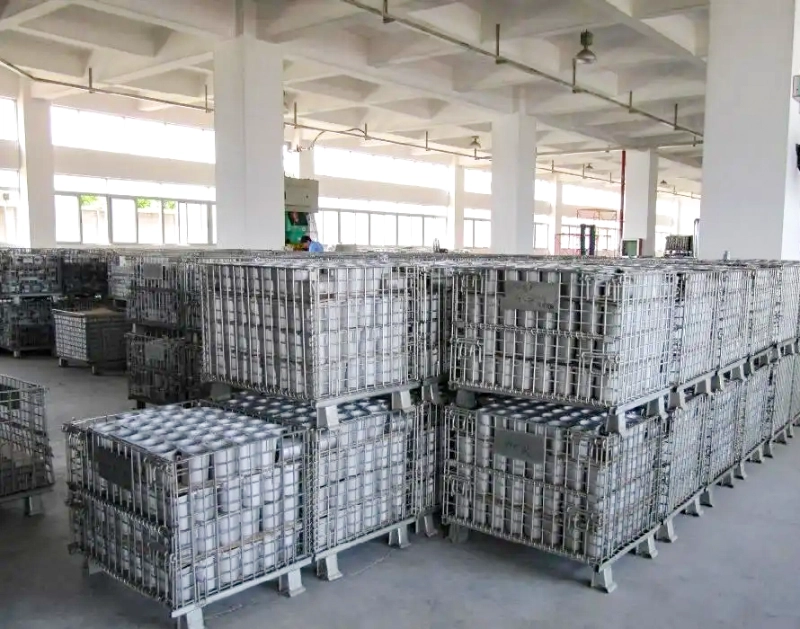
Price, weight, folded height, container count and service expectation in one table
Comparing only purchase price hides four lines that move the delivered result. The table below places them side by side using the figures recorded in our comparison presentation and in our project files. Nothing in this table is a certified rating or a contractual loading quantity.
| Criterion | Collapsible mesh cage (STBOX) | Square-tube folding box (MYBOX) |
|---|---|---|
| Body construction | Predominantly wire-mesh panels carrying the load into the base frame | Mesh panels retained inside a square-tube supporting frame |
| Stacking members | Mesh-based structure with formed stacking feet | Square-tube uprights acting as the stacking columns |
| Unit price in the comparison presentation | Mais Alto | Mais Baixo |
| Unit weight | Lighter | Heavier |
| Folded profile | Low and flat | Flat arrangement, but still relatively tall |
| Units per 40 ft container (presentation reference) | Approximately 360 | Approximately 160 |
| Recommended single-unit load (presentation guideline) | Approximately 1 t | Above approximately 1 t |
| Resistance to loaded stacking | Lower, the mesh can become the limiting member | Higher, the uprights receive the stacked load |
| Finish described in the same comparison | Electroplated or galvanized type | Powder coated as standard |
| Intended reuse pattern | One-time or limited use, temporary staging, volume shipment | Repeated turnover, heavier loads, long-term positions |
Read the container row as a scale indicator, not as a promise. Actual quantity per container depends on the exact folded dimensions, the packing method, the protection wrapping, the container type and the approved loading plan. The same caution applies to the approximate one-tonne guideline: it is the practical limit stated in the presentation, not a certified capacity, and stacked behaviour must be calculated for the specific configuration.
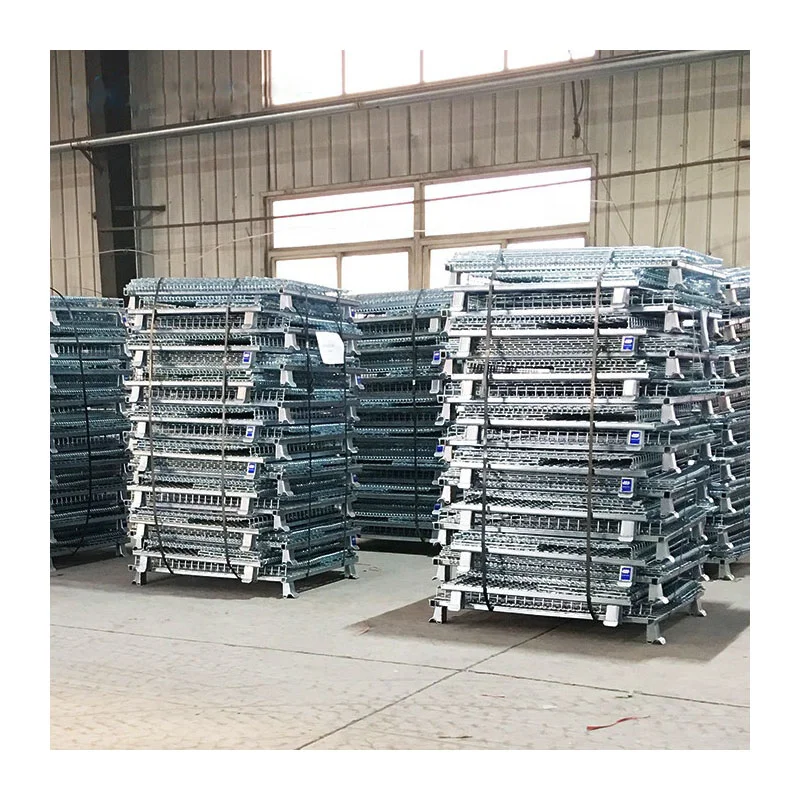
Why the mesh cage shows the higher unit price and can still ship cheaper
The statement in the presentation should be repeated exactly as it stands, because it is routinely flattened into something false: the mesh cage is recorded at a higher unit price than the square-tube box. It is not the low-price product in that comparison, and it should never be presented as cheaper.
What the presentation does claim is a lower delivered cost per usable unit in the applications it describes, and it names the mechanisms. The cage is lighter, which reduces handling effort and freight weight. It folds to a low, flat profile, which is where the roughly 360 versus roughly 160 units per 40 ft container gap comes from. Fewer containers for the same order means less freight allocated to each unit. And in the outdoor staging case discussed in the presentation, the described galvanized-type finish is credited with better corrosion performance than a standard powder-coated box, which lowers expected replacement exposure in that specific environment.
That is a delivered-cost argument, and it holds only while the use count stays low. The moment the same unit is expected to return and repeat, the replacement line in the cost-per-use formula starts to outweigh the freight line, and the ranking can invert even though the unit prices never change.
Two cautions belong with this argument. First, the presentation uses both electroplated and galvanized language for the same finish, and those are different processes; the exact coating process, minimum thickness, relevant standard and acceptance criteria must be fixed in the specification before any corrosion comparison is used contractually. Second, the container quantities are presentation references, not guaranteed loading figures.
Where the count flips the answer
One-time and limited-use positions favour the cage. Material is packed once and shipped; the container travels with the delivery or is consumed at the end of the project; the payload stays moderate; the unit is not expected to come back. In that pattern, paying for extra structural life buys nothing the operation will collect, while lower weight and lower folded volume are collected on every shipment.
Repeated turnover favours the square-tube box. The boxes come back to the workshop after each delivery, they are loaded and unloaded frequently, they sit in a long-term work-in-progress position, they are stacked while loaded, and the payload may vary upward. In that pattern the purchase price is spread over many cycles, and the structural reserve is what protects the count from being cut short by deformation.
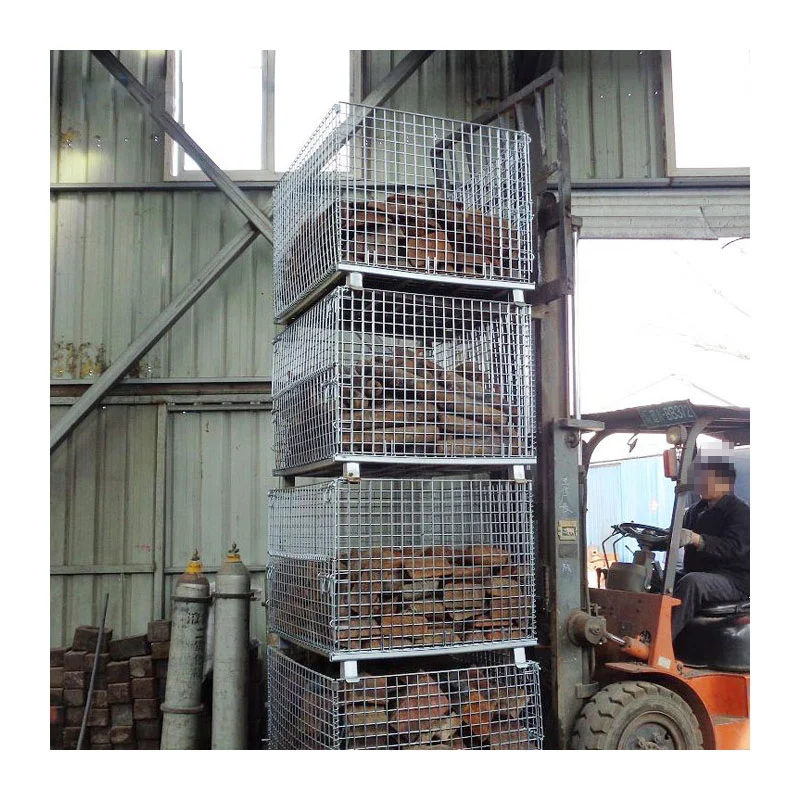
The structural reason is a different load path, not a heavier version of the same one. In a mesh cage the stacked load from every level above is transferred through the lower unit’s mesh body and its perimeter members, so side-mesh compression or distortion is the failure mode to watch. In a square-tube box the frame carries the load and the square-tube uprights receive the stacked load directly. That difference explains the load range, the loaded-stacking behaviour and the expected working life under repeated handling all at once. The load-path detail is covered in our comparison of a collapsible mesh cage and a square-tube folding box, and the stacked-load mechanism specifically in our note on mesh panels as the limiting member in loaded stacking.
On the photograph above: the image index records a forklift stacking heavily loaded containers. No test standard, fixture, duration or certificate is attached to that scene in our files, so it illustrates handling and stacking in a plant, not a certified load rating.
A work-in-progress project where the cage stayed in service
A high reuse count does not by itself push a buyer to the square-tube frame. One project in our files is a factory that already ran stillage cages and needed additional capacity for production-side work in progress. The specified cage was 1050 x 1050 x 1000 mm with 50 x 50 mm mesh and 6.0 plus or minus 0.1 mm wire in Q235 steel, one tonne per cage, up to four tiers with the upper cages limited to 1,200 kg combined, cold galvanized finish, forklift and pallet-jack handling, a half-drop gate on one side, and empty folding. The reference packing was about 150 units per 20 ft container with a stated 25-day lead time for that quantity.
That project stays on the cage because the duty matches the cage: recurring use, but loads inside the stated limit and no demand for heavy loaded stacking. The parameters are project-specific and must be confirmed against the approved drawing, load verification record and order confirmation. They are not a standard model, and they must never be merged with another project’s dimensions, coating thickness or container count.
The cost lines that decide a long-term position
For a position that runs for years, the purchase order is only the first line. A defensible long-term comparison carries five cost lines and one physical constraint.
The first line is delivered unit cost: purchase price plus freight allocation plus packing. The second is handling damage: what repeated forklift and pallet-jack contact costs in mesh repair, gate realignment or foot replacement. The third is inspection and repair time, including the interval at which you check base channels, welds, feet and hinges. The fourth is replacement, the line that decides whether a lower price was actually cheaper. The fifth is the empty-state cost: the floor area and transport volume consumed by empty units between cycles. The physical constraint is the combined payload carried by the bottom unit whenever loaded units are stacked, because a stack behaves as one structure and not as a row of independently rated containers.
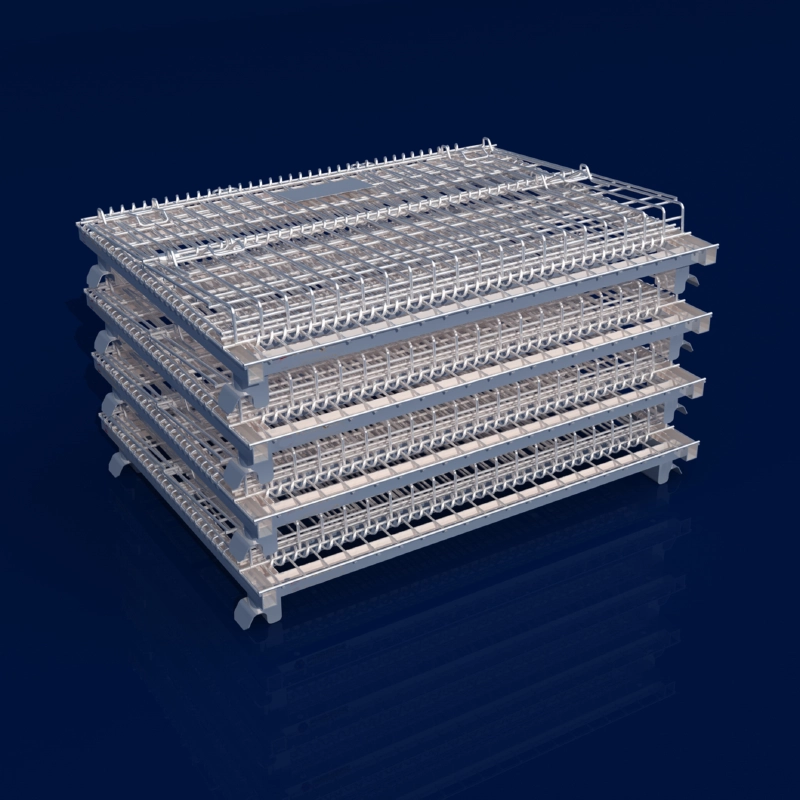
Folded height deserves a separate note, because it is the number buyers most often assume. Our files contain one documented folded height, 190 mm, and it belongs to a single project variant measuring 800 x 1200 x 890 mm. It cannot be transferred to the 1050 x 1050 x 1000 mm or 1000 x 800 x 840 mm variants, whose folded heights were not confirmed in the same documents. Ask for the folded height of the exact size you are ordering, together with the empty-stack arrangement you intend to use.
What to count before you release a purchase order
- Uses per unit per year, and total expected uses over the budget period.
- Whether each unit returns to your site or leaves with the shipment.
- Maximum normal load per unit, the load distribution, and the heaviest combination you will actually run.
- Whether loaded units are stacked, and the combined payload carried above the bottom unit.
- Peak empty storage: how many folded units you hold, for how long, and how they travel.
- The inspection point that fails first in your plant, whether that is mesh, welds, base channels, feet or gate hinges.
- The finish and the environment, including whether units stand outdoors or in humid staging.
Where the wire mesh container is the wrong buy
The cage is the wrong choice when the combined stacked payload above the bottom unit exceeds the limit for the configuration, when a single unit must carry well above the approximately one-tonne guideline, when loads are uncertain or vary widely, or when stacking loaded units is normal practice rather than an occasional event. In those conditions the mesh body becomes the limiting member and the cost-per-use argument collapses, because the count you budgeted for is no longer the count you get.
It is also the wrong comparison when the parts cannot tolerate mesh contact, dust or small-part loss and no liner or lid is being specified, and it is the wrong product category entirely when the requirement is a fixed storage structure. A cage is a movable, foldable container that is loaded and then handled; a cage rating must never be substituted for a rack beam capacity.
Questions buyers ask at the quotation stage
Is the mesh cage the cheaper option?
No. In the comparison presentation the mesh cage carries the higher unit price. What it can offer is a lower delivered cost per usable unit in low-use applications, because of its lower weight, its low folded profile and the roughly 360 versus roughly 160 units per 40 ft container difference in the reference figures. Say it that way in your own evaluation, or the conclusion will not survive the first freight quote.
How many reuses before the square-tube box pays off?
We do not publish a break-even cycle count, and our files contain no measured service-life or cycle data for either product. The honest answer is conditional: if a lower-priced unit has to be replaced after only a small number of cycles in your duty, the initial saving is consumed by the replacement, while a higher-priced unit used across the same cycles spreads its cost over all of them. Model your own count, your own replacement assumption and your own duty, and do not accept a cycle figure that arrives without an agreed duty description and test method.
Does a high reuse count always mean the square-tube box?
No. The work-in-progress project above runs repeated cycles on mesh cages because its loads stay inside the stated limits. The discriminator is the load and the stacked load, not the count alone: count uses first, then check load and stacking, then check freight and environment, and only then compare the price on the sheet.
Precisa de uma Solução de Armazenamento Personalizada?
Fale diretamente com nossos engenheiros técnicos. Oferecemos projetos estruturais gratuitos, avaliações de catálogos de alta capacidade e orçamentos rápidos para B2B.
Solicite um Orçamento Agora →