
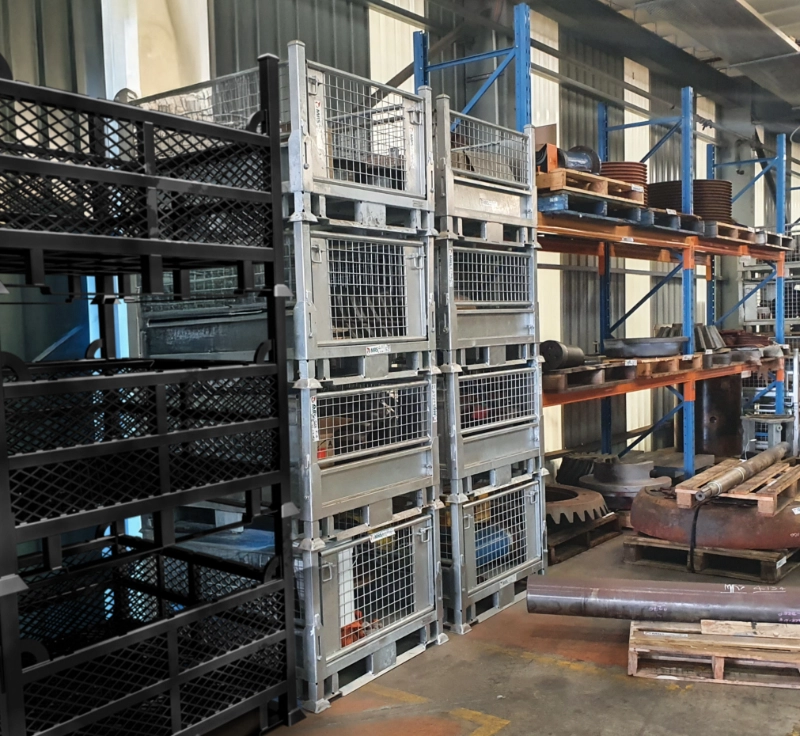
A parts store rarely picks a metal pallet box on cubic capacity alone. The decision usually turns on the floor of the box: it decides what the smallest item in the load can fall through, how a concentrated mass such as a shaft end, a casting boss or a machined flange is carried, and how much material stays behind after the box has been tipped out and swept. Two boxes with the same 1100 mm footprint and the same tube frame behave very differently in service when one has a mesh floor and the other has a sheet steel floor.
The rule we apply in a review is deliberately plain: match the floor to the smallest contact surface in the load, to the way the load is supported underneath, and to the cleaning routine the parts demand. Appearance does not enter it, and neither does the habit of always buying mesh. Our Mybox records treat mesh bodies, steel plate bottoms and rack-compatible bases as separate options, and every one of them is confirmed on the drawing rather than chosen from a catalogue page.
Three floor options that do three different jobs
Before comparing them, split the question into the three arrangements buyers actually ask about. They are not three grades of the same floor, and one is not automatically stronger than another.
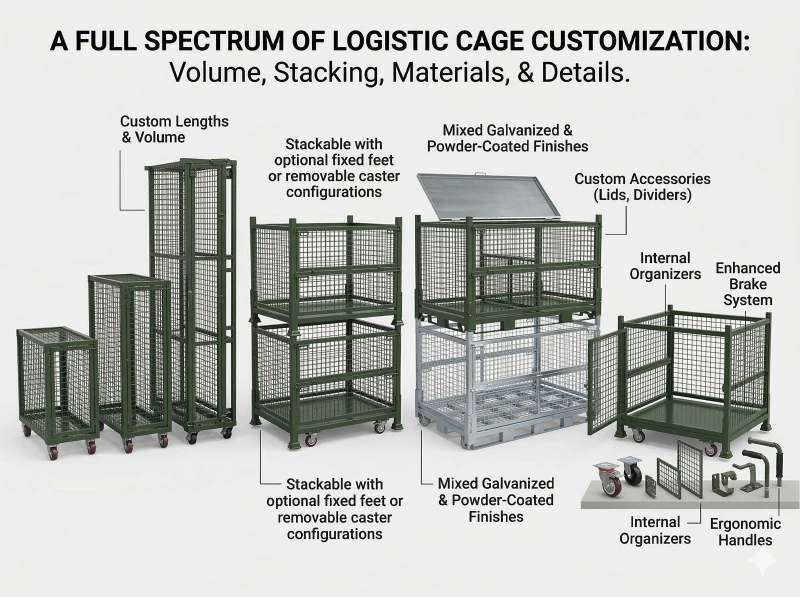
- Mesh floor. A welded wire grid fixed to the base frame, commonly recorded in our files as 50 x 50 mm openings in about Ø5 mm wire. Anything larger than the aperture stays in, fines and swarf pass through, and water or wash residue drains instead of pooling.
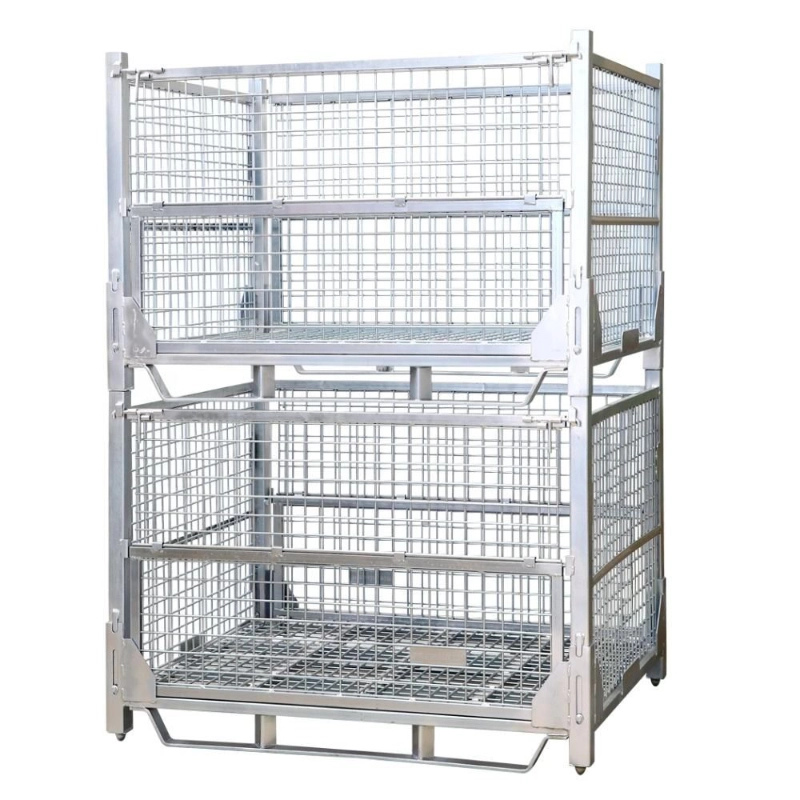
- Sheet steel floor or plate bottom. A continuous steel plate closes the base. Nothing passes through, small items cannot drop between wires, and the surface can be swept flat. It is a documented option on the collapsible pallet box, not a separate product family.
- The pallet or rack beam already under the body. Where the store already runs wooden pallets, plastic pallets or beam racking, the box can be built on a forklift base that sits on that support, or the pallet deck itself becomes the effective floor. In one rack-compatible project record the body is 1000 x 1000 x 900 mm outside, 850 x 880 x 670 mm inside, about 100 kg empty with a 1000 kg uniformly distributed design load, and the base is shaped to stand on beam racking while keeping its stacking function.
Read side by side, the options differ first in what they let past, second in how they spread load, and only third in how they look. That order is also the order in which a selection should be made.
When a mesh floor is the right answer
Mesh flooring earns its place when the load is made of items clearly larger than the aperture and when the store benefits from material falling away. Turned parts with swarf, foundry or shot-blast components with sand and scale, castings that arrive wet, and agricultural produce that has to breathe are all cases where an open base removes a problem instead of creating one. The same grid also lets a checker read fill level and part type from the aisle without opening a gate.
The failure mode to watch is not strength but loss. Anything that fits through the grid leaves the box, and in a parts store that means washers, dowels, spring pins, small brackets and offcuts end up on the floor or in whatever sits underneath. A mesh floor stacked over another box also drops grit onto the load below, which matters once the second tier carries finished or painted parts. Our files carry mesh as a standard configuration on the collapsible stillage; they do not carry a claim that a mesh floor is interchangeable with a plate bottom for the same fine-pitch load.
A sheet steel bottom answers the smallest part, not the heaviest one
A plate bottom is chosen for containment, not as an upgrade in load class. It closes the grid so the smallest item in the batch cannot escape, gives a flat surface that can be swept or hosed, and stops liquids and fines from reaching the tier or the floor below. For a mixed parts load, a box where fasteners are bagged loose, or a cell that must not leave a trail of chips between stations, that is usually enough reason.
Two limits have to be stated honestly. First, a plate bottom does not by itself create a leak-tight or food-contact surface; those are separate compliance questions and our current files contain no such certification, so they must be verified case by case before the box goes anywhere near edible product or a liquid that must not escape. Second, the plate adds mass and traps what a mesh floor would have released, so the cleaning routine has to include access to the underside of the deck. Where a store compares a 70 kg frame with and without a plate, that difference belongs in the handling and freight numbers, not only in the drawing.

Reusing the pallet or rack you already have
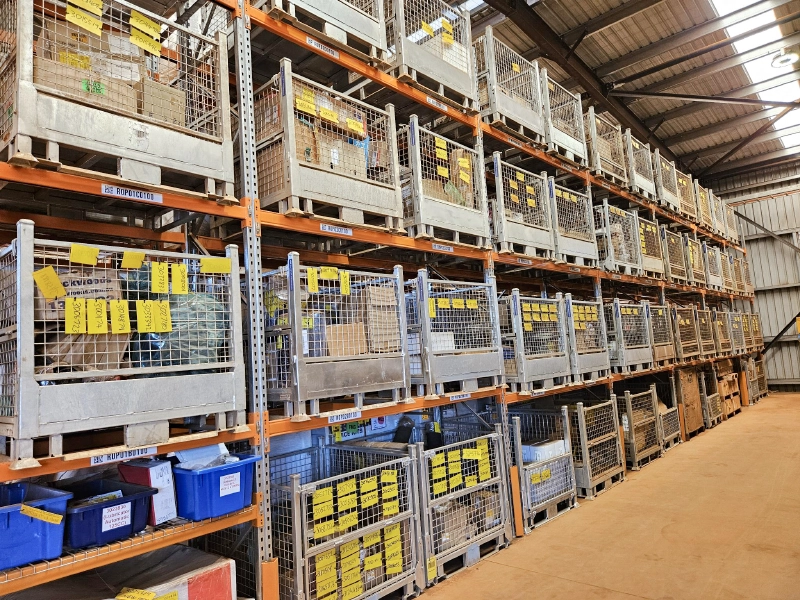
Many stores do not need a new floor at all; they need a body that lands correctly on the support already in the aisle. Three arrangements cover most of it. A box with a forklift base and its own deck stands alone and can be stacked, which is what most of our records describe. A box landing on an existing wooden or plastic pallet uses the pallet deck as the floor, which saves steel but moves the load path into the pallet and the strapping. A rack-compatible body is positioned by the beam and is not stacked on the floor of the aisle.
The check that decides between them is the support spacing under the load. A beam rack or a pallet with widely spaced bearers can leave a span under the middle of the box where the parts press with nothing beneath them, and a box that is perfect on a solid floor can deflect across that gap. Ask what the box rests on, at what centre distance, and whether the load sits over a member or between two. Those three answers change the base far more than the choice of wall panel does.
Concentrated load and residue: the two checks that change the answer
Load rating and floor construction are separate questions, and this is where most specifications go wrong. The figures our project files hold, such as 1000 kg, 1200 kg or 1500 kg, are uniformly distributed design values for that configuration. None of them is a statement about a single 300 kg shaft standing on two contact patches, and none can be inferred from whether the base is mesh or plate. Off-centre mass, impact from a dropped component, a partly open gate and a stack that does not line up with the columns below all reduce what the same box will tolerate.
Residue works the other way round and is easier to get right. List what the load leaves behind: fines, swarf, sand, coating flakes, oil, moisture or food dust. Anything that must leave the box argues for mesh; anything that must stay in, or must not reach the tier below, argues for a plate. Where both apply, the answer is usually a mixed build rather than a compromise: plate where the small parts sit, mesh elsewhere, decided face by face. Costing that correctly starts with the smallest part dimension, not with the heaviest one.
- Ask for the smallest contact surface of the lightest item that must not be lost, then compare it with the aperture.
- Ask for the weight distribution as a footprint sketch with the heavy items marked, not a single total figure.
- Ask what the box stands on, including beam spacing, pallet condition and whether the second tier is loaded to the same figure.
- Ask what the cleaning step must remove, and whether liquid has to drain away or stay inside.
When an inner liner bin is the better answer
If the box is otherwise correct and only a subset of the load is too small, changing the whole floor is the expensive route. An inner liner bin, tote or plastic-lined body inside the same cage keeps the pick face, the forklift handling and the stacking plan unchanged while confining the fine parts to a container that can be lifted out and emptied. It also separates two part numbers inside one load without adding another pallet position, which is often the real driver behind a bottom request.
Keep the boundary clear. A liner is a container, not a certification: it does not turn a general-purpose steel box into a leak-tight or food-grade vessel, and it does not add load capacity to the base. Where the requirement is sealing, the liner material and its closure have to be verified against the substance being carried, separately from the box drawing. Our related note on sheet-lined builds and small-component containment covers that face-by-face logic in more detail.
For the same reason, do not read a bottom option as a strength statement. A plate does not make a box a heavy-duty box, and a mesh floor does not make it a light-duty one; published per-project loads belong to their own size, frame, gate and stacking plan, and a number from another project cannot be carried over.
What to send for a bottom selection
Three inputs are enough for a first proposal: the smallest contact surface in the load, the weight distribution across the footprint, and the cleaning requirement the parts impose. Add the support the box will stand on and whether it will be stacked, and the choice between mesh, plate, mixed build, rack-compatible base or an inner liner usually resolves in one round instead of three. Send those details with your part photos and we will come back with a bottom configuration and a drawing to confirm. Food contact and leak containment are treated as separate verifications and are never assumed from the floor type.
Perguntas frequentes
Is a steel plate bottom stronger than a mesh floor?
Not in any general sense. The floor construction decides containment and how load is spread, while the rated load belongs to the confirmed configuration of frame, tube section, base structure, gate and stacking plan. A plate bottom can spread a local contact patch, but it does not create a higher rating, and our files hold no universal rating for the product line.
Can a mesh floor box be converted to a plate bottom later?
Only as a new build or an agreed retrofit, because the plate has to be welded or fixed to the base frame and the added mass changes the handling numbers. It is decided at the drawing stage with the rest of the configuration, not treated as an accessory added afterwards.
Which option suits small fasteners and mixed part numbers?
A plate bottom, or an inner liner inside an otherwise open box. The deciding figure is the smallest dimension that must not be lost, compared with the recorded aperture, and whether the parts also generate fines that have to drain away.
Precisa de uma Solução de Armazenamento Personalizada?
Fale diretamente com nossos engenheiros técnicos. Oferecemos projetos estruturais gratuitos, avaliações de catálogos de alta capacidade e orçamentos rápidos para B2B.
Solicite um Orçamento Agora →