
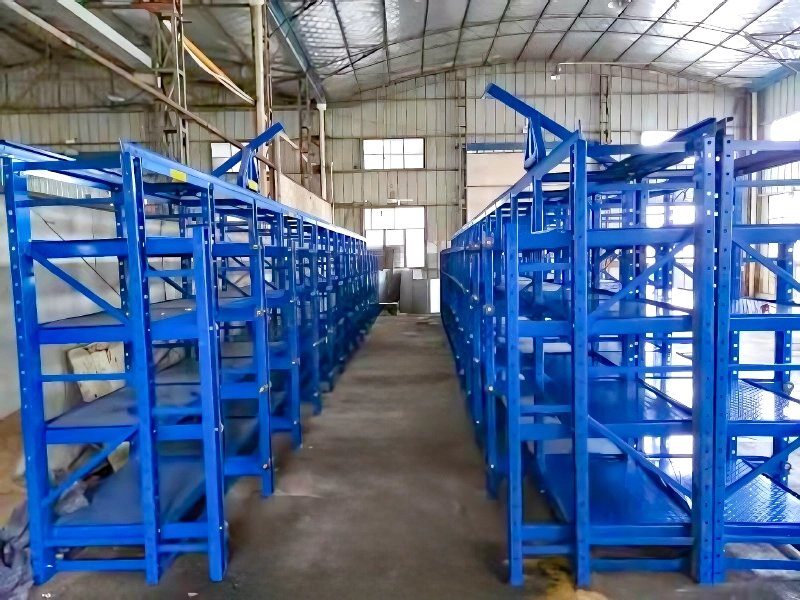
A 2-ton mold is not ordinary warehouse inventory. On the floor, it is difficult to identify, position, contain, and retrieve without bringing lifting equipment into a busy work area. Temporary pallets and forklift movements can also consume the aisle space needed for production traffic. The safer question is not simply where the mold fits, but how the mold will be supported, accessed, lifted, and returned every time.
A three-column mold rack with a sliding drawer can transform floor stacking into layered storage: extend a drawer fully, secure it with mechanical safety controls, and bring an overhead crane, chain hoist, or electric hoist vertically down to the mold. This approach can free up floor area and reduce manual handling, but it is only suitable where the rack is properly rated, anchored to hardened flooring, and compatible with an available overhead lifting path.
Why a 2-ton mold becomes a safety problem on the floor
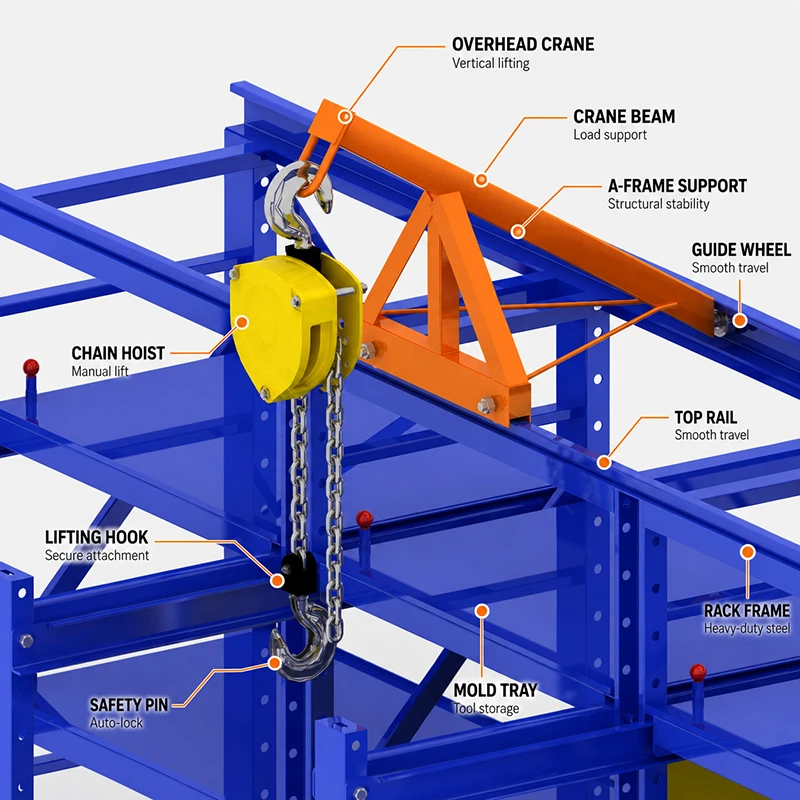
Two tons create more than a weight problem. A mold stacked on the floor can block forklift aisles, require repeated repositioning, and expose people to crushing, pinching, and uncontrolled movement hazards during retrieval. A general-purpose rack is also not automatically suitable: the support must account for load per level, drawer extension, center-of-gravity shift, and the lifting route. The Erack is specified from 0.5 to 3 tons per level, with project dimensions and shelf spacing selected around the actual mold inventory. This range is a design reference, not a permission to place an unverified 2-ton load on any configuration.
How full-extension drawers allow the overhead crane to replace manual pulling
The operation sequence is controlled, not improvised. First, confirm the mold weight, lifting points, drawer capacity, floor condition, and overhead crane or hoist capacity. Open only the intended drawer and use its safety pin and mechanical limit controls. The full-extension design exposes the mold so the overhead hook can approach vertically, rather than asking workers to drag or pry a two-ton tool out of a stack. Guide rails with bearings convert much of the sliding friction into rolling motion; optional pneumatic assistance can reduce the initial pulling force. The overhead crane performs the lift, while the drawer and rack provide the controlled storage position. Workers still need a site-specific lifting procedure and an exclusion zone.
How to free up forklift aisle space without creating a new hazard
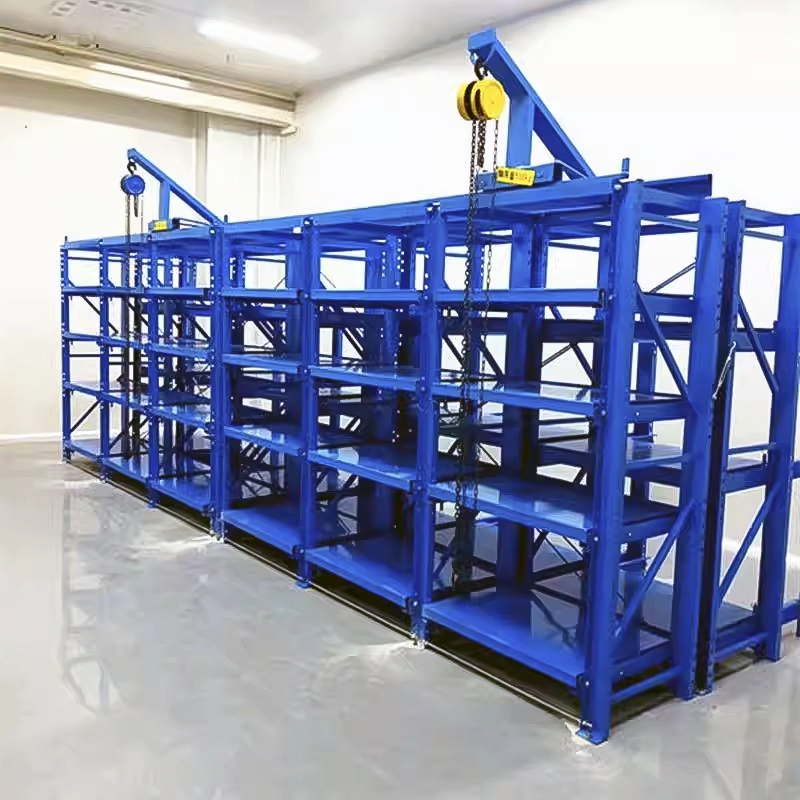
The space gain comes from using layered vertical bays instead of spreading molds across pallets and temporary floor locations. Arrange the bays against the planned work zone, keep the overhead crane travel path and hook approach unobstructed, and reserve a defined aisle for production traffic rather than using it as temporary storage. A rack row can be expanded with modular bays, but the final layout must be verified for drawer depth, mold dimensions, emergency access, forklift turning needs, and overhead crane clearance. The rack does not replace a forklift where forklifts are the correct method; it is a better fit when the facility already has overhead lifting infrastructure and the mold can be handled vertically.
When a sliding-drawer mold rack is the right choice — and when it is not
- Good fit: injection molding, stamping, automotive tooling, mold maintenance, and quick-change areas with hardened floors and a usable overhead crane, manual hoist, or electric hoist.
- Good fit: inventories with repeated retrieval, mixed mold sizes, and the need to keep heavy tools in identified, layered bays instead of on the production floor.
- Plan carefully: coastal, humid, or dusty workshops may require a specific corrosion protection review; confirm coating and maintenance requirements instead of assuming one finish suits all environments.
- Not suitable without redesign: facilities without overhead lifting equipment, inadequate floors, unknown weights or lifting points, insufficient overhead crane clearance, or the need for unverified capacity beyond the selected 0.5 to 3 tons per level range.
FAQ: safely storing 2-ton molds
What keeps a fully extended drawer from tipping the rack over?
The safety concept combines the three-column structure, guide rail control, mechanical limits, safety pins, rear bracing, and floor anchor bolts. These features control the drawer and the center-of-gravity shift; they do not eliminate the need for correct loading, anchoring, inspection, and a level hardened floor.
Can the rack be used without an overhead crane or hoist?
Do not specify this solution assuming workers can manually handle a 2-ton mold. The Erack is designed for vertical lifting after drawer extension. If the facility lacks a suitable overhead lifting path, send the mold weight, dimensions, lifting points, floor information, and retrieval method for a different safety configuration.
Precisa de uma Solução de Armazenamento Personalizada?
Fale diretamente com nossos engenheiros técnicos. Oferecemos projetos estruturais gratuitos, avaliações de catálogos de alta capacidade e orçamentos rápidos para B2B.
Solicite um Orçamento Agora →