
Sebox Collapsible Cage Pallet vs Cardboard Box | Selection Guide
Sebox
Compare cardboard boxes, rigid cages, and Sebox collapsible cage pallets for repeated circulation. See when cartons still make sense, when rigid cages waste return cube, and when a foldable steel stillage becomes more economical.
Cardboard boxes, rigid cages, or Sebox?
For a true one-way dispatch, cardboard can still be the right outer packaging. Once the same unit has to come back empty, be stacked, and move by forklift again and again, the cost logic changes.
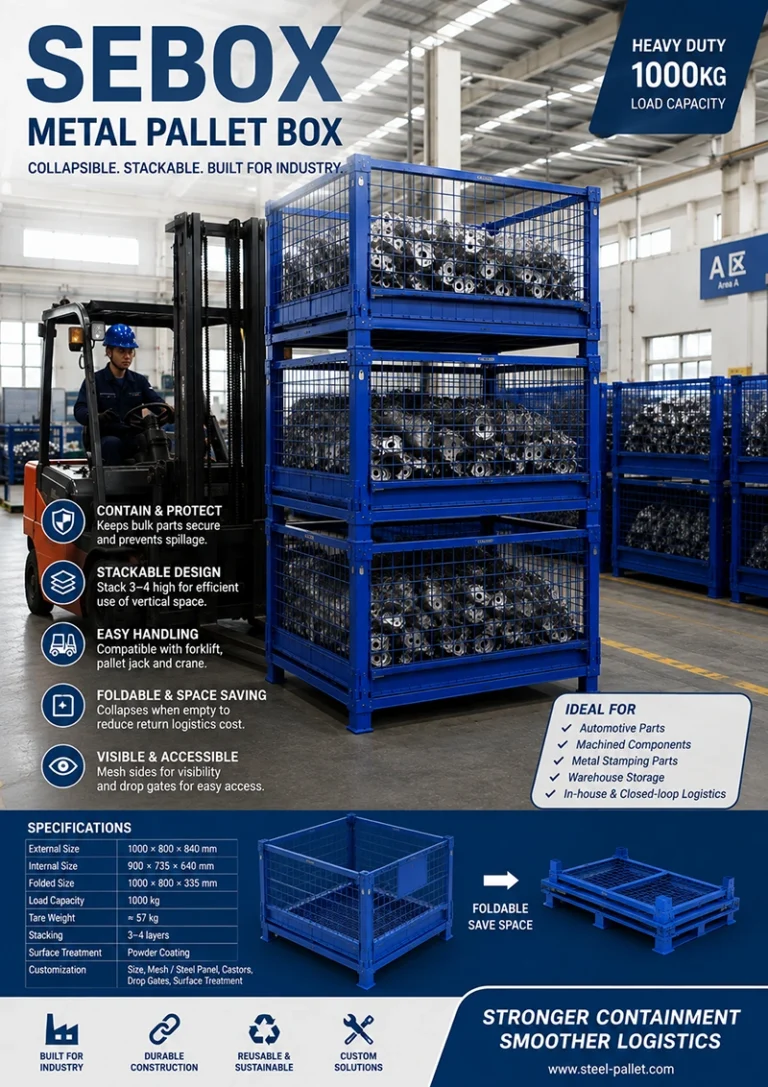
Sebox is a collapsible cage pallet for recurring circulation. It keeps heavy parts contained, supports visual inventory, stacks in use, and folds down when the loop returns. There is no universal break-even cycle count: the decision depends on part value, return distance, damage risk, and empty storage space.
- One-way shipping can still favor cartons.
- Repeated loops usually favor a reusable steel stillage.
- Fold-down return volume helps cut empty-trip cube.
- Forklift pockets and stackable frames suit plant logistics.
How the three options differ in real circulation
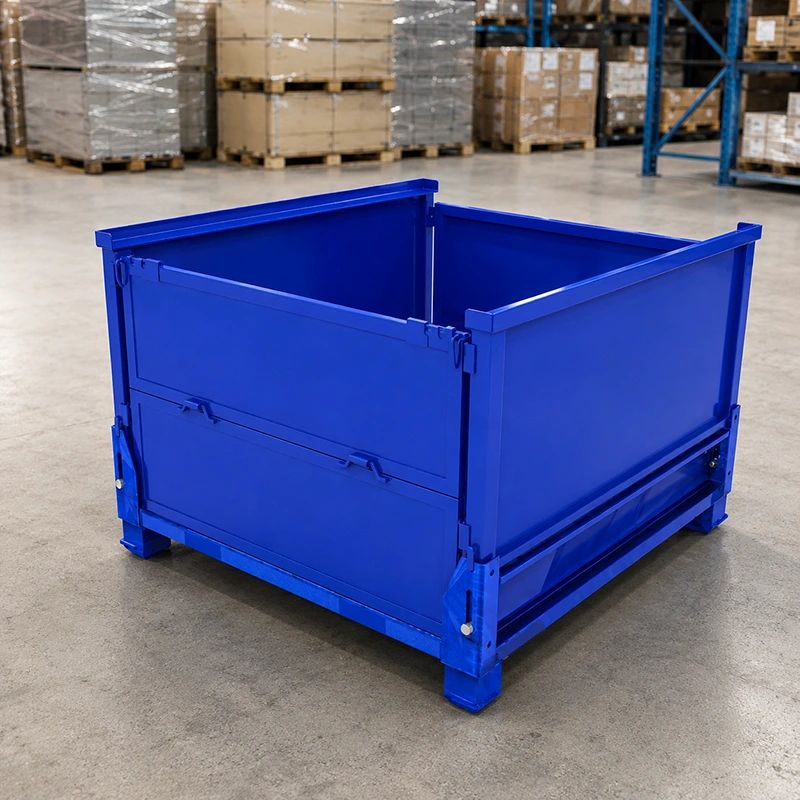
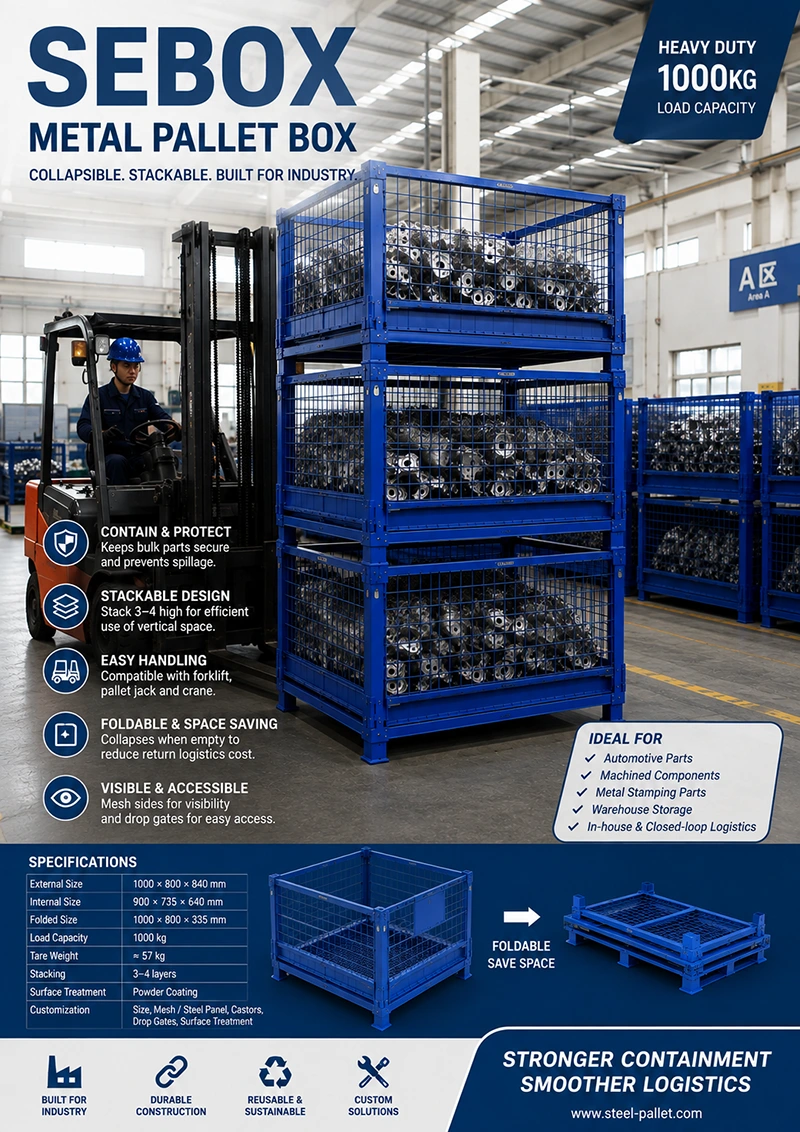
One-way carton route
Cardboard box
Still reasonable for a one-time shipment, low-return work, or light dry goods where the receiver will dispose of the outer packaging after receipt. It starts to fail when the same load has to survive repeated handling, moisture, crush pressure, and return trips.
- Best for one-way dispatch
- Low initial packaging effort
- Weak in repetitive loops
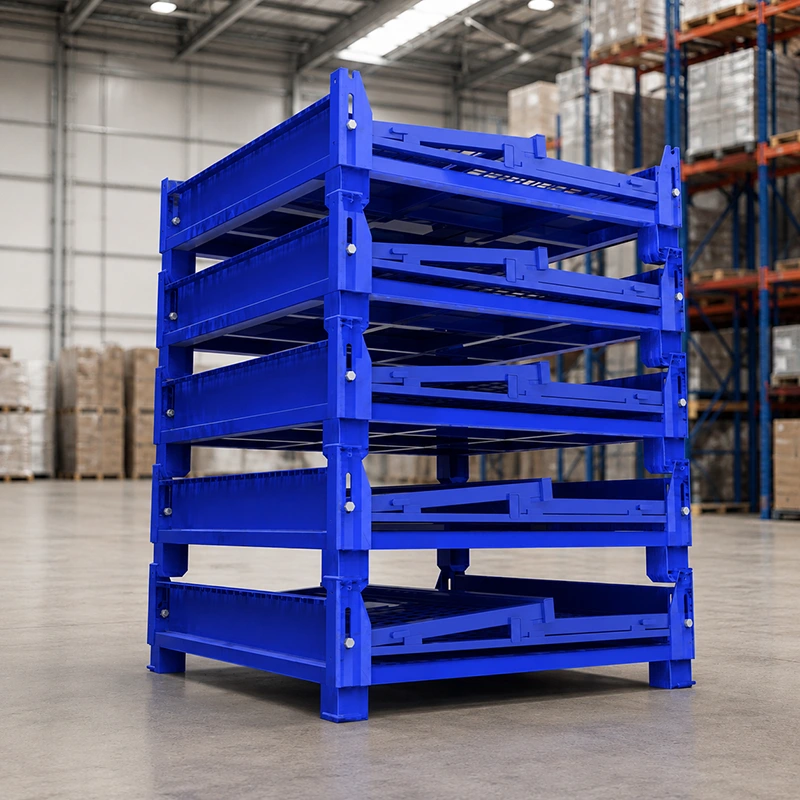
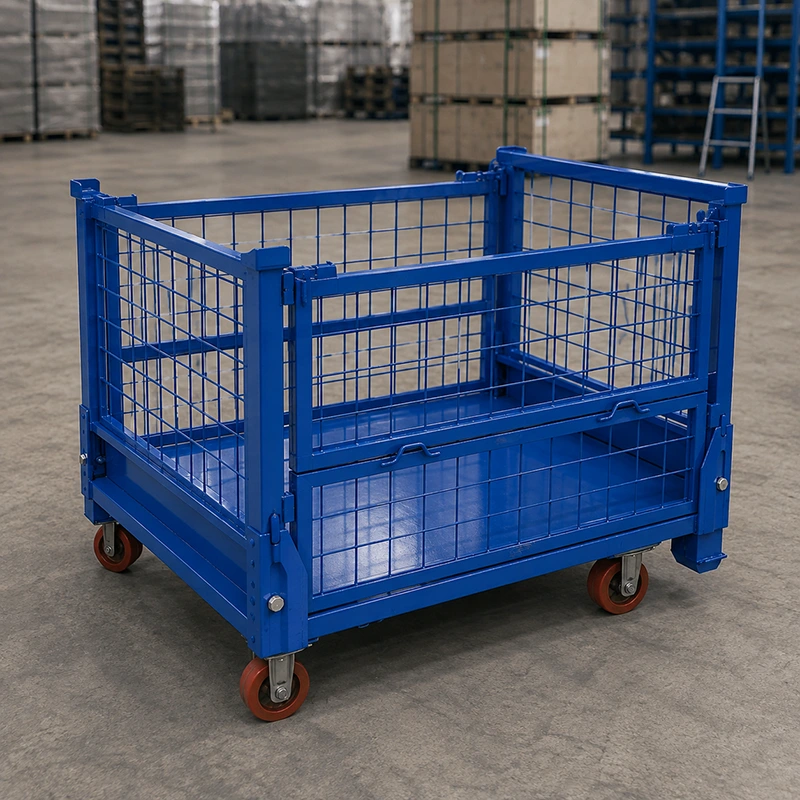
Rigid return container
Non-collapsible cage
Useful when the container stays in a closed loop and rigidity matters more than return efficiency. The trade-off is simple: every empty trip still carries the full outer volume, so backhaul and yard storage keep paying for the same cube.
- Strong but bulky on return
- Full-size empty backhaul
- Easy to inspect in use
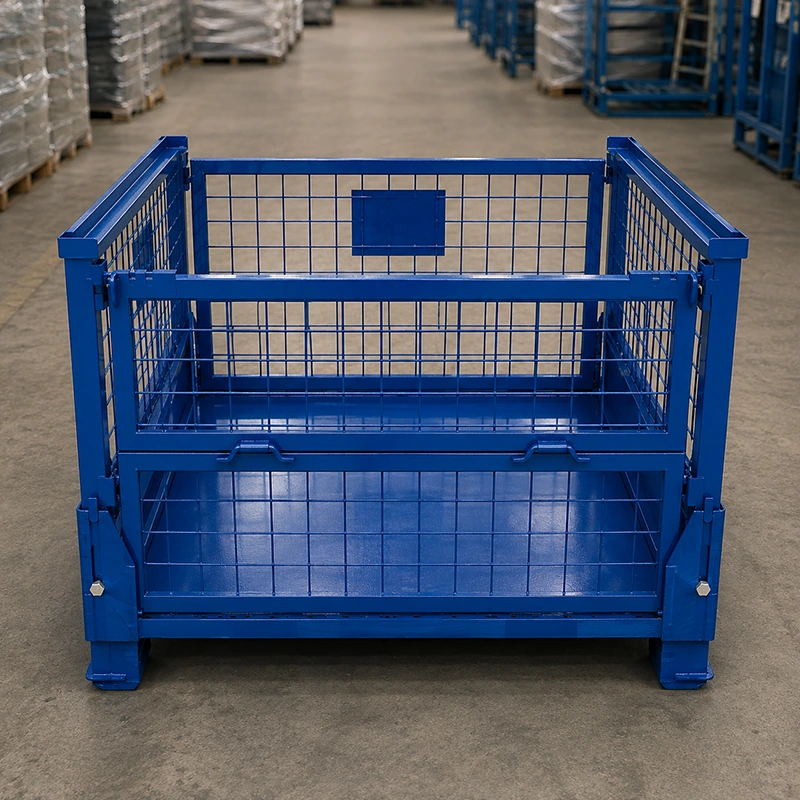
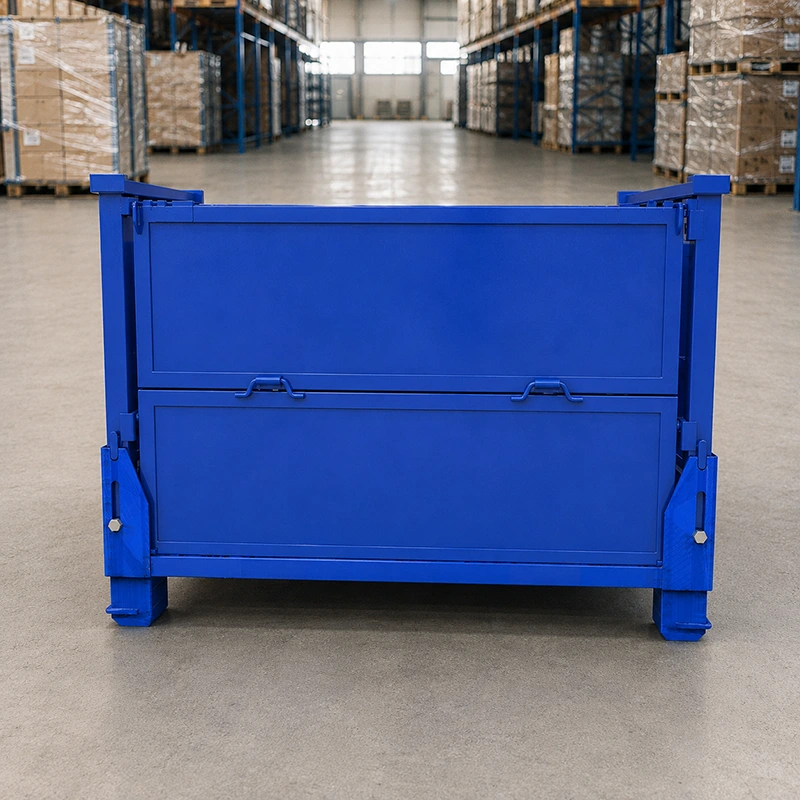
Sebox foldable loop
Sebox collapsible cage pallet
Use Sebox when the same unit circulates repeatedly and empty return cost starts to matter. The fold-down structure reduces return volume, stackability improves yard use, and the half-drop gate helps access parts even after stacking.
- Foldable for return trips
- Stackable in use
- Half-drop gate access
The economics improve when the container comes back
Less empty volume
When the container folds, the return trip and empty storage footprint shrink. That matters most when the same unit comes back after every delivery cycle.
Better part protection
Steel mesh or steel panel containment is more suitable than cartons for heavy, irregular, or sharp-edged parts that would otherwise crush or tear through disposable packaging.
Easier access in stack
Visible contents and a half-drop front gate help operators take parts without fully breaking down the stack, which reduces handling time in the warehouse or line-side buffer.
More stable circulation
Forklift pockets, stackable geometry, and a closed-loop steel frame make repeated plant-to-warehouse movement more predictable than a sequence of disposable cartons.
How to choose the right container path
Map the loop
Check whether the shipment is one-way, multi-trip, or a returnable circuit between plant, warehouse, and customer.
Check the load
Cartons fit light and dry goods better. Heavy parts, mixed metal items, and irregular shapes usually need a steel container with stronger containment.
Check the return cube
If empty return storage and transport are expensive, the ability to fold and stack becomes a material part of the decision.
Request the comparison sheet
Use your own cycle count, return distance, and part damage risk to compare carton, rigid cage, and Sebox side by side.
Questions buyers ask before switching
At what cycle frequency does Sebox become more economical?
There is no universal break-even number. The answer depends on part value, return distance, damage rate, and empty storage cost. In general, once packaging becomes a recurring loop rather than a one-way dispatch, a foldable steel stillage becomes easier to justify.
What is the empty return penalty of a rigid cage?
The full outer volume stays intact on every return trip, so backhaul and yard storage keep paying for the same footprint. That cost grows as circulation frequency rises.
Why does cardboard fail in repeated circulation?
Cartons are vulnerable to moisture, crush pressure, corner damage, and repeated handling. For heavy metal parts or frequent returns, the packaging degrades faster and the risk of part damage rises.
When should I still choose cardboard?
Use cardboard for one-way shipping, light dry goods, or projects where the carton is part of a single-use packing standard and there is no return loop. In those cases, a disposable box can still be the right fit.