
STBOX vs. MYBOX: How to Choose Between a Collapsible Mesh Cage and a Square-Tube Folding Box
Compare the STBOX collapsible mesh cage and the MYBOX square-tube folding box: load limits, loaded stacking, mesh vs. tube load path, finish, container utilization and cost per use.
STBOX vs. MYBOX: How to Choose Between a Collapsible Mesh Cage and a Square-Tube Folding Box
Both units fold, both hold material in batches and both move with standard handling equipment. The difference is structural: a mesh-based collapsible cage for one-time or limited use up to roughly one tonne, and a square-tube folding box for heavier loads, loaded stacking and repeated turnover.

The STBOX and MYBOX appear similar at first glance. Both are foldable storage products designed to organize material in batches, move with handling equipment and reduce their occupied space when they are not needed.
They are not interchangeable, however.
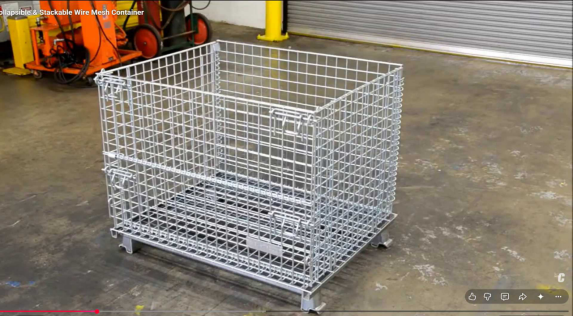
The STBOX is primarily a mesh-based collapsible cage. It is relatively light, folds into a low-profile package and offers strong container utilization, but its recommended load limit is approximately one tonne.
The MYBOX uses a square-tube supporting frame, including square-tube uprights for stacking. It is heavier and occupies more volume when folded, but provides greater structural capacity, better loaded-stacking performance and a longer working life under repeated turnover.
The selection therefore depends on more than unit price:
How much weight must the unit carry?
How many times will it be used?
Will it be stacked with material in place?
Will it be stored outdoors?
How will it be shipped?
Choose by load and use cycle first, then by environment, logistics and price. The STBOX is a practical one-time or short-term solution; the MYBOX is the stronger option for heavy loads and repeated turnover.
1. Comparison at a Glance
| Comparison Factor | STBOX | MYBOX |
|---|---|---|
| Product type | Collapsible mesh cage | Square-tube folding box |
| Body construction | Predominantly wire-mesh panels | Mesh panels supported by a square-tube frame |
| Primary structural members | Mesh body, mesh-panel edges and base structure | Square-tube frame, including square-tube stacking uprights |
| Surface finish | Electroplated or galvanized-type finish, as described in the video | Powder-coated finish as standard |
| Manufacturing approach | More standardized production | Greater structural complexity |
| Unit weight | Lighter | Heavier |
| Unit-price statement in the presentation | Stated to have a higher unit price than MYBOX | Stated to have a lower unit price than STBOX |
| Recommended single-unit load | Approximately 1 t | Recommended for loads above approximately 1 t |
| Resistance to loaded stacking | Lower; the mesh can be the limiting element | Higher; square-tube uprights carry the stacked load |
| Empty stacking | Three levels demonstrated | Structurally better suited to stacking |
| Folded profile | Low and flat | Relatively tall even after folding |
| Units per 40 ft container | Approximately 360 | Approximately 160 |
| Outdoor corrosion performance | Better with the finish described in the presentation | Lower with the standard powder-coated finish |
| Intended reuse | One-time or limited-use applications | Repeated turnover and longer-term use |
| Best-fit application | Temporary storage, delivery staging and volume shipment | Heavy loads, frequent turnover and loaded stacking |
The approximately 1 t figure is the practical limit stated in the product-comparison presentation, not a certified load rating. The container quantities are also presentation references. Actual capacity and loading quantity must be confirmed through approved drawings, test reports and a container-loading plan.
2. Avoiding the Most Common Inquiry Error
The first practical issue is not structural—it is product identification.
Customers frequently use “cage,” “folding box” and similar everyday descriptions without distinguishing the catalogue products. The presentation describes two recurring situations:
| Inquiry Situation | Result |
|---|---|
| The customer needs a MYBOX but describes the requirement as a “hamster cage” | The inquiry may be interpreted as an STBOX request |
| The customer needs an STBOX but attaches a MYBOX image | The image may lead the supplier to quote the wrong product |
| The customer uses the everyday term but not the official product name | Product identification depends entirely on interpretation |
| The load requirement is not confirmed in writing | The supplier may recommend a product that cannot meet the actual application |
| An incorrect product is quoted | Unnecessary drawing, sampling, manufacturing and freight costs may be incurred |
Both products can reasonably be described as foldable storage boxes. A product name alone therefore does not always eliminate ambiguity.
Recommended Inquiry Confirmation
| Information to Confirm | Why It Matters |
|---|---|
| Intended load per unit | Usually the primary structural selection criterion |
| Expected number of uses | Determines whether economy or service life should control the decision |
| Whether loaded units will be stacked | Changes the governing structural requirement |
| Indoor or outdoor use | Influences the corrosion-protection decision |
| Folded and assembled dimensions | Confirms the site and container fit |
| Actual product photograph | Allows visual confirmation of the intended item |
| Shipping destination and method | Influences the delivered cost per unit |
A Simple Quotation-Control Practice
Every quotation should include:
an image of the product being quoted;
the confirmed load requirement;
the expected reuse cycle;
the intended stacking condition;
the selected finish;
and a short written confirmation of the customer’s product terminology.
In this product family, a photograph in the quotation can be more useful than the product name in the description.

3. The Structural Difference Behind the Different Performance
The load, stacking, weight and service-life differences between the products are not separate design choices. They all follow from the basic structural difference.
3.1 STBOX: A Mesh-Based Body
The STBOX is formed primarily from mesh panels. Its structure relies on the mesh body, its edge members and the base frame.
| STBOX Structural Aspect | Description |
|---|---|
| Main body | Wire-mesh panels |
| Load-carrying body | Primarily the mesh and its perimeter members |
| Base | Structural base frame supporting the loaded cage |
| Stacking support | Mesh-based structure and the dedicated stacking corner |
| Overall structural character | Lightweight and standardized, with lower capacity than the square-tube version |
| Main limitation under high load | Mesh-panel deformation and reduced stacking rigidity |
The mesh body provides a practical enclosure at relatively low weight. It is effective when the load remains within the application limit and the product is not required to support a heavily loaded stack.
3.2 MYBOX: A Square-Tube Frame Supporting Mesh Panels
The MYBOX also contains mesh panels, but those panels are supported by square tubes.
| MYBOX Structural Aspect | Description |
|---|---|
| Main body | Mesh panels retained within a square-tube supporting frame |
| Side frame | Square-tube members rather than mesh alone |
| Stacking uprights | Square-tube columns |
| Load-carrying path | Primarily through the tube frame and into the base |
| Overall structural character | Heavier, stiffer and better suited to high loads and repeated handling |
| Main benefit | More capacity and better resistance to deformation under stacked loads |
The square-tube frame makes the product more capable in three connected ways:
| Effect of the Square-Tube Frame | Engineering Consequence |
|---|---|
| The frame carries the load instead of relying mainly on the mesh | Higher load capacity |
| Square-tube uprights receive the stacked load | Better loaded-stacking performance |
| More material is used in the supporting structure | Greater unit weight, but improved durability and service life |
The stronger MYBOX is not a heavier version of the STBOX. It uses a different load path.
3.3 Direct Structural Comparison
| Structural Factor | STBOX | MYBOX |
|---|---|---|
| Mesh enclosure | Yes | Yes |
| Square-tube supporting members | Limited to selected structural areas | Used throughout the main frame |
| Square-tube stacking columns | No | Yes |
| Principal load path | Mesh and edge structure | Square-tube frame and base |
| Unit weight | Lower | Higher |
| Resistance to local mesh deformation | Lower | Higher |
| Loaded-stacking performance | Limited | Better |
| Resistance to repeated handling | Lower | Higher |
| Folded volume | Lower | Higher |

4. Load Capacity Is the Primary Selection Criterion
The presentation was explicit: the required load is the fundamental factor that determines which product should be used.
4.1 The STBOX’s Practical Load Limit
The STBOX is described as having a limit of approximately one tonne.
| Load Condition | Recommended Response |
|---|---|
| Load at or below approximately 1 t | STBOX may be suitable, subject to the approved product rating and operating condition |
| Load above approximately 1 t | Use the MYBOX |
| A manufacturer publishes an STBOX capacity of 1.5 t | Do not rely on that figure without engineering verification |
| The customer expects to load close to 1.5 t | Select the MYBOX |
| The actual load is uncertain or varies significantly | Use the MYBOX or obtain a project-specific structural assessment |
The presentation advises against routinely loading the STBOX above approximately one tonne, even when a higher capacity appears in other product information.
This distinction is important. A stated capacity and a recommended operating limit are not necessarily the same thing.
| Capacity Concept | Meaning |
|---|---|
| Manufacturer’s published maximum | The highest load supported by the approved test or structural model under specified conditions |
| Recommended operating limit | The load range the manufacturer considers appropriate for reliable service |
| Stacked-load limit | The combined load carried through the lower cage and its mesh structure |
| Customer’s actual requirement | Must include the maximum normal load, handling shock and any stacking contribution |
For the STBOX, the approximately 1 t figure should be treated as a selection guideline unless supported by a current, product-specific engineering document.
4.2 Why the MYBOX Is Used Above the STBOX Range
The MYBOX is the appropriate product when the load exceeds the STBOX’s recommended range.
| Customer Requirement | Why the MYBOX Fits |
|---|---|
| Load above approximately 1 t | The square-tube frame carries the load rather than relying mainly on the mesh |
| Loaded units are stacked | The square-tube uprights provide the primary stacked-load path |
| The unit will be moved repeatedly | Greater stiffness supports more handling cycles |
| The product is intended for long-term turnover | A more robust structure supports a longer service life |
| The application cannot tolerate mesh deformation | The frame limits the deformation mechanism associated with the STBOX |
4.3 A Practical Selection Rule
| Maximum Normal Load | Preferred Product | Qualification |
|---|---|---|
| Up to approximately 1 t | STBOX | Confirm the actual configuration, stacking condition and approved rating |
| Above approximately 1 t | MYBOX | Confirm the specific MYBOX rating for the selected configuration |
| Load varies between light and heavy | MYBOX | Greater margin is preferable when the operating range is uncertain |
| Published rating conflicts with the recommended limit | MYBOX | Follow the more conservative application guidance unless formally engineered otherwise |

5. Stacking: Empty Units and Loaded Units Are Different Conditions
The STBOX can be stacked, but the video draws a clear distinction between an empty stack and a loaded stack.
5.1 Empty Stacking
An empty STBOX stack was demonstrated at three levels.
| Stacking Condition | Recorded Observation |
|---|---|
| Empty units | Three-level stack demonstrated |
| Stacking interface | The stacking corner is positioned on the upper mesh surface of the unit below |
| Demonstration purpose | Shows that the units can be nested and accumulated in the empty state |
| Limitation | It does not prove that the same stack can carry the same load in every level |
5.2 Loaded Stacking
When the units contain material, the load from every level above is transferred through the lower unit’s mesh structure.
| Loaded-Stack Condition | Requirement |
|---|---|
| Combined payload carried by the bottom unit | Should not exceed approximately 1 t |
| Number of loaded levels | One, two or more may be possible, provided the combined load remains within the limit |
| Payload above approximately 1 t | The side mesh panels may deform |
| Continued loading after visible deformation | Progressive deformation and collapse risk increase |
| Practical response | Reduce the stack height, reduce the load or change to the MYBOX |
The number of levels alone does not determine whether the stack is acceptable. The combined weight carried by the bottom unit is the controlling factor.
| Example | Combined Payload Above Bottom Unit | Result |
|---|---|---|
| Three levels with 300 kg in each upper level | 600 kg | Within the approximately 1 t guideline |
| Three levels with 400 kg in each upper level | 800 kg | Within the approximately 1 t guideline, subject to formal verification |
| Three levels with 500 kg in each upper level | 1,000 kg | At the approximate limit; no additional margin |
| Three levels with 600 kg in each upper level | 1,200 kg | Exceeds the guideline; use MYBOX or reduce the load |
| One heavily loaded level above two lighter levels | Calculate the actual combined load | Do not approve based only on the heaviest individual level |
These examples illustrate the calculation rather than establish additional certified capacities.
5.3 Why the Mesh Becomes the Weakest Element
The MYBOX uses square-tube uprights as the primary stacking columns. In the STBOX, the stacked load eventually passes through the mesh structure.
| Consideration | STBOX | MYBOX |
|---|---|---|
| Element receiving stacked load | Mesh-based structure | Square-tube uprights |
| Likely deformation mode | Compression or distortion of side mesh | Higher structural rigidity |
| Result of excessive load | Mesh deformation and possible stack instability | Greater margin, subject to the approved MYBOX rating |
| Selection implication | Keep combined stacked load within the stated limit | Use for heavier or variable stacked loads |
A stack should be treated as one structure, not as a group of cages that each retain their individual capacity.
5.4 Required Stacking Precautions
The following are operating recommendations based on the application described in the video:
inspect the lower unit before adding material above it;
do not place material on visibly deformed mesh;
keep the stack level;
distribute loads evenly;
confirm that the stacking corners are correctly located;
do not exceed the approved number of levels;
calculate the combined payload above the bottom unit;
and remove the load if mesh deformation or instability appears.
6. Surface Finish and Outdoor Performance
The STBOX uses an electroplated or galvanized-type surface treatment, while the MYBOX is described as having a powder-coated finish as standard.
| Finish Aspect | STBOX | MYBOX |
|---|---|---|
| Standard finish described in the video | Electroplated or galvanized-type finish | Powder coating |
| Corrosion performance outdoors | Better in the comparison presented | Lower with the standard powder-coated finish |
| Appearance | Functional metallic finish | Decorative powder-coated appearance |
| Coating a MYBOX with the same corrosion-protection treatment | Not applicable | Would increase the product cost |
| Maintenance exposure | Lower expectation in the stated outdoor application | Greater exposure to coating damage and corrosion |
| Selection impact | Favorable for outdoor or exposed storage | Requires additional protection if used outdoors |
The presentation’s preference for the STBOX outdoors is based on its corrosion performance and the cost of applying a comparable corrosion-protection treatment to the MYBOX.
Important Specification Note
The video describes the STBOX finish as “electroplated” and also presents it as a galvanized-type corrosion-protection solution. These terms should not be treated as interchangeable without checking the released product specification.
The following information should be confirmed before contractual use:
| Specification Item | Why It Matters |
|---|---|
| Exact coating process | Electroplating and hot-dip galvanizing are different processes |
| Minimum coating thickness | Determines the actual protection margin |
| Relevant coating standard | Defines inspection and acceptance requirements |
| Salt-spray or accelerated-corrosion evidence | Supports performance claims |
| Expected outdoor service life | Depends on the environment as well as the coating |
| Surface-condition acceptance | Controls visible consistency and rejected areas |
The selection logic in the video is valid, but the exact finish specification must be confirmed before it is used as a contractual comparison.
7. Container Utilization and Freight Economics
The most significant commercial difference between the products is the volume required for shipment.
7.1 The Folded Profiles
| Packing Characteristic | STBOX | MYBOX |
|---|---|---|
| Folded appearance | Low and flat | Flat arrangement but still relatively tall |
| Square-tube uprights in folded package | Not applicable in the same way | Continue to contribute significant folded height |
| Container-volume utilization | High | Lower |
| Freight allocation per unit | Favorable | Less favorable |
| Handling and unloading | More compact packages | Larger and taller packages |
The lower folded profile of the STBOX means that more units can be placed in the same container.
7.2 Reference Container Quantities
The presentation gives the following corrected comparison for a 40 ft container:
| Container | STBOX Quantity | MYBOX Quantity | Difference |
|---|---|---|---|
| 40 ft container | Approximately 360 units | Approximately 160 units | Approximately 200 additional STBOX units |
The presenter initially miscalculated the MYBOX quantity as approximately 80 units and corrected it during the session to approximately 160 units.
These figures are useful for understanding the scale of the packaging difference, but they should not be used as guaranteed contractual loading quantities.
| Factor Affecting Actual Loading Quantity | Effect |
|---|---|
| Exact folded dimensions | Determines how many units can be arranged |
| Packing method | Changes the usable container volume |
| Protection and wrapping | May alter the final package dimensions |
| Container type and internal dimensions | Affects usable height and length |
| Loading sequence and restraint method | Influences whether all units can be safely packed |
| Palletized or unpacked shipment | Changes the available loading pattern |
| Transport route and destination limits | May reduce the theoretical maximum |
The final quantity must be confirmed through an approved container-loading plan.
7.3 Freight-Cost Consequence
| Metric | STBOX | MYBOX |
|---|---|---|
| Units per demonstrated 40 ft container | Approximately 360 | Approximately 160 |
| Containers required for the same order | Fewer | More |
| Freight allocated per unit | Lower | Higher |
| Number of separately handled packages | Potentially greater per container, but concentrated in fewer containers | Greater package volume and more containers |
| Exposure to freight-rate changes | Lower for the same order | Higher |
| Destination unloading | Compact packages are easier to distribute | Larger packages require more handling space |
For an export order, container utilization may be as commercially important as the ex-works unit price.
A product that occupies substantially less container volume can have a lower delivered cost per usable unit even when its individual unit price is not the lowest.
8. One-Time Use Versus Repeated Turnover
The number of times a product will be used determines whether the lower delivery cost of the STBOX or the longer service life of the MYBOX is more valuable.
8.1 One-Time or Limited Use
The STBOX is suited to a product that is loaded, delivered and then removed from service.
| One-Time-Use Condition | Why the STBOX Fits |
|---|---|
| Temporary storage during a single delivery | No long-term reuse benefit is required |
| Material is packed once and shipped | Compact transport and handling are decisive |
| The cage leaves the customer with the product | Replacement is outside the customer’s operating cycle |
| Low or moderate payload | The load remains within the recommended range |
| Material is not expected to be returned | Longer structural durability has limited financial value |
8.2 Repeated Turnover
The MYBOX is preferred when the same unit will move through the customer’s operation repeatedly.
| Repeated-Turnover Condition | Why the MYBOX Fits |
|---|---|
| The boxes return to the workshop after each delivery | The initial purchase cost is spread across multiple uses |
| Frequent loading and unloading | The square-tube frame tolerates repeated handling better |
| Long-term work-in-progress storage | Service life becomes more important than minimum shipping volume |
| Loaded stacking | The square-tube uprights provide the stronger stacked-load path |
| Variable load conditions | Greater structural margin is preferable |
| Customer wants a calculable ownership cost | A longer life reduces the expected replacement cost |
8.3 The Replacement Arithmetic
The presenter uses hardware-processing operations as an example. He notes that an STBOX may fail after only a small number of uses. While this is not a guaranteed service life, it illustrates why a one-time product may be uneconomical for repeated turnover.
| Product | Expected Use Pattern | Cost Consequence |
|---|---|---|
| STBOX | Used once or for only a small number of cycles | Low initial and delivered cost can justify the selection |
| STBOX | Required for repeated turnover | Early replacement may erase its initial economy |
| MYBOX | Used repeatedly over a longer period | Higher initial cost is distributed across more uses |
| MYBOX | Used only once | Additional structural cost may not deliver a useful return |
A simple lifecycle comparison can be expressed as:
Cost per use = purchase cost + freight allocation + handling cost + expected replacement cost + maintenance cost, divided by the number of expected uses.
| Comparison Method | Question Answered |
|---|---|
| Ex-works price only | How much does one unit cost before shipping? |
| Delivered cost per unit | What does one usable unit cost at the customer’s site? |
| Cost per expected use | Which product provides the better economic result over the intended cycle? |
The third method is the most relevant when comparing the STBOX and MYBOX for a recurring operation.
9. The Unit-Price Statement Must Be Read Carefully
The presentation contains an important distinction that should not be simplified into “STBOX is cheaper.”
| Comparison Point | Source Statement | Correct Interpretation |
|---|---|---|
| Unit price | The STBOX is stated to have a higher unit price than the MYBOX | Do not describe the STBOX as having a lower ex-works price |
| Manufacturing | The STBOX is described as more standardized | Supports repeatability and production efficiency |
| Unit weight | The STBOX is lighter | Benefits transport and handling |
| Freight | Approximately 360 STBOX units versus approximately 160 MYBOX units per 40 ft container | Can materially reduce freight allocated per delivered unit |
| Corrosion protection | The STBOX has better outdoor performance in the stated comparison | Reduces replacement exposure in suitable outdoor applications |
| Overall economics | The STBOX is presented as more economical for the described use cases | The conclusion concerns the complete application, not simply the purchase order |
The commercially correct way to express this is:
The STBOX may have a higher individual unit price, while its total delivered cost per usable unit can be lower in the applications described because of manufacturing efficiency, freight efficiency and reduced replacement exposure.
Delivered-Cost Comparison
| Cost Element | STBOX | MYBOX |
|---|---|---|
| Ex-works unit price | Higher in the source comparison | Lower in the source comparison |
| Manufacturing consistency | Higher | More complex |
| Unit weight | Lower | Higher |
| Folded shipping volume | Lower | Higher |
| Freight per delivered unit | Lower | Higher |
| Containers for the same order | Fewer | More |
| Expected replacement exposure | Higher for repeated use | Lower for repeated use |
| Best overall position for one-time use | Strong | Less advantageous |
| Best overall position for repeated use | Less advantageous | Strong |
A formal quotation comparison should therefore include the delivered cost, expected use cycle and replacement assumption—not only the ex-works price.
10. A Practical Selection Method
Step 1: Confirm the Maximum Normal Load
| Maximum Load | Direction |
|---|---|
| Up to approximately 1 t | STBOX may be suitable |
| Above approximately 1 t | MYBOX |
| Uncertain or variable | MYBOX or project-specific verification |
Step 2: Count the Expected Use Cycles
| Expected Use | Direction |
|---|---|
| One delivery or temporary staging | STBOX |
| A small number of uses | STBOX may remain economical |
| Frequent and repeated turnover | MYBOX |
| Long-term recurring use | MYBOX |
Step 3: Identify the Stacking Condition
| Stacking Condition | Direction |
|---|---|
| Empty units only | Either, subject to the approved stack configuration |
| Loaded units above approximately 1 t in total | MYBOX |
| Loaded stack close to the STBOX limit | Use conservatively and verify formally |
| Any doubt about mesh deformation | MYBOX |
Step 4: Match the Environment
| Environment | Direction |
|---|---|
| Outdoor or exposed storage | STBOX is preferred in the source comparison |
| Indoor warehouse | Either product may be suitable |
| Humid or coastal exposure | Verify the actual coating specification and maintenance requirements |
| Short-term project use | STBOX |
| Permanent high-turnover position | MYBOX |
Step 5: Compare Delivered Economics
| Commercial Factor | Preferred Option |
|---|---|
| Large export order | STBOX, subject to verified loading quantity |
| Remote or freight-sensitive destination | STBOX |
| Local delivery with low freight | MYBOX may be competitive |
| One-time use | STBOX |
| Repeated use with measurable replacement cost | MYBOX |
11. Selection Matrix
| Customer Requirement | Recommended Product | Reason |
|---|---|---|
| Load up to approximately 1 t | STBOX | Within the stated recommended range |
| Load above approximately 1 t | MYBOX | Square-tube frame provides the higher load path |
| One-time delivery staging | STBOX | Low delivered cost and compact export volume are decisive |
| Temporary storage during a single project | STBOX | Minimal reuse expected |
| Frequent turnover | MYBOX | Greater structural durability and service life |
| Repeated loaded stacking | MYBOX | Square-tube uprights carry the stacked load |
| Outdoor storage | STBOX | Better corrosion performance in the stated comparison |
| Volume export shipment | STBOX | Approximately 360 units per 40 ft container in the reference |
| Remote destination with high freight | STBOX | Freight is distributed across more compact units |
| Long-term fixed material-handling point | MYBOX | Lifecycle cost replaces initial price as the main factor |
| Combined stacked payload above approximately 1 t | MYBOX | STBOX mesh deformation and collapse risk |
| Load uncertain or variable | MYBOX | Larger structural margin is preferable |
| Published STBOX figure of 1.5 t | Do not rely on it without verification | The presentation recommends approximately 1 t as the safer limit |
12. Application Example: Machined Parts in Hardware Processing
The presentation uses hardware-processing operations to show why the two products can be appropriate for the same general application but different operating cycles.
12.1 Temporary Staging and Delivery
| Situation | Description | Recommended Product |
|---|---|---|
| Machined parts are temporarily stored | The product is loaded for a limited period | STBOX |
| The load requirement is moderate | The parts do not require the heavier square-tube structure | STBOX |
| The box travels with the finished delivery | The customer will not return it for reuse | STBOX |
| The unit is required only once | No replacement calculation is necessary | STBOX |
In this scenario, investing in a longer-life MYBOX may not produce a corresponding operating benefit.
12.2 Recurring Work-in-Process Turnover
| Situation | Description | Recommended Product |
|---|---|---|
| Machined parts return to storage after each delivery | The same unit is used repeatedly | MYBOX |
| The customer calculates replacement cost | Product life becomes part of the ownership model | MYBOX |
| The boxes are loaded and unloaded frequently | Repeated handling becomes the governing condition | MYBOX |
| A heavier load may be added in future | The product needs more structural reserve | MYBOX |
The central question is simple:
Is the customer buying a container for one shipment, or buying equipment for repeated handling cycles?
13. Information Required for a Defensible Selection
| Required Information | Why It Matters |
|---|---|
| Maximum material weight per unit | Determines whether the STBOX load range is acceptable |
| Load distribution | Concentrated and distributed loads affect the structural response differently |
| Expected number of use cycles | Determines the relative value of service life |
| Whether units will be stacked with material | Changes the governing structural requirement |
| Maximum loaded stack height | Establishes the load carried by the bottom unit |
| Indoor or outdoor environment | Determines the required corrosion protection |
| Exact coating specification | Avoids assuming equivalent protection from different processes |
| Assembled dimensions | Confirms site fit |
| Folded dimensions | Determines packing and container utilization |
| Container type and packing method | Confirms the actual number of units per shipment |
| Destination and freight method | Influences delivered cost per unit |
| Forklift or handling-equipment compatibility | Ensures the product can be moved safely |
| Maintenance and inspection requirements | Supports reliable long-term use |
| Expected disposal or return method | Completes the lifecycle-cost calculation |
14. Recommended Operating Safeguards
| Area | Recommended Practice |
|---|---|
| Load identification | Display the approved load limit in a visible location |
| Mixed materials | Confirm that the heaviest permitted combination has been considered |
| Stack inspection | Inspect the lowest unit before adding material above it |
| Mesh deformation | Remove the load and investigate; do not continue using visibly deformed mesh |
| Stacking height | Follow the approved maximum and do not extrapolate from an empty-stack demonstration |
| Surface protection | Avoid damaging the coating during loading, unloading and transport |
| Outdoor use | Follow the specified inspection and maintenance schedule |
| Replacement planning | Record actual use cycles and failures for future quotations |
| Container loading | Use the approved loading plan rather than relying only on the reference quantity |
| Product identification | Include the correct product image in the purchase order and packing list |
15. Seven Lessons from the Comparison
1. The Load Requirement Usually Decides the Product
Most selection questions can be settled quickly. If the load exceeds approximately one tonne, the MYBOX is the appropriate direction.
2. The Stack Is One Structure
A lower cage carries all the payload above it. Applying the single-unit rating to every level is a serious selection error.
3. The Structural Difference Explains the Performance
The square-tube frame is why the MYBOX offers greater load capacity, better loaded stacking and longer service life. The mesh body is why the STBOX is lighter and more compact for transport.
4. Container Utilization Is Part of the Product
The difference between approximately 360 and 160 units in a 40 ft container can materially change freight allocated per unit and the total cost at the customer’s site.
5. Surface Finish Matters for Outdoor Service
The corrosion-protection system affects both initial suitability and expected replacement cost.
6. Match the Product to the Number of Uses
A one-time-use STBOX can be highly economical. A STBOX repeatedly replaced for a recurring operation may cost more than a MYBOX used for the same period.
7. Compare Delivered Cost, Not Only Unit Price
The source comparison describes the STBOX as having a higher unit price but better overall economics in its intended scenarios. The quotation should therefore compare the complete delivered and lifecycle cost.
16. Where Each Product Applies
| Application Area | More Suitable Product | Reason |
|---|---|---|
| Temporary storage of machined parts | STBOX | One-time or limited-use application |
| Delivery and distribution staging | STBOX | The unit leaves the site with the shipment |
| General indoor storage with light material | STBOX | Within the recommended load range |
| Outdoor storage | STBOX | Better corrosion performance in the source comparison |
| Export orders with high freight sensitivity | STBOX | Favorable container utilization |
| Production work-in-progress with regular turnover | MYBOX | Greater durability under repeated handling |
| Components heavier than approximately 1 t | MYBOX | Square-tube frame carries the load |
| Loaded stacking | MYBOX | Square-tube uprights provide the stronger load path |
| Long-term fixed handling positions | MYBOX | Service life dominates lifecycle economics |
Conclusion
The STBOX and MYBOX are often compared by appearance or unit price, but those are not the best starting points. Their structures determine how they should be used.
The STBOX: Lightweight, Compact and Suited to Short-Term Use
The STBOX is built predominantly from mesh panels and folds into a low-profile package. In the product comparison, approximately 360 units fit into a 40 ft container, compared with approximately 160 MYBOX units.
Its recommended single-unit load is approximately one tonne. When loaded units are stacked, the combined payload carried by the bottom cage should not exceed that approximate limit. Above it, the side mesh may deform and create a collapse risk.
The STBOX uses an electroplated or galvanized-type finish that gives it better outdoor corrosion performance than the standard powder-coated MYBOX in the application discussed.
The MYBOX: Stronger for Heavy Loads and Repeated Turnover
The MYBOX uses square tubes to support its mesh panels and to form its stacking uprights. This gives it:
a higher practical load range;
better loaded-stacking performance;
greater resistance to deformation;
and a longer working life under repeated handling.
Although it folds, the square-tube structure leaves the MYBOX considerably taller in its folded state, reducing container utilization.
The Final Selection Rule
| Requirement | Preferred Product |
|---|---|
| Load up to approximately 1 t, one-time or limited use, compact export shipment | STBOX |
| Load above approximately 1 t, repeated turnover, heavier or loaded stacking | MYBOX |
The practical rule from the presentation is straightforward:
Choose by required load first. Then decide whether the product needs to survive one shipment or many turnover cycles. The lower delivered cost of the STBOX is valuable for short-term use; the stronger and longer-lived MYBOX becomes more economical when the boxes are used repeatedly.
Send us the maximum load per unit, how many times the container will be reused, whether loaded units are stacked, and the shipping destination. We will confirm the STBOX or MYBOX direction, the applicable finish and the loading plan against your operation — and reply with a quotation that compares delivered cost, not only unit price. Request a STBOX / MYBOX Quotation