
For export movers, overseas plants, and projects that need a return loop, freight savings do not come from a slogan. They come from the structure. When a steel stillage nests tightly when empty, the same unit helps you on the outbound leg, the return leg, and the warehouse reset in between.
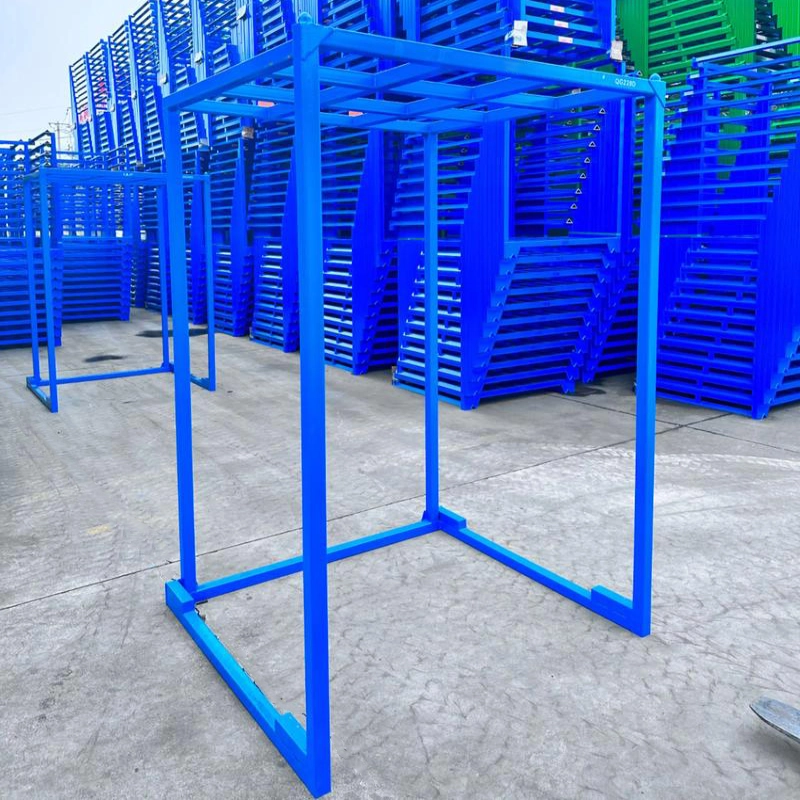
Why nesting changes the freight math
Most buyers look at loading only from the outbound side. That is incomplete. A returnable stillage has two freight lives: the loaded trip and the empty return trip. If the empty frames stay bulky, the return leg eats space and turns into dead freight. If the frames nest, the same shipment can be turned into a compact stack of steel instead of a large volume of air.
That is why the structure matters more than a generic promise. Nesting clearance, fork entry, outer width, and frame stability all decide whether the empty rack can compress into a small return bundle. In practice, the loading result is not a marketing number. It is set by the rack envelope and the way the customer packs the cargo.
What the documented loading samples actually mean
The project files show several loading samples: 52 units in a 40 ft container, 64 units in a 40 ft high container, 88 units in another 40 ft high container condition, and 144 units on a 17 m flatbed truck arrangement. These are project values, not a universal standard. They depend on the exact rack size, pallet size, cargo height, packaging method, and the transport mode used in that project.
That distinction matters. A rack that works for a 40 ft standard container may not deliver the same count in a 40 ft high container if the cargo height changes. The opposite is also true: a taller container can still lose density if the rack outer dimensions are too generous or the top clearance is wasted. When the rack is engineered around the pallet and cargo envelope, the container count improves because the structure is doing the work, not because someone guessed a lower number.
- 40 ft standard container: one documented project reached 52 units.
- 40 ft high container: documented samples reached 64 and 88 units, depending on project dimensions.
- 17 m flatbed: one project sample reached 144 units.
Bubble wrap and straps, stretch wrap and straps, or a wood box?
For export, the packing method is often the real trade-off between freight density and protection. Bubble wrap plus straps is a light option when the cargo is already stable and the rack frame is doing the main protection work. Stretch wrap plus straps is similar, but it gives a tighter surface hold when cartons or pallet faces need more restraint. Both methods usually preserve more usable container space than a rigid crate.
Wood box packaging is the protective fallback, but it comes with a cost. In one project file, wood box packaging was quoted at about RMB 90 per square meter, and the container count fell to around 30 pieces in a 40 ft container. That is the right choice only when cargo fragility, handling risk, or customer requirements justify the extra cost and the loss of loading density. If the main goal is to move more units per container, a wood box usually works against that goal.
The rule is simple: choose the lightest packaging that still protects the load for the actual route. If the route has long sea transit, cross-dock handling, or rough yard transfers, the packaging may need to be upgraded. But if the goods are stable and the stillage is structurally sound, heavy crating often wastes cubic space that could have carried more product.
Where Rerack fits well, and where it does not
Rerack fits best when the cargo is already palletized, the pallet size can be engineered into the frame, and the customer wants repeatable return transport. It is also a strong option for temporary warehouse layouts, seasonal overflow, and factory or 3PL loops where the floor plan changes often. Because the frames nest when empty, the warehouse does not have to keep a fixed-racking footprint just to support a short-term flow.
It is less suitable when the load is unstable, loosely stacked, or too soft to keep shape on a pallet. It is also a poor match for projects that expect violent forklift handling, long-term rain exposure, or uncontrolled outdoor storage without a suitable coating plan. For cold storage or humid environments, the finish must be chosen project by project. The product can be engineered for indoor and refrigerated use, but environment still drives the final coating and handling decision.
Why the project value is not a universal standard
One of the biggest mistakes in export procurement is to treat a loading sample as if it were a fixed promise. It is not. A 52-unit container sample does not mean every project will load 52 units. A 144-unit flatbed sample does not mean every rack will fit that count. The right way to specify a returnable stillage system is to start with pallet size, cargo height, fork entry, packing method, and the transport mode, then let the structure determine the result.
That is also why the best comparison is not “how many units can one rack fit” in isolation. The real question is whether the rack can be nested back down after the outbound trip, returned in less volume, and re-used without forcing fixed storage into the layout. When that answer is yes, the freight story improves on both legs.
Note: All loading counts and packaging numbers above are project samples. Final results always depend on the rack envelope, cargo geometry, packaging choice, and transport route. If you want a project-specific return freight plan, the next step is to review the product detail page and the related case studies, then map the exact loading pattern to your container or flatbed.
Need a Custom Storage Solution?
Speak directly with our technical engineers. We offer free structural designs, heavy-duty catalog evaluations, and quick B2B price quotations.
Request a Quote Now →