
For export shippers, overseas plants, and projects that need a return cycle, freight savings do not come from a slogan. They come from the structure. When a steel stillage nests tightly when empty, the same unit helps you on the outbound leg, the return leg, and the warehouse reset in between.
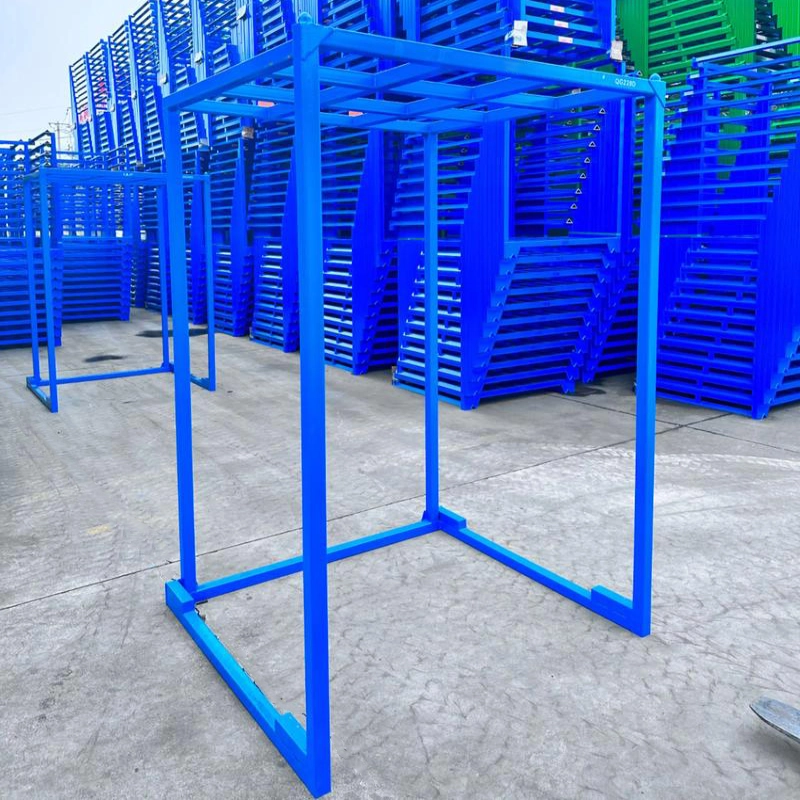
Why nesting changes the freight math
Most buyers only look at the outbound loading. That is incomplete. A returnable stillage has two freight lives: the loaded trip and the empty return trip. If the empty structures remain bulky, the return leg consumes space and turns into dead freight. If the structures nest, the same shipment can be turned into a compact stack of steel instead of a large volume of air.
That is why structure matters more than a generic promise. Nesting clearance, fork entry, external width, and structural stability decide whether the empty rack can be compressed into a small return package. In practice, the loading result is not a marketing number. It is defined by the rack envelope and the way the customer packs the load.
What documented loading samples really mean
Project files show several loading samples: 52 units in a 40-foot container, 64 units in a 40-foot high cube container, 88 units in another 40-foot high cube condition, and 144 units in a 17 m flatbed truck arrangement. These are project values, not a universal standard. They depend on the exact rack size, pallet size, load height, packing method, and the transport mode used in that project.
That distinction matters. A rack that works for a standard 40-foot container may not deliver the same count in a 40-foot high cube if the load height changes. The opposite is also true: a taller container can still lose density if the rack's external dimensions are too generous or if the top clearance is wasted. When the rack is designed around the pallet and the load envelope, the container count improves because the structure is doing the work, not because someone guessed a smaller number.
- Standard 40-foot container: one documented project achieved 52 units.
- 40-foot high cube container: documented samples achieved 64 and 88 units, depending on project dimensions.
- 17 m flatbed: one project sample achieved 144 units.
Bubble wrap and strapping, stretch film and strapping, or wooden crate?
For export, the packing method is often the real trade-off between freight density and protection. Bubble wrap plus strapping is a lightweight option when the load is already stable and the rack structure is doing the main protective work. Stretch film plus strapping is similar but gives a firmer surface when boxes or pallet faces need more containment. Both methods generally preserve more usable container space than a rigid crate.
Wooden crate packing is the protective fallback, but it comes at a cost. In one project file, wooden crate packing was quoted at about RMB 90 per square meter, and the container count dropped to about 30 pieces in a 40-foot container. That is the right choice only when load fragility, handling risk, or customer requirements justify the extra cost and the loss of loading density. If the main goal is to move more units per container, a wooden crate usually works against that goal.
The rule is simple: choose the lightest packing that still protects the load for the actual route. If the route has long ocean transit, cross-dock handling, or rough yard transfers, the packing may need to be upgraded. But if the goods are stable and the stillage is structurally sound, heavy crates often waste cubic space that could have carried more product.
Where Rerack fits well and where it does not
Rerack fits best when the load is already palletized, the pallet size can be designed into the structure, and the customer wants repeatable return transport. It is also a strong option for temporary warehouse layouts, seasonal overflow, and factory or 3PL loops where the floor plan changes frequently. Because the structures nest when empty, the warehouse does not need to maintain a fixed rack footprint just to support a short-term flow.
It is less suitable when the load is unstable, loosely stacked, or too soft to hold shape on a pallet. It is also a poor choice for projects expecting rough forklift handling, prolonged rain exposure, or uncontrolled outdoor storage without a proper coating plan. For cold storage or humid environments, the finish must be chosen project by project. The product can be designed for indoor and cold storage use, but the environment still drives the final coating and handling decision.
Why project value is not a universal standard
One of the biggest mistakes in export procurement is treating a loading sample as if it were a fixed promise. It is not. A 52-unit container sample does not mean every project will load 52 units. A 144-unit flatbed sample does not mean every rack will fit that count. The correct way to specify a returnable stillage system is to start with the pallet size, load height, fork entry, packing method, and transport mode, and then let the structure determine the outcome.
É também por isso que a melhor comparação não é “quantas unidades um rack pode caber” isoladamente. A questão real é se o rack pode ser reencaixado após a viagem de ida, retornado em menos volume e reutilizado sem forçar armazenamento fixo no layout. Quando essa resposta é sim, a história do frete melhora em ambas as pernas.
Nota: Todas as contagens de carregamento e números de embalagem acima são amostras de projeto. Os resultados finais sempre dependem do envelope do rack, geometria da carga, escolha de embalagem e rota de transporte. Se você quiser um plano de frete de retorno específico para o projeto, o próximo passo é revisar a página de detalhes do produto e os estudos de caso relacionados, e então mapear o padrão de carregamento exato para o seu contêiner ou plataforma.
Precisa de uma Solução de Armazenamento Personalizada?
Fale diretamente com nossos engenheiros técnicos. Oferecemos projetos estruturais gratuitos, avaliações de catálogos de alta capacidade e orçamentos rápidos para B2B.
Solicite um Orçamento Agora →