
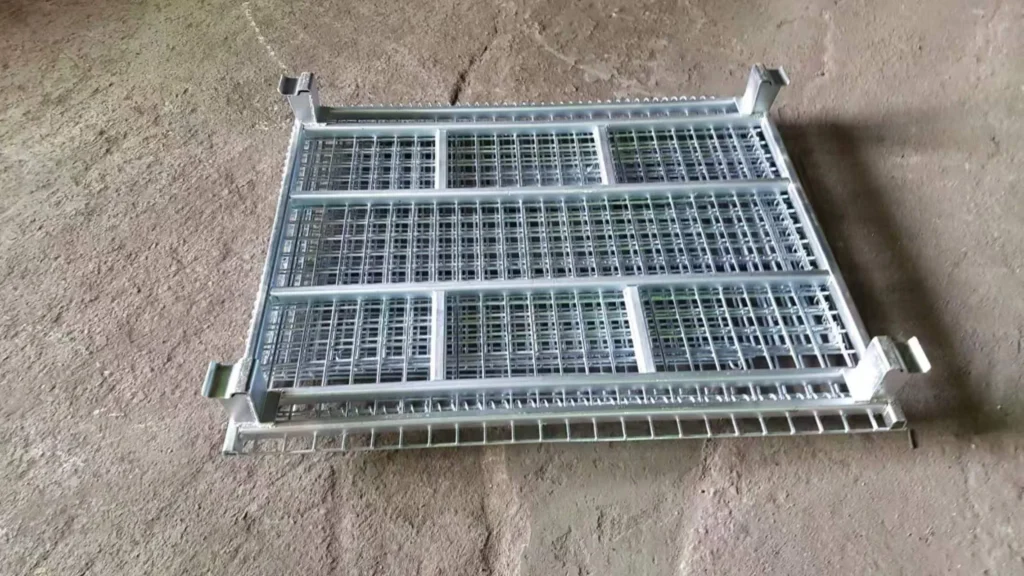
“The cage failed after a year.” In many factories, that diagnosis is incomplete. A Stbox wire mesh container often starts to show trouble at the base: a stacking foot drops, the bottom mesh sags, a channel reinforcement twists, or a weld opens. The trigger is frequently the handling method rather than ordinary storage. A fork entering too aggressively, lifting off-centre, or striking the front frame transfers impact into the feet and bottom structure first.
For a warehouse manager, the practical question is not whether a wire mesh container can be handled by a forklift. It is whether every operator handles the same cage in a controlled way, within the approved drawing and load plan. Stbox is a collapsible, stackable industrial storage cage for parts, WIP and bulk handling. Its Q235 welded structure, formed stacking feet and U-channel base reinforcement are designed around these interfaces—but they cannot compensate for violent fork truck operation or an overloaded, misaligned stack.
Why the base feet and bottom mesh bend first
The base is where several forces meet. The feet carry the load from an upper cage, the bottom mesh supports the contents, and the U-shaped channel reinforcements transfer load toward the frame. If a fork contacts the underside unevenly, only part of this structure takes the load. The result can be a locally bent foot, a distorted bottom panel, or a stretched weld even when the cage contents are within the documented project rating.
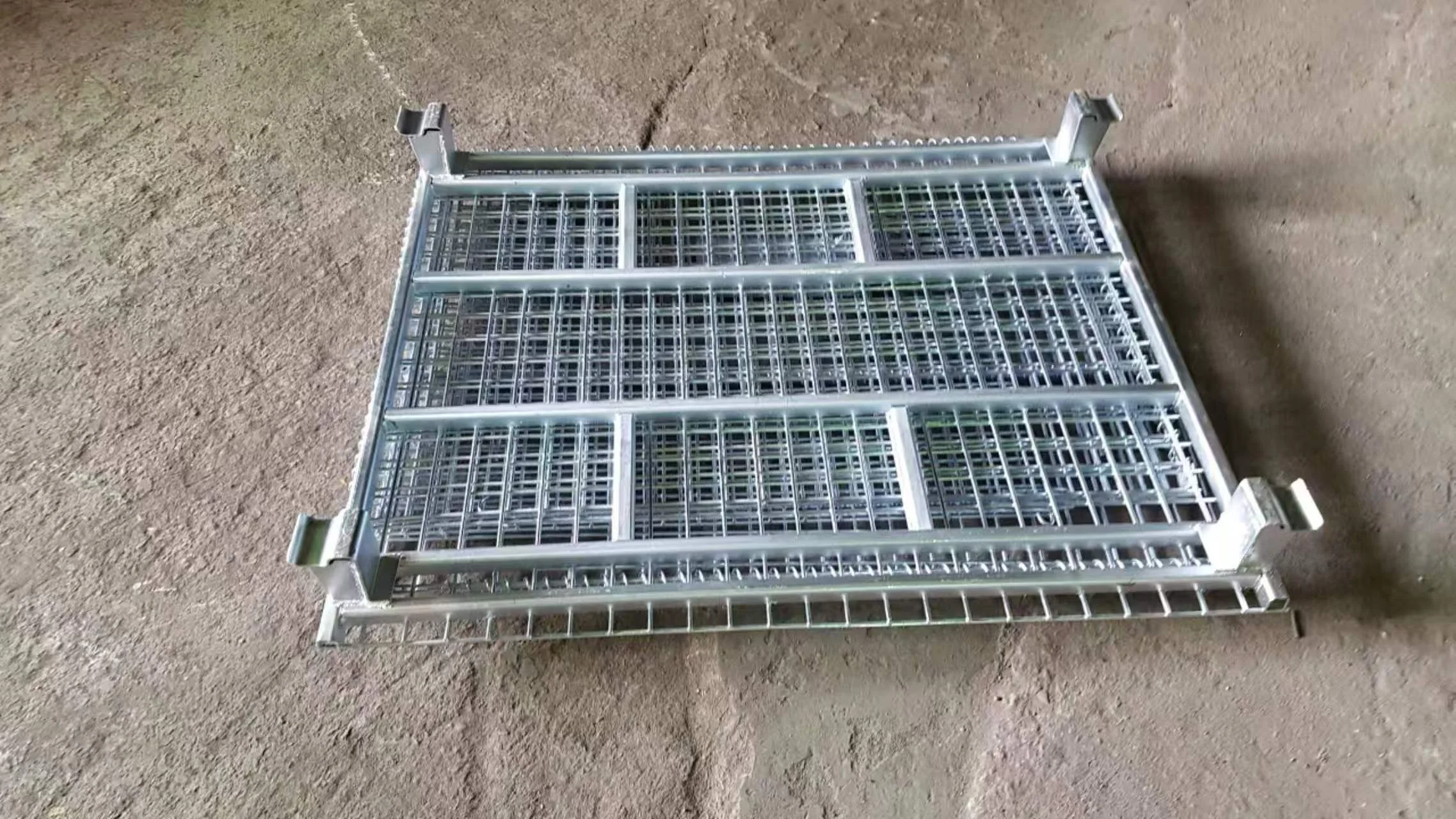
Stbox projects use different dimensions, wire diameters, reinforcement layouts and load limits. One documented 13967 configuration lists 800 × 1200 × 890 mm, 5.8 mm wire, a 1,000 kg load and 47 kg tare; another project lists 1,400 kg per cage. These are not interchangeable promises. Confirm the approved drawing before assuming the same capacity, foot geometry or number of bottom channels applies to every batch.
The three forklift mistakes that damage a wire mesh container
1. Violent fork entry or lifting. Driving the forks into a cage at speed, stabbing the base, or accelerating while the forks are still finding the entry points creates an impact load. The bottom mesh may bow and the foot-to-frame weld may be shocked. The documented handling risk is simple: enter and lift at a steady speed. Keep the forks level, fully engaged and clear of the base members before raising.
2. Off-centre or one-sided lifting. An off-centre fork condition—one fork deeper, one fork carrying more, or the load not centred—makes the base twist. That twist is concentrated at the stacking feet and channel ends. Four-way pallet-jack access shown in the Stbox image set helps with route planning, but it does not make diagonal or partial engagement safe. Align the vehicle with the cage, use both forks correctly, and do not release a stacked load until every foot is fully seated.
3. Striking the gate or front frame. When operators use the forks to push, pull or correct a cage, the half-drop gate and front frame can become an unintended impact point. A lowered gate is for access and loading, not for absorbing fork contact. Close and secure the gate before transport, keep the fork tips away from the mesh and frame, and use a pallet jack or forklift only in the approved orientation.
A practical inspection routine for the bottom assembly
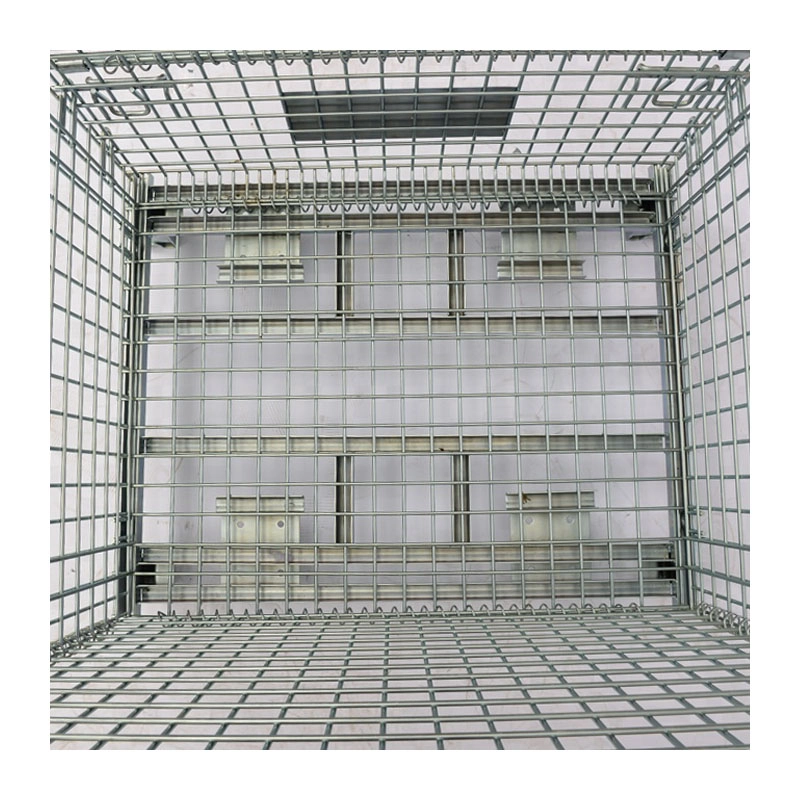
Inspect empty cages on a level floor, then repeat the check after a normal handling shift. Look at the four stacking feet for a change in height, leaning, crushed edges or a foot that no longer seats cleanly on the cage below. Check the bottom mesh for a permanent bow, sharp displaced wires, broken intersections or a gap between mesh and frame. Examine each visible U-channel reinforcement and its ends for twisting, buckling or separation. Finally, inspect welds around the feet, bottom frame, gate frame and high-impact corners for cracks, opening or fresh metal movement.
Do not judge a cage only by its appearance when loaded. A load can hide a sagging base. Fold and unfold the cage only when it is empty and safe to handle; confirm that the panels, hinges and gate return to their intended position. A door that no longer aligns, latches or closes without force is a handling-control warning, not merely a convenience issue.
When to isolate and stop using the cage
- Isolate the cage immediately if a stacking foot is visibly bent, cracked, crushed or no longer fully seats in the approved stack position.
- Stop forklift or pallet-jack use if the bottom mesh or channel reinforcement has permanent deflection, sharp deformation, or visible separation from the frame.
- Quarantine the unit when a weld is open or cracked at a foot, bottom frame, gate frame or other load-transfer point.
- Do not stack the cage if it leans, rocks, cannot align with the cage below, or the gate no longer closes and latches correctly.
Mark the unit clearly, remove the load using a controlled method, and do not return it to service based on a quick bend-back or weld touch-up made without an approved engineering decision. Repair suitability depends on the actual deformation, material and project design; this article does not prescribe a repair process or acceptance limit.
Choose the handling plan with the Stbox configuration
- For repeat forklift and pallet-jack movement, specify the vehicle entry direction, load centre and approved lifting method with the drawing.
- For stacked storage, define the permitted tier count and upper-cage load separately; a cage rating is not automatically the allowable load at every level.
- For precision or small parts, consider the documented PP hollow-board liner options rather than assuming a 50 × 50 mm mesh suits every component.
- For empty returns, use the collapsible format and approved strapping or transport plan; folded-cage stack dimensions vary by project.
FAQ: base-foot deformation and replacement decisions
What usually causes a Stbox foot to deform?
The common recorded causes are violent fork entry or lifting, off-centre fork engagement, impact against the gate or frame, and stacking without complete foot seating. Overloading or mixing project load rules can add stress. The correct diagnosis requires checking the foot, bottom mesh, channel reinforcement and welds together—not replacing one visible part by assumption.
What should I send when the feet have sunk?
Report the cage configuration, approximate load, handling equipment, stacking arrangement, photos of the feet and bottom mesh, and whether the gate still closes. Steel Pallet can then review the use scenario and advise whether an adjusted reinforcement structure or replacement recommendation is appropriate. Until that review, isolate any cage with deformation, open welds, unstable stacking or a gate that will not close securely.
Need a Custom Storage Solution?
Speak directly with our technical engineers. We offer free structural designs, heavy-duty catalog evaluations, and quick B2B price quotations.
Request a Quote Now →