
Why a Wooden Pallet Can Become an Export Liability
Wooden pallets are the default in many warehouses, and for plenty of domestic, low-risk moves they do the job. But the moment goods cross a border, that same wooden pallet can trigger a different kind of cost: fumigation paperwork, port inspection, and in the worst case, rejected or re-treated cargo. For export, food, and pharmaceutical logistics teams, the question is less “is wood cheap?” and more “is wood predictable at the border?”
The short version: a wooden pallet typically serves around 1.5 years in demanding cycles before rot, splintering, or contamination pushes it out of service, and it can harbor moisture and microbes that no one wants near food or pharma. A full-steel, hot-dip galvanised carrier is built for roughly 20 years of service and is naturally exempt from the ISPM 15 wood-packaging rule. The rest of this article explains when each option is the right call.
What ISPM 15 Actually Requires
ISPM 15 (International Standards for Phytosanitary Measures No. 15) governs wooden packaging material used in international trade — pallets, crates, and dunnage included. The rule exists to stop live pests from riding along inside untreated timber. To be compliant, wood packaging must be either:
- Heat-treated to a core temperature that kills pests (marked “HT”), or
- Fumigated with methyl bromide (marked “MB”), or
- Manufactured from an approved composite that meets the standard.
Each compliant unit carries the IPPC mark. Miss the mark, and customs may order re-treatment, re-export, or destruction — plus the demurrage and admin time that come with a hold. None of this applies to all-steel load carriers, because the regulation targets wood, not metal.
The Hidden Costs of Wooden Pallets
Even when wood passes inspection, the lifetime cost is not just the purchase price. Three costs tend to surprise export teams:
- Service life. Industry sources commonly cite a typical wooden-pallet service life around 1.5 years under demanding, multi-trip export conditions. After that, cracking, nail loosening, and contamination accelerate.
- Moisture and microbes. Wood absorbs humidity. In food, feed, or pharma chains that means mold risk and cleaning difficulty that steel simply does not have.
- Re-treatment and paperwork. Every re-issue to a new destination can mean renewed fumigation and documentation — a recurring administrative tax on every border crossing.
None of this makes wood “bad.” A properly heat-treated wooden pallet is a legitimate, widely accepted export base. The point is to count the recurring costs honestly rather than compare only the sticker price.
When Wooden Pallets Are Still the Right Choice
To be clear, wood is not obsolete. A compliant wooden pallet stays the sensible option when:
- The move is domestic or between countries that accept your treatment mark without friction;
- Loads are low-value, non-food, and not sensitive to moisture or contamination;
- The pallet is a one-way, disposable base where return logistics make no economic sense;
- Your customer or destination specifically mandates wooden packaging.
If all four describe your situation, the simplicity of wood is a feature, not a compromise. The steel argument below is for everyone else.
Why Full-Steel Carriers Replace Wood in Export Chains
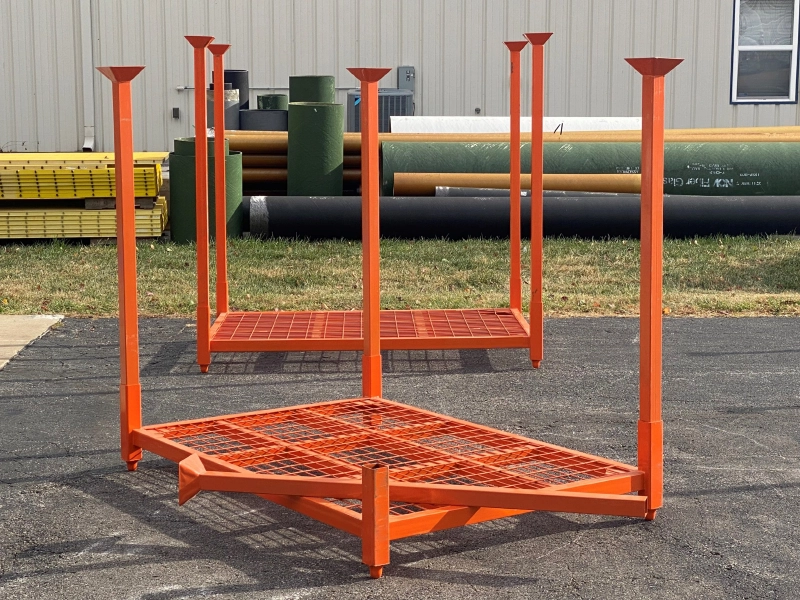
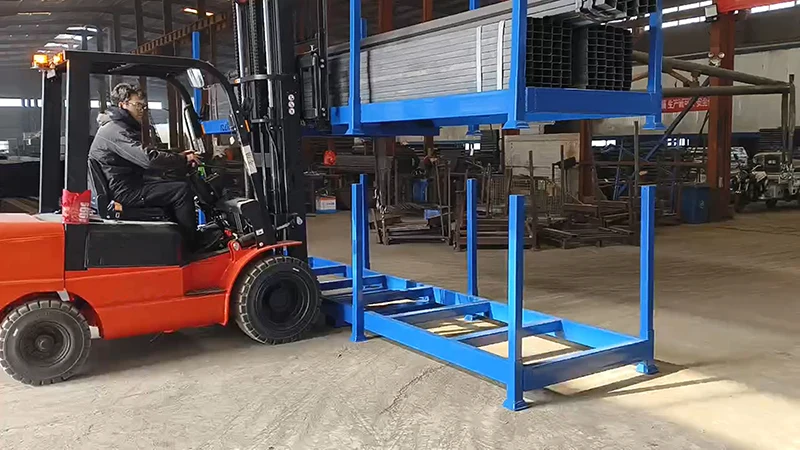
A demountable post pallet or stack rack made from Q235 steel with a hot-dip galvanised coating changes the equation in three ways:
- ISPM 15 is simply not in scope. Metal carries no pest risk, so there is no fumigation mark to lose and no treatment to renew on re-export.
- Service life jumps an order of magnitude. A hot-dip galvanised steel carrier typically serves 20 years or more, versus the ~1.5-year typical wooden life — and galvanising adds cathodic protection so it resists rust even in condensation and cold-store conditions.
- Cleaning and hygiene improve. Smooth steel surfaces wash down for HACCP-style audits far more easily than porous wood.
For the full comparison of post pallets against fixed racking, see our Derack vs Beam Rack guide.
TCO and Residual Value: Counting the Whole Life
A fair comparison looks at total cost of ownership, not purchase price. Indicative factors to model:
- Replacement frequency. A ~1.5-year wooden life means roughly a dozen replacements over the 20-year life of one steel carrier — each with its own fumigation and handling cost.
- Damage-driven write-offs. Steel carriers protect loads structurally, which tends to reduce crushed or contaminated goods versus floor-stacked or weak-base wood.
- Residual value. At end of life a steel unit retains meaningful scrap/resale value; a broken wooden pallet is disposal cost.
- Return logistics. Demountable posts fold down and nests, shrinking empty-return volume the same way a collapsible steel stillage does.
None of these numbers are universal — they depend on trip frequency, load value, and climate. They are a framework for your own TCO model, not a promise of a fixed saving.
When Steel Carriers Are the Better Fit — and When They Are Not
Steel wins clearly when loads are high-value, food- or pharma-adjacent, moisture-sensitive, exported repeatedly, or moved through strict-border destinations. It also suits closed-loop supply where the carrier returns and earns its keep over many trips.
Steel is the weaker choice when the base is genuinely one-way and disposable, when a customer mandates wood, or when the absolute lowest upfront spend on a single non-sensitive shipment is the only priority. The right tool follows the trip pattern, not the catalogue.
For a galvanised steel family built exactly for loose-part and export use, see our Galvanised Stillages range.
Bottom Line
Wooden pallets are not a mistake — a compliant, heat-treated wooden pallet is a valid export base. The risk appears when teams treat “wood is cheap” as the whole story and ignore ISPM 15 friction, ~1.5-year service life, moisture, and recurring re-treatment. For repeated, high-value, or hygiene-sensitive export, a full-steel galvanised carrier removes the wood-specific costs entirely and typically pays back across its 20-year life. Choose by trip pattern, and the decision gets easy.
Need a Custom Storage Solution?
Speak directly with our technical engineers. We offer free structural designs, heavy-duty catalog evaluations, and quick B2B price quotations.
Request a Quote Now →