
When a procurement or finance team prices a storage upgrade, the first number on the table is usually the purchase price. That number alone answers the wrong question. A fixed beam rack and a demountable post pallet do not compete on sticker price — they are two different cost shapes. This article compares the two on total cost of ownership (TCO), and shows the layout conditions where each one wins.
A demountable post pallet (also called a post pallet, portable stack rack, stillage or manurack) is a steel frame with removable posts. The load is carried by the posts and the base, not by the goods inside. That makes it a movable, nestable load unit that behaves more like returnable transport packaging than like installed racking.
Two Ways to Store — Two Different Cost Shapes
A fixed beam rack is infrastructure. It is bolted to the building, laid out once, and optimized for one-way, high-selectivity access to individual pallet positions. A post pallet is an asset you can move, stack, empty and return — it carries the goods and then travels with them.
The difference shows up everywhere in the budget: capital spend, installation, floor area, reverse logistics, damage and residual value. Comparing only the first invoice hides most of the story.
Space: Who Really Pays for the Aisle
Fixed racking earns its selectivity with aisle space. In a conventional selective beam-rack layout, a commonly cited rule of thumb is that roughly 60% of the floor area is given to aisles and structure rather than stored product. You pay rent on that space whether or not it holds a pallet.
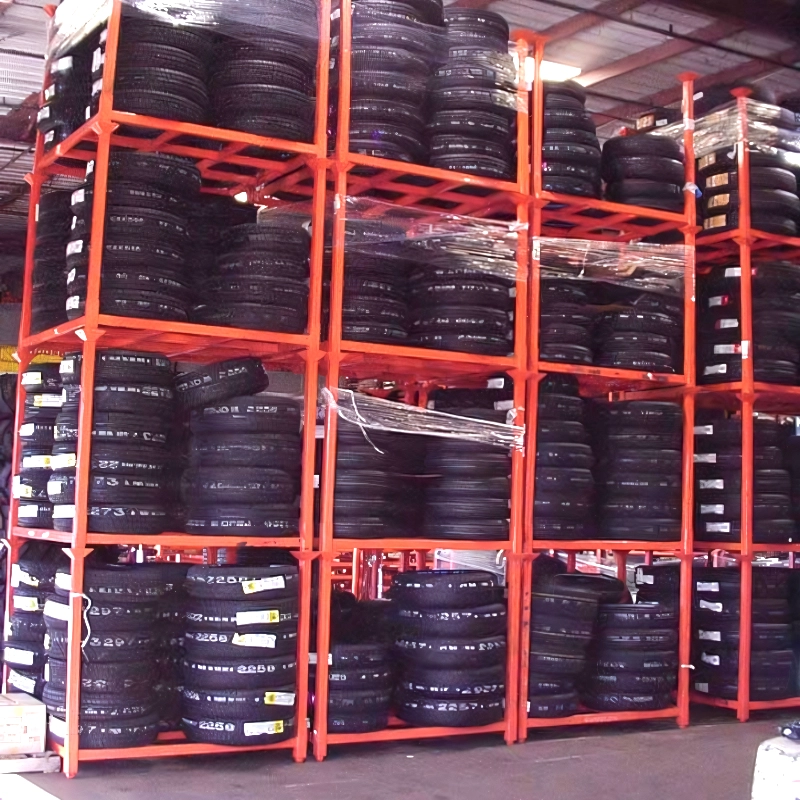
A post pallet changes the geometry. Because the frame is the structure, units stack 4–5 high on the same footprint and keep each layer individually accessible. Industry data for this kind of structural stacking often quotes vertical space utilization gains on the order of +400% to +500% versus floor or single-level methods. The gain is not free floor — it is turning floor area into usable cube without adding aisles you cannot use.
Flexibility: Bolted-In vs Movable
Fixed racking is laid out once. When the product mix, batch sizes or throughput shift, the usual answers are more racking, a rebuild, or a second warehouse. Each one is a construction project.
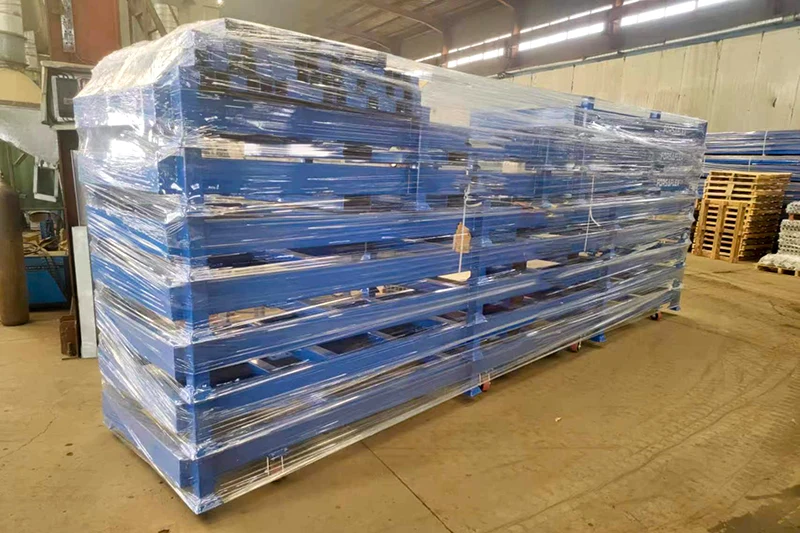
A post pallet is tool-free to re-deploy. Posts are removable, so in a quiet season the empty bases nest together — typical nesting ratios run about 4:1 to 6:1 — and a single container carries a large number of empty frames back for the next loop. That mobility is the feature fixed racking deliberately trades away to get 100% selectivity.
The TCO Math, Not the Sticker Price
Total cost of ownership adds the items a purchase order leaves out. The table below lists the recurring and one-time elements that separate the two approaches. The numbers are indicative industry ranges, not a measured result for any single site.
| Cost element | Fixed beam racking | Demountable post pallet |
|---|---|---|
| Capital spend | Moderate–high per position | Higher per unit, fewer positions needed |
| Installation | Bolted to floor, engineering | No bolts; walk-in ready |
| Floor area used | ~60% to aisles/structure (rule of thumb) | Stacks up; minimal aisle |
| Layout change | Rebuild / construction | Move frames; re-nest empties |
| Reverse logistics | N/A (static asset) | Posts off, nested; return freight cut sharply |
| Cargo damage | Bottom-layer crush if floor-stacked nearby | Load on posts, not on product |
| Service life | Long, but fixed in place | Steel frame, 20+ yrs, reusable |
| Residual value | Low once layout is obsolete | Scrap steel value; redeployable |
The point is not that one is “cheaper” in isolation. It is that fixed racking spends money up front on selectivity and structure, while a post pallet spreads value across space saved, returns saved and damage avoided. Which one has the lower TCO depends entirely on how volatile the layout is.
When Fixed Racking Is the Better Buy
Beam racking is the right tool in exactly the cases it was built for. Choose it when:
- You need 100% individual pallet selectivity and pick single positions constantly.
- SKU count is high, stable, and each pallet is addressed on its own.
- The layout is settled for years — no seasonal swings, no product-mix churn.
- Throughput is high enough that the aisle cost is paid back by picking speed.
In those conditions the selectivity and density of fixed racking are hard to beat, and a movable frame would only add handling steps. This comparison is not an argument against beam racking; it is a boundary on where a post pallet should be used.
When the Post Pallet Wins
The post pallet pulls ahead the moment the layout stops being static. Choose it when:
- Batch sizes and product mixes swing with season or customer — you re-stack instead of rebuilding.
- Goods are pressure-sensitive (powder, feed, tires, pipes) and bottom-layer crush is already costing you.
- Empty frames return in a closed loop, so nested transport cuts reverse freight.
- You rent warehouse space and the marginal square metre is expensive — stack up, do not widen aisles.
- You want one asset that stores, transports and returns without being dismantled from the building.
For these volatile layouts, the post pallet’s lack of bolts is not a weakness — it is the feature that keeps the storage system adjustable as the business changes.
A Simple Decision Rule
If the question is “which pallet position do I pick right now,” fixed racking usually wins. If the question is “how do I store this month’s mix and a different mix next month without a construction crew,” the post pallet is the lower TCO. Price the aisle, the rebuild, the return freight and the damage — not just the frame — and the right answer usually appears.
For the product detail and load options, see our Demountable Post Pallet and the Post Pallet vs Beam Rack comparison.
Frequently Asked Questions
Does a post pallet replace selective beam racking?
No. It does not try to. Beam racking keeps 100% single-pallet selectivity, which a stacked frame cannot match. The post pallet is for load batches, buffers and volatile layouts where flexibility and space-per-foot matter more than addressing every pallet individually.
Is the higher upfront cost recovered?
In static, high-selectivity operations the beam rack often recovers faster. In seasonal, return-loop or damage-prone operations the post pallet typically wins on TCO through saved floor, saved return freight and avoided cargo loss. The answer is site-specific, so it should be modelled on the actual loop rather than assumed.
Need a Custom Storage Solution?
Speak directly with our technical engineers. We offer free structural designs, heavy-duty catalog evaluations, and quick B2B price quotations.
Request a Quote Now →