
|
Is your workshop floor cluttered with valuable injection molds and blow molds for PET bottles, PP cups, and jerry cans? Every square foot occupied by a mold on a pallet is space that could house another molding machine. Slow, risky mold changes are eating into your production uptime and putting your six-figure tooling assets at risk. It’s time to stop managing clutter and start optimizing your production flow. |
The Real Cost of “Floor Storage” in Your Plastics Packaging Plant
In a high-volume plastics packaging facility, the game is won and lost at the molding machine. Yet, for many plant managers, the area around these machines tells a different story. Expensive plastic injection mold storage rack and thermoforming dies are often relegated to wooden pallets, taking up vast amounts of valuable floor space. This isn’t just untidy; it’s a direct drain on your operational efficiency and profitability.
Consider the typical mold changeover process. A Die Setter needs to locate the correct mold, clear a path for the forklift, carefully navigate the crowded workshop, and then attempt a precise transfer. This process is slow, fraught with risk, and a major bottleneck that directly opposes Lean and SMED (Single-Minute Exchange of Die) principles. The consequences are clear:
- Lost Production Capacity: Every square foot used for disorganized floor storage could be generating revenue with a new injection or blow molding machine.
- Asset Damage: Molds stored on the ground are susceptible to moisture, leading to rust on precision surfaces. Worse, accidental collisions with forklifts can cause irreparable damage to tooling that costs tens of thousands of dollars.
- Safety Hazards: Heavy, unsecured molds create a dangerous environment for your team, increasing the risk of serious workplace injuries.
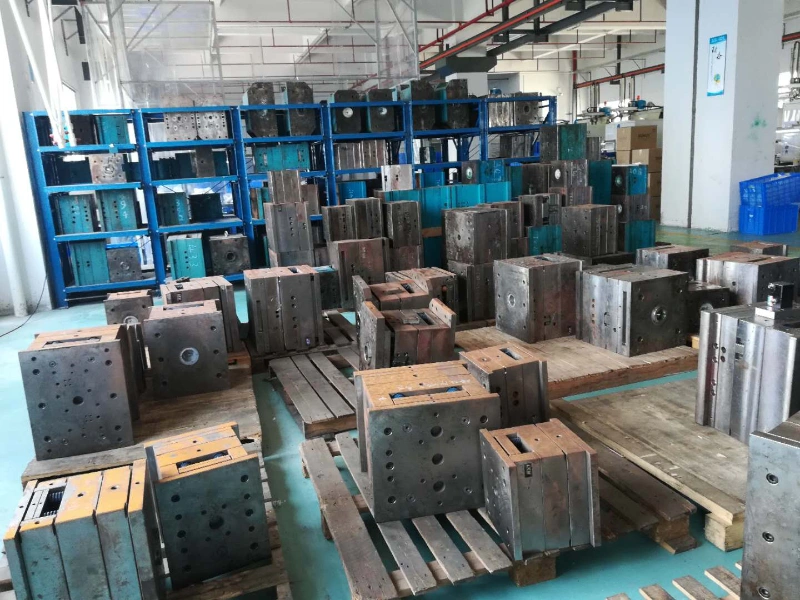
Before: Disorganized, space-consuming, and unsafe floor storage is a hidden drain on productivity.
Engineered for Your Workflow: The Erack Heavy-Duty Mold Racking System
A dedicated heavy duty mold racking system isn’t just shelving; it’s a piece of production equipment designed to solve these core challenges. By understanding the physics of heavy load management and the realities of a busy workshop, we provide a solution that pays for itself in reclaimed space and uptime.
1. Reclaim Your Floor with a Rock-Solid Vertical Structure
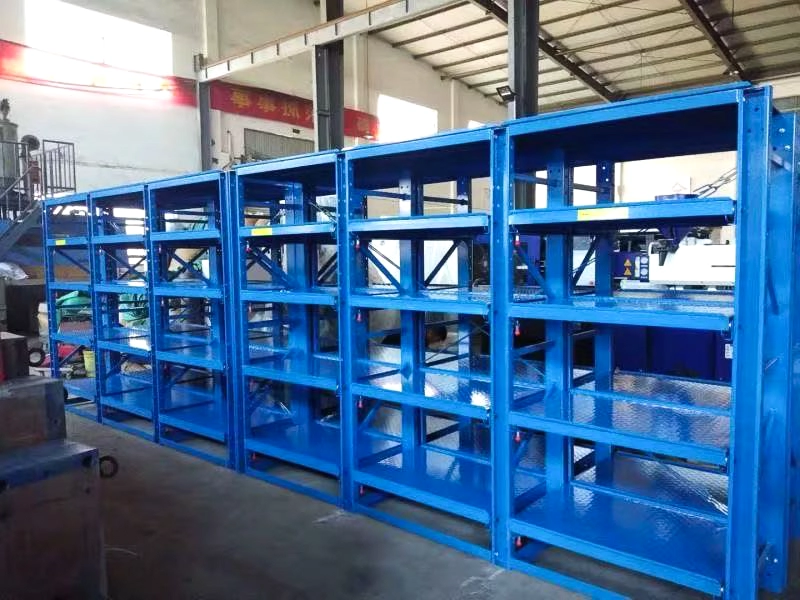
Our system’s backbone is constructed from 10# channel steel (Q235B grade), forming a three-pillar framework engineered to handle single-layer loads from 1 to 3 tons (2,200 – 6,600 lbs). This isn’t just about strength; it’s about stability. This robust design allows you to safely store your heaviest blow molds vertically, transforming a sprawling mold graveyard into a compact, organized library. The result? You can reclaim up to 80% of your mold storage footprint, freeing up critical space for expansion.
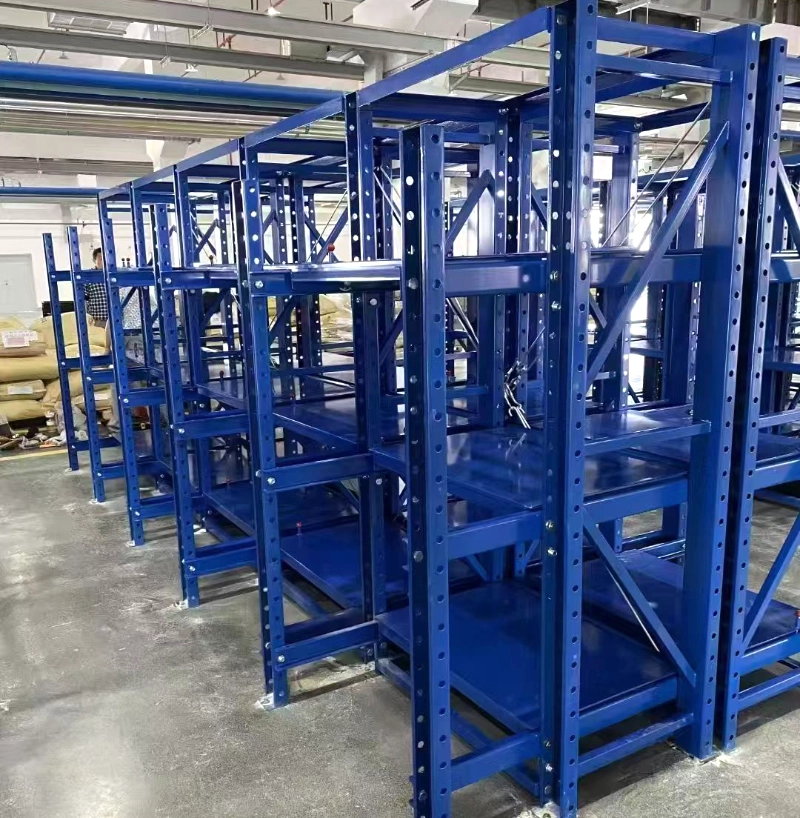
The 10# channel steel and three-pillar structure provides the stability needed for heavy vertical storage.
2. Slash Changeover Times with 100% Full-Open Access
The core innovation is the drawer type mold rack design. Each drawer, equipped with high-precision Harbin bearings, can be extended to its full depth. This simple mechanical advantage has a profound impact on your workflow:
- Effortless Operation: The bearings convert sliding friction to rolling friction. A Mold Setter can slide out a 4,000-lb mold with minimal effort, eliminating physical strain.
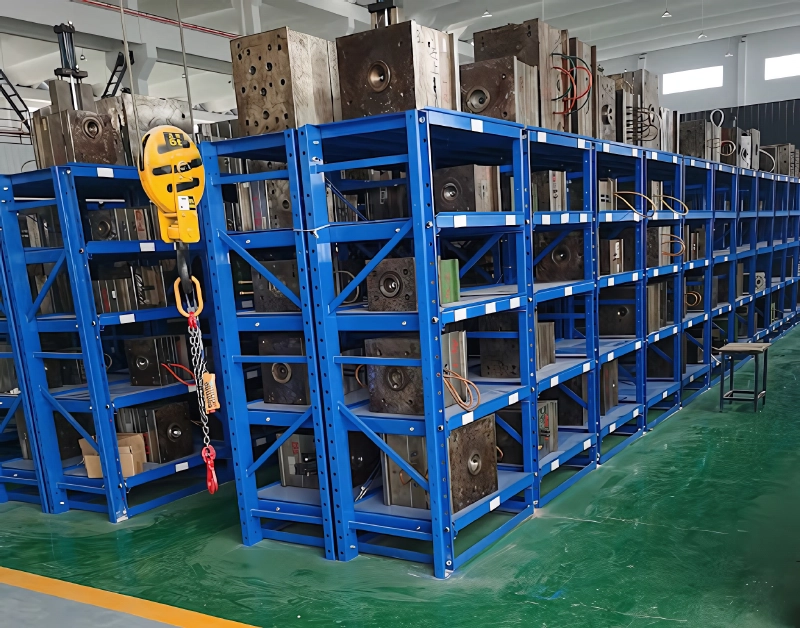
- Zero-Dead-Angle Lifting: With the drawer fully extended, your overhead crane or chain hoist has direct, unimpeded vertical access to the mold’s center of gravity. This completely eliminates the need for risky and time-consuming forklift maneuvers between tight aisles.
This direct integration with your lifting equipment is the key to achieving true Single-Minute Exchange of Die, reducing changeover times by as much as 80%.
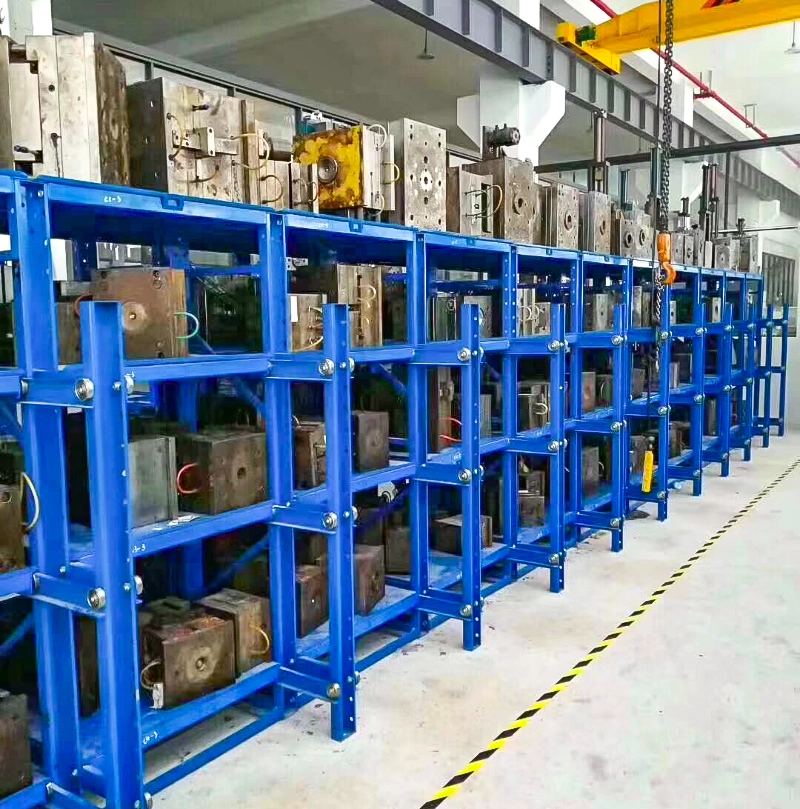
A fully extended drawer allows for direct, safe, and rapid lifting with an overhead crane.
3. Protect Your Assets with Multi-Layered Safety and Durability
Your molds are high-value assets. Our system is designed to protect them. Every drawer is equipped with a mechanical self-locking safety pin, ensuring it cannot slide out accidentally once retracted. This simple, failsafe mechanism is critical for meeting OSHA and internal EHS standards.
Furthermore, every steel component undergoes a rigorous 7-step surface treatment process, including acid washing, phosphating, and a 60-80μm powder coating. This creates a durable, corrosion-resistant finish that protects the rack—and more importantly, your molds—from the humid conditions often found in plastics manufacturing environments, guaranteeing a service life of over 15 years without rust.
The Result: A Streamlined, Profitable, and Safe Production Floor
Implementing an engineered mold storage rack is more than a 5S initiative; it’s a strategic investment in your plant’s core operational capacity. The “after” picture is one of order and efficiency: clean aisles, rapid and predictable mold changes, and a production floor optimized for what it does best—manufacturing high-quality plastic products. By organizing your tooling, you unlock the full potential of your machinery and your team.
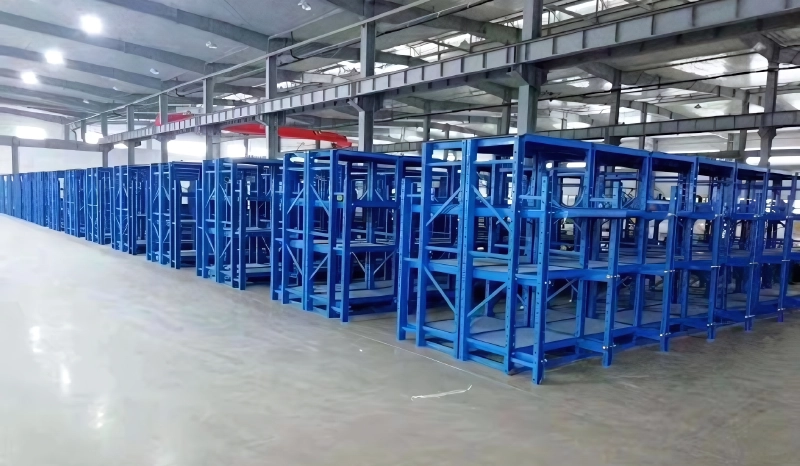
After: A high-density storage system frees up floor space for production and streamlines workflow.
Frequently Asked Questions
1. How much weight can a single drawer hold? Will it support our heavy blow molds?
Each drawer is engineered to support loads from 1 to 3 tons (2,200 to 6,600 lbs), depending on the model. The structure, built with 10# channel steel and a three-pillar design, is specifically designed for the heavy, concentrated loads of industrial molds.
2. We use an overhead crane for all mold changes. Is this system compatible?
Absolutely. The system is designed to work seamlessly with overhead cranes and chain hoists. The 100% full-extension drawer provides unobstructed vertical access, allowing your crane operator to lift and place molds quickly and safely without any interference from the rack structure.
3. Our workshop floor space is limited, but our mold inventory is growing. How can this help?
This is the primary problem our system solves. By utilizing vertical space, you can store the same number of molds in a fraction of the footprint. Combined with the ability to reduce aisle widths from a forklift-required 12-15 feet down to just 4-5 feet for a crane, the space savings are often over 70%, freeing up room for more machines.
4. What about durability in a humid environment near our cooling towers?
The 7-step surface treatment is key. The process, which includes phosphating and a thick 60-80μm powder coat, creates a barrier that is highly resistant to oxidation and corrosion. We guarantee the finish for 15 years, making it ideal for typical plastics plant environments.
5. How difficult is it for an operator to pull out a drawer with a 4,000 lbs mold on it?
It’s surprisingly easy. Each drawer glides on high-quality Harbin bearings that convert the immense static friction of a heavy load into smooth rolling friction. An operator can pull out a fully loaded drawer with a minimal amount of force, protecting them from the back strains and injuries associated with trying to move heavy objects manually.
Related mold rack products
Need a Custom Storage Solution?
Speak directly with our technical engineers. We offer free structural designs, heavy-duty catalog evaluations, and quick B2B price quotations.
Request a Quote Now →