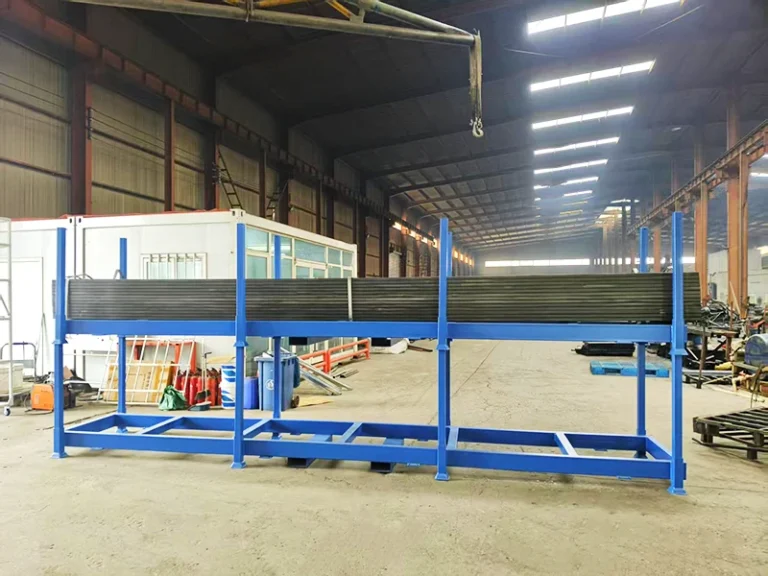
Standard demountable long-stock rack
Best for long pipes, profiles, and bundled tubular stock that need stackable transport and controlled ground contact.

Project-based Derack heavy-duty pipe rack for long steel pipes and elongated stock. Rated at 2,000 kg in the acceptance case and tested with a 2,264 kg bundle, with spacer tubes and an independent forklift aisle for safer handling.
PROJECT-BASED HEAVY DUTY
Built for long steel pipes and elongated profiles that need stable stacking, safer forklift access, and pack-down return transport.
Derack is a project-configured demountable post rack used to turn floor stacking into a structural load-bearing system. For the 130013475 acceptance case, the rack was rated at 2,000 kg and tested with a 2,264 kg pipe bundle. The design also leaves fork space under the load through spacer tubes, so forklift tines can separate the load from the frame and handle the rack more safely. Because Derack is engineered per job, load rating, post count, base span, and stacking height must be confirmed for each application.
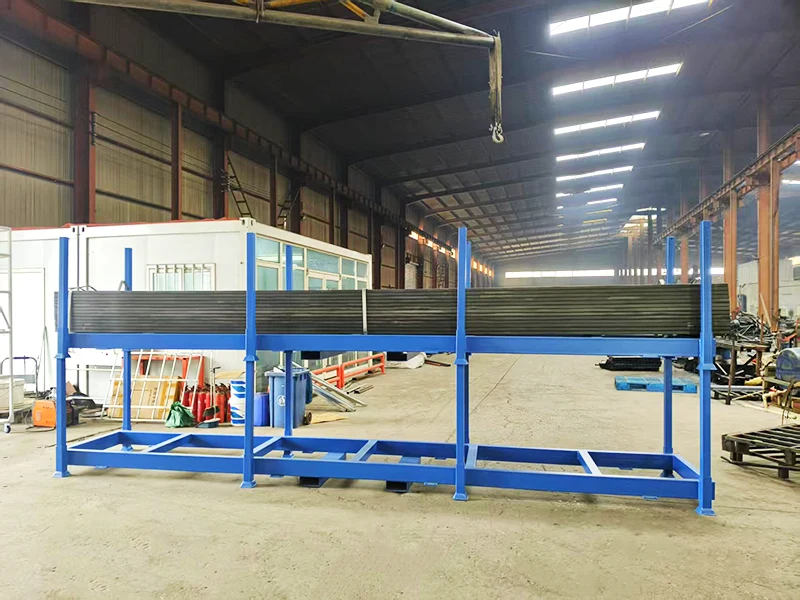
Best for long pipes, profiles, and bundled tubular stock that need stackable transport and controlled ground contact.
For higher-risk long loads that need a clear forklift channel under the load and less side shift during turning or lifting.
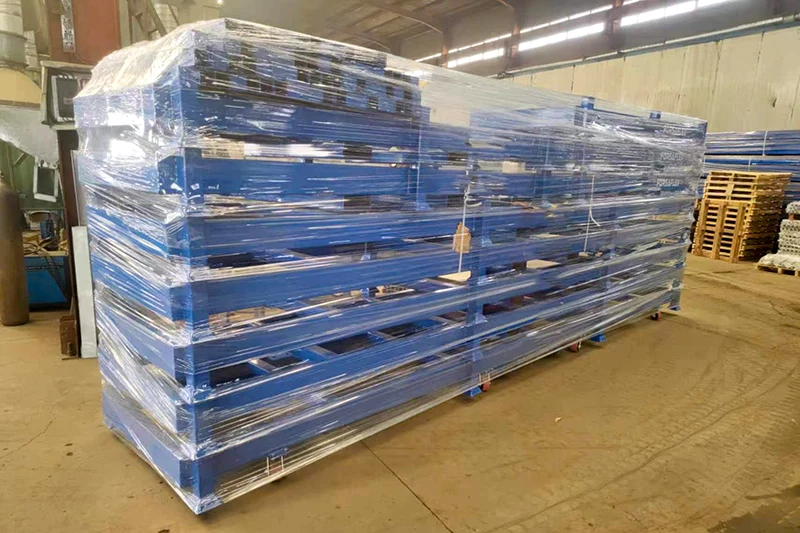
When empty return volume matters, the posts can be removed and nested to cut transport and warehouse space usage.
This product should be specified by actual bundle weight, center of gravity, and frame span. In the referenced acceptance case, the rack was rated at 2,000 kg and successfully tested with 2,264 kg, but that does not make 2,000 kg a universal standard.
Spacer tubes create fork clearance so the tine can enter without scraping the load and can keep the bundle separated from the rack during handling.
The demountable-post format lets empty racks nest back down, which helps reduce trailer space, yard space, and return freight cost.
A dedicated forklift aisle and structural load path help long tubes and profiles stay aligned, especially when the load length makes turning and lifting more sensitive.
Share tube length, unit weight, bundle diameter or cross-section, center-of-gravity position, and whether the load will be stacked or only transported.
We decide post count, base span, fork entry layout, and whether the job needs spacer tubes, restraint points, or a wider support frame.
We define forklift entry direction, lifting method, stacking height, and how the empty posts will be removed, packed, and returned.
The final design is confirmed against the project load, stacking condition, and transport route before production is released.
For this specific acceptance case, the rack was rated at 2,000 kg and tested with a 2,264 kg bundle. For new projects, the load must be engineered from the actual bundle and stacking condition, not copied from a different case.
The source record shows an acceptance test with a heavier-than-rated pipe bundle placed on the rack, followed by a stability and stack check. The project also used spacer tubes to create fork space under the load.
Yes, if the rack is designed as a demountable post system. Empty posts can be removed and nested, so the return volume is lower than a fixed welded frame.
The independent forklift aisle gives the tines a clear path under the load, which helps reduce side shift and makes lifting or turning long stock safer.