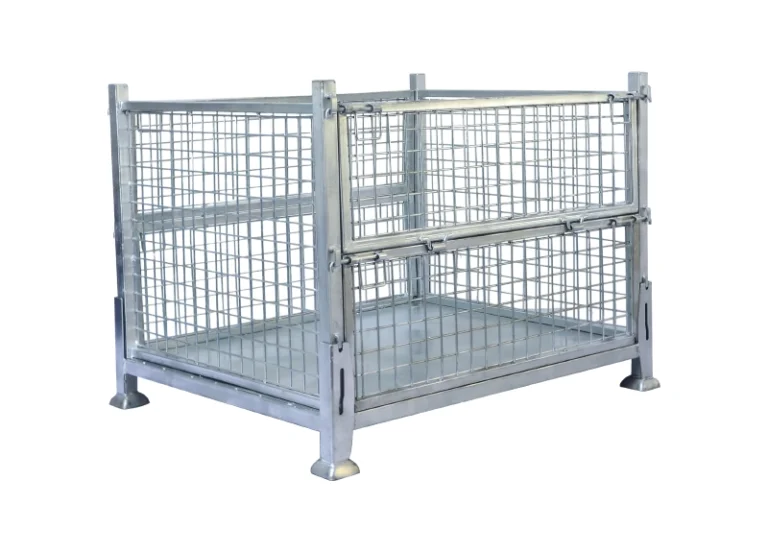
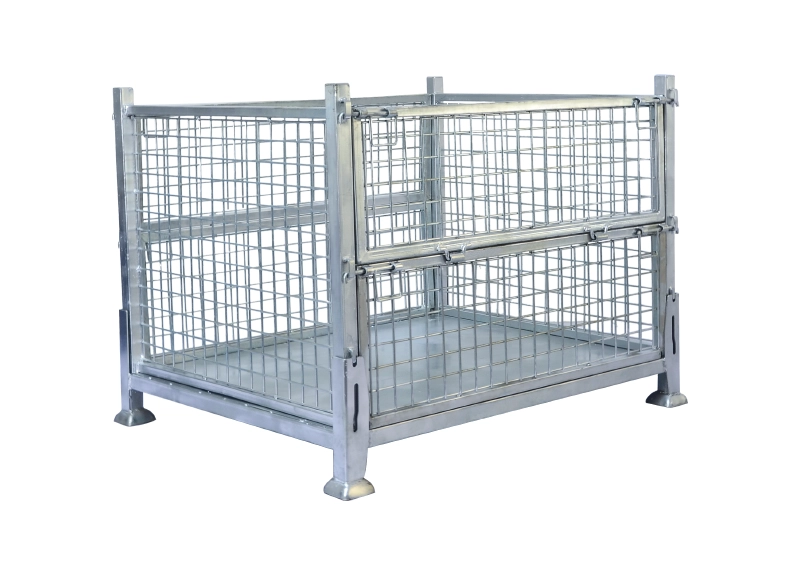
Open wire-mesh stillage
Use the visible mesh enclosure for industrial parts, shafts, rollers and other loose items where identification and ventilation matter. Confirm mesh opening, wire diameter and bottom support for the actual load.

Mybox is a configurable collapsible steel stillage with a steel-tube frame and wire-mesh enclosure for industrial parts storage, stacking, handling and return logistics. Confirm dimensions, load cases and options.
MYBOX COLLAPSIBLE STEEL STILLAGE
Mybox is a collapsible steel stillage for consolidating loose industrial parts into one forklift- or pallet-truck-handled unit. Its steel-tube upright frame and wire-mesh enclosure provide a more reinforced platform than a light, all-mesh storage cage, while the folding structure reduces the space needed for empty returns.
Mybox is a configurable metal collapsible box rather than one fixed-size SKU. The reference configuration is 1,100 × 885 × 950 mm outside, 967 × 765 × 720 mm inside, and about 330 mm high when folded. That project reference records about 70 kg tare weight, 4,000 kg static load, and 2,000 kg dynamic load, using Q235 carbon steel, 40 × 2 mm and 30 × 1.5 mm tube sections, and 5 mm steel wire. These figures are reference-configuration values, not a blanket rating for every Mybox variant. Final dimensions, load case, stacking height, fork access, and safety conditions must be checked against the approved drawing. Compared with a conventional wire mesh container, Mybox adds a steel-tube upright skeleton and can be configured with different doors, bases, lids, casters, rack interfaces, and surface treatments. It is intended for repeatable industrial storage and internal or returnable logistics—not as a default lifting cage, sealed dust-proof box, or substitute for a rack safety design.
Use the visible mesh enclosure for industrial parts, shafts, rollers and other loose items where identification and ventilation matter. Confirm mesh opening, wire diameter and bottom support for the actual load.
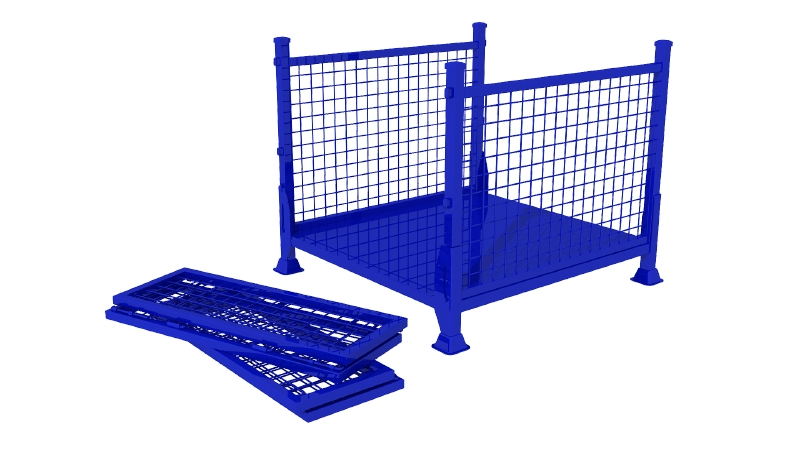
Fold the approved side structure after unloading to reduce empty storage and return volume. Folding height is project-dependent; confirm whether the lid or casters must be removed before transport.
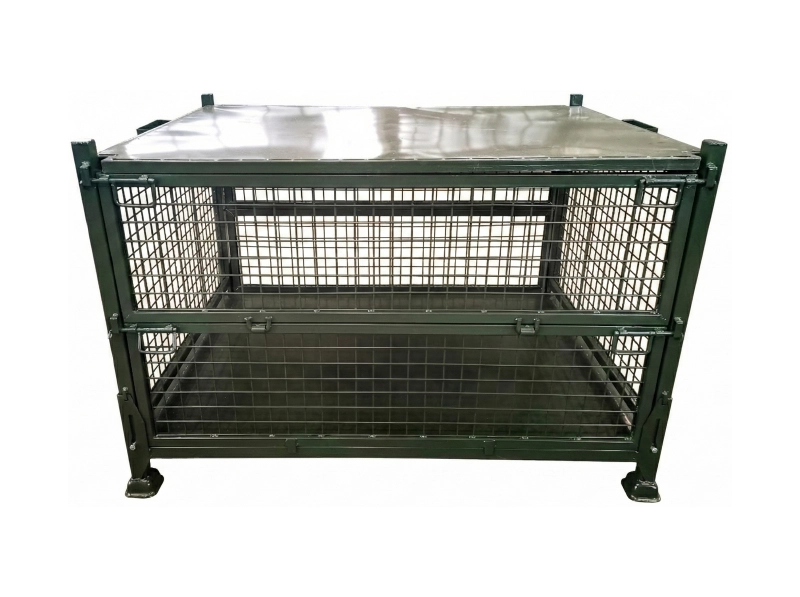
Choose a lid or more closed steel-panel arrangement when the goods need additional containment or restricted access. A lid does not by itself establish a dust-proof, theft-proof or weather-proof performance claim.
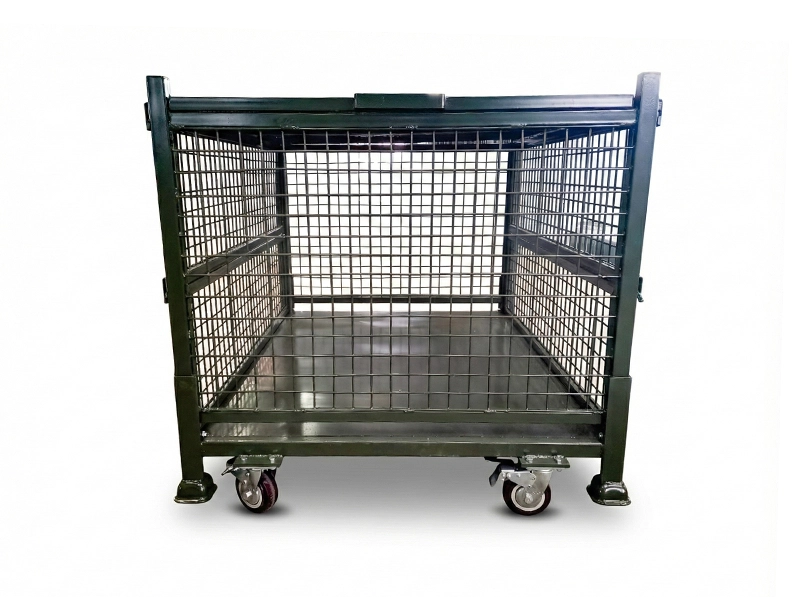
Add casters for short-distance warehouse picking or line-side movement when the floor, slope, pushing distance and loaded movement frequency are suitable. Confirm whole-unit caster capacity and brake requirements; do not derive the box rating from a single wheel rating.
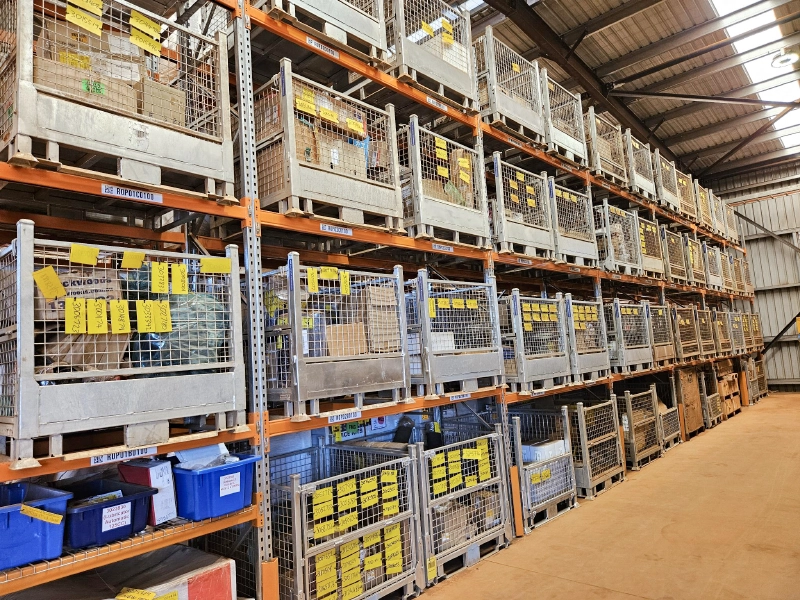
For high-frequency SKUs, a project-specific base can be designed for a stated pallet-rack beam and location. Provide beam height, beam width, clear bay height, rack capacity and the required locating method; compatibility is not universal.
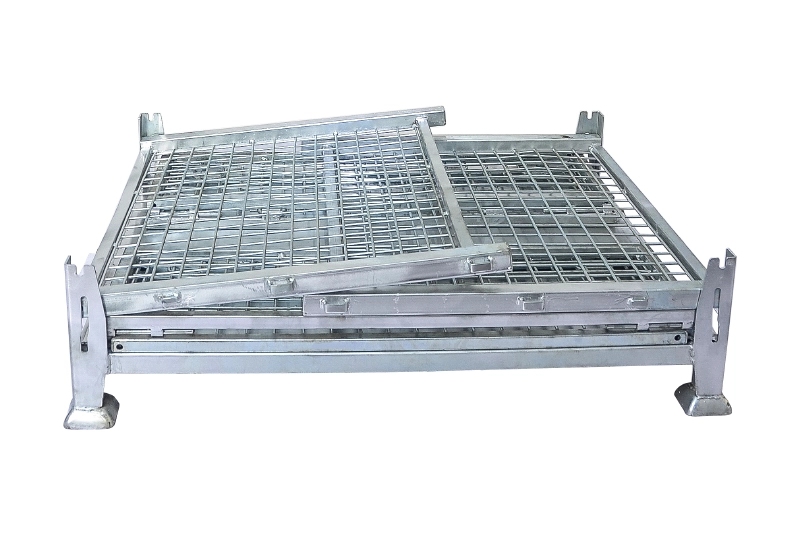
Folded units can be wrapped and loaded for return or export logistics. Container quantity depends on final footprint, folded height, lid, casters and packing method, so loading counts are quoted per approved packing plan.
The steel-tube upright skeleton carries the structure around the mesh enclosure and gives the design a stronger basis for project-specific stacking and larger formats than a light all-mesh cage. Loads still require confirmation for the selected dimensions and distribution.
A closed and latched Mybox can be handled as a unit by forklift or pallet truck when the base and fork access are designed for that route. This helps avoid repeated decanting of loose parts between storage and production.
Once unloaded, the side structure can be folded to reduce the footprint or height of empty units. The approved folding sequence and the folded dimension must be checked before routine operation.
Half-drop, full-opening, removable or multi-side door arrangements are available as design options. The correct choice depends on where the operator stands, what equipment surrounds the box and whether access is manual or forklift-assisted.
Powder coating, cold galvanizing and hot-dip galvanizing are recorded surface-treatment options. Indoor, outdoor, humid, chemical or cleaning conditions should be stated in the RFQ; coating or galvanizing is not a substitute for an unconfirmed corrosion or compliance certificate.
Send the part name, piece dimensions, individual and full-box weight, centre of gravity, sharp edges, loading pattern and whether the unit moves by forklift, pallet truck, caster or approved lifting attachment.
Confirm required internal dimensions, allowed outside dimensions, door side, access opening, base type, mesh or panel enclosure, lid, divider, pallet locating feature and any rack or vehicle clearance.
State whether the requirement is static storage, dynamic forklift movement, caster movement, stacking or lifting. Specify the target load distribution and stacking layers; do not use the reference 4,000 kg static or 2,000 kg dynamic figures for a different variant without engineering confirmation.
The final drawing should confirm tube sections, wire or plate details, folding mechanism, stacking feet, fork pockets, caster or lifting hardware, dimensions, tolerances and the selected powder-coat, cold-galvanized or hot-dip-galvanized finish.
Before production release, align the acceptance record, any requested load test or material documentation, marking, packaging and export loading plan. Folded-unit shipping quantities remain an estimate until the final packing arrangement is approved.
Train operators to latch doors fully, distribute loads, seat stacking feet correctly and move at controlled speed. Do not stack on uneven ground, with unlocked casters or with an unstable or offset load; ordinary fork-handling versions are not automatically approved for crane lifting.
Mybox is a configurable collapsible steel stillage, also described as a metal collapsible box or steel pallet cage. It consolidates loose or heavy industrial goods into a fork-handled, stackable and returnable unit. It is a product platform with project-specific dimensions and options, not one universal SKU.
A conventional wire mesh container may suit standard-size, lower-complexity storage. Mybox adds a steel-tube upright frame and can be engineered for larger formats, folding returns, different door arrangements, steel-panel protection, casters or a stated rack interface. The two products' load ratings must not be compared without matching size, load distribution and handling conditions.
The PDP reference configuration is 1,100 × 885 × 950 mm outside, 967 × 765 × 720 mm inside, about 330 mm folded height and about 70 kg tare weight. Its recorded project values are 4,000 kg static and 2,000 kg dynamic. Because Mybox is a configurable platform, those numbers are not universal ratings; the quotation and approved drawing must confirm the selected variant.
Project records include two-layer safety recommendations and three-, four- or five-layer arrangements, but the number is not universal. It depends on the selected frame, load, centre of gravity, floor, stacking feet, stability controls and operating method. The supplier must confirm the permitted layers for the final drawing and load case.
The base can be designed for forklift or pallet-truck handling, and a caster version can support suitable short-distance warehouse movement. Fork length, entry clearance, floor condition, slope, brake use and loaded movement frequency must be confirmed. A standard fork-handling box should not be treated as a lifting cage unless lifting points and hardware are specifically designed and approved.
Recorded options include powder coating, cold galvanizing and hot-dip galvanizing, with colour confirmed against the project requirement. Custom options include overall dimensions, mesh or steel-panel sides, mesh or steel bottom, wood-pallet locating features, lids, half-drop or full-opening doors, dividers, casters, rack locating features, lifting points, labels and logos. Final material thickness, coating requirements and environmental suitability remain quotation inputs.
Do not default to the open-mesh version when the goods need complete enclosure, controlled dust protection, restricted access, a certified lifting application, food or chemical compliance, or a known rack interface that has not been checked. Consider a lidded or steel-panel variant, another packaging system, or a separately engineered lifting or racking solution.
Send the goods and load data, required internal and external dimensions, door and access direction, handling equipment, stacking layers, rack or vehicle limits, environment, finish, quantity, packaging and any requested testing or documentation. Use the CTA to submit the operating conditions for a configuration table and quotation. Related selection routes are PDP-02, PDP-03, PDP-04, PDP-05 and PAGE-01.