
Cold Storage Without Floor Penetration: Why Inverted Nestainer Racks Protect the Insulation Layer
In a cold room, storage hardware affects more than capacity. It also affects insulation integrity, cleanliness, airflow, forklift access, and how quickly the layout can change when the frozen SKU mix shifts. That is why many operators choose an inverted nestainer rack, also called a rerack, instead of drilling anchors for fixed racks.
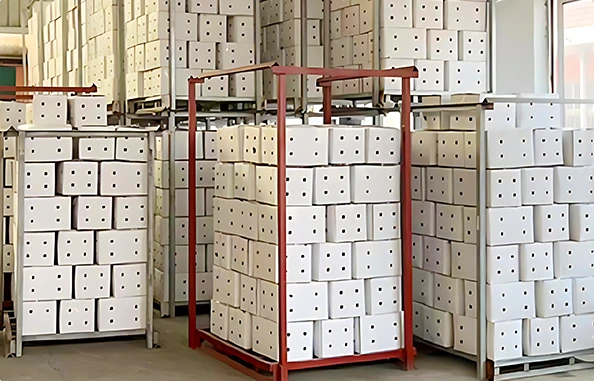
Why a self-supporting inverted rack matters in a cold room
Cold storage envelopes depend on continuous insulation and vapor control. Once a fixed rack is anchored to the floor or near the wall line, the environment becomes harder to modify and keep clean. A self-supporting inverted nestainer rack sits on the slab and is moved by forklift. The rack supports the load; the insulation layer is not penetrated for anchors.
That is the main logic behind the rerack approach. You add vertical storage without turning the cold room into a construction project. No repeated drilling. No unnecessary floor penetration. No compromising the modular layout of the environment when the buffer area needs to expand or shrink with seasonal demand.
How frozen cartons are sorted and stacked
In cold room operations, goods are usually cartonized before entering the rack. Operators group frozen cartons by SKU, batch, shipping sequence, or route. The pallet supports the load, while the inverted rack keeps the block stable and forklift-ready. This is far better than loose floor stacking when product must remain organized and easy to move.
Stacking directly on the floor seems cheaper at first, but the bottom cartons bear the full compression load, the stack can drift, and FIFO becomes harder to maintain. In a low-temperature environment, every extra handling step also means more exposure time for workers. A nestainer system reduces touchpoints by allowing the forklift to move a unitized block at a time.
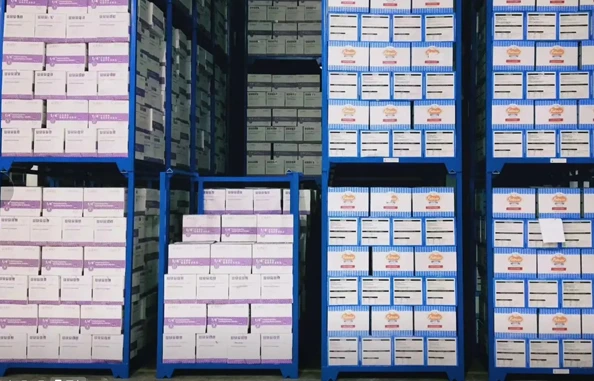
The 100 mm clearance of the empty rack and the forklift fork engagement
For the empty return loop, the rack family uses a nesting geometry that leaves about 100 mm of clearance in the referenced version so forklift forks enter cleanly. That clearance is practical. It helps the operator separate, lift, and reposition empty racks without binding, while the nested stack still occupies far less floor area than a row of fixed racks.
This is where the same system solves both ends of the cycle. Loaded racks create vertical storage. Empty racks collapse into a compact return stack. For cold storage operators, this is valuable during low-demand periods or between inbound waves, because empty hardware no longer consumes the same floor footprint as active storage.
Inverted rerack versus fixed pallet rack
Selective pallet rack is a strong choice when the warehouse needs permanent aisles and exact slot access. But it is not always the best fit for cold rooms with variable product mix, short campaigns, or temporary overflow. Fixed racks lock the aisle plan in place. If demand shifts, you inherit unused lanes, harder maintenance, and less freedom to resize the buffer area.
An inverted nestainer rack is more flexible. It suits cold room storage for palletized cartons, when you want to preserve the insulation envelope, and when you prefer mechanical forklift handling over manual rehandling. It is also a better match for operations that need a temporary storage zone, seasonal buffer, or a closed-loop return system for empty racks.
It is less suited to very small unpacked items, random loose goods, or ultra-permanent high-bay layouts that require fixed slot access at every level. In those cases, a different rack family may fit the workflow better. The key is matching the storage method to the load shape and turnover pattern, not forcing every cold room into the same layout.
When the rerack version is the right choice
Choose the inverted version when you need a movable storage block, faster seasonal layout changes, or a cleaner way to keep frozen cartons organized without floor anchoring. It fits cold storage operators, frozen food processors, and buffer warehouses handling palletized or cartonized products.
Because the Strack family is built as a welded steel nestainer system, it can support loaded stacking and empty nesting in the same workflow. That is the practical advantage: the environment stays adaptable, the insulation layer stays intact, and the forklift stays in command of the handling pace.
If you are comparing detailed product specifications or a live project reference, continue here:
Go to PDP-04 Open CASE-02Precisa de uma Solução de Armazenamento Personalizada?
Fale diretamente com nossos engenheiros técnicos. Oferecemos projetos estruturais gratuitos, avaliações de catálogos de alta capacidade e orçamentos rápidos para B2B.
Solicite um Orçamento Agora →