
Cold Storage Without Floor Penetration: Why Inverted Nestainer Racks Protect the Insulation Layer
In a cold room, storage hardware affects more than capacity. It also affects insulation integrity, cleaning, airflow, fork access, and how quickly the layout can change when frozen SKU mix shifts. That is why many operators choose an inverted nestainer rack, also called a rerack, instead of drilling anchors for fixed racking.
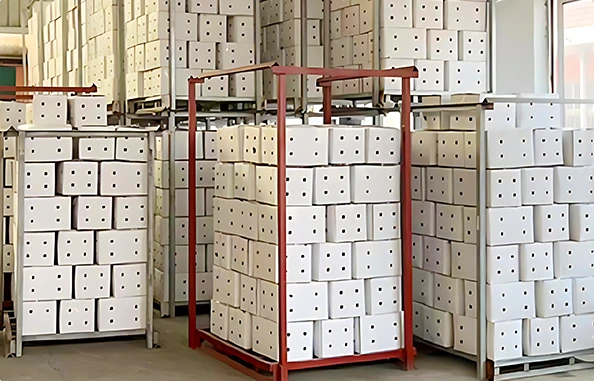
Why a free-standing inverted rack matters in a cold room
Cold storage envelopes depend on continuous insulation and vapor control. Once a fixed rack is anchored into the floor or near the wall line, the room becomes harder to modify and harder to keep clean. A free-standing inverted nestainer rack sits on the slab and is moved by forklift. The rack carries the load; the insulation layer is not pierced for anchors.
That is the main logic behind the rerack approach. You add vertical storage without turning the cold room into a construction project. No repeated drilling. No unnecessary floor penetration. No compromise to the room’s modular layout when the buffer area needs to expand or shrink with seasonal demand.
How frozen cartons are sorted and stacked
In cold-room work, goods are usually cartonized before they enter the rack. Operators group frozen cartons by SKU, lot, dispatch sequence, or route. The pallet supports the load, while the inverted frame keeps the block stable and forklift-ready. This is much better than loose floor stacking when product must stay organized and easy to move.
Direct floor stacking looks cheaper at first, but the lower cartons take the full compressive load, the stack can drift, and FIFO becomes harder to maintain. In a low-temperature environment, every extra rehandling step also means more exposure time for workers. A nestainer system reduces touch points by letting the forklift move one unitized block at a time.
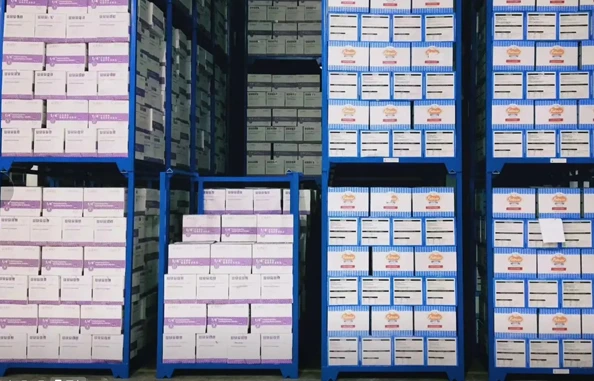
The 100 mm empty-rack gap and forklift tine fit
For the empty return loop, the rack family uses a nesting geometry that leaves about 100 mm of gap in the referenced version so forklift tines can enter cleanly. That gap is practical. It helps the operator separate, lift, and reposition empty frames without binding, while the nested stack still occupies far less floor area than a row of fixed racks.
This is where the same system solves both ends of the cycle. Loaded racks create vertical storage. Empty racks collapse into a compact return stack. For cold storage operators, that is valuable during off-peak periods or between inbound waves, because empty hardware no longer consumes the same floor footprint as active storage.
Inverted rerack versus fixed pallet racking
Selective pallet racking is a strong choice when the warehouse needs permanent aisles and exact slot-by-slot access. But it is not always the best fit for cold rooms with changing product mix, short campaigns, or temporary overflow. Fixed racks lock the aisle plan in place. If demand shifts, you inherit unused lanes, harder maintenance, and less freedom to resize the buffer area.
An inverted nestainer rack is more flexible. It is suitable when you need cold room storage for palletized cartons, when you want to preserve the insulation envelope, and when you prefer forklift mechanical handling over manual rehandling. It is also a better match for operations that need a temporary warehouse zone, seasonal buffering, or a closed-loop return system for empty racks.
It is less suitable for very small unpacked items, random loose goods, or ultra-permanent high-bay layouts that demand fixed slot access at every level. In those cases, a different rack family may fit the workflow better. The key is matching the storage method to the load form and the turnover pattern, not forcing every cold room into the same layout.
When the rerack version is the right call
Choose the inverted version when you need a movable storage block, a faster seasonal layout change, or a cleaner way to keep frozen cartons organized without floor anchoring. It fits cold storage operators, frozen-food processors, and buffer warehouses that handle packaged products on pallets or in cartons.
Because the Strack family is built as a welded steel nestainer system, it can support loaded stacking and empty nesting in the same workflow. That is the practical advantage: the room stays adaptable, the insulation layer stays intact, and the forklift stays in charge of the handling rhythm.
If you are comparing product detail specs or a live project reference, continue here:
Need a Custom Storage Solution?
Speak directly with our technical engineers. We offer free structural designs, heavy-duty catalog evaluations, and quick B2B price quotations.
Request a Quote Now →