
For cold room operators, the finishing question is not “which option is most corrosion-resistant by default?” It is “what does the rack actually face in this environment?” If the stackable rack sits inside an enclosed cold room or refrigerated warehouse, with no direct rain, no external UV, and only limited temperature variation within a controlled operating window, electrostatic powder coating is generally the practical choice.
This matters because many buyers pay for a heavier corrosion package before they have a use case that requires it. In indoor cold rooms, the more important decision is often structural strength, forklift compatibility, nesting efficiency, and total system cost. The finish should follow the working condition, not a generic assumption that every cold room stackable rack must be galvanized.
Why indoor cold rooms usually do not need galvanization by default
Inside a sealed cold room, the rack is not exposed to rain, weather washing, or the same kind of day/night thermal cycling that drives outdoor corrosion. That is why an electrostatically painted steel stackable rack can be sufficient for many frozen food and chilled storage layouts. The coating helps protect the structure’s surface during normal warehouse handling, while the system’s real value comes from the heavy-duty rack frame, stable corner posts, and the ability to stack or nest without wasting aisle space.
For buyers planning an indoor cold storage project, this is often the right balance: enough surface protection, a simpler budget, and a finish that matches the real environment rather than an oversized one. In other words, the coating decision should be tied to site conditions, cleaning routine, and storage cycle—not a standard rule of “more protection is always better.”
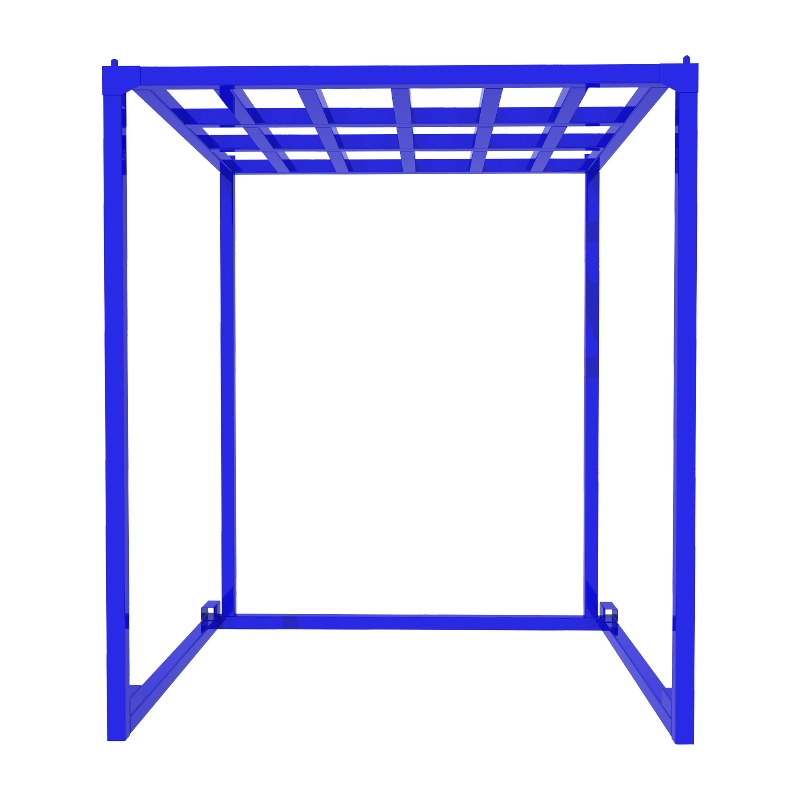
Where the line shifts: outdoor rain, wet zones, and internal rust risk
The finish choice changes as soon as the rack leaves the controlled indoor environment. If a stackable rack sits outdoors, under a dock canopy with recurring splashback, or in a zone with prolonged humidity and frequent wet handling, a stronger corrosion package should be discussed before purchase. This is especially important when water can collect in tube ends, joints, or hidden cavities after prolonged rain exposure. Once moisture is trapped, internal rust becomes a real limit issue, and basic powder coating is no longer the only conversation you should have.
This is also why we do not treat galvanization as the automatic answer. Galvanization, hot-dip protection, or other higher-corrosion-resistance options are specification decisions, not standard labels. The right answer depends on whether the rack is truly indoor-only, whether it will be exposed to rain or washing, and whether the operator is considering long-term outdoor storage instead of enclosed cold room storage.
How to specify the rack correctly before buying
The easiest way to avoid overbuying is to clearly describe the working condition. Tell the supplier whether the rack is for frozen storage, chilled staging, or a mixed indoor/outdoor buffer zone; whether forklifts will move it frequently; whether empty racks will be nested for reverse logistics; and whether the environment is dry, humid, or water-exposed. For indoor freezer and cold room use, electrostatic powder coating is often sufficient. For outdoor or long-damp-exposure applications, request a stronger corrosion package upfront.
That way, the product matches the job. A stackable rack is not just about finish; it is also about high-strength support, stacking stability, and space efficiency. If your operation needs a mobile cold room rack, a post pallet, or a stackable container that can nest when empty, the coating should support the workflow rather than drive it.
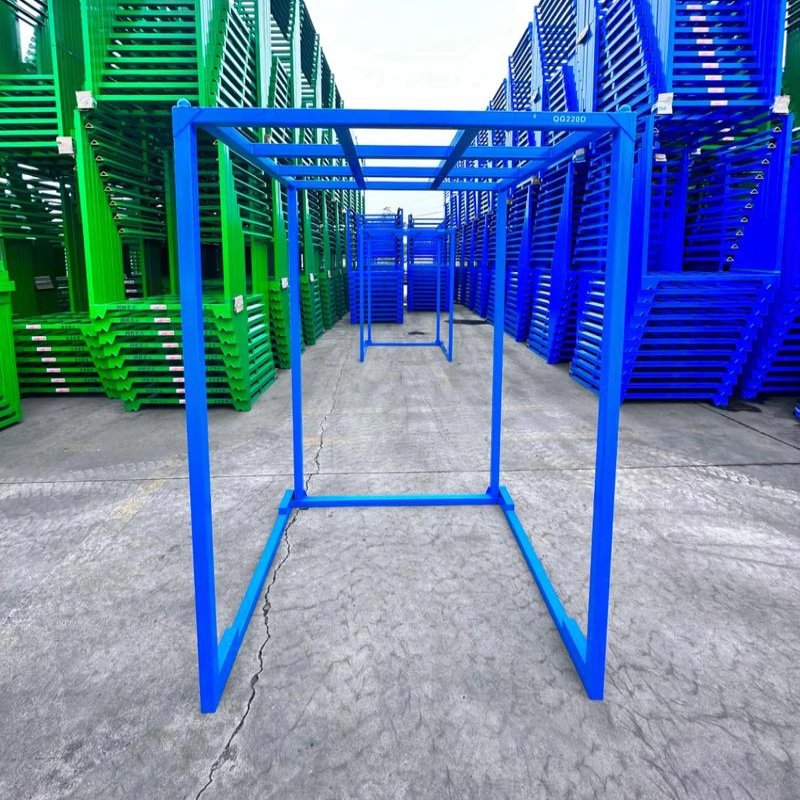
Common cold room use cases
- Frozen and chilled food buffer storage inside enclosed cold rooms
- Indoor pallet staging where a powder-coated steel stackable rack is sufficient and galvanization would add unnecessary cost
- Temporary warehouse layouts that need stacking, nesting, and fast forklift handling
- Mixed-condition projects where indoor areas can use electrostatic painting, but outdoor exposure requires a stronger corrosion specification
FAQ
Is electrostatic powder coating enough for a cold room stackable rack?
Yes, in many indoor cold room projects it is. If the rack stays in an enclosed environment with no direct rain and no constant moisture exposure, powder coating is often the right balance between protection and cost. It is not a zero-maintenance promise, however—you should still inspect welds, edges, and contact points regularly.
When should I ask for a stronger corrosion finish?
Ask when the rack faces outdoor rain, prolonged humidity, washing, or any condition where water can remain on the tubular structure and create internal rust risk. If that is your operational reality, do not assume standard powder coating is enough; specify the coating by working condition first.
If you are comparing options for indoor cold rooms now, use PDP-04 for product-level specification verification and CASE-02 for application proof. That is the fastest way to confirm whether your project is an indoor powder-coating job or an environment that needs a stronger corrosion package.
Precisa de uma Solução de Armazenamento Personalizada?
Fale diretamente com nossos engenheiros técnicos. Oferecemos projetos estruturais gratuitos, avaliações de catálogos de alta capacidade e orçamentos rápidos para B2B.
Solicite um Orçamento Agora →