
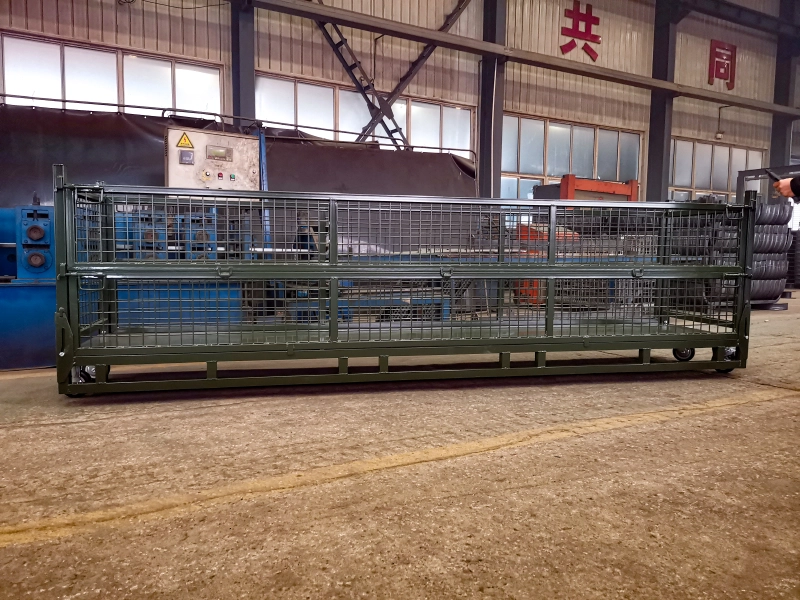
A fabrication shop has to hold 3200 mm stock — extrusion, tube, shaft or profile — and the floor will not take anything wide or tall: external width 1150 mm, total height 915 mm. Those three numbers look like a specification. They are not. Between “3200 mm internal length” and a long-part box that a forklift can pick, a person can load and a truck can carry, there are four separate decisions, and an envelope that satisfies one of them can still fail the other three.
Our 16263 project record is a useful example for exactly that reason, because it is still an open proposal rather than a finished design. The recorded requirement is a 3200 mm internal length, a 1150 mm external width, a total height not over 915 mm, casters and fork channels underneath, with the load requirement and the surface treatment still undecided. The proposal answers with a 3340 × 1150 × 915 mm body, 3200 × 970 × 590 mm internal, 185 kg empty, and it records 1000 kg capacity and three stacking layers as proposal values only. Treat it as a starting envelope for a fit discussion — not as a released drawing, and not as a general capability of collapsible steel boxes.
Where the 140 mm between “3200 internal” and “3340 external” goes
3340 minus 3200 leaves 140 mm of length. That is the two end frames: roughly 70 mm per end for the corner post, its wall thickness and the return that closes the long side. Width behaves the same way: 1150 external against 970 internal is 180 mm, about 90 mm per side for the post, the folding gate and its latch. None of that is slack the buyer can reclaim later. It is structure, and it is what turns a nominal internal figure into a loadable length.
So the first thing to put on a drawing is not “internal length 3200 mm” but the working measurement: net internal length taken between the end frames at loading height, near the deck — not across the top rail, where a rail or a gusset can narrow the opening. Then three follow-up checks: whether the internal length is constant over the whole 590 mm internal height or interrupted by bracing; whether the 3200 mm figure already carries a welding and coating allowance; and what clearance the longest part needs to be inserted at all. A part specified as 3180 mm long that two people slide in by hand produces a different drawing from a part that has to be lifted over a side panel.
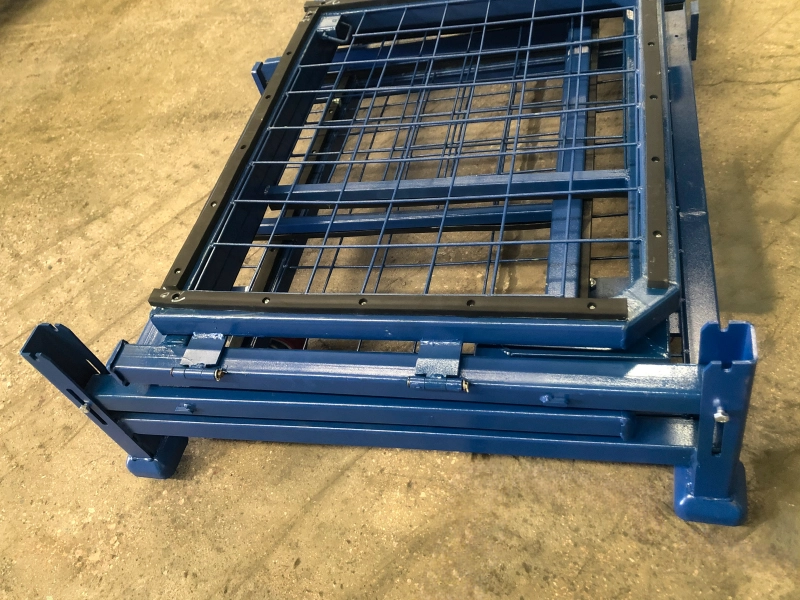
The end frame in that detail is the structure that consumes the 140 mm. Ask for its width and for the stacking foot position at the same time: on a long body the foot has to land on the columns of the box below, so the foot layout follows the end-frame geometry, not the nominal outline.
A face-by-face reading of the proposal envelope
- Length. 3200 mm net internal inside a 3340 mm external body; 140 mm is end structure, and the loadable length is shorter still once insertion clearance is counted.
- Width. 970 mm net internal inside 1150 mm external. That decides how many long items lie side by side — usually one row, occasionally two, rarely more.
- Height. 590 mm internal inside 915 mm total. The 325 mm difference has to absorb the base depth, the fork channels and the top rail; if the 915 mm limit is measured over the casters, the wheel height comes out of that same 325 mm, which is the figure to confirm before anything else is discussed.
- Access side. Which face opens, how far it opens, and whether a 3200 mm rigid part can physically be inserted through that opening.
- Base. Fork channels in two directions per the record, with the spacing still marked as an open item.
- Empty state. The folded envelope, which is not recorded for this scheme and therefore cannot be quoted as a return-freight figure.
Fork channel spacing and centre of gravity are two confirmations, not one
The 16263 record states that the base is welded as one piece with forklift channels reserved in two directions, and it lists “fork channel spacing 1000 mm — acceptable?” as an open question. That is the honest status, and it shows why the spacing has to be confirmed against truck data rather than assumed. A 1000 mm spacing inside a 1150 mm external width leaves about 75 mm per side; tine thickness, the base underside structure and any caster plate have to fit inside that margin. Spacing is also fixed at build, so the spread positions of the trucks you actually run — and the tine thickness — are the input, not the outcome. Dual-direction entry is not four-way entry; the record claims two directions, and the drawing should name which two.
The second confirmation is centre of gravity along the 3200 mm length. Long stock is rarely evenly distributed: a heavy head on a shaft, a bundle pushed to one end, two lengths of different wall thickness in the same box. The load centre moves away from the fork heel, and a truck’s usable capacity falls as that distance grows — so the truck has to be checked at the real load centre, and the tines have to reach under the mass rather than stop short of it. Our earlier look at forklift tine length and clearance on steel stillages covers the truck side of that check in more detail; this article only adds the long-body consequence.

Handle casters as a third, separate review. The record recommends four swivel and two fixed casters, iron-core polyurethane or nylon, bolted on by the buyer after delivery to save shipping space. That is a sensible proposal, but it means the wheel mode and the forklift mode share one base: caster plates compete with the fork channels for the same 325 mm, and a box that rolls well on a smooth bay floor may still need a forklift to travel between buildings. Neither mode proves the other.
The loading action decides the gate, and the gate is still open
The proposal puts folding gates on the two sides in the 1150 mm width direction — that is, along the long sides — secured by latch pins, with half-open and full-open positions. The record is explicit that the illustration shows a working principle, not the structure of this design. So the gate geometry is unresolved, and that matters more here than on a standard box: a 3200 mm rigid part can only go in through a fully opened long side or from above. Half-open access is for shorter items, or for reaching in to position a load already placed.
Two site checks follow from that. First, aisle space in front of the long side: a folding gate needs room to swing and fold, and a folding pair throws less than a single full-length panel, but the aisle still has to be measured rather than assumed. Second, the pick-and-place action itself — a 3200 mm part held by two people at 590 mm internal height is a low lift with a long reach, which is where handling injuries actually come from. If the shop normally lifts by overhead crane, note that this scheme records casters and fork channels only; crane lifting points would be a separate design item, not a default feature.

The double-bay long box in that photo is a good illustration of what not to assume. Dividing a long body into bays is useful when one lift has to carry separate part families, but each bay shortens the usable length: two bays across a 3200 mm internal length give roughly 1590 mm per bay, which cannot carry a 3200 mm part at all. Bay division belongs to shorter stock mixes, not to this requirement.
When an existing long-goods rack is the better answer
Long-part storage has more than one honest solution, and a collapsible box is only one of them. The conditions below decide it, not the product name:
- Cantilever or long-material rack. If the stock never leaves the building, is picked by crane or side-loader and has no shipping or return loop, a rack usually wins — no empty body to move, no 185 kg shell to fold, no return-freight question.
- Open post pallet or nesting stillage. A few long items handled by forklift with tie-downs, where an enclosing side panel adds nothing but weight and a gate to maintain.
- A-frame or glass-type rack. Flat panels and sheet, which need edge support rather than a trough.
- Fixed box, no folding. A one-leg route with no empty return saves the hinge and latch hardware and the folded-state tolerances.
- One-way wooden packaging. A single shipment does not repay a returnable body.
- Where the collapsible box wins. Repeated loops inside and outside the building, mixed lengths consolidated into one lifted unit, forklift handling that needs containment and a countable unit, and stacked storage at modest height.
There is also an arithmetic limit worth stating plainly. A 3200 mm internal length inside a 970 mm internal width is a narrow trough: one row of long stock per box, 590 mm high. If a store needs three or four rows of long material plus stacked reserve, a rack will generally hold more per square metre than a fleet of boxes, and the box becomes the transport unit rather than the storage system.
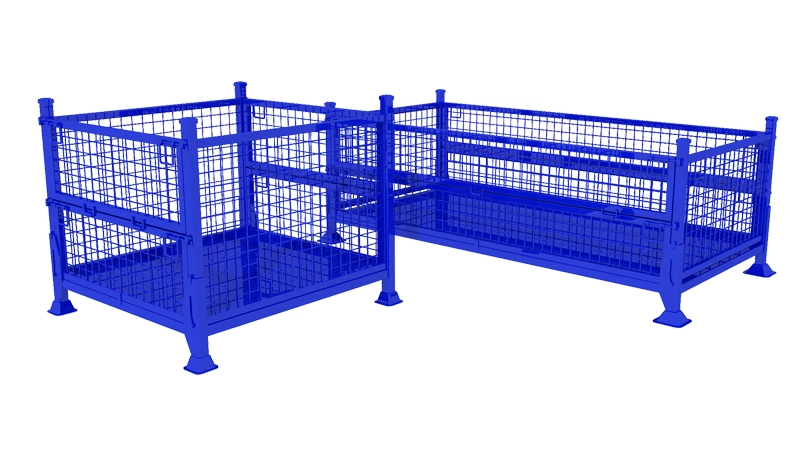
Proportion, not dimension, is what that comparison shows: the length-to-width ratio you choose for a long-part body is a storage decision before it is a transport decision.
What this proposal does not fix yet
- Load capacity of 1000 kg and three stacking layers are proposal values. The requirement was recorded as undecided, so neither number is a rating for your load.
- Panels: mesh or steel plate on walls and base is unresolved, which leaves containment of small parts, visibility for stock checks and cleaning between uses open.
- Surface treatment: powder coating is proposed with a colour choice; the corrosion duty — indoor bay or outdoor yard — is unresolved.
- Fork channel spacing of 1000 mm is a question in the record, not a confirmed dimension.
- Gate and hinge structure is a working-principle illustration only.
- Packaging: stretch film plus strapping is the standard answer in the record, with the note that it does not fully protect the paint film; a wooden crate is available at extra cost and reduces the loading count, which was proposed at 42 units per 40 ft high cube for this body.
- Folded height of this scheme is not recorded, so no empty-return volume can be quoted from it.

Long bodies do fold — the folded long container above is from the same product family — but the folded profile of a 3340 mm body is a dimension to be measured on a drawing, not inferred from the photograph.
What to send us for a preliminary fit check
- The longest part length plus the tolerance you actually work to, and whether it must be inserted without being lifted over a side rail.
- Cross-section, part count per box and how many rows you expect to store in one body.
- Total load per box and where the mass sits along the length — one end, evenly spread, or a bundle offset to one side.
- The lifting equipment: forklift model, fork spread positions, tine length and thickness; whether a pallet truck or overhead crane is also involved.
- Height and width limits including door openings, and the aisle space available for opening the long side.
- Whether the box must stack, at how many layers, and the floor and clear-height limits at the stacking location.
- The empty return route, so the folded envelope and container count are checked against the same route.
- Indoor or outdoor use, and the finish that decision demands.
With those inputs, the internal length, the end-frame allowance, the fork channel spacing and the gate configuration can be settled together. Without them, any figure — including the 3200 mm in this record — is a proposal value waiting for confirmation.
Questions buyers ask about long-part box specification
Is the 3200 mm internal length the longest part I can load?
No. It is the clear length between the end frames. The longest loadable part is shorter once insertion clearance, any internal bracing, weld and coating tolerance, and the loading path are counted — and on this body the loading path is a long side that folds, not an open end.
Can the fork channel spacing simply be set to 1000 mm?
Only after the trucks are known. Spacing is fixed at build, and 1000 mm inside a 1150 mm external width leaves about 75 mm per side for tine thickness and base structure. Send the spread positions and tine thickness of the trucks in the fleet, plus where the load centre sits along the 3200 mm length.
Does the recorded 1000 kg capacity and three-layer stacking apply to my parts?
Not as stated. Both are proposal values from a record where the load requirement was undecided. Capacity, stacking layers and the truck’s capacity at the real load centre are three separate confirmations, and none of them transfers from one project to another.
When should I keep my existing long-goods rack instead of buying boxes?
When the material is stored and picked in one place, handled by crane or side-loader, and never travels in a returnable loop. A box earns its place when the long parts have to move, be counted, be contained during handling, and come back empty — and when the empty body can fold out of the way.
The 16263 envelope is a starting point: 3340 mm outside, 3200 mm inside, 1150 mm wide, 915 mm over the wheels and channel base, with the load requirement and finish still open. Sending the part length, the centre of gravity, the forklift and the door or aisle limits together is what turns it into a drawing that a fabricator can price and a shop can actually load.
Precisa de uma Solução de Armazenamento Personalizada?
Fale diretamente com nossos engenheiros técnicos. Oferecemos projetos estruturais gratuitos, avaliações de catálogos de alta capacidade e orçamentos rápidos para B2B.
Solicite um Orçamento Agora →