
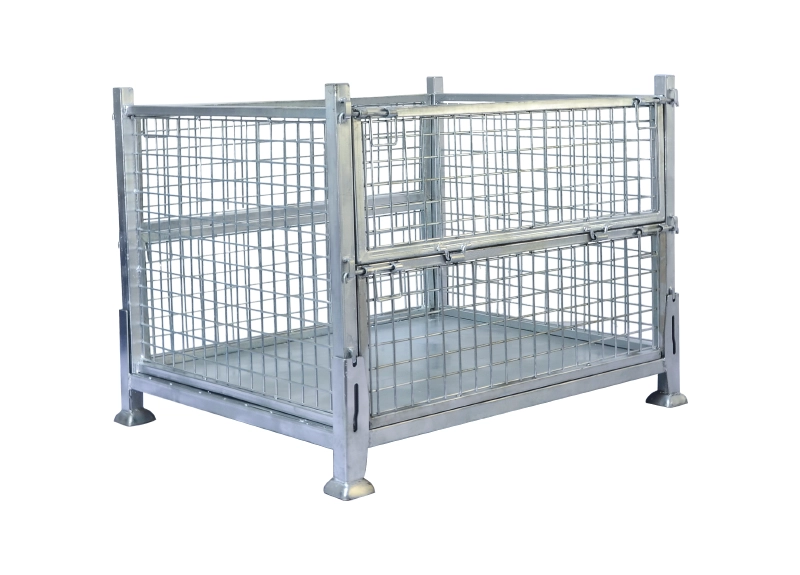
A paint distributor who wants pails off the floor and into a stacked steel pallet box usually starts the conversation with footprint, price and delivery. The step that decides whether the consolidation actually works is duller and earlier: how each pail’s base ring lands on the box bottom, and what happens the first time a pail loses its lid.
Those are two separate reviews with two different owners. Bottom support is a steel geometry question that a drawing can settle. Spill handling is an environmental decision that belongs to your EHS function and your local rules, and no box bottom substitutes for it. The order matters: settle pail-to-deck support first, then assess what leak response you need as its own requirement — never the other way round, because a base chosen for appearance is hard to change once the boxes are in the warehouse.
The pail base ring is the only load path into the deck
A sealed paint pail carries its mass through the base ring — the rolled chime where the bottom disc meets the wall. The centre of the base is usually slightly domed and carries almost nothing. Two pail suppliers quoting the same nominal capacity can therefore present different base diameters and different ring widths, and a steel pallet box does not care about capacity; it cares about the ring. Before any base discussion, record four numbers per SKU: base ring outside diameter, ring flat width, pail height including lid and handle, and filled mass. Nominal 5 gal or 20 L pails commonly sit somewhere in the 280–300 mm base range, but the spread between suppliers is real, so measure your own pails instead of accepting a catalogue figure.
Filled mass deserves its own line because paint is dense. A nominal 20 L pail is not a 20 kg unit. Use the label mass or put one full pail on a scale, then multiply by the count you intend to load. That number drives the base members, the deck plate, the stacking layer count and the truck, and it is the figure most often estimated from volume instead of weighed.
Matching pail base diameter to bottom member spacing
Ask for member pitch, centre to centre, and the clear gap between members — not simply “beam spacing”, which hides both. Then run three checks against your actual pail.
First, each pail should land on at least two members in the direction of the gap, with bearing on each side no less than the ring’s flat width. If the member pitch is larger than the pail base diameter, no arrangement lets a pail span two members, and the honest answer is a different bottom: a sheet steel plate deck, or a captive insert that distributes the load. Second, trace the ring rather than trusting the layout drawing. Draw the pail circles on the real deck drawing, including the first and last rows against the end frame and the gate line; the marginal row is where pails end up half on steel and half over air. Third, confirm that the gate is not a bearing surface. A half-drop gate, a removable gate and its latch are access parts, and a loaded pail should not rest on them.
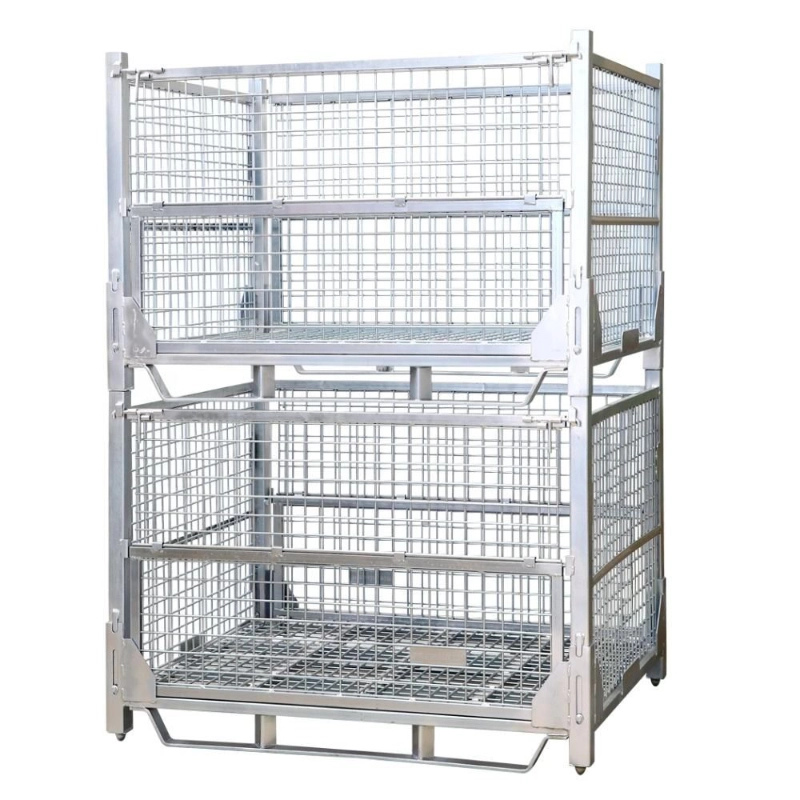
On the mesh decks recorded in our project files — commonly 50 × 50 mm aperture with Ø5 mm wire — a paint pail cannot fall through, so the risk shifts from falling to point contact. Each pail touches a number of wire crossings, which is generally fine for a steel pail base but worth checking on HDPE pails with a softer base. A plate deck spreads the same load across an area instead of a set of points. The trade-off is not load capacity as much as residue, cleaning and what the deck does with a drip, which is the subject further down.
What each bottom option is actually good for
- Plataforma de malha de arame: light, drains, easy to see a drip from above and below; carries a dense pail pattern on multiple crossings, but holds nothing and gives no barrier if a pail weeps.
- Sheet steel plate bottom: spreads point loads, gives a flat surface for pails and labels, and stops a small drip at deck level; adds mass, needs cleaning, and is not a sealed vessel.
- Pallet base or fork-pocket base: suits existing pallet handling, but the bearers are usually few and widely pitched — verify pail diameter against bearer pitch before ordering, since this is the layout most likely to leave pails bridged over a gap.
- Fixed insert or liner tray inside the box: a compromise when base members are already built; useful for drips, but it reduces net internal height and must be restrained so it cannot shift under load.
Verifying net dimensions, pail stacking and centre of gravity
Layout work must be done on the internal dimensions, never the outer ones. Recorded project builds show how far apart those two sets are: one collapsible steel stillage at 1100 × 885 × 950 mm outside gives 967 × 765 × 720 mm inside; a 1200 × 1200 × 1100 mm build gives 1065 × 1075 × 885 mm with around 1500 kg design uniform load and a 330 mm folded profile; a caster scheme at 1300 × 900 × 900 mm outside gives 1175 × 775 × 690 mm inside. Those are project references, not a series specification, but the pattern holds: walls, base structure and top rail consume real space, and a pail layout drawn on the outer figure will not fit.

From the internal space, count pails per layer in both directions and then subtract clearance for lids, handles and spouts. Clearance above and beside the pail decides whether a lid can be opened in place at all; if it cannot, the access face has to be settled now — four-sided access, a half-drop front gate, or a removable gate — because retrofitting access to a loaded box is not practical.
Two layers of pails in one box is never automatic. Upper pails need a divider or load spreader so they do not load the lids of the lower pails, and the layer count is a line of its own, separate from the per-box load. Our project files routinely record stacking layers and per-box load as two separate figures, with layer counts of three to five boxes or a design use height around four to five metres on the builds that were checked for it. Those were parts, rollers and produce jobs; none of them transfers to a pail pattern, and a pail-heavy box has a different mass distribution.
Centre of gravity is where a pail load differs most from a crate of parts. Full pails are dense, and a single layer of them puts the mass high in the box. A partially filled box also has off-centre mass unless the pattern is symmetric about both centre lines; if you must run a short row, place it against a fixed end rather than against the gate. That offset feeds two downstream checks: the stacking feet must sit on the column tops of the box below — a foot resting on a mesh top rail is not a stack — and the truck’s capacity at the actual load centre is a separate review from the box rating. If the box is going onto racking rather than the floor, the beam interface is yet another review.
Also worth saying plainly: the twenty-odd recorded builds behind this product line do not share one rating. Sizes, loads, folded profiles and layer counts are per project and per drawing, and the folded height of 330–370 mm recorded across projects is an envelope, not a promise for your build.
What a mesh deck does with a leaking pail
A pail that loses its lid, is overfilled, or rides a hot trailer will weep or spill. On a mesh deck nothing is held: liquid passes the apertures and arrives at the box underneath, the rack beam, or the floor, whichever is below. On a plate bottom the deck stops it at the deck — but only until the level reaches a gate gap, a hinge line or a corner joint, none of which are sealed. So the accurate description of a plate-bottom steel pallet box is this: it gives you time and a visible location for a drip. It is not a container, it has no declared holding volume, and it has not been tested against your product.
Finish belongs in the same paragraph because it is often confused with chemical resistance. Recorded finishes include electrostatic powder coating controlled to roughly 50–70 μm in our video records, plus cold and hot-dip galvanizing; all three are atmospheric corrosion protection. None of them is evidence that the box tolerates paint, solvent or water-based product standing in the base for weeks. We have no compatibility test data for that condition, and it should not be inferred from a coating figure.
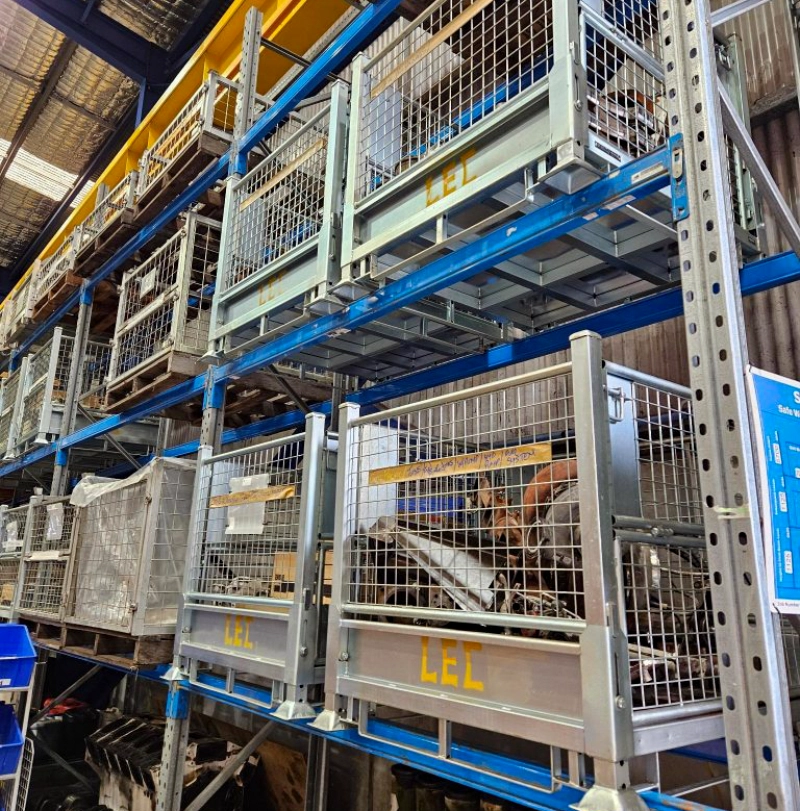
Cleaning is the quieter half of the same problem. A plate deck retains dried paint film and grit in the corners, and if pails are stored above other stock, a spill has somewhere to fall. Decide who cleans the base, with what, and how often, before the first box is filled rather than after the first incident.
When a drip tray or a separate bund is the right call
The decision is not about how careful your team is. It follows from what the product is, where the box sits and whether anyone pours. Four cases, only one of which points at us:
- Your product is regulated or your permit requires containment: you need a dedicated spill pallet or bund with a declared volume, tested and certified for that duty, plus EHS sign-off. That is not this product, and we will not present a steel pallet box as one.
- Anyone pours, decants or re-labels inside or directly above the box: add a removable drip tray with a raised rim, sized to the internal footprint with lifting handles, and put it on a change-out schedule. It is an accessory with its own supplier decision, chosen for the liquid and the volume you are willing to handle.
- Pails stay sealed, handling is forklift-only, the floor stays dry: a tray may not earn its cost. Absorbent pads, a scheduled base inspection looking for rust lines, paint runs and distorted lids, and a written response step may be the proportionate answer.
- Pails sit on a rack level above other stock: the spill has somewhere to fall. Choose deliberately: pails at floor level, a plate bottom plus tray, or a rack-level drip pan under the bay. Sitting pails over cartons and hoping is not one of the options.
If your EHS or your insurer asks whether a box is a bund, the answer is no, and it is better to hear that before the order than after the audit. Where a bundled containment arrangement is needed, the box and the containment are two different purchases.
Pre-order checklist for a pail consolidation
Send the following and the base, deck and gate questions can be answered on a drawing rather than in a meeting:
- Pail base ring outside diameter and ring flat width, per SKU — a photo of one pail upside down shows this faster than a description.
- Filled mass per pail, weighed or from the label, plus pails per layer and rows in each direction.
- Pail height including lid, with the clearance you need to open or reclose a lid in place.
- Bottom preference: member pitch under the pail footprint, or a request that we set it from your pail base.
- Access face: four-sided, half-drop gate or removable gate, and which face the picker works from.
- Stacking: how many boxes high, what sits below, and whether the stack stands on the floor or on rack beams.
- Handling: forklift pockets, pallet jack entry or casters, with the truck you actually use.
- Spill: how a drip is handled today, whether anyone pours at the box, and whether a tray or a rated bund is being specified separately.
If the member pitch we would choose does not clear your pail base, we say so before quoting rather than after delivery. If the requirement turns out to be containment, that part belongs with a containment supplier and we will tell you so.
Questions buyers ask at this stage
Can a standard 1200 × 1000 metal pallet box take paint pails without a special base?
Only after the ring check. Pail base diameter against member pitch, the marginal rows against the end frame, and the gate line decide it. Bases with few widely pitched bearers usually need a plate deck or an insert for pail loads, while a finer mesh or slat pattern may need nothing changed at all.
Will the box hold the paint if a pail leaks?
No, not in any containment sense. A plate bottom slows a drip and shows you where it is; joints, hinges and gates are not sealed, there is no declared holding volume and no compatibility test data. Rated containment is a different product, chosen with your EHS.
Do we need a tray if the pails stay sealed?
Not always. Sealed pails, forklift-only handling and no pouring can be covered by absorbent and a scheduled base inspection. The answer flips as soon as someone decants at the box, or as soon as pails are stored above goods that a spill would reach.
For the stacking side of the same decision — how many loaded boxes may stand on each other, and why a layer count from another project cannot be transferred — our note on loaded stack height for stackable metal pallet boxes works through the same evidence. The product family itself is described on the Mybox collapsible steel stillage page.
Precisa de uma Solução de Armazenamento Personalizada?
Fale diretamente com nossos engenheiros técnicos. Oferecemos projetos estruturais gratuitos, avaliações de catálogos de alta capacidade e orçamentos rápidos para B2B.
Solicite um Orçamento Agora →