
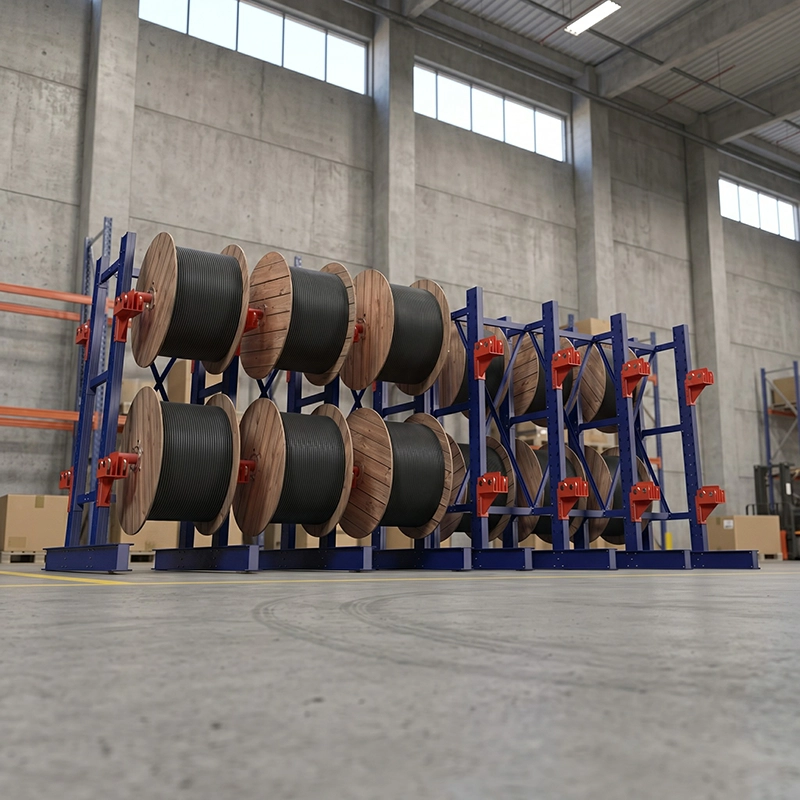
Floor storage of cable drums rarely fails because someone chose badly at the start. It fails because the floor plan was never a plan: reels arrive, get set down wherever the forklift could reach, and within a season the free floor area has become a low-density storage field with paths worn through it. Measured against a reel list, the same area often holds a fraction of the drums it could hold on levels.
The decision that actually matters is not “racking versus no racking”. It is whether floor storage is still the cheaper choice once you price the footprint, the aisle it forces you to keep open, and the way reel sizes are separated. This article lays out the conditions where floor stacking still wins, the specific layout problems a cable drum storage rack can change, and how to avoid signing a cost conclusion that was never based on your own numbers.
When floor stacking is still the right answer
Floor storage is not a mistake to be corrected. It is a legitimate layout when the reel population is small, the drums are handled whole and often, and the floor is genuinely available. It tends to stay viable when reels are turned over within days rather than stored for months, when most drums are large enough that a second level would exceed practical handling height, when the only handling equipment is a crane or a heavy forklift with no interest in precise bay approach, and when the site has no fixed storage boundary because the yard or hall is shared with production.
Floor storage also remains the honest answer when the reel data is not available. A rack has to be laid out against diameters, widths, weights and quantities; if those numbers do not exist yet, a rack drawing is guesswork with a price attached. Keeping reels on the floor while the reel list is compiled is a defensible interim position, provided the floor area is temporarily marked out so the reels do not colonise the entire hall.
What a rack changes in the layout — and what it does not
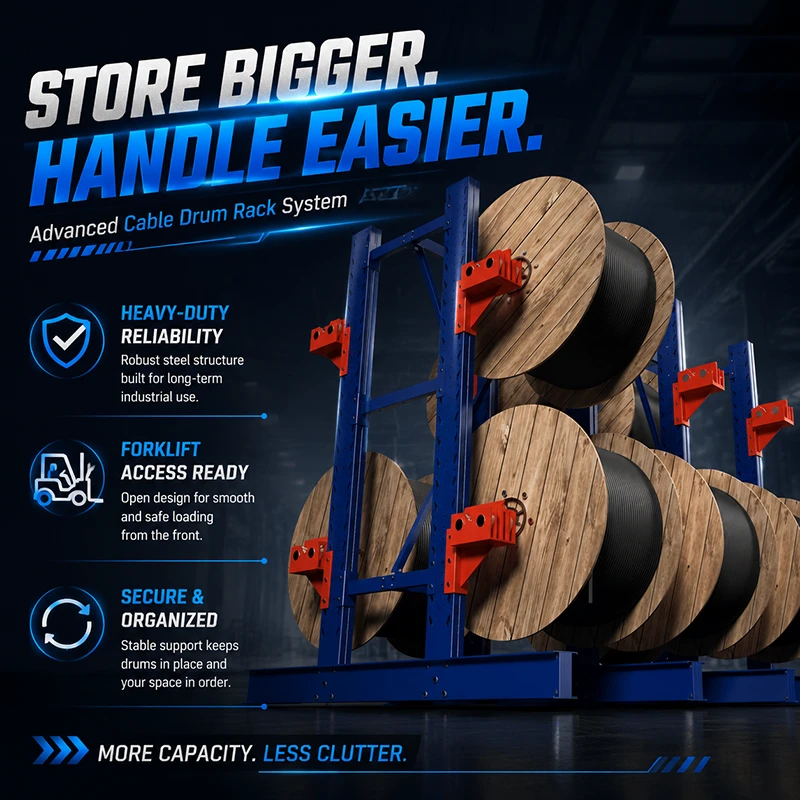
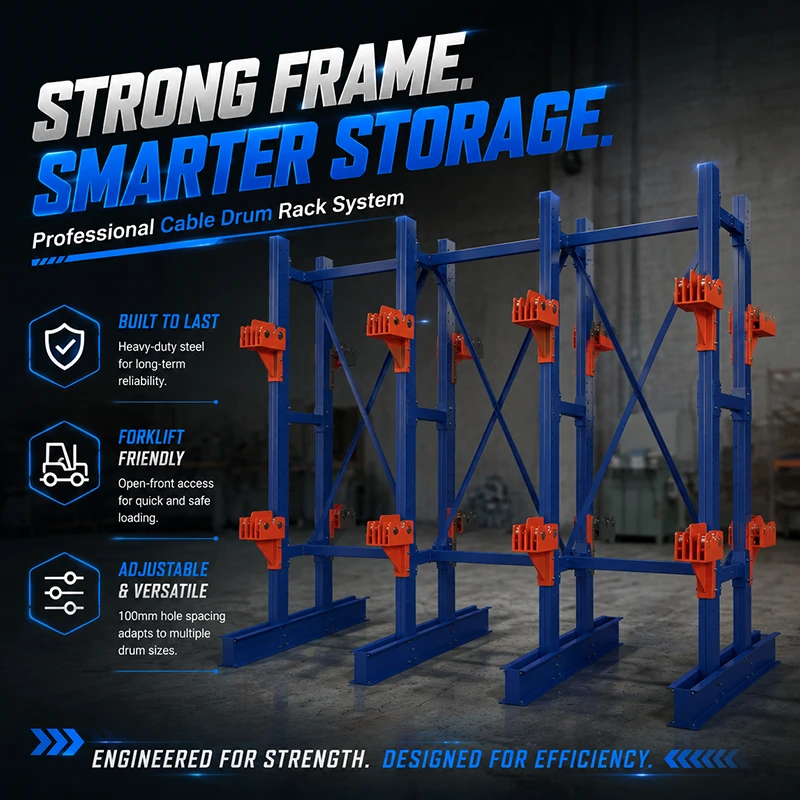
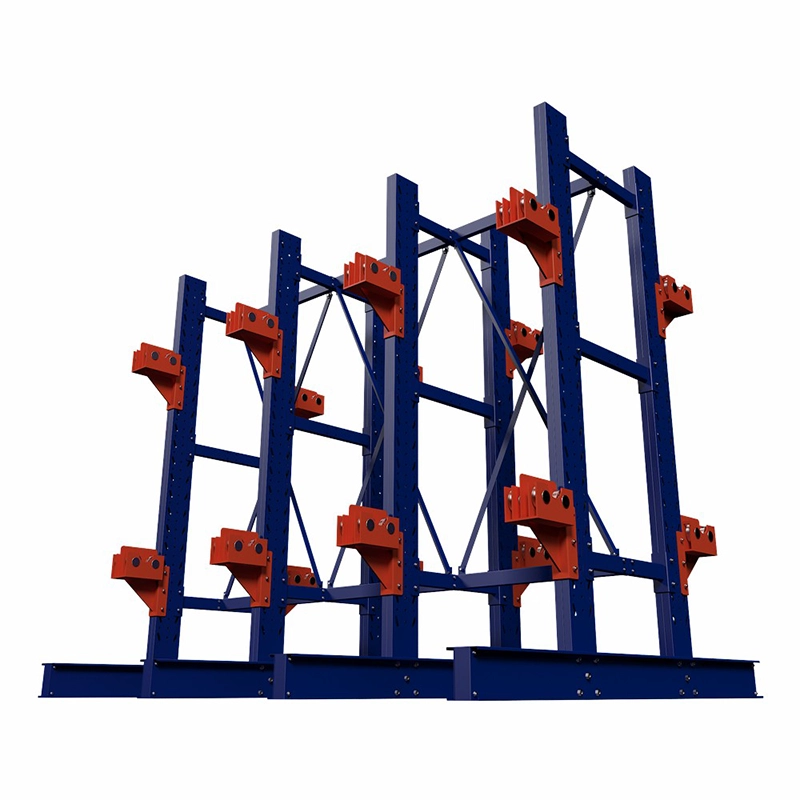
The gain from racking is not “more space”. It is that the same floor area starts carrying drums on two vertical levels while the aisle stays a designed dimension rather than leftover clearance. A bay is built from a main frame and additional auxiliary frames, with reel support brackets set at fixed levels, so the number of positions per bay is a drawing decision instead of a stacking decision. In the project records behind this product, the two structural facts that come back repeatedly are the bolted main-frame and auxiliary-frame assembly and the punched upright that lets support height be repositioned as drum diameters change.
What a rack does not do is shrink the footprint of the reels themselves, or remove the need to handle them. A drum still has to be lifted into place, still has to leave the bay when the whole reel is required, and still needs an approach path for the truck or forklift. A rack also does not make an unclassified inventory organised. If reels of three diameters and two weight classes are stored in the same bay without a rule, the rack reproduces the same mix one level higher.
The aisle arithmetic that decides whether two rows fit at all
Most first-draft cable drum rack layouts are drawn as two parallel rows and then fail on the aisle. The recorded example is worth walking through because it is a calculation any planner can repeat. For a documented layout of 9,630 mm long, 1,200 mm wide and 3,150 mm high, with Ø800 mm reels on the lower level and Ø500 mm and Ø600 mm reels above, one single row provides 12 positions for the Ø800 mm drums and 48 positions for the two smaller sizes. Placed in a 10 × 4.3 m area, two such rows would have left roughly 1,550 mm of aisle — not enough for the handling equipment to work the bays — so the proposal settled on one row per area. The same reasoning was applied to the second, 10 × 3.9 m area.
Two conclusions follow for anyone planning floor space. First, the aisle is not a leftover; it is an input, and it has to be fixed before rows are drawn. Second, one row with three levels of positions can beat two rows squeezed against each other, because an unusable aisle converts floor area into nothing at all. If you are currently comparing floor storage with racking on a sketch, run the same subtraction on your sketch: area width, minus row depth, minus the aisle your truck actually needs.
Sorting the reel list is the part that saves space
A rack laid out around one reel diameter wastes volume on every reel that does not match it. The documented approach is to split the inventory into groups instead of forcing one shelf height across the hall. In one recorded project the customer’s reel list covered roughly 500–3,000 kg, diameters from Ø737 mm to Ø2,007 mm, and a spread of reel widths; the design responded by dividing the reels into a two-level group with four positions per frame unit and a single-level group with two positions per frame unit, both around 3,000 mm high. That is grouping by geometry, not by preferences.
This is also where the classification discipline pays off operationally. Once reels are assigned by diameter and by status — incoming inspection, released stock, cut-down remnants — the bay layout becomes a rule operators can follow without asking. Support height adjustment on the punched upright is what makes that rule survive changes in drum mix, and it is the reason a rack bought for today’s reels can be re-set for next year’s reels rather than replaced.
How to avoid a cost conclusion that has no data behind it
The most expensive layout decision is a confident one built on assumptions. A useful comparison needs five inputs from the site, not from a catalogue: the reel list with outside diameter, width, centre or through-shaft detail and unit weight; the available floor dimensions including the handling approach; the handling equipment that will work the bays; the number of storage levels the ceiling and lifting practice allow; and the environment, since an outdoor yard adds a finish and drainage requirement that an indoor hall does not.
Two further cautions belong in any internal business case. First, no universal load rating, steel grade or reel-size range should be written into a plan before it is confirmed for the specific configuration — the figures in this article come from individual project records, not from a general specification. Second, a rack that is never filled is more expensive than a floor that is imperfectly organised. If the reel count is expected to fall, buy the bays you need now and extend with auxiliary frames later rather than filling the hall on day one.

Where a cable drum storage rack fits best
- Cable wholesale and distribution warehouses holding mixed reel diameters that must be located without searching the floor.
- Cable factories keeping buffer stock between production, testing and despatch, with a defined bay for each status.
- Power and electrical equipment plants storing reels off the floor in a bay assigned by drum size.
- Centralised wire dispensing areas where a roller-bearing support lets the reel stay in the rack while cable is drawn off.
- Existing cantilever racking that can be retrofitted with reel support tubes once the connection dimensions are verified.
- Outdoor yards, only where the corrosion-control finish and drainage have been specified for that site.
Planning questions we are asked most
Can we keep some drums on the floor and put only the small ones on racks?
Yes, and it is usually the better first step. Splitting the inventory means the rack is built around the reels that benefit most from a defined position and a second level, while the largest drums stay on the floor with a marked-out area. The layout should still be drawn as a whole, because the rack rows set the aisle that the floor area then has to work around.
How do we know a rack is the wrong purchase for our site?
Three signals. If reels are handled whole and leave within days, a rack adds handling steps for little storage gain. If the reel list cannot be supplied, any bay count is a guess. If the ceiling or lifting practice allows only one level, a rack has to justify itself on organisation alone — and on some sites that is not enough.
What should we send with a layout request?
The reel list with diameter, width, shaft detail, unit weight and quantity; the floor plan with usable dimensions and handling approach; the equipment used to load and unload; the number of levels available; and whether the area is indoor or exposed. With those five, a bay arrangement and aisle can be proposed instead of quoted blind.
Need a Custom Storage Solution?
Speak directly with our technical engineers. We offer free structural designs, heavy-duty catalog evaluations, and quick B2B price quotations.
Request a Quote Now →