
For exporters, 3PL teams, and seasonal warehouses, the real cost of an empty rack is not the steel itself. It is the floor area, return freight volume, and staging space that stays occupied when the rack has no load inside it.
Strack is built for that exact gap between loaded storage and empty return. In a loaded state it behaves like a welded steel stackable rack family for forklift handling. In an empty state it nests, so the footprint collapses instead of sitting as a permanent block of dead space. On referenced project samples, that nesting behavior can reduce floor occupation by about 70%–80%, which changes how much you pay to move, park, and buffer empty racks.
1. What empty nesting actually changes
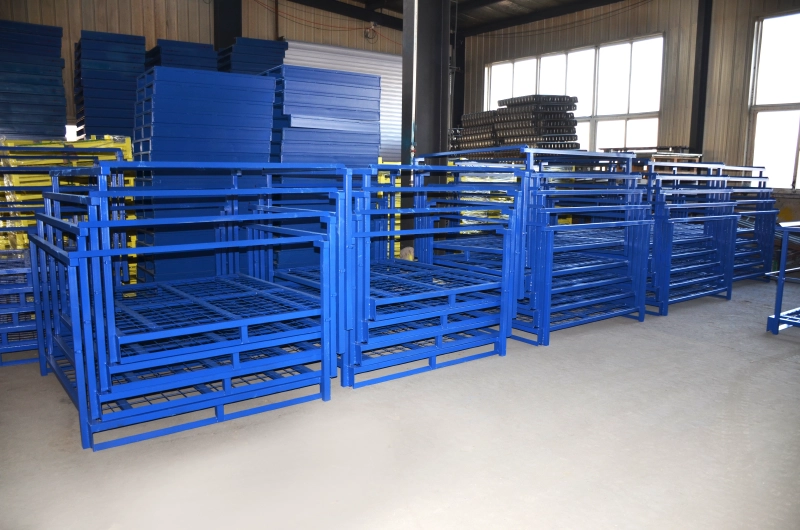
The logic is simple. A fixed rack layout consumes the same bay whether it is full or empty. A nestainer rack can be stacked when loaded, then nested when it returns empty, so the same floor area can hold far more frames during reverse logistics or off-season storage. That is why the space saving is not only a warehouse issue; it is also a transport issue.
In practice, the business value shows up in two places. First, fewer truck trips or lower backhaul spend for the same number of empty frames, because the frames occupy much less cubic volume. Second, less yard or buffer-floor pressure, because empty equipment no longer blocks a full staging lane.
2. How the 100 mm gap mechanism supports nesting
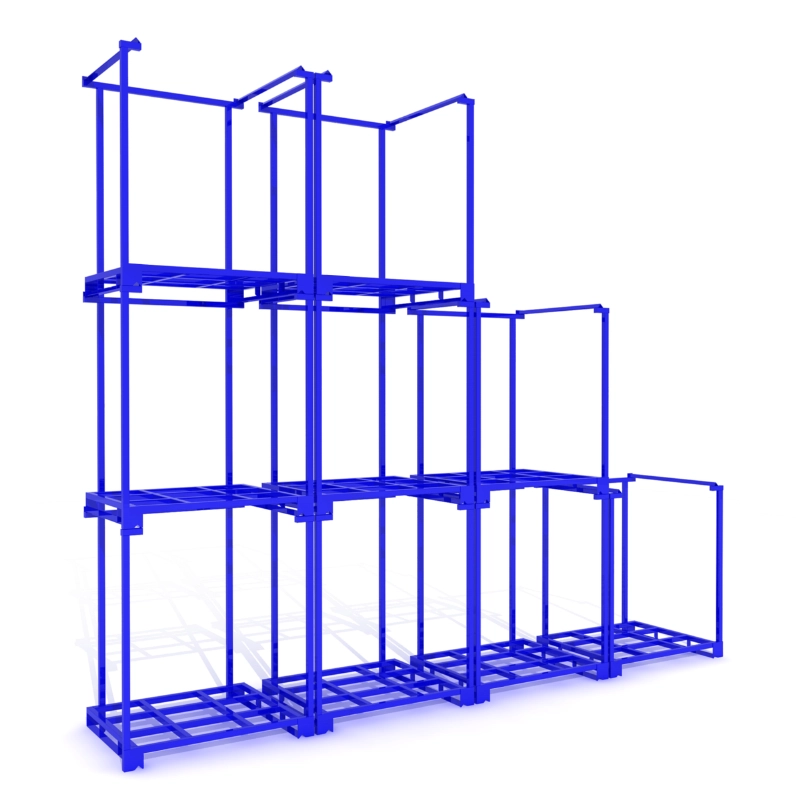
The referenced sample version uses an empty-stack gap of about 100 mm to suit forklift tine thickness. That gap is the practical reason the rack can be handled without forcing the frames apart during pickup and return. It is not a decorative dimension; it is the clearance that lets the forks enter cleanly and lets the empty units nest without interference.
For teams that handle repeated reverse transport, that clearance matters as much as the steel thickness. If the tine path is too tight, empty frames become awkward to move and the nesting advantage disappears in the yard. If the gap is set correctly, the operator can collect, return, and re-stack empty frames in a tight loop with less manual re-handling.
3. Why 70%–80% less footprint matters for return freight and seasonal buffering
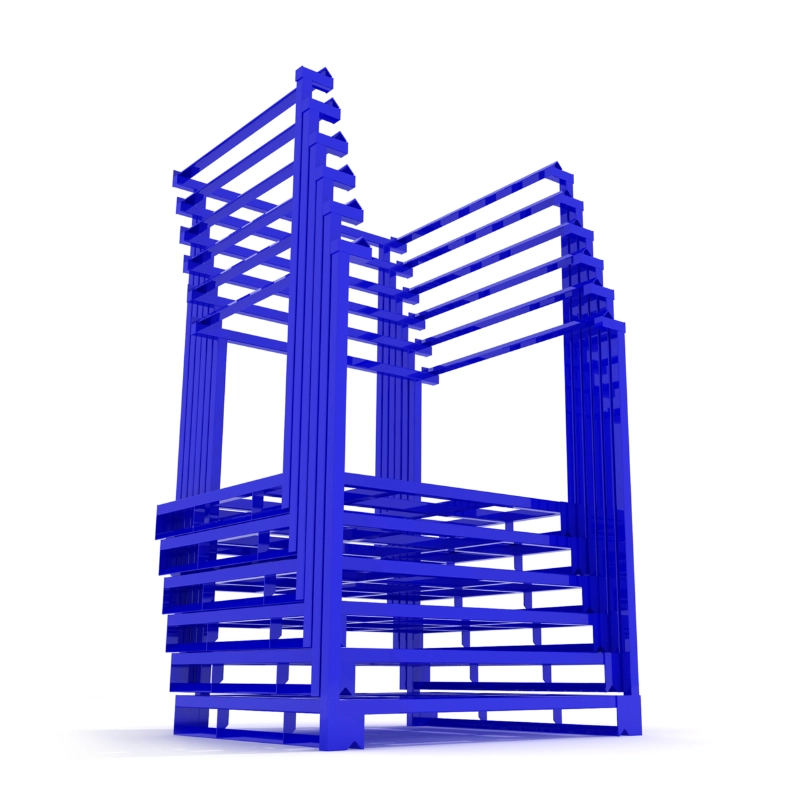
When a customer site sends racks back after a season peak, the carrier is not charging for steel alone. The carrier is charging for occupied space, handling time, and the number of units that must be moved. A rack family that can compress by roughly 70%–80% reduces that load dramatically. In many reverse-logistics lanes, that means the empty-rack run can approach half the cost of a non-nesting return, especially when the route is dominated by empty equipment rather than freight value.
The same mechanism helps with seasonal buffering. Instead of leaving a fixed bay full of unused frames, you can keep the empty units nested in a much smaller reserve area and release ground space for infeed staging, outbound picks, or temporary overflow zones. For exporters and 3PLs, that flexibility is often the difference between adding another storage block and using the space you already have.
4. Where nesting racks outperform fixed floor storage
A ground-fixed racking layout is useful when you need permanent SKUs, consistent aisle geometry, or constant pick access. But when the problem is empty-frame storage, fixed racks keep consuming the same footprint even after the product has left. A stackable rack family with nesting capability is better when the load changes by season, when outbound volume spikes, or when the frames must move between plant, customer site, and return depot.
That said, nesting racks are not the right answer for every operation. If your goods are loose, very small, or require rigid compartmentalization, you may need mesh decks, side rails, or a different storage system. If your warehouse depends on permanent pick faces and fixed carton access, a conventional rack can still be the cleaner choice. Strack is strongest when the load is unitized, forklift handled, and expected to return empty.
The product family can also be configured for pallet-supported loads, side containment, wire mesh decks, or inverted use depending on the payload. The correct version should always be matched to the actual pallet size, load height, handling route, and stacking pattern, because the nesting ratio is tied to the fork tine thickness and the project sample, not to a universal one-size-fits-all promise.
5. When to choose Strack
Choose it when you need to move palletized cartons, woven bags, FIBC bulk bags, or other unitized loads as a single forklift-ready unit. Choose it when empty frames must be stored compactly after the peak season. Choose it when the bigger cost is not the storage rack itself, but the space and freight wasted by empty equipment. If those three pressures are present, nesting is usually the more efficient operating model.
For dimension confirmation and project-specific load configuration, continue to the product detail page. For a real operational example of seasonal buffering and reverse logistics, open the case reference.
Need a Custom Storage Solution?
Speak directly with our technical engineers. We offer free structural designs, heavy-duty catalog evaluations, and quick B2B price quotations.
Request a Quote Now →