
If your warehouse still relies on loose floor piles, the first losses are often invisible at the start of the shift: a crushed bottom row, a tilted stack, or a picker who has to break the pile just to find one pallet. The floor looks full, but the load path is uncontrolled.
That is where a welded nestainer rack changes the conversation. Instead of asking the bottom carton, bag, or pallet to carry the rest of the pile, the frame carries the load. The rack also gives the forklift a repeatable entry path, so the warehouse can move a unitized load as one piece instead of re-handling it three or four times.
Strack is built for that job: loaded stacking when the goods are on site, and empty nesting when the shift is over. In practice, that means one system can support active storage, buffer space, return transport, and seasonal overflow without turning the floor into a permanent heap.
Why floor stacking fails as soon as the load gets soft or tall
Direct floor stacking can work for robust, uniform cartons for a short time. It breaks down when the load is soft, tall, mixed, or sensitive to pressure. Woven bags tilt. Bulk bags bulge. Wrapped pallets slide. Once the stack starts leaning, the bottom layer takes the full compression load and the whole pile becomes harder to access.
FIFO also suffers. If the only way to reach an older pallet is to move the newer ones first, the warehouse pays twice: once in handling time and again in damage risk. That is why direct floor stacking is usually the wrong choice for crush-sensitive loads, frequent batch changeovers, or any operation that needs clean picking order.
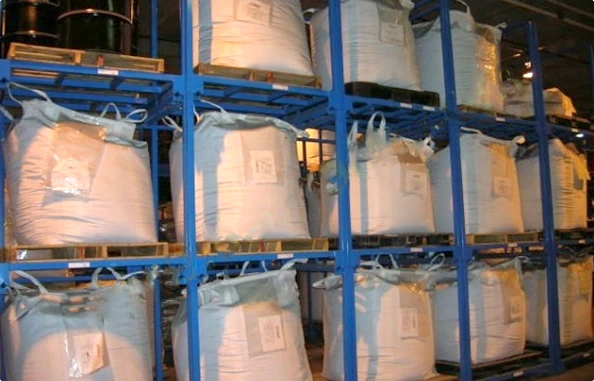
In the image above, the bag loads are not asking the bottom layer to absorb the full stack. The rack frame is taking the structural role, which is why three-tier storage can stay orderly instead of turning into a soft-floor pile.
What the frame changes in daily handling
A nestainer rack changes three things at once. First, it creates a fixed load boundary, so the goods stay inside a defined footprint. Second, it gives the forklift a stable base and entry geometry, which reduces the chaos that comes from improvising with loose piles. Third, it lets empty racks nest into a compact footprint when the run is over, so parked racks do not keep consuming the same floor area as active stock.
That combination matters in cold room storage, palletized carton storage, woven bag staging, and seasonal buffering. It is also the reason many operations prefer a stackable rack when the layout must change with the season. A fixed racking system is still useful for dense pick faces, but it locks the aisle pattern in place. A nestainer rack is the more flexible choice when you need to reorganize the floor without redesigning the building.
There is one important limit: the rack is not a cure for an unstable load. If the goods cannot be unitized, pallet-supported, or otherwise handled as a single forkable load, the rack does not solve that upstream problem. It works best when the load already has a stable base and the handling team wants to stop crush, stop topple risk, and stop repeated manual re-handling.
Where Strack fits, and where it does not
Strack fits palletized cartons, FIBC bulk bags, woven bags, plastic pails, boxed frozen foods, and similar unit loads that can be moved by forklift. It also fits temporary warehouse setup, production staging, and closed-loop transport, because the same frame can be used for loading, storage, and return.
It does not replace every storage system. If your main need is high-selectivity single-pallet access in a permanent lane structure, selective pallet racking still has a role. If your stock is homogeneous and deep-lane storage is the priority, drive-in racking may be the better fit. But if the problem is floor crush, toppling, changing inventory, or empty-rack return space, the nestainer rack is the cleaner answer.
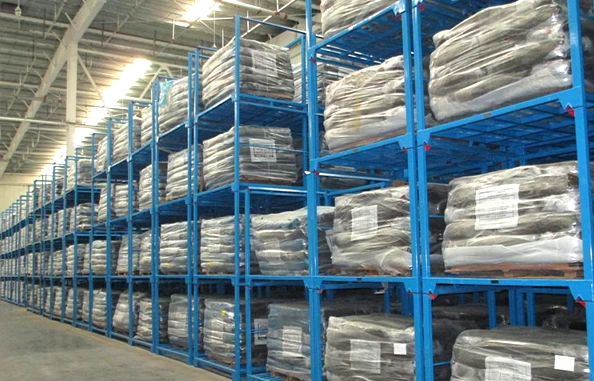
The warehouse layout shown here is a controlled four-tier configuration. That should be read as a layout choice, not a universal promise: the right tier count still depends on the load, the pallet base, the forklift path, and the space you need to keep clear for access.
Best-fit applications
- Cold room storage and food warehouse buffering
- Palletized carton and woven bag storage where bottom-load crush must be avoided
- Seasonal goods buffering and production line staging
- Forklift handling, closed-loop transport, and empty-rack return storage
FAQ
Can a nestainer rack replace floor stacking everywhere?
No. It is a better fit when the load is unitized, forkable, and at risk of crush, tilt, or access loss. For loose bulk that cannot sit on a stable base, the first step is still to unitize the load properly.
Does empty nesting really matter if the racks stay on site?
Yes. Empty racks still consume floor space when they are parked, and that space is usually the same space you want for active stock, staging, or forklift movement. Nesting helps you recover that footprint instead of paying for it twice.
If you are comparing direct floor stacking with a fork-ready nestainer layout, review PDP-03 for the product details and PAGE-01 for the broader layout option, then send us your pallet size, load height, and turnover pattern.
Need a Custom Storage Solution?
Speak directly with our technical engineers. We offer free structural designs, heavy-duty catalog evaluations, and quick B2B price quotations.
Request a Quote Now →