
Sebox Steel Mesh Pallet Box: What 1000kg Really Means for Load, Stacking, and Handling
If you are buying a metal pallet box for a workshop or warehouse, “1000kg” is one of the first numbers you will see. The problem is simple: many teams read it as “this box can carry anything up to 1000kg in any way.” That is not how load ratings work. For Sebox, 1000kg should be read as the standard uniformly distributed load for the intended model and load pattern. It is not a promise for a single point load, a top-heavy stack, or a moving stack that has not been planned.
That difference matters when the box is used for machined parts, forged pieces, castings, or mixed small components. A heavy duty wire mesh container can look forgiving because it is open and visible, but the real load path still runs through the base frame, corner posts, and handling points. If weight is dumped into one corner, the frame sees a very different force than when the same mass is spread across the full floor area.
1. 1000kg means uniform load, not a point-load shortcut
On a collapsible cage pallet, the safest reading of 1000kg is “the payload should be spread across the base.” This is the right assumption for general warehouse bulk storage, cartoned parts, and evenly packed metal components. When the load is irregular, you should not treat the number as a license to put the heaviest item on one side and call it done. The welded steel mesh, reinforced base, and forklift pockets help the box handle industrial use, but they do not erase basic load physics.
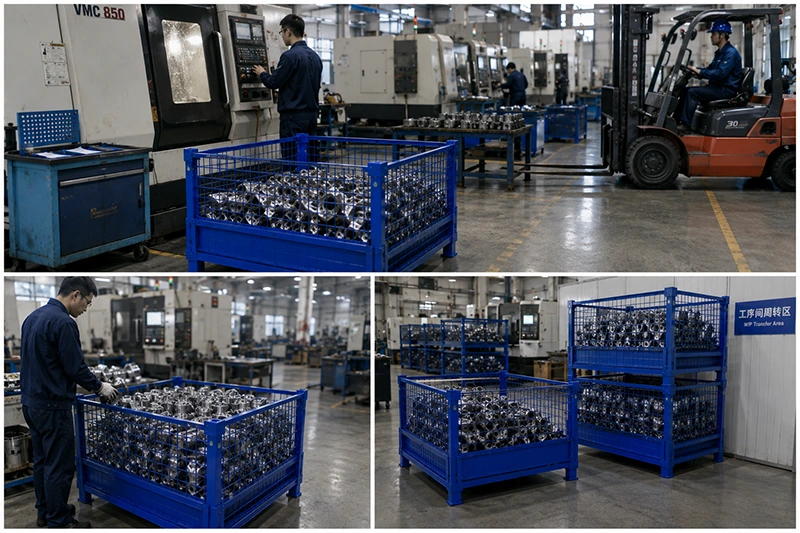
Practical rule: if your product has sharp edges, dense core parts, or tooling concentrated in one area, the working load should be reviewed as a layout problem, not a catalog number problem. Spread the mass, keep the center of gravity low, and make sure the base can transfer force into the bottom frame without twisting.
2. Stacking changes the math: the bottom layer carries more than its own fill weight
Once you stack 3 or 4 layers, the bottom unit is no longer only carrying its own payload. It also carries the vertical load transferred by the upper layers, plus handling and floor-condition margins. That is why “1000kg per box” does not automatically mean “3,000kg or 4,000kg stack is fine.” Stack rating and single-box load rating are different questions.
If you need high-density block stacking, check three things before you commit: whether the specific model is approved for stacking, whether the floor is flat enough to keep the stack square, and whether the load is stable enough to avoid shifting during storage or transfer. Sebox is a mesh pallet stacking box designed for visual inventory and compact storage, but the stacking plan still has to match the real parts inside it.
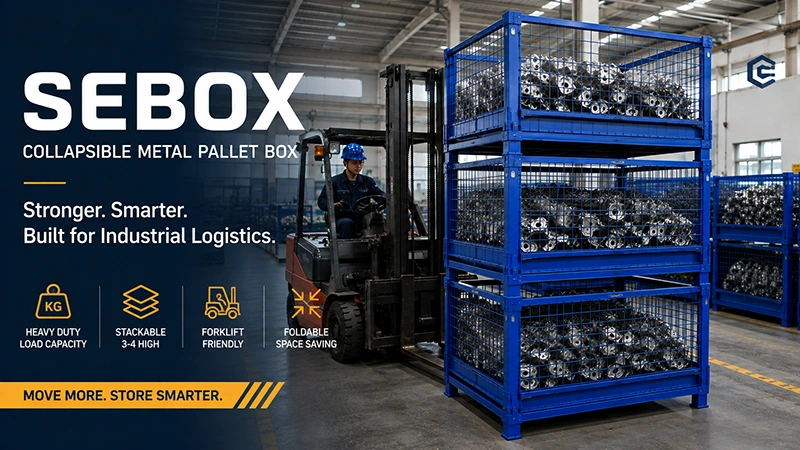
For mixed loads, the bottom tier is usually the most sensitive point. If upper layers are heavier than expected, or if one unit is loaded unevenly, the bottom box can see concentrated compression that is much higher than the nominal 1000kg label suggests. In other words: the answer to “how much does the bottom layer carry?” is not a fixed universal number. It is the sum of the stack design, the actual payload distribution, and the way the stack will be handled.
3. Can a forklift move the whole stack? Yes, if the stack is built for it
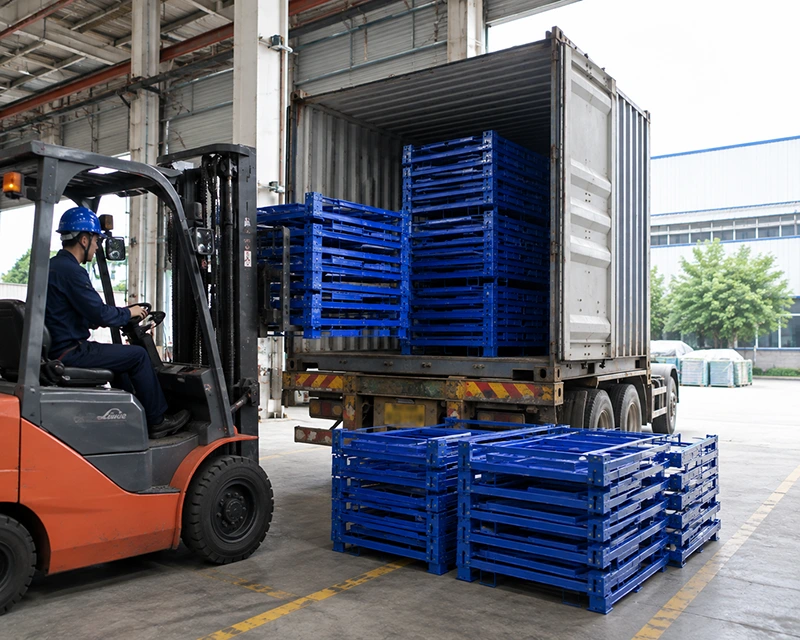
Forklift and pallet jack handling are the default advantages of a steel mesh pallet box. If the stack is aligned, the load is centered, and the forklift pockets are used correctly, a full stack can be moved as a unit in many warehouse workflows. That said, movement is a different stress case from static storage. Start and stop forces, mast tilt, and corner impacts all increase risk.
A crane should not be assumed unless the project has a separate lifting scheme and the product is specified for that method. For Sebox, forklift handling is the normal route; crane handling should only be used when the supplier and the project team have approved the lifting plan. If your operation needs bottom-layer access while the stack stays in place, a half-drop front gate is more useful than trying to unstack everything.
Where Sebox fits best
- Warehouse bulk storage for machined parts and mixed metal components
- Production-line buffering when operators need visual inventory without unpacking
- Closed-loop logistics and export packing where return freight matters
- Heavy-duty handling where a collapsible stillage reduces empty-return volume
FAQ
Is 1000kg a uniform load or a concentrated load?
For Sebox, treat 1000kg as the standard uniformly distributed load unless the specific drawing or specification says otherwise. If your load is point-heavy, reduce the working load or spread it across the base so the frame is not forced at one spot.
Can I stack 3–4 layers and still call it 1000kg?
No. A stack changes the load case. The bottom tier carries the upper tiers, so the safe answer depends on the approved stacking plan, the pallet box model, the payload distribution, and the handling method. If you want a 3–4 layer plan, ask for stacking advice before you order.
Need a Custom Storage Solution?
Speak directly with our technical engineers. We offer free structural designs, heavy-duty catalog evaluations, and quick B2B price quotations.
Request a Quote Now →