
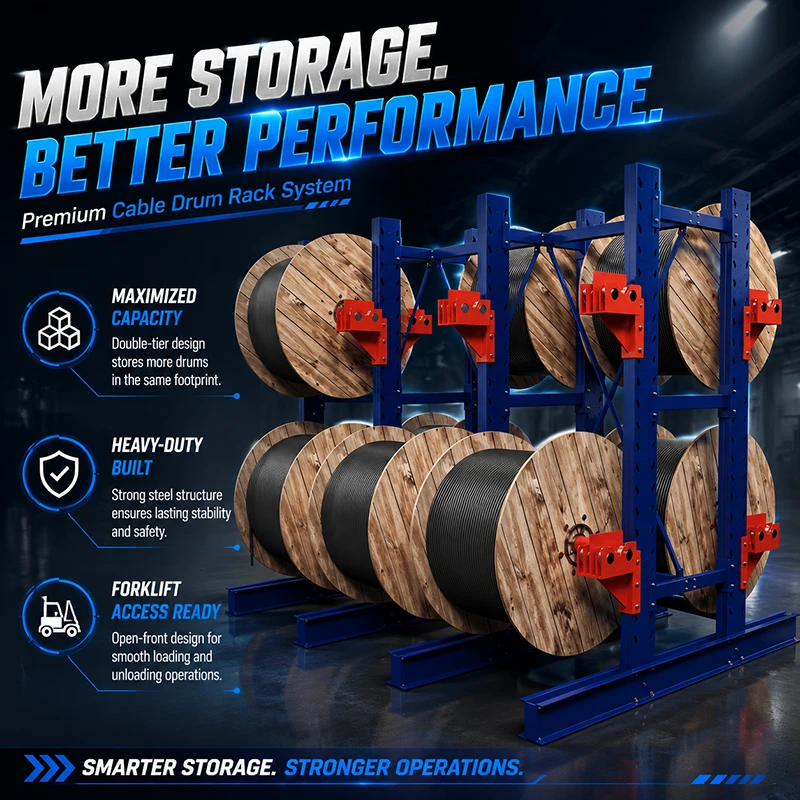
A cable drum on the floor looks like free storage. It is not. The visible cost is the square metres the drum occupies; the invisible cost is the aisle you keep open so a forklift can reach it, the drum that gets rolled or chocked when it is buried two deep, and the operator minutes spent hunting a reel that the stock list says should be in the bay.
This article separates the floor-stacking costs that show up in money from the ones that only show up as friction, sets out the cases where stacking on the floor is still the cheaper answer, and explains what a cable drum rack such as Carack changes and what it cannot change. The dimensions quoted below come from documented cable-drum rack project layouts, so treat them as references to be re-checked against your own reel list, not as universal ratings.
What Floor Stacking Really Costs
Floor storage is not one cost. It is a group of costs that arrive at different times, and in a cable store the ones that hurt most are the ones nobody invoices.
- Storage area that must also stay clear for handling. A stacked reel needs a working face, so if the pile is two or three deep, the aisle in front of it is part of the storage plan whether you count it or not.
- Access order instead of access by choice. Whatever you need is usually at the back or the bottom, so the reels in front move twice.
- Reel and cable damage. Rolling, chocking and dragging a drum abrades the flange and the outer wrap, and the bottom reel sits in whatever water collects on the concrete.
- Mixed diameters with no address. A store holding small reels next to drums up to Ø2,007 mm, a diameter that appears in one documented reel list, has no natural way to keep sizes apart on the floor.
- Search and identification time. Without a fixed position per reel type, finding the right drum depends on the memory of whoever is on shift.
- Handling risk. A round load on a smooth floor moves when it is touched, and a forklift working around loose drums has less margin than one working into a defined bay.
Which of Those Costs Are Cash, and Which Are Only Friction
Turn the same list into money and it splits cleanly. Some lines are one-off capital, some recur every shift, and one of them decides whether the site ever revisits the question.
| Cost line | Floor stacking | Racked storage |
|---|---|---|
| Building or yard area per reel | Reel footprint plus a working face for every retrieval | Reel positions stacked on levels above the same footprint |
| Reel and cable damage | Flange, wrap and cable-end damage from rolling and chocking | Reels carried on brackets, clear of the floor contact point |
| Retrieval time | Rises with pile depth and with the mix of diameters | Fixed bay and level per reel type |
| Floor kept clear | Pile depth decides how much floor stays empty | Aisle width becomes a design input instead of a leftover |
| Capital and installation | No rack cost | Project-priced structure, delivered disassembled and assembled on site |
Floor stacking wins on the first and the last line and loses on the middle three. That is the whole argument: the saving is on the invoice, the cost is in the operation.
When Floor Stacking Is Still the Right Answer
Racking is not automatically the better choice, and this is where a supplier should be straight with you. Keep the floor when any of the following is true.
- Volume is low and turnover is slow. A handful of reels used a few times a year does not justify a structure and an inspection routine.
- The reel is consumed where it stands. In a cutting or dispensing bay, the floor is the workstation and the drum stays there.
- Diameters exceed practical level sizes. In one documented reel list the diameters ran from Ø737 mm to Ø2,007 mm and the design split into a two-level group and a single-level group instead of forcing every reel into two levels.
- The reel is heavier than your lifting equipment. A rack stores reels; it does not lift them. If nothing on site can place a reel at height, floor storage is the practical answer.
- No layout fits an aisle. On the two documented areas of 10 × 4.3 m and 10 × 3.9 m, a two-row layout would have left only about 1,550 mm of aisle, so a single row per area was proposed. Where even one row plus a working aisle does not fit, keep the floor.
- The site is short-term. Rack value returns over years of handling; a leased bay that closes next season rarely pays for a structure.
What a Cable Drum Rack Reclaims
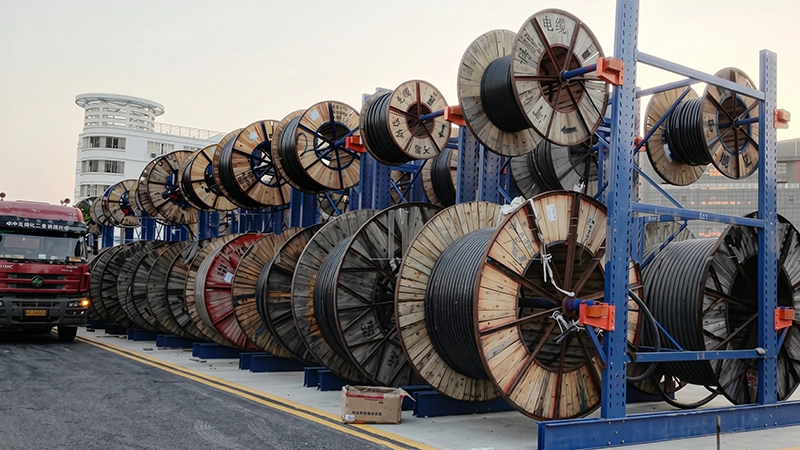
A cable drum rack does one thing floor stacking cannot: it puts reels above each other inside a footprint you already have, and it gives each reel type an address. Carack is a fixed modular steel structure, built from main frames and auxiliary frames with reel support brackets at selected levels. It is not an automated cable carousel, not a winding machine and not a roll-out cantilever rack; it is storage and retrieval, sized per project.
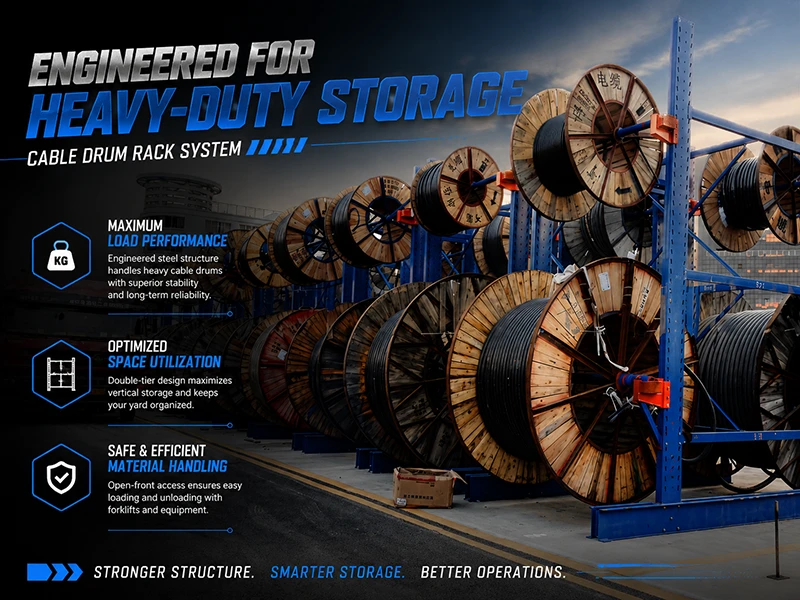
In one documented layout, opportunity 13839, the rack was 9,630 mm long, 1,200 mm wide and 3,150 mm high, with the lower level sized for Ø800 mm reels and the upper levels for Ø500 mm and Ø600 mm reels. A single row in that design provided 12 positions for the Ø800 mm reels and 48 positions for the other two sizes. Those numbers are project references; your reel list decides yours.
Aisle Width Decides the Layout Before Capacity Does
The first question is not how many reels fit. It is how much aisle you keep, because the aisle is what makes the rack usable. The 13839 layout is a useful worked example of that order of thinking.
| Parameter | Documented reference (opportunity 13839) |
|---|---|
| Rack envelope | 9,630 mm long × 1,200 mm wide × 3,150 mm high |
| Level assignment | Lower level for Ø800 mm reels; upper levels for Ø500 mm and Ø600 mm reels |
| Positions in one row | 12 × Ø800 mm; 48 × Ø500/Ø600 mm |
| Site areas reviewed | 10 × 4.3 m and 10 × 3.9 m |
| Result | Two rows would have left about 1,550 mm of aisle, so one row per area was used |
Read that last line as a method, not a rule. Measure the aisle your forklift actually needs with a load on the forks, then see what is left for racks.
Handling Mixed Reel Diameters Instead of One Universal Level
A single shelf height suits one reel size, and real cable stores carry several. Documented reel lists include diameters from Ø737 mm to Ø2,007 mm and reel weights of roughly 500 kg to 3,000 kg. The layout response in that project was to divide the inventory into groups: a two-level group with four positions per frame unit and a single-level group with two positions per frame unit, both about 3,002 mm high.
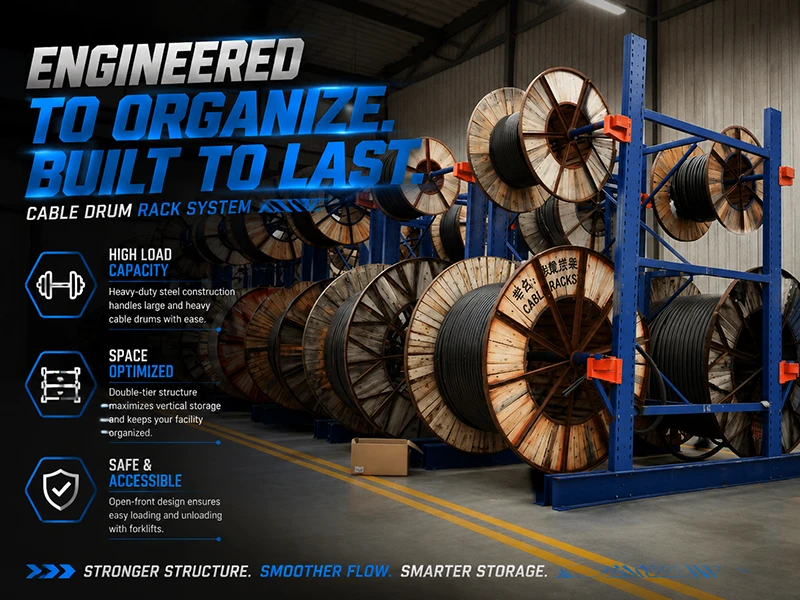
The practical point is that level spacing should follow your drum diameters, and the reel list should be split by diameter, weight and status before the rack is drawn, so production, test and dispatch reels do not compete for the same bay.
Adjustable Supports and Controlled Reel Rotation
Two details separate a reel rack from a generic shelf. The first is support position: the dedicated upright profile has installation holes at 100 mm intervals, so the bracket height is set around the drum rather than the other way round. The second is rotation.
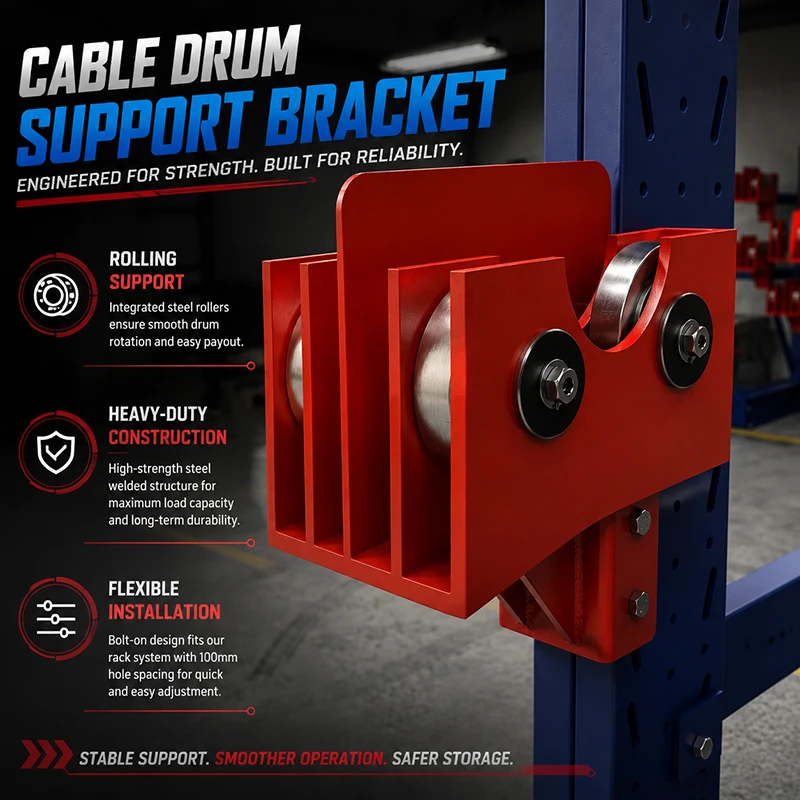
Optional roller-bearing supports let a reel turn on the rack so cable can be withdrawn in part without taking the whole drum off. That is a different job from storing a reel that always leaves in one piece. Where a reel has to come off the rack and be transferred to a trolley, the fork clearance and support geometry must be confirmed for that reel: the customer discussion on this point is recorded in the project file, but a final clearance design was not settled there, so treat it as a specification item to close before ordering.
Main Frame, Auxiliary Frame and Bolted Connections
Carack is built as a main frame extended by auxiliary frames for multi-bay layouts. The auxiliary frames are not independent units: they rely on the main frame’s upright for support, which is why bay count and the floor or anchoring conditions belong to the design rather than to an accessory list.
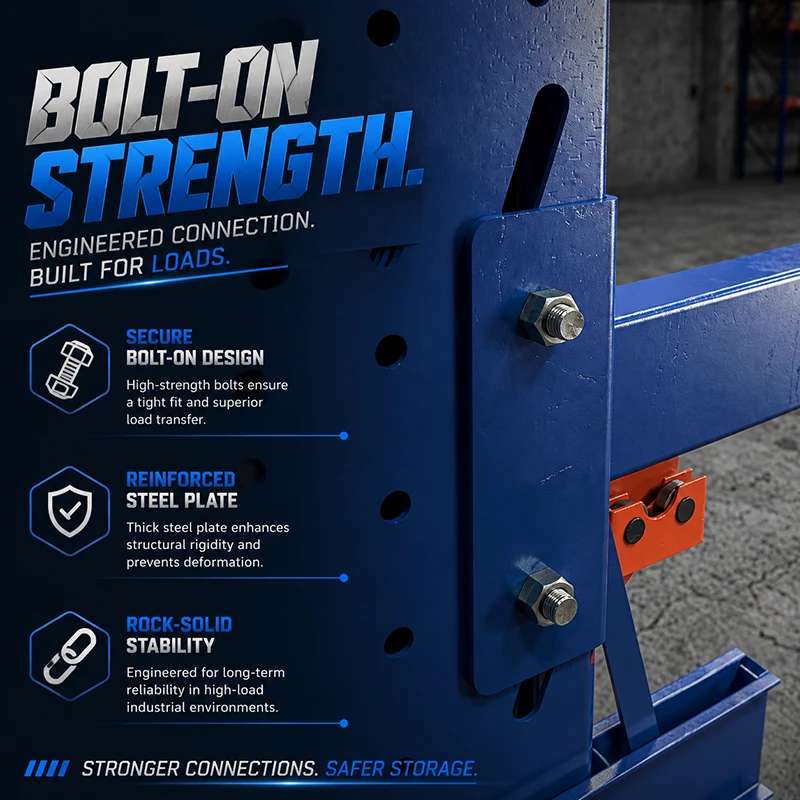
Connections are bolted steel plates on a punched upright, and the structure is delivered disassembled for transport and assembled on site. In documented projects the longest parts were 3,000 to 3,150 mm and one packed group measured about 1 to 1.2 m³; wrapping film plus straps is the basic packing, with wooden cases available where surface protection matters more. Rated load per bay, steel grade, anchoring and floor loading are confirmed per configuration and are not published here as universal figures.
Outdoor Use, Retrofit and the Limits of a Rack
Two cases come up often enough to state plainly. Outdoor storage: one documented project, opportunity 14554, specified hot-dip galvanizing for reels kept outside, on a rack 3,000 mm wide and high with one main frame plus two auxiliary frames, four reel positions per unit for Ø1,400 mm reels of 800 mm width, and reference frame weights of 583 kg for the main frame and 302 kg for an auxiliary frame. Outdoor service still depends on the approved finish, drainage and an inspection routine; a rack should not be bought on an outdoor warranty that has not been written down.
Retrofit is the second case. An existing cantilever rack can be adapted for reels with support tubes of Ø60 mm and a bracket extended 500 mm, for reels up to Ø1,000 mm, but only when the connection dimensions on the existing rack are verified first. Reference quantity in that project was 20 or 100 pieces at about 32 kg per set. Where the connection cannot be verified, the accessory does not apply.
What to Send Us to Size a Rack
A reel rack is quoted from your data, not from a catalogue page. Six inputs decide the layout.
- Reel list: diameter, width, weight and quantity for every reel type, including the largest one you will ever store.
- Site plan: available footprint, ceiling height, and the aisle your forklift needs with a load on the forks.
- Handling equipment: forklift capacity, lift height, attachment, and whether reels are lifted or rolled.
- Environment: indoor or outdoor, and the finish or corrosion protection you require.
- Process: whether reels leave the rack whole, or cable is withdrawn while the reel stays on the rack.
- Growth: how many bays you expect to add later, so the main-frame and auxiliary-frame split is right from the start.
Cable Drum Storage Questions Buyers Ask
Is floor stacking always more expensive than a cable drum rack?
No. Floor stacking carries no capital cost and no structure to inspect, and it stays the better answer for low volume, slow turnover, reels consumed where they stand, reels heavier than your lifting equipment, or a layout where even one row plus a working aisle does not fit. The rack case is strongest where mixed reel sizes, frequent retrieval and constrained floor area meet.
How do I decide the level heights?
Work from the reel diameters you actually store, not from a standard shelf. In the documented layouts the level assignment followed the reels, with a lower level for Ø800 mm drums and upper levels for Ø500 mm and Ø600 mm, and a mixed list from Ø737 mm to Ø2,007 mm was split into a two-level group and a single-level group. Support brackets sit on upright holes at 100 mm intervals, so the final height is set per project.
Can cable be pulled off a reel while it is on the rack?
Only where roller-bearing supports are specified for that reel. A rack sized for whole-reel removal and a rack sized for in-place withdrawal are different configurations, and where the reel has to be lifted off and moved to a trolley the fork clearance and support geometry must be confirmed first.
What does a cable drum rack not do?
It does not lift reels, it does not wind or measure cable, and it is not an automated carousel. It also has no universal rated load, steel grade or outdoor warranty until engineering confirms the configuration, and its auxiliary frames are not free-standing because they depend on the main frame.
Need a Custom Storage Solution?
Speak directly with our technical engineers. We offer free structural designs, heavy-duty catalog evaluations, and quick B2B price quotations.
Request a Quote Now →