
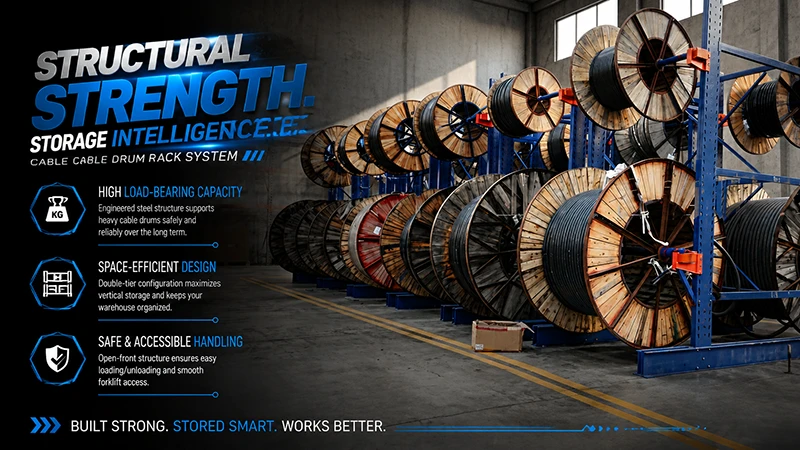
Two different machines are quoted under the same three words. One is a storage rack that gives every drum a defined position and lets a forklift put it there and take it away. The other is an A-frame pay-out stand that holds a single reel at working height so cable can be pulled off it continuously. Buyers who treat them as the same purchase end up with a storage structure that cannot feed a line, or a pay-out stand with nowhere to keep the other thirty reels.
The decision is a process decision, not a price decision. If the pain on your floor is footprint, mixed reel diameters and drums that move twice, you are buying storage — Carack is a modular steel cable drum rack with adjustable reel supports and optional roller-bearing supports. If the pain is feeding a machine, you are buying pay-out hardware. This comparison sets out what each device actually does, where the line between them really falls, and how to check which one your site needs first.
What Each Device Actually Solves
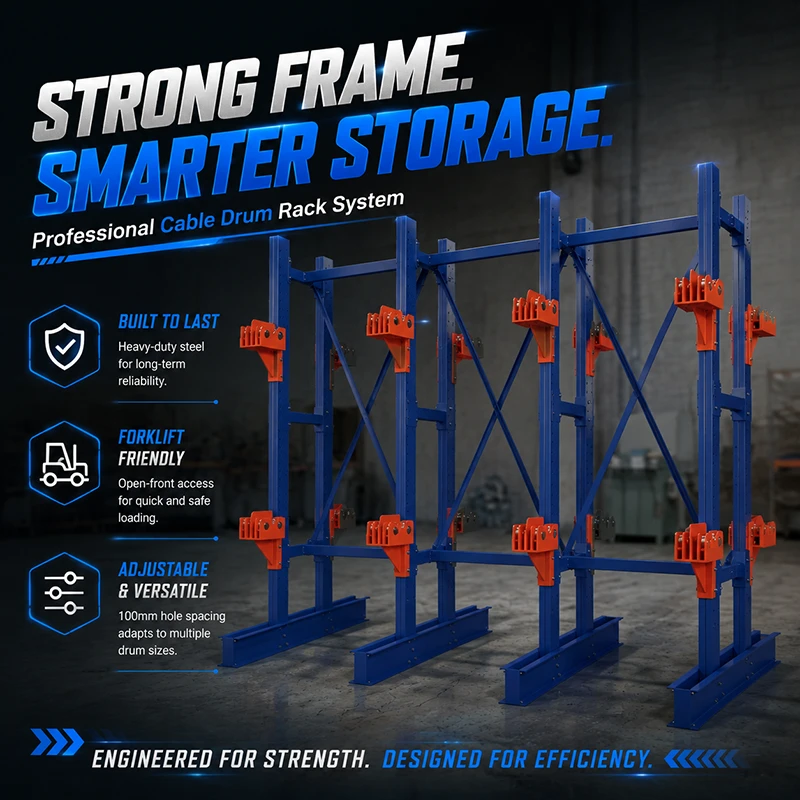
A cable reel storage rack is an inventory structure. Its job is to hold many reels off the floor in defined bays, separate them by diameter, weight, cable type or production status, and keep each one retrievable by forklift. Carack is built as a rigid steel frame from main frames and auxiliary frames, with reel support brackets installed at selected levels. The auxiliary frames are not free-standing units; they rely on the main frame upright for support, which is why the bay count is a layout decision rather than an off-the-shelf number.
An A-frame pay-out stand is a process device. It holds one reel — occasionally two — in the position where cable is drawn off, at a working height and orientation that suits the run. It is sized around the job in front of it, not around the size of the reel population behind it.
| Decision point | Cable reel storage rack | A-frame pay-out stand |
|---|---|---|
| Primary job | Hold many reels off the floor in defined positions | Hold one reel where cable is paid out |
| Reel count it is sized for | The stored inventory; one recorded layout alone provided 12 positions for Ø800 mm reels plus 48 positions for Ø500 mm and Ø600 mm reels in a single row | Typically one reel, at the machine or the cut and measure area |
| How the reel moves | Whole drum in and out by forklift | Reel is placed once, then cable runs off it |
| What drives the sizing | Reel diameters and weights, aisle width, forklift approach, level split | Working height, pay-out direction, run length |
| Structure | Bolted main and auxiliary uprights with support brackets at selected levels | A-shaped frame carrying a spindle or axle |
| Withdrawing part of a reel | Possible only where roller-bearing supports are specified for that position | Its normal operating mode |
| Not designed for | Powered pay-out, tension control, automatic measuring or cutting | Holding a mixed reel inventory |
When a Cable Drum Storage Rack Is the Right Answer
Choose storage when the problem is the population of reels, not the feed. Mixed diameters are the clearest signal: on a recorded project the customer reel list ran from roughly 500 kg to 3,000 kg per reel, with diameters from Ø737 mm to 2,007 mm and reel widths from 610 mm to 1,118 mm. One universal level height would have wasted the rack, so the design was split into two groups — a two-level group with four positions per frame unit and a single-level group with two positions per frame unit, both about 3,002 mm high. The dedicated upright profile carries installation holes at 100 mm intervals, which is what makes that kind of split adjustable at installation instead of fixed at drawing stage.
Aisle width is the second signal. On another recorded layout the rack measured 9,630 × 1,200 × 3,150 mm, with the lower level sized for Ø800 mm reels and the upper levels for Ø500 mm and Ø600 mm reels. In a 10 × 4.3 m area, two rows would have left only about 1,550 mm of aisle, so the proposal used one row per area. A storage rack is only useful if the truck can still reach it, so the aisle check belongs in the rack decision, not in a later site meeting.
Storage is also the answer when the reel has to leave the rack and go onto a mobile trolley. That is a handling question, not a rotation question: it depends on confirmed fork clearance and support geometry for the specific reel and truck. A recorded customer discussion confirmed that removing a reel from the rack and transferring it was a live concern — it did not confirm that a final design solved the clearance issue, so this must be verified per configuration rather than assumed.
When an A-Frame Pay-Out Stand Is the Right Answer
Choose a pay-out stand when one reel has to feed something continuously. The stand lives next to the machine, the coating line or the cut and measure station, and its whole purpose is to let cable run off the drum at low friction in the direction the process needs. It is positioned for the run.
It is not inventory. A stand does not separate reels by diameter or cable type, does not give the yard a retrievable location for thirty drums, and does not shorten the forklift trip to the far end of the bay. If the requirement on your floor is continuous pay-out into a machine, a storage rack on its own will not deliver it — that is a different device class and should be quoted as such. Equally, if reels are stacked on the floor because they have no positions, a pay-out stand will not fix the footprint.
To be explicit about the boundary: Carack is a fixed, modular steel storage structure. It is not an automated cable carousel, not a cable winding machine, and not a powered pay-out unit.
Where the Line Blurs: Rotation Inside the Rack
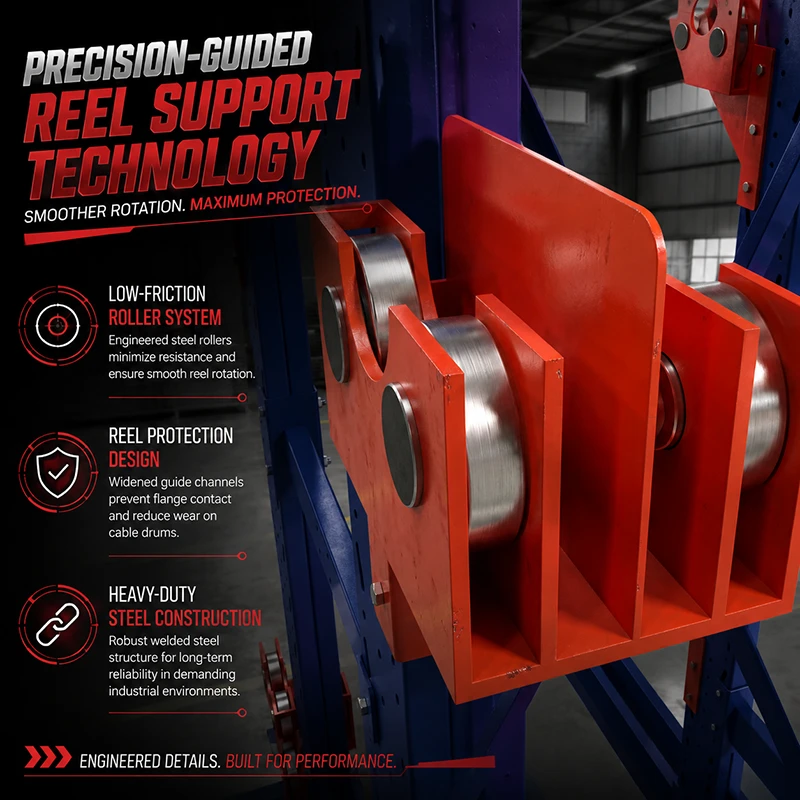
Carack can be specified with roller-bearing reel supports. Where those supports are specified, a reel can rotate in its position and cable can be withdrawn without taking the whole drum down. That option is the reason the two product classes get confused, and it is worth stating its limits plainly.
The rotation support is there for partial withdrawal, not for continuous production pay-out. There is no drive, no tension control, no accumulation and no measuring or cutting function in the rack, and whether the geometry suits your reel, your truck and your aisle has to be confirmed in the quotation or the drawing for that configuration. On a recorded outdoor project, the roller-bearing support was specified together with hot-dip galvanizing, which shows how the two decisions — withdrawal method and finish — are taken together rather than separately.
Quick Decision Checklist
- Count the reels that have no position today. Many reels and mixed diameters point to a storage rack first.
- Ask whether the reel is retrieved whole and moved. Whole-drum handling by forklift points to a storage rack.
- Ask whether one reel must feed a process continuously. Continuous pay-out at a machine points to a pay-out stand.
- Ask whether part of a reel must come off without lowering the drum. Partial withdrawal points to a storage rack with roller-bearing supports, confirmed position by position.
- Measure the aisle and the forklift approach before the layout is drawn — a two-row plan in a 10 × 4.3 m area left only about 1,550 mm of aisle on a recorded project.
- Check the finish against the location. Hot-dip galvanizing was requested on a recorded outdoor storage project; outdoor service needs an approved corrosion-control specification.
Frequently Asked Questions
Can a cable reel storage rack replace an A-frame pay-out stand?
No. A storage rack gives each drum a defined position and keeps it retrievable; an A-frame stand exists to let cable run off a reel continuously. Where a rack is specified with roller-bearing supports, a reel can rotate in place for partial withdrawal, but that is not the same job as feeding a line. In most plants the two are used together — the rack stores, the stand pays out.
Which one should I buy first?
Look at which problem costs you more today. If reels sit on the floor, take up working area and move twice, buy the storage side first: it fixes locations, diameter separation and forklift access. If a single reel has to feed a machine and cable is being dragged off a drum on the floor, buy the pay-out device. If both are true, sequence the rack first, because a pay-out stand still needs a reel delivered to it.
What can the rack not do that a pay-out machine can?
Carack is a fixed, modular steel storage structure with optional roller-bearing supports. It has no drive, no tension control, no accumulation and no measuring or cutting function, and it is not an automated cable carousel or winding machine. If your specification calls for powered or tension-controlled pay-out, that is a different machine class and should be quoted separately.
Deciding With Your Own Reel List
Start with the process, not the hardware. If your reels need positions, adjustable supports and a forklift approach that works in the aisle you actually have, the storage side of this comparison is your project. If a reel has to feed a line, the pay-out side is. Send the reel diameters, reel weights, aisle width and the handling equipment you use, and the level split, support positions and finish can be sized around them instead of guessed.
Need a Custom Storage Solution?
Speak directly with our technical engineers. We offer free structural designs, heavy-duty catalog evaluations, and quick B2B price quotations.
Request a Quote Now →