
What Forklift Clearance Do You Need to Move a Motorcycle Shipping Rack?
If your warehouse team has ever lined up a forklift with a motorcycle rack and stopped to ask, “Will the forks actually go in?”, the answer is not found in a generic pallet rating. It starts with the fork opening, center spacing, lifting clearance, and the direction from which your truck must approach. Mtrack is a configurable motorcycle shipping pallet and rack system: the base is designed around a defined forklift interface instead of leaving the operator to force a standard pallet fork into an unsuitable frame.
For a project review, confirm the forklift model, fork blade dimensions, fork spacing, load condition, turning space, and whether the rack must be approached from two or four sides. The figures below are documented project references—not a universal Mtrack rating. Use them to prepare the interface discussion, then have the final opening and spacing checked against the actual truck before production. For the broader storage context, see our motorcycle pallet storage guide and the Mtrack product page.
Start with the fork opening, not the outside rack size
In one documented motorcycle-club project, the fork opening was specified at 200 × 69 mm, with a center spacing of 820 mm. Those dimensions describe the access interface for that project. They should not be copied automatically to a different motorcycle, pallet width, or forklift. A narrower fork, a thicker fork heel, or a different approach angle can change whether the blades enter cleanly and whether the load remains centered.
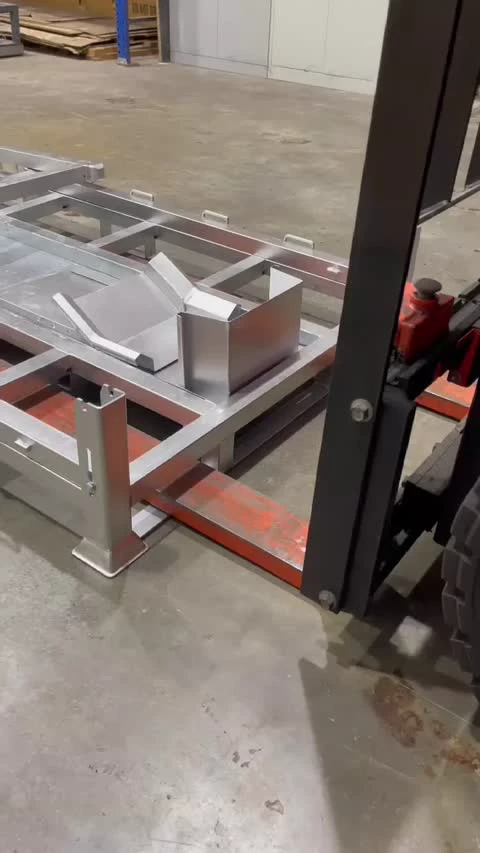
Before ordering, measure the usable fork length and blade section, then compare those measurements with the drawing-confirmed opening. Also check the center-to-center distance: a pair of openings may be individually large enough while still being incorrectly positioned for your truck. The correct question is not simply “Can a forklift lift this rack?” It is “Can this forklift enter both channels fully, keep the load balanced, and withdraw without striking the frame?”
Why a 1-inch lift can make a pallet-fork interface workable
One engineering reference records the rack base being raised by 1 inch. That lift leaves approximately 3.75 inches of clearance, allowing the base to be approached by a standard pallet forklift in the referenced arrangement. The lift is an interface decision: it protects room for the fork blades below the structure rather than relying on a shallow gap that invites contact with the bottom members.
Clearance still needs to be checked in the loaded condition. Floor unevenness, fork thickness, tire position, pallet deflection, and the operator’s approach angle can reduce practical clearance. The rack should be lifted smoothly with both forks aligned and fully engaged. If the blades stop against a cross-member, do not accelerate or pry upward. Forcing the forks can bend the access frame, damage the fork pockets, or shift the motorcycle restraint points. Stop, record the obstruction, and revise the opening or approach plan with the supplier.
When four-way entry is the better choice
Two-way entry may be enough for a fixed loading lane, but a warehouse or freight hub often needs to approach from more than one direction. In a documented freight-hub configuration, the entry width was adjusted to 750 mm, leaving a 150 mm fork lane for four-way entry. This was a project-specific layout decision made around the handling route and rack geometry—not a blanket requirement for every Mtrack.
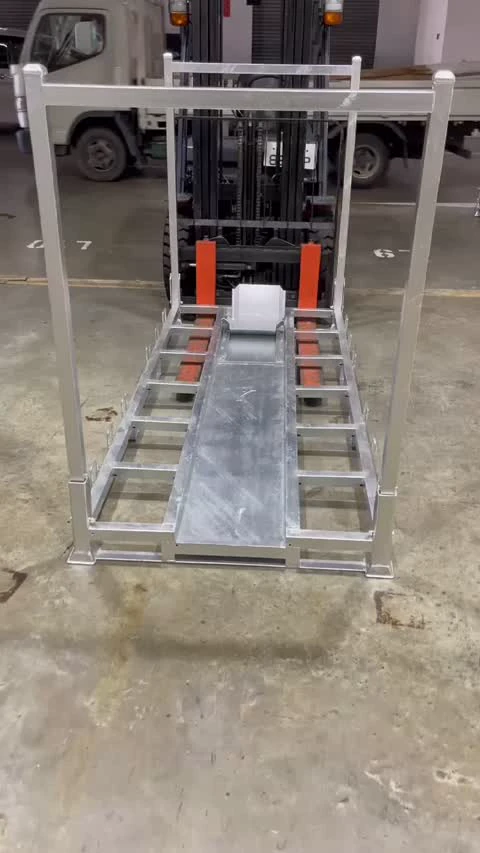
Four-way access can reduce turning and re-positioning in container staging, cross-docking, and dealer warehouse lanes. It can also consume more frame width or affect usable storage density. The design review therefore has to balance fork lanes with motorcycle envelope, rack depth, container or trailer limits, and the required loading direction. Do not assume that a wider opening automatically improves handling; the fork lane must suit the actual truck and the surrounding aisle.
What to send before you ask, “Will my forklift fit?”
- Fork interface: fork blade width, thickness, usable length, and maximum spread or center spacing.
- Approach plan: two-way or four-way entry, aisle direction, container or trailer loading direction, and available turning room.
- Loaded condition: motorcycle dimensions and weight, rack tare, restraint arrangement, and the intended lifting points.
- Operating limits: stacking policy, floor condition, transfer frequency, and any requirement to place the rack into an existing storage system.
Mtrack can be configured around these inputs with wheel positioning, restraint points, removable or fold-down posts, and a defined forklift interface. However, fork-channel size and forklift capacity remain project-confirmed items. No general tonnage or universal working load should be assumed from the product name alone. If your current truck cannot meet the proposed opening, the correct remedy may be a revised interface, a different handling route, or a different forklift—not aggressive fork entry.
Forklift clearance FAQ
Is 200 × 69 mm the standard Mtrack fork opening?
No. It is a documented project reference, together with 820 mm center spacing. Other projects can use different openings and spacing. Send the forklift details and handling drawing so the interface can be confirmed before fabrication.
Can any standard pallet forklift move a raised Mtrack rack?
Not automatically. The referenced 1-inch lift and 3.75-inch clearance were intended to fit the standard pallet-fork arrangement in that project. The forks must enter the channels fully, remain compatible with the opening and spacing, and lift the loaded rack within the project-approved handling conditions.
Need a Custom Storage Solution?
Speak directly with our technical engineers. We offer free structural designs, heavy-duty catalog evaluations, and quick B2B price quotations.
Request a Quote Now →