
If you store loose fasteners, washers, small bushings or short turned parts in a metal pallet box, the bottom panel is doing more work than the four sides. The walls stop a tote from spilling sideways; the floor stops a part from disappearing through the grid. When the floor is mesh and the part is smaller than the grid opening, every forklift trip becomes a search for missing pieces on the concrete.
Sebox is built so the base and each of the four gates can be specified independently—mesh panel or solid steel plate. Choosing the right combination is a containment decision, not a styling choice. This guide covers when a solid steel plate is the correct insert, when mesh is the correct insert, and how to mix the two across the base and the four gates.
Why small parts favour a solid steel plate
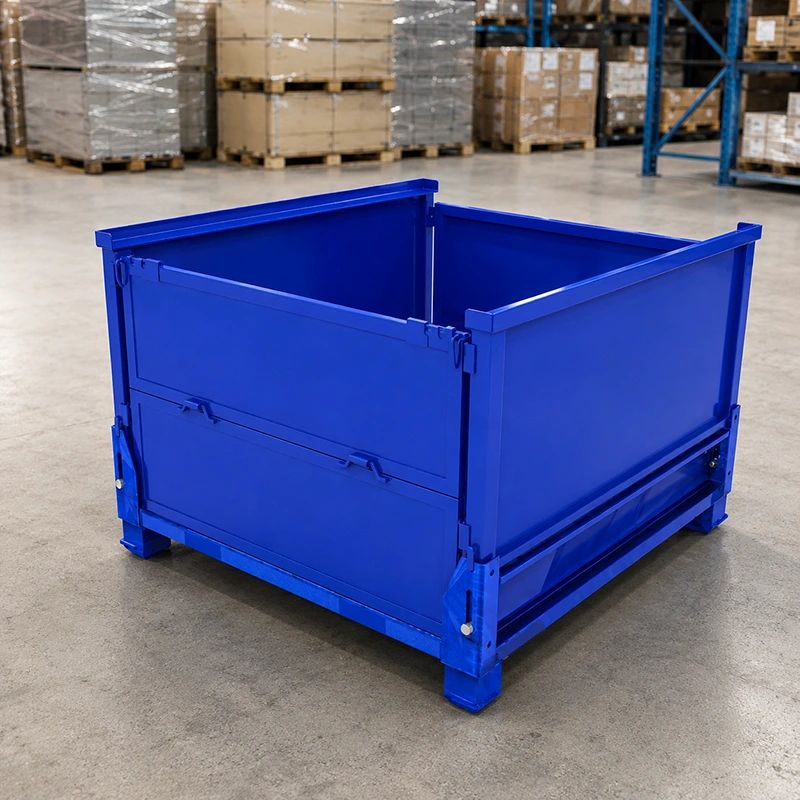
A standard welded mesh panel on a metal pallet box is sized for airflow and visual inventory, not for catching loose small parts. On a Sebox, that means a part roughly the size of the grid opening—M6 cap screws, small washers, thin shims, springs, bushings under 30 mm—can pass through during forklift handling, tipping or impact loading. A solid 1.5 mm hot-rolled steel plate closes the floor, which is what stops the slow leak.
A solid base also blocks contamination from below. Coolant splash, oil drips from a rack above, dust kicked up by forklift traffic, and cardboard debris from mixed storage all pass straight through a mesh base into the load. A solid plate keeps those contaminants out and lets the box be wiped clean between batches—important when parts are going straight back to a CNC machine or an assembly fixture.
Pair the solid plate with a half-drop front gate, as shown below, and you keep the access benefit while sealing the floor. The drop gate lets an operator reach parts at any layer of the stack without dismantling the box.
Where mesh panels earn their keep
Mesh is the right insert when the part cannot fall through the opening. Anything that sits comfortably on a welded grid—large castings, formed brackets, gear blanks, motor housings, valve assemblies—is a mesh candidate. The benefit of mesh in these cases is real and worth keeping:
Visual inventory without unpacking. A forklift operator or stock clerk can read the contents of a stack of Sebox cages from two metres away without unstacking, opening or counting. That alone saves several minutes per cycle on a busy line-side rack and reduces the temptation to leave boxes half-open.
Airflow for residual processes. Heat-treated parts coming out of a quench, freshly plated components, or coated parts still releasing solvent all benefit from air circulation. A mesh cage lets the part breathe in storage instead of being sealed in its own moisture or vapour.
Lower empty weight and easier inspection. With the side panels and base in mesh, an operator can visually confirm the box is empty before folding it for return. A solid-sided box hides debris that then gets folded inside.
Faster wash-down and contamination check. If a swarf or a stray piece is left inside a mesh cage, it shows up on the next inspection pass. Inside a solid plate box, you have to open it.
Mix-and-match the base and the four gates
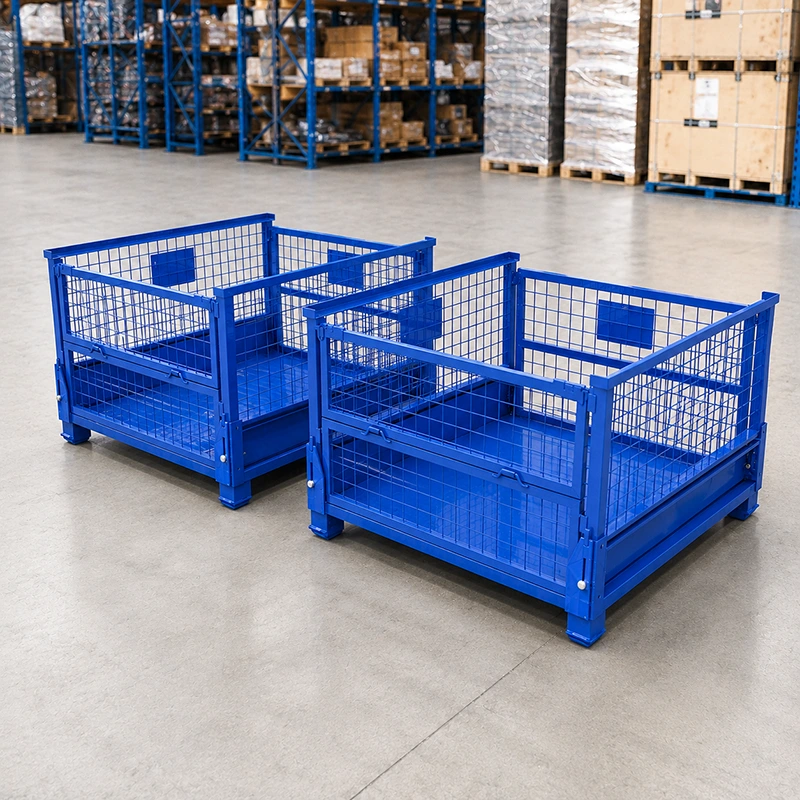
Sebox is not sold as a one-configuration box. The base, the front gate, the rear gate and the two side gates are specified independently. That is the part procurement teams most often miss—they request “mesh” or “solid” as if the whole box is one choice. In practice, the four common combinations solve four different problems:
Solid base + mesh sides: the default for mixed-line parts that include both small loose items and larger components. Floor is sealed against leakage and floor-level contamination; sides give visual inventory and airflow.
Solid base + solid sides: for oily, coolant-soaked or dust-sensitive parts that must stay clean between machining and assembly. Heavier, but the box is a closed container.
Mesh base + mesh sides: for heat-treated, freshly plated or coated parts where airflow matters more than a sealed floor—typically used on a rack rather than a forklift.
Mesh base + solid sides: less common, but useful when parts need airflow from below but protection from side impact during transport.
Specify the configuration on the SKU. Mixing inserts on a single purchase order is supported; changing configuration on a partial order is not. If your team is unsure, send a sample of the smallest part you expect to store and the contamination profile of the line, and the right insert combination can be confirmed before production.
Where each insert configuration fits in a real line
- CNC and machining cells storing fasteners, washers, small bushings and short turned parts—solid base, mesh sides, half-drop front gate for line-side access.
- Automotive assembly lines with mixed-size parts in closed-loop plant logistics—solid base plus mesh sides for visual inventory plus floor containment.
- Heat treatment or coating areas holding parts that need to cool or off-gas—mesh base plus mesh sides, stored on a rack rather than a forklift.
- Oil, coolant or dust-exposed production—solid base plus solid sides for a sealed container that can be wiped down between batches.
Frequently asked questions
Can I order a Sebox with mixed inserts, for example a solid base and mesh sides?
Yes. The base, front gate, rear gate and two side gates of a Sebox are specified independently. State the insert per face on the order. Mixed configurations are common and supported.
My parts are around 10–20 mm. Will a standard Sebox mesh still hold them?
For Sebox variants built with the standard welded mesh grid, parts smaller than the grid opening can pass through during handling, tipping or impact. For anything in the 10–20 mm range, specify a solid plate base and consider a solid plate for the lower portion of the side panels if the load sits low in the box.
Need a Custom Storage Solution?
Speak directly with our technical engineers. We offer free structural designs, heavy-duty catalog evaluations, and quick B2B price quotations.
Request a Quote Now →