
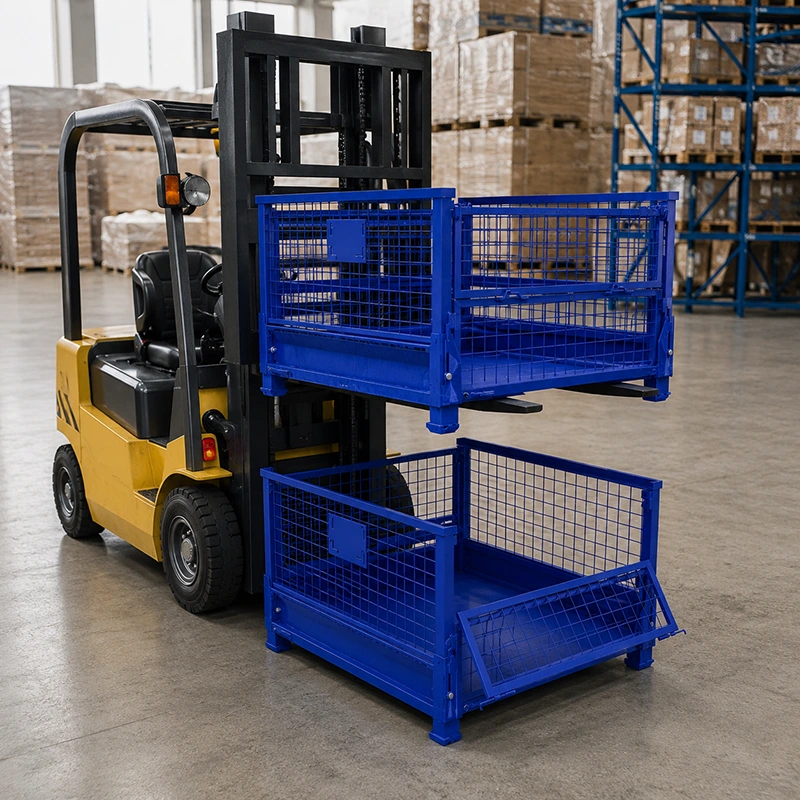
On a busy machining or automotive line, empty containers are the silent footprint tax. They show up between stations, at the assembly buffer, and beside every active workstation, and they take up the same floor area they did when full. Adding more bins only pushes the clutter around; widening aisles or installing conveyors to “solve” the empties becomes a capital project the line did not ask for.
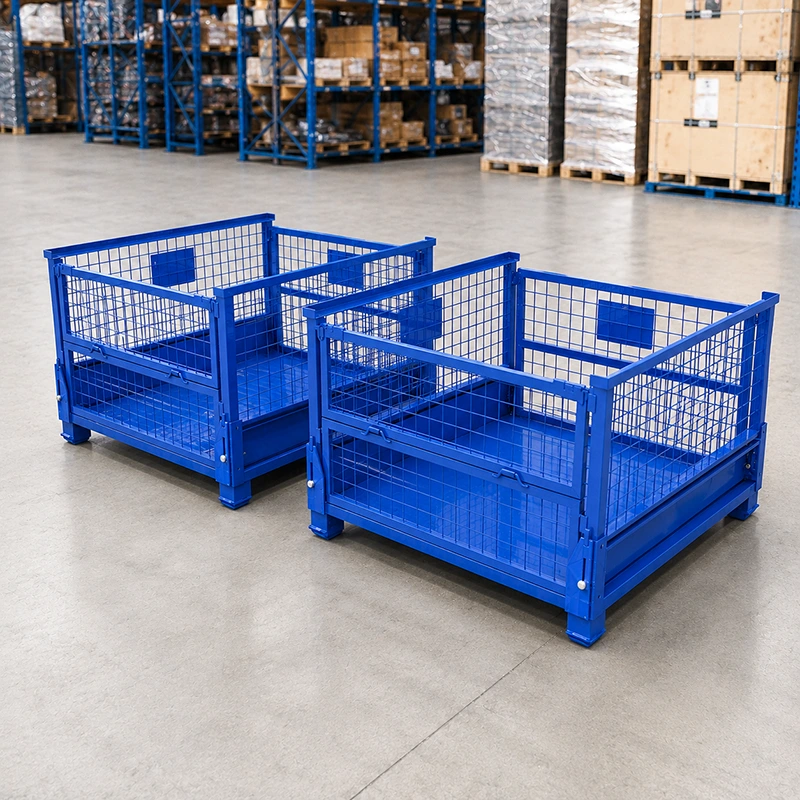
A collapsible steel stillage addresses the empty-state problem in the same container that handled the full state. When the box is loaded it stacks as a rigid, palletized unit; when it is empty the side frames fold down against the base to a compact profile — a documented folded footprint is 1000×800×335 mm — and a stack of folded empties fits back into roughly the same rack bay the loaded stack came from. The folding motion is independent of the mobility option: the same collapse works whether the box sits on forklift feet, rides a pallet jack, or rolls on swivel casters. Line-side equipment, dock door height, and aisle width do not have to change.
Why empty containers keep showing up in line-side audits
Empty containers accumulate wherever the line has finished its work. A stillage that carried finished parts to the assembly buffer waits there until someone returns it to the staging area. A bin that just emptied at a machining cell sits beside the operator’s feet until the next forklift loop comes around. By mid-shift, the same floor area that supports production is now storing packaging.
The traditional fixes each have a price. Ordering more bins adds storage racks. Specifying larger bins worsens operator handling and pushes loads past ergonomic limits. Adding conveyors to “solve” empty returns becomes a capital project with electrical, controls, and downtime costs that the line did not request. None of these is wrong, but none of them addresses the underlying fact: the empty box is the same container that was full five minutes ago, and it does not need the same volume.
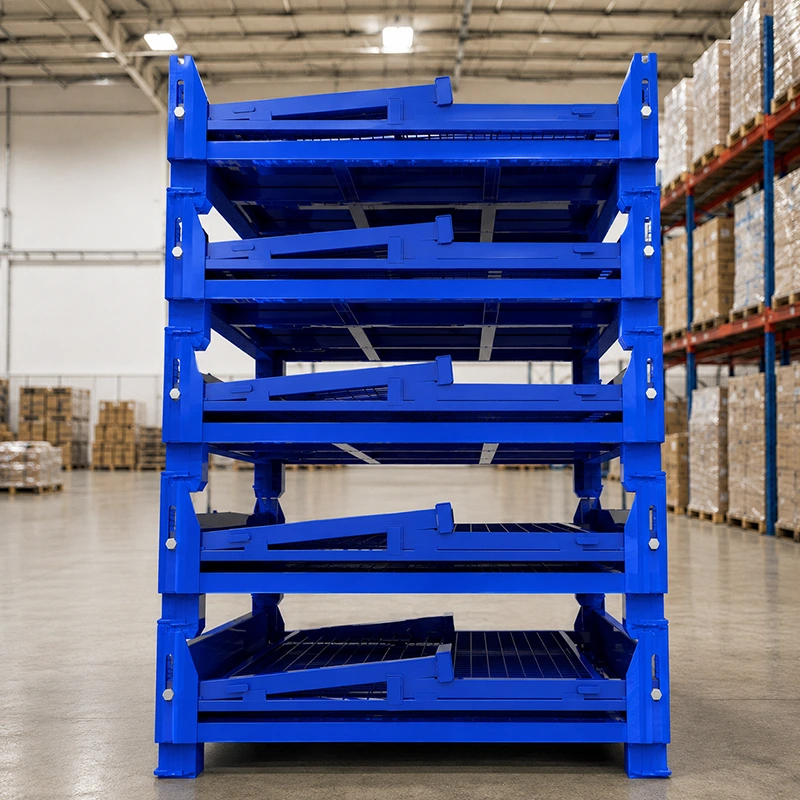
The same line footprint, with empties that fold out of the way
The collapsible steel stillage is built for the empty state. The base stays intact so the forklift pockets and pallet-jack engagement surface remain unchanged. The side frames and gates hinge down against the base, leaving a flat, low-profile folded unit. One documented variant folds to 1000×800×335 mm — roughly one third of its operating height — while the base footprint stays the same.
Because the base footprint is unchanged, the line layout does not need to change. Forklift trucks, pallet jacks, dock doors, rack bays, and aisle widths all stay the same. The folded stack lives where the loaded stack used to live. What changes is the empty volume: a folded stack takes about one third of the height of a loaded stack of the same units, which is the difference between an empty-storage rack that fills up and one that keeps up with the shift.
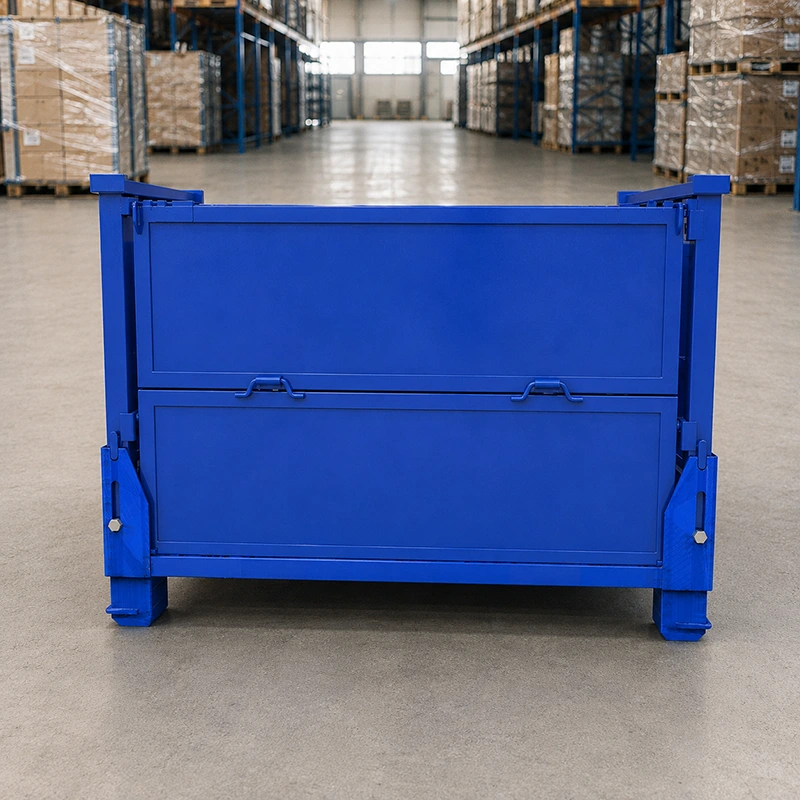
With or without casters — foldability is independent of mobility
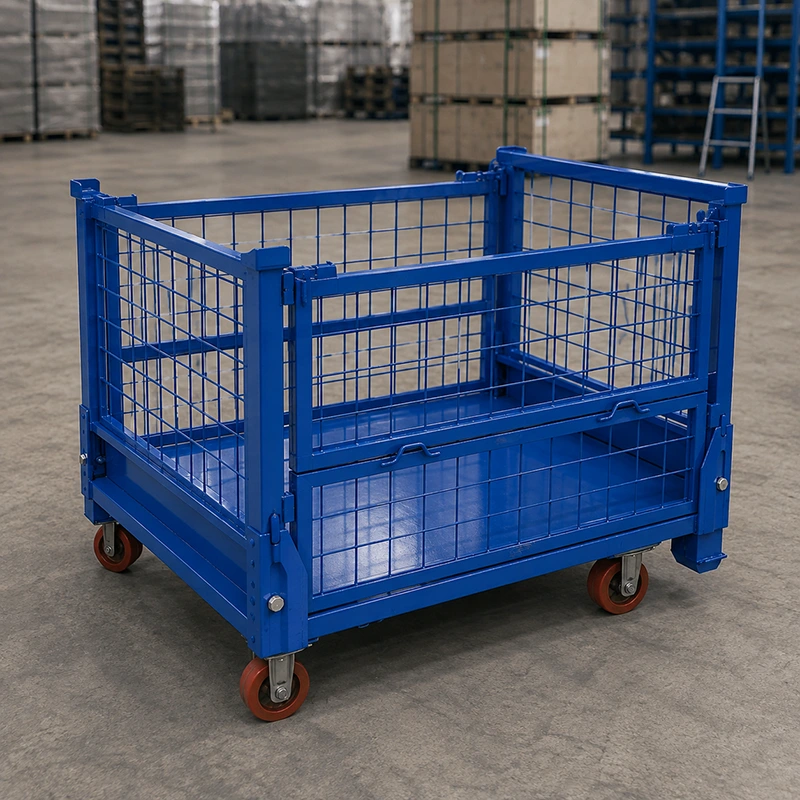
Buyers often ask whether adding casters removes the folding benefit. It does not. The folding mechanism lives in the side-frame hinge and the base, not in the casters. A caster-equipped stillage folds to the same compact profile as a pallet-foot stillage, and a pallet-foot stillage folds the same way as a caster-equipped one. The casters are an additive mobility feature, not a structural replacement.
The right way to choose between the two is by the line’s primary handling method. If loaded boxes move between CNC cells and assembly by forklift or pallet jack, keep pallet feet and casters are not needed. If operators also need to push partially-loaded or empty units a few metres between adjacent stations — for example from a saw to a deburring bench — a caster-equipped variant delivers that without a second container type on the floor. Folding is unaffected in either case.
How to plug folding into your current line-side flow
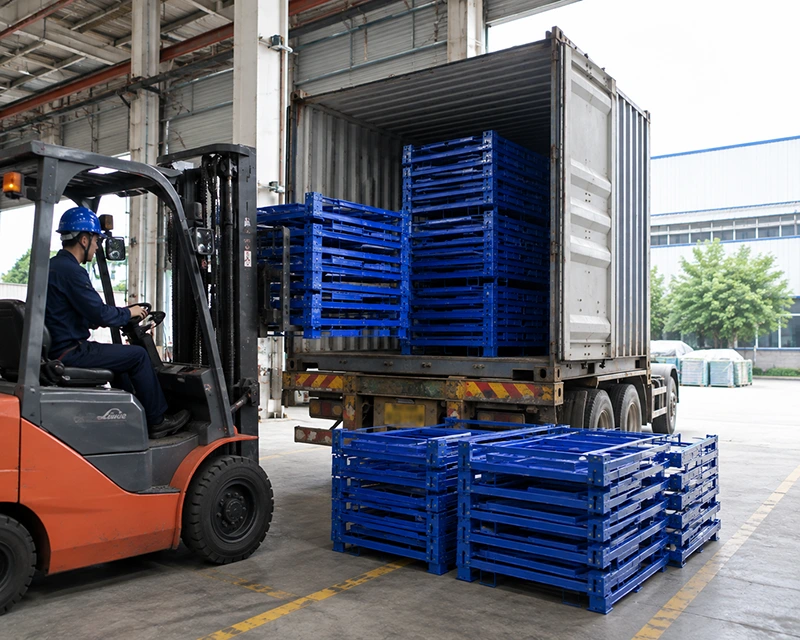
Integration happens at the operator’s hands. When a stillage is emptied at the assembly buffer, the operator folds the side frames down against the base — typically without tools and in seconds — and stacks the folded unit on the empty pallet beside the workstation. At end of shift the folded stack rides a pallet jack back to the receiving dock. From the dock it rides the same container truck as the loaded units did the previous day; folded volume per box is roughly one third, so a shipping container carries more folded empties than loaded units.
What stays the same on the line: forklift trucks, pallet jacks, aisle widths, dock door heights, empty-storage racks, receiving bay dimensions. What changes: empty volume per box drops, full-load pickup frequency drops, and line-side clutter disappears. The line’s own equipment list is not touched.
What to confirm before ordering for your line
The “no rework” outcome is real but conditional. Six configuration points must be resolved before the stillage order is released.
- Folded height vs empty-storage rack clearance. The 1000×800×335 mm folded profile fits most rack bays, but verify the actual clearance against the specific unit you are buying.
- Caster load rating. If you specify swivel casters, their rated capacity must match the heaviest part weight you intend to push on them. Caster rating is typically lower than the stillage’s static load rating.
- Panel type. Mesh sides for visual inventory and lighter weight; solid steel panels for small parts that would otherwise escape through the mesh.
- Gate arrangement. A half-drop front gate keeps access open when units are stacked; a full drop gate swings clear. Pick the configuration that matches how operators reach parts in a stack.
- Forklift pocket dimensions vs existing trucks. Pallet-foot or pocket geometry has to match the trucks already in the fleet.
- Variant load rating. Source documents cite 1000 kg, 1300 kg and 1500 kg variants. Confirm the rated load before quoting a load number to operations.
Where this approach applies on the floor
- Automotive parts assembly lines: closed-loop transfer of stillages between CNC machining and final assembly, with the same forklift handling loaded and folded empty units.
- CNC machining workshops: store batches of finished metal parts in wire mesh stillages on the rack beside the machine, and return folded empties to the receiving dock at end of shift.
- Heavy scrap-metal collection: rigid steel containment with the same forklift interface, with empty folding for return trips from the scrap yard.
- Cross-dock distribution centres: receive folded stillages in shipping containers, deploy loaded units to the line, and return folded stacks to the dock.
Buyer questions, answered for the line-side case
Does installing a collapsible stillage require any change to my current line layout?
In the typical case, no. The empty unit collapses to the same base footprint as the loaded one, so the forklift pockets, pallet-jack paths, dock door height, and rack bay used for empty storage remain compatible. The items to check are folded height against your empty-storage rack clearances, caster load rating if you specify a mobile variant, and the gate type against how operators access parts in a stack. None of these is a line re-engineering item; they are configuration questions resolved before the order.
Is the folding mechanism the same whether the stillage has casters or pallet feet?
Yes. The folding motion sits in the side-frame hinge and is independent of the base option. A caster-equipped stillage still folds down to its compact profile, and a pallet-foot stillage folds the same way. Casters only affect how the unit moves short distances at line-side; they do not change the folding behaviour or the folded dimensions. If you need both forklift transfers between cells and short pushes between adjacent stations, a caster-equipped variant folds the same way and does not require a second container type on the line.
Need a Custom Storage Solution?
Speak directly with our technical engineers. We offer free structural designs, heavy-duty catalog evaluations, and quick B2B price quotations.
Request a Quote Now →