
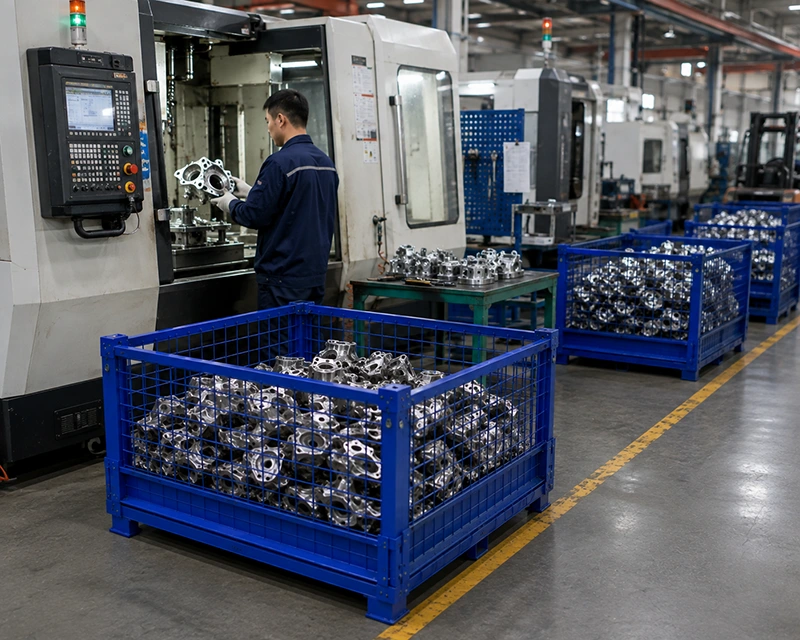
Open pallets are the default staging tool in many machining cells. A flat deck lets the operator drop a batch of parts after a CNC run, slide the load onto a pallet jack, and move on to the next operation. It is fast, familiar and almost free to set up. The problem is what happens to the parts once they leave the spindle.
A foldable steel pallet replaces the flat deck with a rigid, four-sided enclosure. Workpieces sit inside welded mesh or steel-panel walls, the base still takes a forklift or pallet jack from below, and the same unit folds down when it goes back to empty storage. On selected configurations the base can be ordered with casters and a tow arm, which turns the box into a mobile buffer that rides between CNC, deburr, inspection and assembly without a powered truck.
What Actually Goes Wrong on an Open Pallet
Open pallets expose every problem of inter-process staging at the same time.
- Rolling and shifting. Cylindrical blanks, sleeves and turned parts roll off the deck the moment the pallet jack turns or brakes. The same parts migrate to one side during transport, so a balanced-looking stack ends up leaning.
- Edge damage. Sharp-finished parts dig into the wooden deck, into each other, and into the steel banding that tries to hold the load together. Machined faces lose their protective film and pick up scratches.
- Mixed batches. With no walls, batches from different work orders slide into each other, especially after a sudden stop. Operators spend time re-sorting at the next station.
- Hard to count. A loose pile has to be picked up to be counted. Inventory checks stop the cell or rely on paperwork that drifts out of sync.
- Contamination. Coolant, chips and floor grit collect on the open deck and ride with the load into the next operation.
- No protection at the next stop. A generic flat pallet gives the load nothing: no side containment, no access gate, no shielding from the next handover.
This is why most machining shops that move WIP on open decks eventually add cardboard, stretch wrap, banding or a wooden crate on top. Each fix is partial, and each one adds handling time.
A Foldable Steel Pallet With a Rigid Frame Around the Load
The Sebox foldable steel pallet keeps the palletized base that the cell already uses, and adds the four-sided enclosure that open pallets cannot provide.
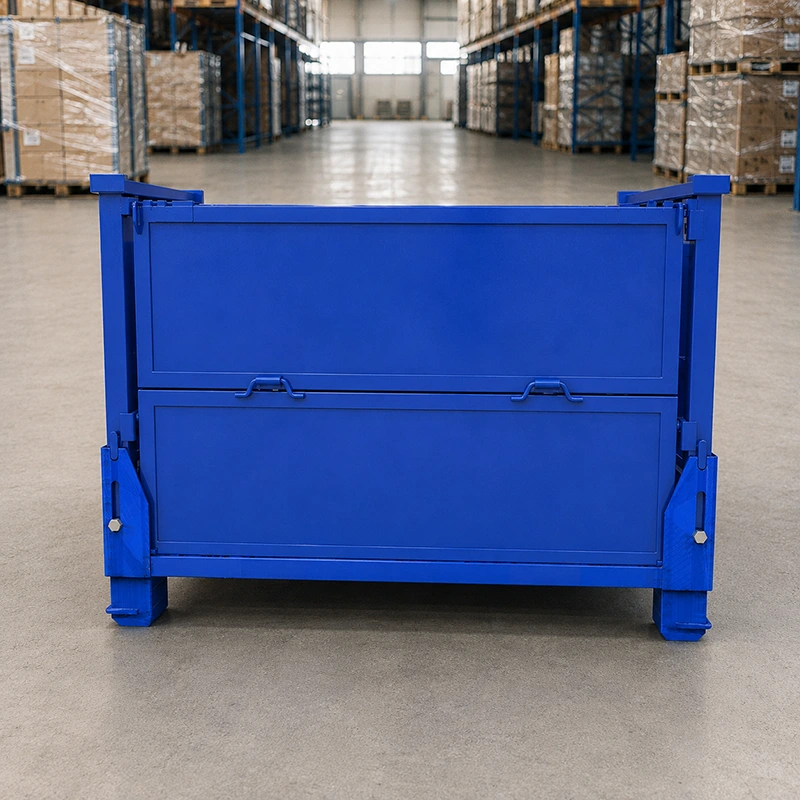
- The base still carries forklift pockets or pallet-jack feet, so the box slots into the same handling flow as a flat pallet.
- The walls are welded steel frames with mesh or solid panel inserts. Mesh gives visual inventory without opening the box; solid panels stop small parts from poking through.
- A half-drop or side gate is built into one or more sides. Operators can reach the bottom layer of a stack without unstacking anything above it.
- The same construction folds flat when empty. Documented variants fold to 1000×800×335 mm and 1220×1015×335 mm, roughly one third of the assembled height.
This is the part that closes the open-pallet failure list: parts stay inside the box, batches stay separated, the deck under the load is still a standard pallet interface, and visual counts no longer require lifting every piece.
Optional Casters and Tow Arm for Inter-Process Transfer
Forklift and pallet-jack transfer is not always the right answer between two adjacent machines. On a machining cell with short moves — CNC to deburr, deburr to inspection, inspection to assembly — a powered truck adds queue time at every handover.
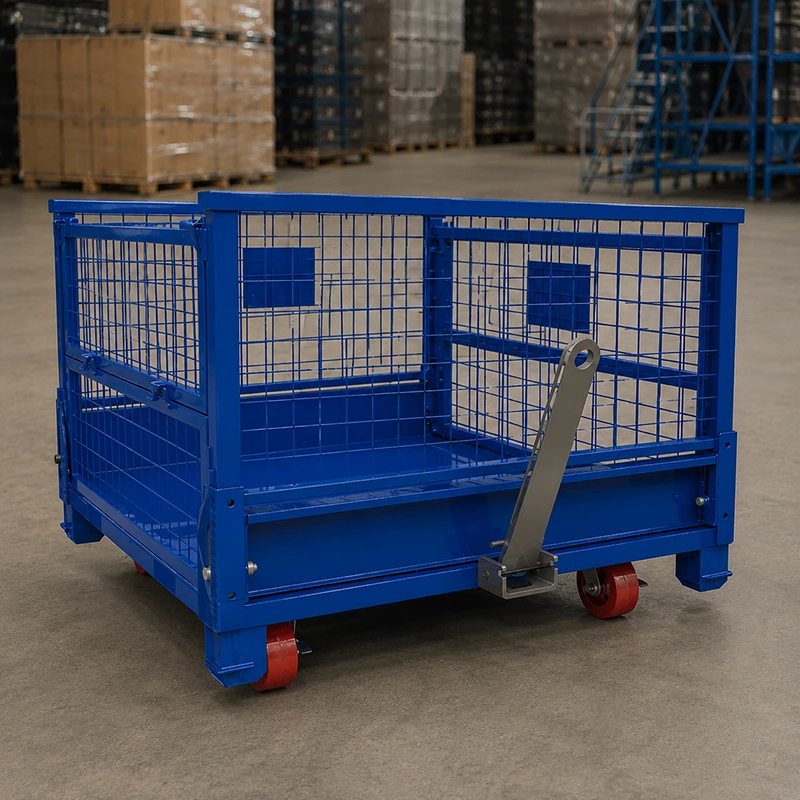
- Four swivel casters convert the loaded box into a wheeled buffer that one operator can push across a flat workshop floor.
- A welded tow arm lets the same box be pulled by a small electric tug or another wheeled unit in a tow train.
- The casters and tow arm are options, not standard equipment. Cells that already run on forklift-and-pallet-jack flow can keep the standard pallet base and skip the caster package.
- The caster option still leaves the forklift pockets in place, so a pallet jack or forklift can take over for longer moves or for loading the truck.
For a CNC-to-assembly cell running a 5–15 m loop, the caster option is usually the cheapest way to cut one truck move per cycle. For a cell that hands parts off to a different building or a yard, the standard pallet base is the more useful configuration.
Folded Empty Boxes: What It Means for Workshop Floor
Folding is not just a transport trick. It also changes what happens to the empty box between cycles.
- A folded Sebox drops to roughly one third of its assembled height. Documented folded sizes include 1000×800×335 mm and 1220×1015×335 mm; treat these as variant-specific figures and confirm the SKU before sizing empty storage.
- Empty folded units stack against a wall or under a rack, freeing the staging lane for live WIP. In cells that previously parked 6–10 empty wooden pallets on the floor, the same number of folded steel units typically fits along one rack bay.
- Return-trip volume drops with the box. Loaded inbound, folded outbound, the reverse-logistics footprint of a closed-loop WIP loop shrinks.
- Folding is a manual hinge operation, not a forklift task, so the empty cycle can be done by one operator at the end of the shift without tying up equipment.
The combined effect on a small cell: fewer empty pallets on the floor, faster moves between machines when the caster option is added, and a single container type that goes from inbound delivery to outbound finished goods without repacking.
Where a Foldable Steel Pallet Fits in a Machining Cell
- CNC and machining workshops moving batches between rough cut, finish cut, deburr and inspection stations.
- Automotive and mechanical-parts WIP buffers that feed assembly lines from a separate process hall.
- Contract manufacturers running short, repeatable WIP loops with one operator moving multiple boxes per shift.
- Plants that need visual inventory of in-process parts without breaking down each pallet at the count.
Buyer Questions on Machining WIP Staging
Is the caster and tow-arm package standard on the Sebox?
No. Forklift pockets or pallet-jack feet are part of the standard base. The four-caster and tow-arm package is an option that is selected when the cell runs short, frequent inter-process moves on a flat floor. Cells that move WIP with forklifts or pallet jacks only should keep the standard pallet base.
Can a foldable steel pallet replace every open pallet in a machining cell?
It can replace the WIP and inter-process staging pallets where the parts need side containment, batch separation or visual count. It is not the right tool for every flat-deck job: incoming raw bar stock, finished goods on stretch wrap, or any load that needs open top access for a crane or hoist will still go on a flat pallet. Use the Sebox where the failure points of an open pallet — rolling, edge damage, mixed batches, slow counts — actually show up.
For a foldable steel pallet sized to your machining WIP loop, send us the workpiece envelope, the cycle batch count, the longest single move, and whether you want the optional caster and tow-arm package. We will return a process-staging proposal with the right base configuration, panel type and gate arrangement for your cell.
Submit Your Workpiece Form · Read More Process Staging Solutions
Need a Custom Storage Solution?
Speak directly with our technical engineers. We offer free structural designs, heavy-duty catalog evaluations, and quick B2B price quotations.
Request a Quote Now →