
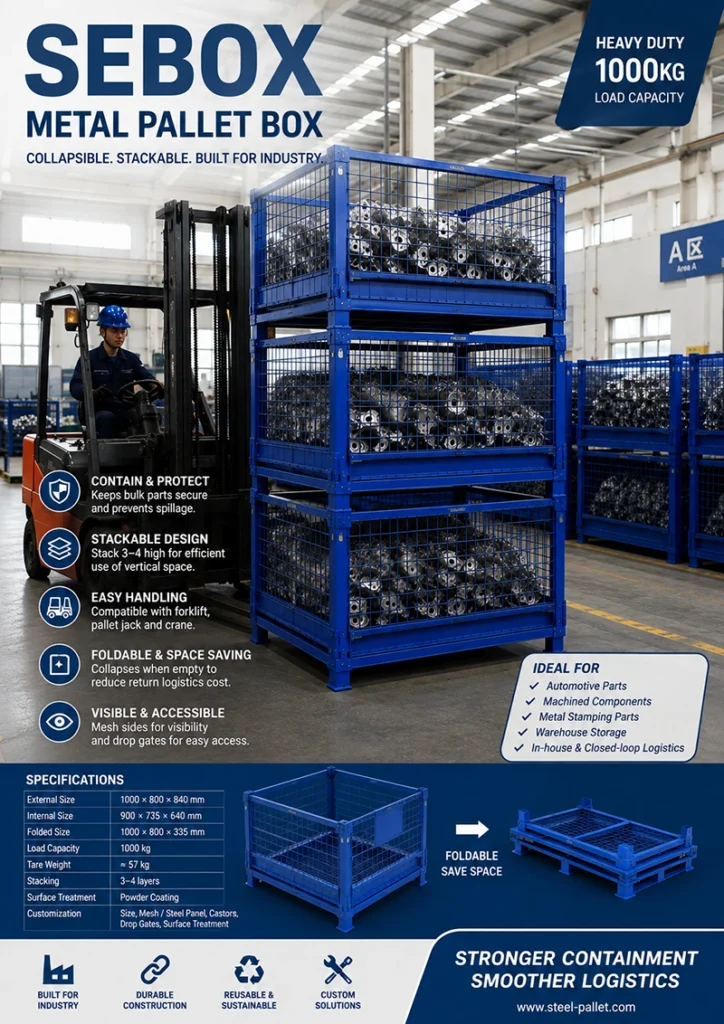
In an automotive assembly plant, the most expensive minute of the day is usually the one nobody planned: a missing bracket between sub-assembly and final line, a batch of stamped parts that spilled on the floor, a forklift waiting while operators count boxes one by one. The hand-off between stations is where small inefficiencies compound into line stoppages. That is why an increasing number of automotive parts plants are standardizing inter-station circulation around a single repeatable unit: the collapsible cage pallet.
A collapsible cage pallet, also called a metal pallet box, foldable steel pallet or wire mesh stillage, converts each batch of brackets, shafts, housings or sub-assemblies into one palletized load that can be moved by forklift, pallet jack or tugger in a single touch. Steel mesh sides keep parts contained, allow visual inspection without opening the box, and fold flat when empty so return-trip volume drops dramatically.
Why standardize inter-station circulation around one repeatable unit?
Automotive assembly lines rarely follow a straight path. Press shop, machining cell, sub-assembly, final line and inspection stations each have their own footprint, aisle width and lifting equipment. When parts move between them in mixed containers — wooden crates, cardboard cartons, plastic totes, loose pallets with stretch wrap — every hand-off becomes a custom job: the operator must reposition, recount, repack or re-pallet the load before the next station will accept it.
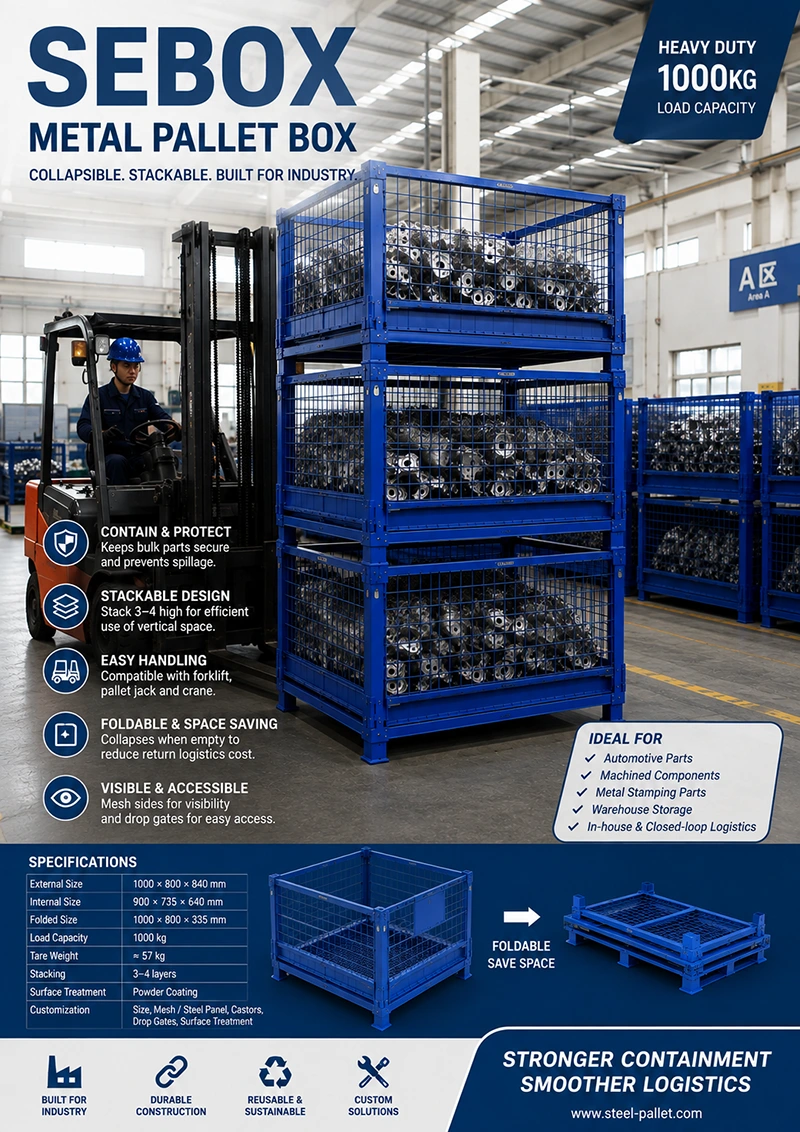
A collapsible cage pallet fixes the unit. One external footprint (documented variants range from 1000×800 mm up to 1240×1015 mm) fits every cell. Pallet-style feet accept a forklift, pallet jack or tugger; reinforced posts and corner frames let loaded units stack three or four high beside the line. Because the same container shows up at every station, the line-side team stops asking how the batch is packaged and starts asking whether the batch is complete. The container itself disappears from the conversation, which is exactly the point of standardization.
The hidden cost of manual handling between stations
Manual handling looks cheap until you count contact points. If a batch of machined brackets is moved by hand from a CNC cell to a sub-assembly bench, every part is touched, lifted and set down at least twice per trip — typically more, because operators re-grip, re-stack and re-orient on the bench. Each touch is a chance to drop a part, scratch a surface, mix batches or trigger a recount. Multiply that by the number of batches per shift and the number of stations in the loop, and the “free” manual transfer is actually the largest single source of lost parts and micro-stoppages on the line.
A single collapsible cage pallet move replaces those hand-carries with one forklift or pallet-jack pass. The batch arrives in the same container it left in, so there is no repack, no recount, no reshuffle. Loaded variants documented in our technical sheets span 1000 kg to 1500 kg uniformly distributed load, depending on the SKU; what matters for the line engineer is that one pass replaces five to ten hand-trips, and the operator who used to carry parts is now available for value-adding work at the station. The reduction in handling touches directly reduces scratches, mix-ups and the ergonomic load that drives absenteeism on inter-station transfer.
Visual inventory that prevents line stoppages
The second cause of unexpected stoppages is invisible stock. With a closed cardboard carton or a solid steel bin, a line-side operator cannot tell how many parts are left until they open the lid, lift the divider or tip the box. By the time the shortage is visible, the line is already starving. Open mesh sides flip this problem: the operator walks past the cage pallet, glances through the welded wire mesh, and sees the part level instantly. No opening, no re-closing, no interruption.
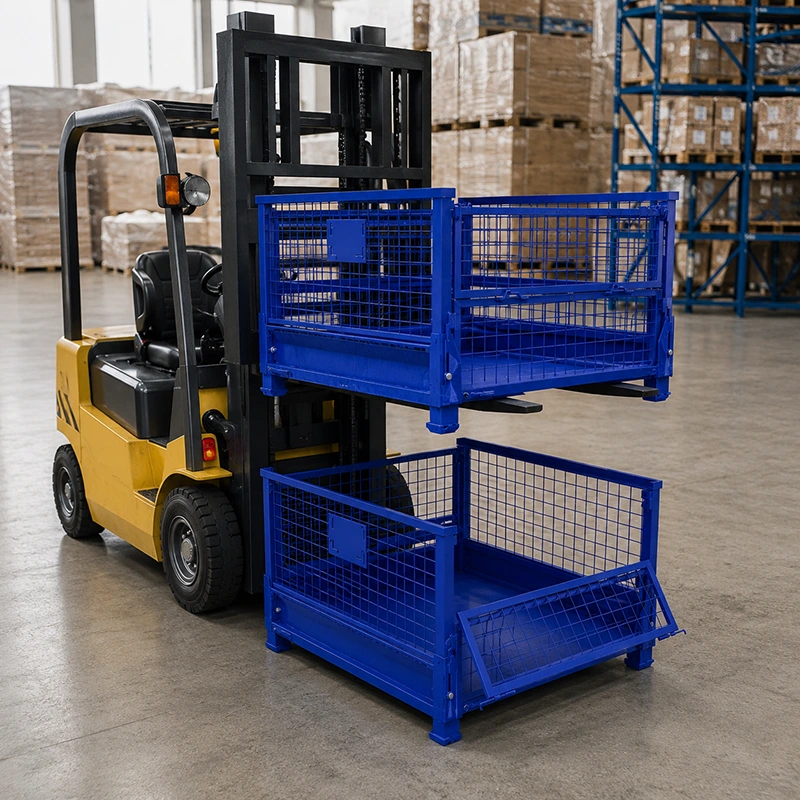
The half-drop front gate takes this further. Even when cages are stacked three high beside the line, the operator can lift the drop-front latch on the bottom unit, reach in and pull a single part without unstacking the column above. This is the access pattern that makes a stack-and-feed line possible: parts are buffered in stacked cages near the station, and the line never stops to hunt for the last ten pieces. Combined with the mesh visibility and a pallet-style base that a forklift or pallet jack can pick up from any side, the result is a circulation loop where inventory is always visible, always reachable and always one mechanical move away from the next station.
Where the collapsible cage pallet fits an automotive line
- Press shop to machining cell: stamped blanks move in mesh cages that double as wash baskets, so the same container goes from press to deburr to CNC without repacking.
- CNC machining to sub-assembly: finished shafts, housings and flanges stay in the same cage from machine output to the assembly bench, preserving batch identity.
- Sub-assembly to final line: pre-kitted modules are delivered in stackable cages parked beside the line, replenished one-for-one by forklift or tugger.
- Line-side WIP buffering: stacked cages with half-drop gates act as a visible, reachable buffer that the line can draw from without stopping.
- Return-trip and empty storage: when empty, the same cage folds flat — one documented folded profile is 1000×800×335 mm — so empty containers stack inside a 20GP at high density and return-trip cost drops sharply.
FAQ
How does a collapsible cage pallet actually improve inter-station circulation?
It makes every transfer one unit and one mechanical move. Parts leave the previous station in the same cage they arrive in, so there is no repack, no recount and no reshuffle at the hand-off. The line engineer stops managing packaging and starts managing flow.
Why does visual inventory matter for automotive assembly lines?
Open mesh sides and a half-drop front gate let line-side operators see part levels and reach bottom-layer stock without unstacking or opening lids. That visibility is what converts a stop-and-count moment into a continuous-flow decision, and it is the most direct way to prevent starvation stoppages between stations.
Need a Custom Storage Solution?
Speak directly with our technical engineers. We offer free structural designs, heavy-duty catalog evaluations, and quick B2B price quotations.
Request a Quote Now →