
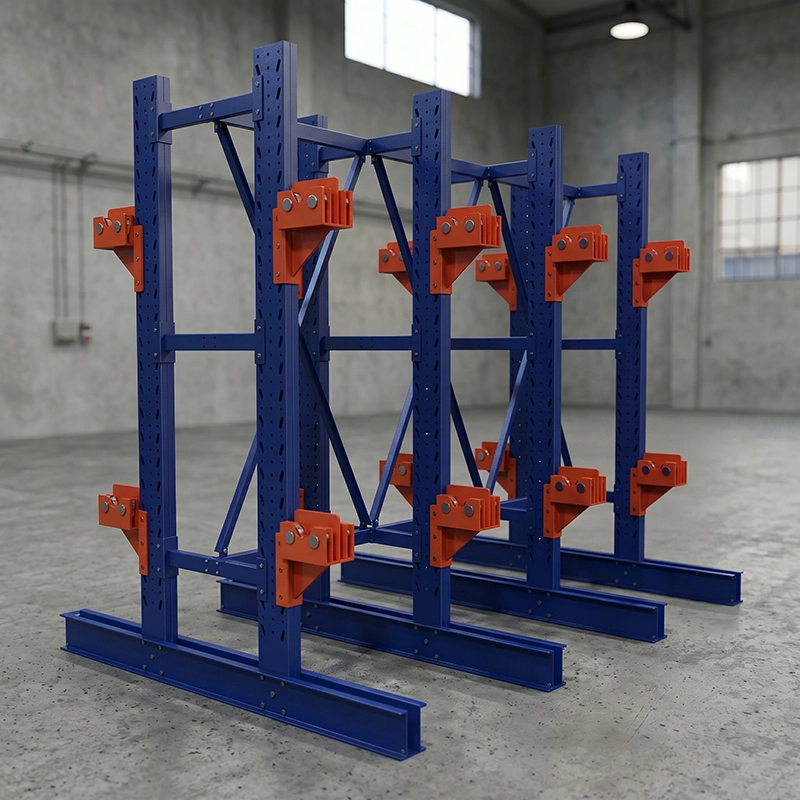
A cable drum rack standing in an open yard is a different purchase from the same rack standing inside a warehouse. The steel frame does not change. What changes is that every surface, bolt, plate edge and base detail is now exposed to rain, to water standing on a concrete slab, and to wooden reels that soak up moisture and keep it against steel for weeks. Buyers who plan reel storage outdoors or under a half-covered canopy usually arrive with one question: which finish makes this last?
That question cannot be answered with a blanket promise. On the Carack cable drum rack, hot-dip galvanizing is a project-level requirement that has to be written into a specific order — it is not a finish applied to every rack in the range, and it is not an outdoor service life guarantee. This article sets out what the project record actually shows about rain exposure, how the finish, drainage, edge protection and inspection interval should each be confirmed before production, and why we decline to put a number of years on an outdoor installation.
What the Project Record Says About Rain Exposure
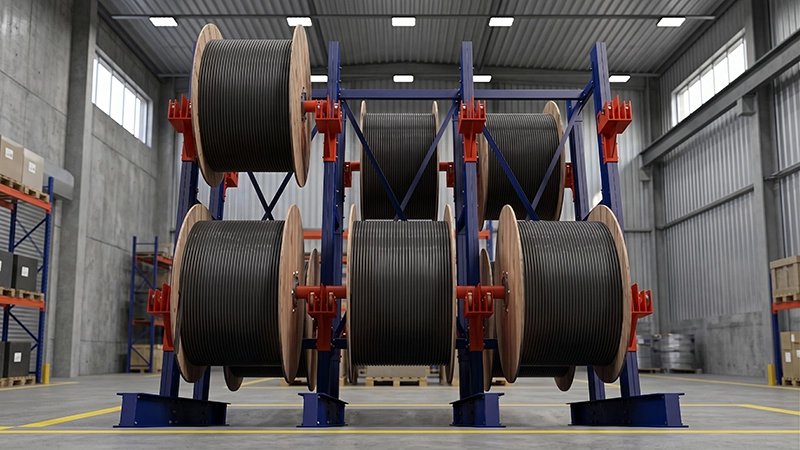
The clearest recorded case is opportunity 14554, an outdoor storage request: one main frame plus two auxiliary frames, four reel positions per rack unit for reels of Ø1,400 mm and 800 mm width, overall rack width and height 3,000 mm, with reference frame weights of 583 kg for the main frame and 302 kg for the auxiliary frame. A roller-bearing support was specified so reels could be rotated for partial withdrawal, and hot-dip galvanizing was requested because the rack was going outdoors.
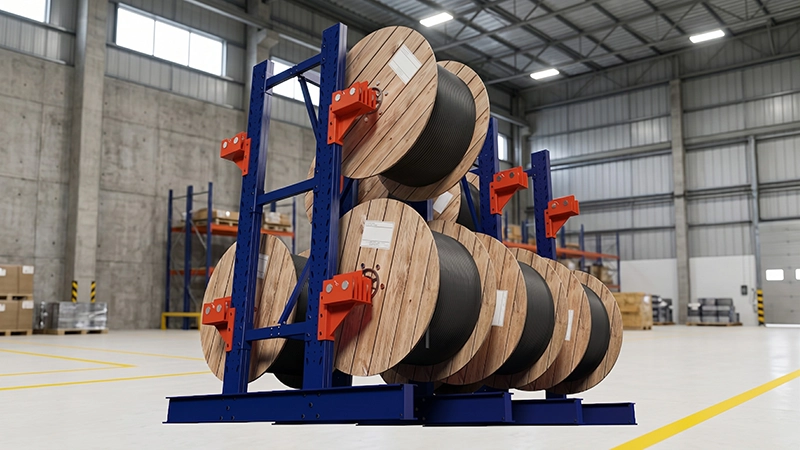
Two points in that record matter more than the dimensions. First, the galvanized finish was a request attached to that project’s exposure, not a catalogue default. Second, our own operating note for the product is explicit: the structure must be protected from prolonged rain unless the approved finish and the drainage design allow outdoor service. In practice this means an uncovered yard is a joint decision about coating, slab drainage and inspection — not a coating decision alone. Wooden drums make it harder, because a wet drum flange holds water against the support and the upright long after the rain has stopped.
Surface Treatment: The Options and What Has to Be Written Down
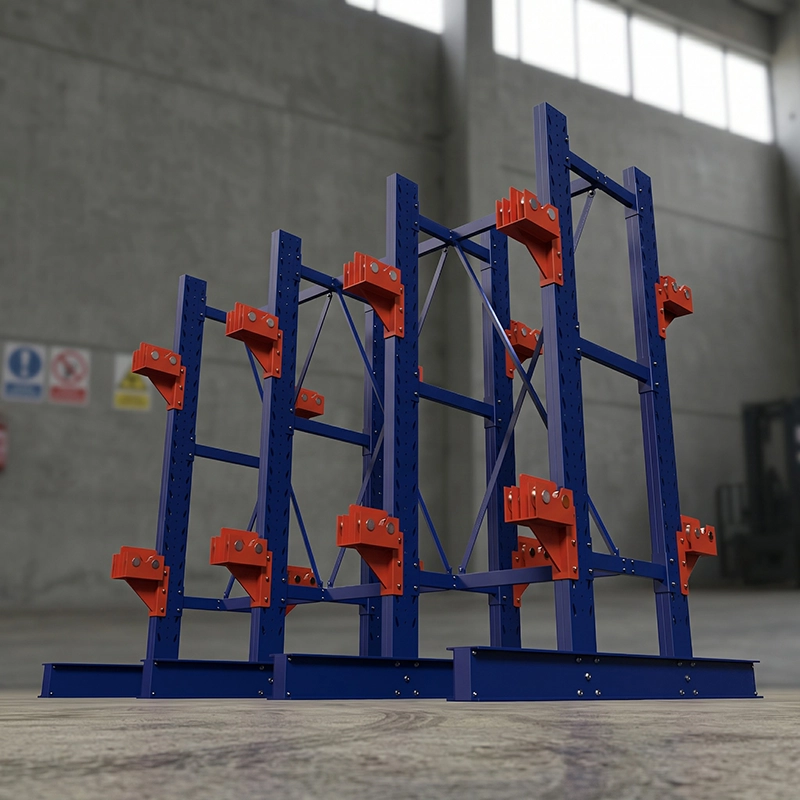
The finish options follow directly from exposure, and each has to be defined in the purchase order rather than assumed. For indoor service the standard shop coating system used on the quoted configuration is normally sufficient. For a covered canopy, a loading-dock door exposed to wind-driven rain, or a semi-outdoor shed, the approach is usually a heavier paint system, typically a zinc-rich primer plus intermediate and top coats, confirmed coat by coat. For an open yard, hot-dip galvanizing after fabrication is the route recorded on the outdoor project — and where the buyer needs a specific zinc thickness or coating class, that figure, the process route and the measurement point all belong in the order.
Three practical consequences should be checked before the drawing is released. A documented Carack structure is shipped disassembled and assembled on site, with reference longest parts of 3,000–3,150 mm across the reviewed designs; if galvanizing is required, the bath capacity, handling and any hole reaming after coating must be confirmed with the supplier, because a coated hole that no longer accepts its bolt becomes a site problem. Second, colour is not corrosion protection: a painted rack in an open yard cannot be compared to a galvanized one on appearance. Third, mixing finishes within one structure — galvanized frames with painted brackets, for example — needs to be a written decision, since dissimilar coatings and bare contact faces create their own maintenance points. Where no zinc specification is confirmed for a configuration, no corrosion performance should be inferred from the word “galvanized” in a quotation.
Drainage, Standing Water and the Base Detail
A reel rack is not a drainage structure. Water collects where geometry lets it: on base plates, in the gap between a bolted plate and the upright, on flat bracing faces, and inside the flange cavity of a drum standing on the support. The bolted upright-to-base-beam connection used on this rack is exactly the kind of joint that traps a film of water if the rack sits on a slab that does not shed it. The design answer is layout, not coating: set the rack on graded concrete that falls away from the frame, keep drums and frame out of the line where roof runoff lands, avoid creating a ponding pocket around the base, and give the base detail enough clearance to be inspected and cleaned.
Coordination is often the real constraint. On the recorded indoor layout for a 10 × 4.3 m area, subtracting two rows left only about 1,550 mm of aisle, so the proposal used a single row per area; the same logic was applied to a 10 × 3.9 m area. Outdoors, a drainage channel, a kerb or a truck turning envelope consumes the same space, so the row count and the aisle should be fixed after the site drainage and vehicle route are known, not before. Where the slab is already built and cannot be regraded, that is a design limitation to be stated openly at quotation stage.
Cut Edges, Field Damage and Repair Responsibility
Most early corrosion on an outdoor rack does not start on a large flat surface. It starts on a cut edge, a drilled hole, a site weld, a chipped corner from transport, or a scratch made while a reel was landed on the support. A coated or galvanized member that is cut or drilled after coating has lost its protection at precisely the point where water sits. The order should therefore state the repair system to be used on site, who supplies it, and which operations are forbidden — typically drilling new support holes into a finished upright without an agreed repair.
The same logic applies to the reel support itself. Roller-bearing supports are specified for controlled rotation, and their mounting bolts and bracket faces are a maintenance item rather than a permanent seal. Note also that the accessory route for adapting an existing cantilever rack — Ø60 mm support tubes, a 500 mm bracket extension, intended for reels up to Ø1,000 mm where the existing connection is verified — is a dimensional retrofit, not a corrosion upgrade. If that existing rack is already outdoors, the condition of its own coating governs the outcome, and the connection dimensions still have to be confirmed before anything is quoted.
Inspection and Maintenance: Build a Cycle, Not a Promise
Because no single life figure is being offered, the practical substitute is a written inspection cycle. Three checkpoints carry most of the risk. Before the first wet season, walk the structure and record the condition of coating at base plates, the lower 500 mm of each upright, and every bolted connection. During the wet season, check for standing water at the base and for water held between drum flanges and supports. After the wet season, look for the transition from white rust to red rust, for coating breakdown at cut edges and drilled holes, and for loosened or corroded bolts. Structural checks run alongside: bent members, cracked welds, distorted brackets, and roller bearings that no longer turn freely.
The interval itself should be set from the site’s exposure and confirmed by the buyer, since rain frequency, coastal salt, industrial atmosphere and the amount of forklift activity all change it. What we can state as a working rule is the direction of the cycle: an outdoor or semi-outdoor installation needs a documented inspection before the first wet season and at least one scheduled review per year thereafter, with findings recorded so the next review has a baseline. Indoor racks under a sound roof normally need nothing beyond the standard periodic structural inspection.
Why We Do Not Promise an Outdoor Service Life
An outdoor life figure would have to assume a coating thickness, a substrate preparation standard, a water chemistry, a slab that drains, an operator who does not damage the finish, and a maintenance interval that is actually followed. Change any one of those and the number is meaningless. On this product the position is stricter still: the reviewed project documents do not confirm a universal rated load per bay, a verified steel grade, a safety factor, an anchoring requirement, a floor-load requirement or a standardised corrosion system. The Q235 and Q345 references that appear in search keyword material are not confirmed by these project records.
So the honest deliverable is a configuration-confirmed specification instead of a warranty figure: the finish route written into the order, the drainage and base detail agreed with the site, the repair system named, and the inspection cycle accepted by the operator. If a project demands a guaranteed number of years in an open yard, that demand has to be resolved with the coating supplier and the civil works — not with a rack drawing, and not with a phrase in a quotation.
Where an Outdoor Carack Installation Is the Wrong Answer
There are site conditions where we would rather say no than sell a galvanized frame. The rack is not suitable when the slab cannot shed water and cannot be regraded, when the yard is exposed to heavy salt spray and no agreed coating system can be maintained, when the buyer needs a sealed or roofed enclosure rather than an open structure, when the reels must be dispensed under controlled tension rather than simply rotated, or when the reel removal clearance and forklift approach cannot be confirmed. It is also the wrong choice where inspection access will be blocked by stock, because an uninspectable outdoor rack is an unmaintained one.
- Covered yard or canopy storage where the frame is dry but the slab is washed by rain — galvanizing plus graded drainage, confirmed per project.
- Indoor warehouse bays close to a loading door with wind-driven rain — heavier paint system and a base detail that can be cleaned.
- Cable factory buffer areas between production, testing and dispatch, where reels move weekly and the finish is at risk from handling.
- Long-term open yard storage only when the finish, drainage, repair system and inspection cycle are all written into the order.
Questions Buyers Ask Before an Outdoor Order
Is every Carack cable drum rack hot-dip galvanized?
No. Galvanizing is a project requirement, recorded on the outdoor project where the buyer asked for it. Other configurations are quoted with the paint system that matches their exposure. If your site is outdoors, say so in the enquiry and ask for the finish route to be stated in writing on the quotation.
How many years will a galvanized rack last outdoors?
We do not put a number on it. Coating thickness, preparation, site water chemistry, standing water, mechanical damage and inspection frequency all move the answer, and none of them is fixed by the rack drawing. What can be fixed is the specification: process, measured thickness, repair system, drainage detail and inspection interval.
What do we need to send with an outdoor enquiry?
Reel outside diameter, drum width, bore and weight with quantity, the storage area dimensions including drainage and vehicle routes, the exposure description (open yard, canopy, indoor near a door), the finish requirement you intend to specify, and your required inspection arrangement. On the reviewed records, reel lists have ranged from roughly 500 kg to 3,000 kg with diameters of Ø737–2,007 mm and widths of 610–1,118 mm — groups like that were split into a two-level group at four positions per frame unit and a single-level group at two positions, both about 3,002 mm high. Your own list decides yours.
Can the frame be delivered knocked down and galvanized?
Documented Carack structures are shipped disassembled and assembled on site, with reference longest parts of 3,000–3,150 mm and packed volumes around 1 m³ to 1.2 m³. Wrapping film plus straps is the basic packing; wooden cases can be specified when surface protection matters more. If galvanizing is required, confirm bath capacity, hole reaming and site repair material at the same time as the packing method.
If you are planning a reel rack for a yard, a canopy or a door-exposed bay, start from the finish and drainage requirements rather than the frame drawing. The cable drum racking product page sets out the frame, support and layout options that the specification is then written against.
Need a Custom Storage Solution?
Speak directly with our technical engineers. We offer free structural designs, heavy-duty catalog evaluations, and quick B2B price quotations.
Request a Quote Now →