
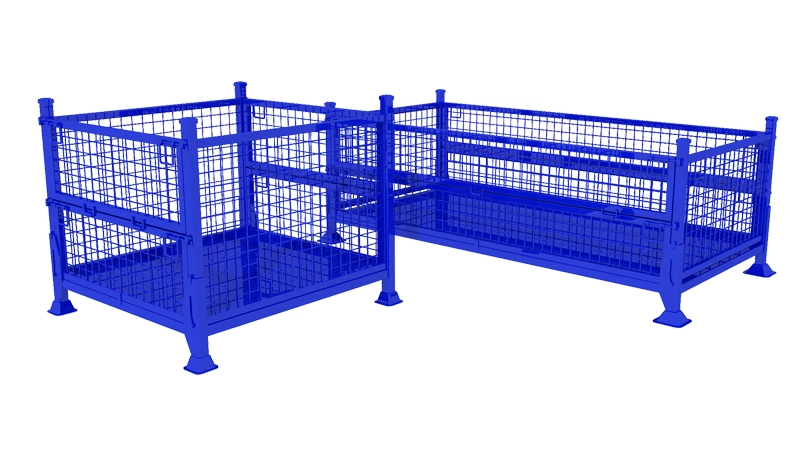
A produce warehouse that handles both potatoes and yams rarely orders one box. Even when the mesh, the door hardware and the coating are identical, the two crops arrive with different fill heights and leave with different layer counts, so the box that fits one load leaves 500 mm of unused internal height on the other. The usual temptation is to standardise on a single size to simplify purchasing and spares.
The two specifications below come from one enquiry’s technical scheme (project file 15730): the same folding door construction, the same 50 × 50 mm mesh on Ø5 mm wire, and the same stacked-and-folded handling logic, yet 1300 mm and 800 mm external heights. They are scheme figures from a single requirement set, not a delivered installation and not a series specification — but they show exactly where the two loads stop being interchangeable.
Two crops in one order, two box heights
The enquiry asked for two sizes: a taller box for potatoes (specified around 130 to 140 cm of load height) filled and stacked four high in the store, and a shorter box for yams (around 80 to 90 cm) stacked five high. Container loading for both was part of the same request.
| Item | Potato box (scheme 1) | Yam box (scheme 2) |
|---|---|---|
| Outer size, mm | 1400 × 1100 × 1300 | 1100 × 1100 × 800 |
| Net internal size, mm | 1230 × 960 × 1090 | 930 × 960 × 590 |
| Recorded internal volume | approx. 1.29 m³ | approx. 0.53 m³ |
| Tare weight | 123 kg | 82 kg |
| Recorded load per box | 1200 kg | 1000 kg |
| Recorded stacking layers | 4 | 5 |
| Recorded 40HQ plan | 112 units | 140 units |
The first surprise is that five layers is not taller than four. At 1300 mm pitch, four potato boxes reach about 5.20 m; at 800 mm pitch, five yam boxes reach about 4.00 m. The yam stack is more than a metre shorter while holding one extra layer, because the pitch — not the layer count — drives the clear height a warehouse has to reserve.
The second surprise is where the height goes. In both drawings, outer height minus net internal height is 210 mm. That band is the base deck, the stacking feet and the top rail, and it is the reason a box height should never be handed to a warehouse planner as usable fill height.
Comparing net internal height with the height you actually load

Three figures have to be separated before any comparison is honest. The first is net internal height inside the rail: 1090 mm on the potato box, 590 mm on the yam box. The second is the fill level you will actually work to — produce is not filled level with the top rail, because the feet of the upper box land there and the door pins have to close over a clear panel edge. The third is the stacking pitch, which is the outer height when the feet sit on the columns of the box below.
A practical check: take the fill level you accept in the store, add the 210 mm band, and see whether the resulting box still lets the layer count you need fit under the lowest obstruction in the building — beam, sprinkler head, light fitting or roller door track. If it does not, the honest answer is usually one layer less or a shorter box, not a heavier single box with more load crammed into it.
The long sides of both boxes carry folding doors fixed by pins, so the panel can be half opened or fully opened for discharge. On a 1090 mm internal depth that full opening matters: it decides whether a worker scoops the crop out from one position or walks around the box. Ask for the door opening height in metres, not just the gate type.
Load per box, layers, and the pressure the crop puts on the sides
The recorded 1200 kg and 1000 kg are load-per-box figures. They are not an instruction that four or five boxes may each be loaded to that figure on top of the lowest one, and they are not a stack rating. In our own files the per-box load and the layer count sit on separate lines and are confirmed per project.
Compare the two loads against their own internal volumes and the difference becomes visible: the potato box records about 930 kg per cubic metre of internal space, the yam box about 1900 kg per cubic metre. The short box carries roughly twice the mass per litre, which is exactly why the yam box is not simply the potato box cut down — its panel bracing, base and feet are resisting a denser load, not a lighter one.
Questions worth settling on paper before a drawing is released:
- What does the lowest box actually carry — the sum of the boxes above it, or only its own load? State the figure the stack has to survive.
- Do the stacking feet land squarely on the columns below? A 1400 × 1100 footprint will not alternate with a 1100 × 1100 box in the same stack.
- Is the crop loose or bagged? With 50 × 50 mm mesh on Ø5 mm wire, the smallest tuber has to be checked against the aperture, and a sheet panel or liner may be needed if small produce is loaded loose.
- How much side pressure builds at full fill? Folding panels braced by pin-fixed doors behave differently from a fixed welded panel, and the pin is the part that sees repeated impact.
- What floor loading and point load does the stack create, and does the store’s floor or racking accept it?
- How is the crop discharged — half gate, full gate, tip and pour — and who lifts it, forklift, pallet jack or overhead crane?
Cleaning, moisture and the surface finish question
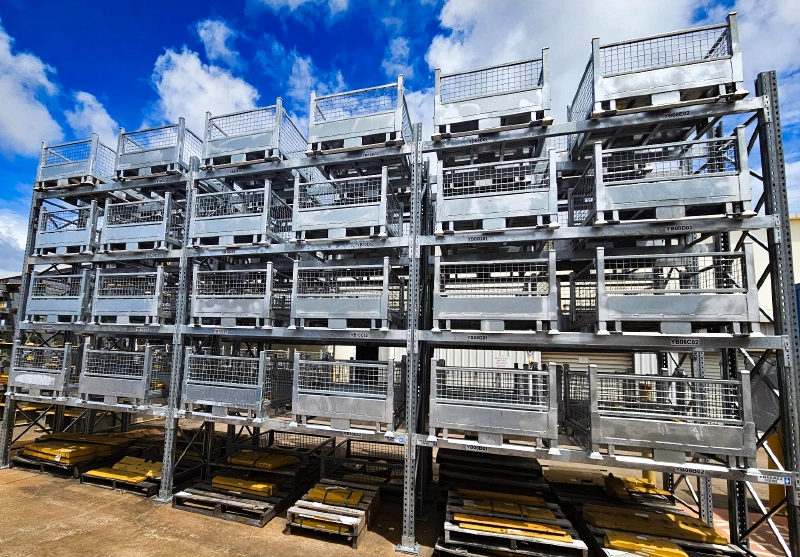
This enquiry specified powder coating, which suits an indoor, dry store. For the same box used outdoors or washed down between crops, the enquiry record carries the alternative of cold galvanizing at a higher price, and the choice belongs to the buyer: a coating decision made for appearance indoors is not the same as one made for wet handling.
Mesh panels drain and ventilate, which is why open mesh is the usual default for tuber crops: surface water does not stand in the base the way it does in a closed plastic box, and air moves through the load. That is a physical property of the panel, not a performance promise about the crop. Our files hold no food-contact compliance statement and no measured data on loss rates, bruising or shelf life for either crop, so we do not present either as fact. If your buyer or auditor requires a compliance document, ask for it as a separate item and treat its absence as a blocker, not a detail.
Cleaning also decides bottom construction. A mesh or slotted base lets soil and debris fall through during storage and drains wash water, but it traps residue in the wire; a steel sheet base sweeps clean quickly and holds water if the drainage is not designed in. Whichever is chosen, ask how the base drains, whether the box can be emptied and swept with the gate fully folded down, and whether the coating is expected to survive a pressure washer.
When a plain pallet, a plastic crate or a fixed cage is already enough
Two custom box heights are worth buying only when the arithmetic really diverges. The cases where they do not:
- Single-layer floor storage. If nothing is ever stacked on the box, a pallet with a bulk bag or a lined crate carries the same crop for less money; the steel box is buying stacking and reuse, and neither is being used.
- Light, hand-carried volumes. Plastic or plywood foldable boxes stay competitive below the sort of load that needs a welded steel frame, and they are easier to handle without a forklift — but they cannot be read as a substitute for a frame designed around a 1000 kg crop load.
- One-way movement. Where containers leave and never come back, the folding mechanism and the tare weight are cost without a return leg to save.
- Space is not the constraint. A fixed wire cage is cheaper than a collapsible one; the folding premium only repays where empty containers occupy floor between seasons.
- Racking is already in place and sized. If the store is racked, the box has to suit the beam and the clear entry, and a taller floor-stacked box may be the wrong purchase altogether.
Conversely, two heights start to pay when the short crop would otherwise waste a fixed 500 mm of internal height on every layer, multiplied across four or five layers of clear height that the building does not have.
Buyer questions we answer before a box height is drawn
Can one box height serve both potatoes and yams?
Mechanically yes, if the internal height suits the taller fill and the pitch suits the clear height. Commercially it usually costs layers: a 1090 mm internal box filled only to yam height wastes roughly half a metre per layer, and on five layers that is over two metres of building height doing nothing. A single size is the right answer when the clear height is generous and simplifying spares matters more than the wasted space.
Does five layers always need more clear height than four?
No. In this scheme, five layers of an 800 mm box need about 4.00 m and four layers of a 1300 mm box need about 5.20 m. Pitch times layers is the number to compare, never the layer count alone.
Can you confirm the box is food-contact compliant or that it prevents crop damage?
No, and we will not write it into a quotation. The project files record material, mesh aperture, coating option, dimensions, load per box and stacking layers; they do not contain a food-contact compliance statement, a salt-spray test report or any measured crop-loss result. What we can confirm is what the drawing says, and we will state that in writing for your review.
What to send for a box-height discussion
To get a useful answer rather than a catalogue page, send the crop (or crops), the target weight per box when loaded, whether the produce is loose or bagged and the smallest tuber you will load, the layer count you want, the clear height under the lowest obstruction in the store, the handling equipment, and whether the boxes stay indoors or go outdoors. With those figures the comparison above can be run on your building instead of on this scheme. If you are still deciding between a folding framed box and a fixed wire cage, the companion article on that structural choice covers where the frame, not the height, is the deciding factor.
Need a Custom Storage Solution?
Speak directly with our technical engineers. We offer free structural designs, heavy-duty catalog evaluations, and quick B2B price quotations.
Request a Quote Now →