
Empty stillages almost never come back to the place they left. A box loaded at Plant A is unloaded at a customer dock, a subcontractor, a port or a second plant, and from that moment the return leg has to be organised by somebody. The pallet box itself is only half the decision: the other half is which empty-box route the loop can actually support.
Treat the route as a hypothesis, not a conclusion. Before comparing box types, three route numbers decide whether a returnable steel stillage is even relevant — how often a lane runs, where empties can be collected, and how long a box sits waiting for that collection. Direct return, depot consolidation, third-party recovery, rental pooling and one-way packaging each answer those three numbers differently, and each one loads a different amount of work onto your own team.
Four Empty-Box Routes and What Each One Asks of You
The same collapsible cage pallet can sit inside any of these routes. What changes is who owns the return leg, who absorbs a box that goes missing, and how much counting and inspection lands on the receiving site.
| Route | Who moves the empty | Fits when | Where it breaks |
|---|---|---|---|
| Direct return | Your outbound vehicle or the same carrier on the return leg | The same lane runs both directions with roughly balanced volume | The lane is effectively one-way, so the empty leg is real cost that is never itemised |
| Depot consolidation | Several sites feed one collection point, then a grouped movement | Empties appear at many small nodes with low individual volume | Empties sit at the depot for weeks and the fleet must be sized for the dwell, not the throughput |
| Third-party recovery | An operator inspects, holds and redeploys boxes under contract | You want asset ownership without running the reverse leg | Condition disputes and write-off rules are decided by someone else’s inspection standard |
| Rental pool | The pool owner; you hold boxes for the duration of the loop | Volume is unstable, seasonal or the loop ends | Cost keeps running during dwell, and the pool decides which box type you get |
| One-way packaging | Nobody — the packaging is consumed | Lanes are one-way, returns are uneconomic, or volumes will not repeat | It repeats every trip and returns nothing to the next cycle |
None of these is the default. A plant that fights for a folding fleet on a lane that never returns empties is in the wrong half of this table, and no box specification will fix it.
Three Numbers to Fix Before Any Box Is Ordered
Return frequency. Count loaded movements per lane per month, not boxes in the warehouse. A lane that ships twice a month cannot build a disciplined return routine; a lane that ships daily can. If the two directions differ by a large factor, the empties have to be accumulated somewhere, and that somewhere is a cost line of its own.
Collection point. Decide where an empty is allowed to wait: the customer dock, your own cross-dock, a third-party depot, or the vehicle. Every additional node adds a handling step, a counting step and one more place a box can be lost. Fewer nodes is usually the cheaper design, even when it is the less flexible one.
Turnaround time. How many days pass between a box being unloaded and the same box being loaded again? Turnaround multiplied by shipments per month is the fleet you must own. It is also the number that decides whether a folding box is worth its hinges: if boxes wait weeks, you are buying storage for the wait, not transport for the return.
Direct Return: Fastest Loop, Most Dependent on the Backhaul
Direct return is the simplest route and the one that most often fails quietly. It works when the same vehicle or the same carrier already runs the lane in both directions, because then the empty is a load opportunity rather than an extra journey. It stops working when the return volume does not match the outbound volume: a site that receives full boxes weekly but only ships once a quarter will accumulate empties no matter how well they fold.
This is where the folding geometry earns its place. On our recorded folding stillage projects, the empty body collapses to roughly 330–370 mm depending on size and build, which lets empties be parked in floor space the operation already reserves rather than in a dedicated empty-box area. That figure is a project value per configuration, not a series rating, and it has to be re-confirmed on the drawing you actually order.

A full trailer leaving a plant is the easy half of the loop. The harder half is the same trailer returning with something worth carrying, and that is a scheduling question before it is a packaging question.
Consolidation and Third-Party Recovery: Paying Someone to Own the Middle
When empties surface at many small customer sites, direct return cannot be scheduled, so the loop needs a middle. Consolidation groups empties at a depot or cross-dock and moves them as a block; third-party recovery goes further and hands inspection, holding and redeployment to an operator, often with the assets still owned by you.
Both routes convert a transport problem into a contract problem. What has to be written down is who declares a box serviceable, what happens to one with a bent gate or a missing latch pin, how write-offs are valued, and what the operator is allowed to do with your boxes while they wait. On the shopfloor side, consolidation adds a second counting event: the box is counted at the customer, again at the depot, and again on return. If the count at each node uses a different unit — boxes, stacks, pallets — the reconciliation will disagree and the discrepancies will be blamed on the boxes.
What Folding and Counting Add to the Loop
Folding is not one action. On a lidded or gated build the sequence is usually: open the gate and latch, fold the side panels, decide whether the lid and the casters stay attached or come off, stack the collapsed body so the stacking feet land on the columns of the unit below, then tag and strap the stack. Each of these is a small step that only becomes visible when someone times it on the floor.
Counted empties also change. An erected box shows its contents and its condition; a folded stack shows neither. Counting therefore moves from per-box to per-stack, which means the stack has to be counted and sealed in one place, by one person, before it moves. Units that are folded at different times by different shifts will not agree on what a stack contains.
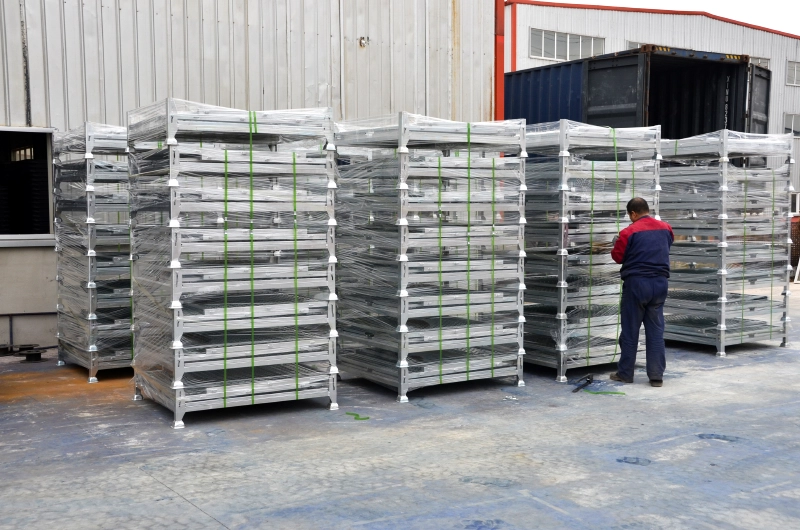
Damage behaves the same way. A bent gate or a missing latch pin is found during folding, at the end of the loop, not when the box is loaded. If nothing records it at that point, the fault is only discovered by the next customer who tries to erect the box, and by then it is a delivery problem rather than a maintenance one.
When Rental or One-Way Packaging Is the Honest Answer
Buying a returnable fleet is a commitment to a loop that repeats. Where the loop does not repeat cleanly, rental or a consumable pack is not a compromise — it is the correct comparison.
Rental pool fits when volume moves up and down faster than a fleet can be bought and retired, when a loop has a defined end (a project, a season, a contract), or when the return lane is handled by someone else anyway. It does not remove the return leg; it moves it onto the pool operator’s network and prices it into the contract.
One-way packaging fits when the lane only runs in one direction with no realistic backhaul, when return freight would exceed the value of the box, or when the receiving site cannot be relied on to fold, count and hand back anything. Industrial crates and sheet-steel pallet boxes are durable, but durability does not create a return route where none exists.

The practical split is often mixed: a returnable steel stillage fleet on the lanes that loop predictably, rental for the peaks, and one-way packaging for the lanes that never come back. That is a fleet decision, not a product decision.
Test the Route Before You Commit the Fleet
A route can be tested on one lane before a fleet is ordered. Pick a lane with data you can read, run two or three complete cycles, and record the same items each time: loaded boxes out, folded units back, folded stack height measured rather than quoted, days of dwell at each node, labour minutes per fold and per count, and units found damaged or missing per cycle.
Those records tell you which route the lane can support and what the empty leg actually costs in handling. What they do not do is prove a freight saving before the loop runs — so no saving figure should be written into a business case until the pilot has produced one on your own lane.
For the measurement side of the pilot, our earlier piece on how the folded return-stack height is measured covers the envelope that a return buffer actually gets sized on.
What This Changes in the Specification
- Route first: state the return frequency, the collection point and the dwell time before any size or load figure is discussed.
- If the route is direct return, specify the folded envelope and confirm it against the space the plant can actually reserve.
- If the route is consolidation or third-party recovery, specify a counting unit — box or sealed stack — and one inspection standard for every node.
- If the route is unstable, price rental or one-way packaging alongside the purchase case rather than treating it as the fallback.
- Whatever the route, keep load rating and stacking layer count as two separate project values and re-confirm both on the drawing.
Frequently Asked Route Questions
Does a folding box always beat a fixed cage on return cost?
No. Folding reduces the volume an empty occupies, but it does not reduce the number of journeys, and it adds fold, count and inspection steps at the end of the loop. If boxes cannot be consolidated and the lane is one-way, a folding box still travels back in low volume — it just does so as a folded unit. Folding pays where the return leg exists and the constraint is space in the vehicle or the empty buffer.
How do you count empties without opening every box?
By sealing and counting at stack level. The stack is built, counted and tagged at one point by one person, and the count travels with the tag. This requires a written rule for stack cardinals and a habit of rebuilding the stack in the same way; without it, a folded stack becomes an unknown quantity and the loop will be reconciled by weight or by guesswork.
Can one fleet serve direct return and consolidation at the same time?
Physically yes, contractually it has to be defined. The same box will be inspected by different parties on different routes, so the condition standard, the latch and gate configuration and the identifying mark must be identical everywhere. Mixed routes with mixed box types are where counting disputes start.
Send Us Your Loop
Tell us the shipping nodes and return nodes, how often each lane runs, how many boxes move per cycle and how many days an empty waits for collection. With those four answers we can discuss which of these routes fits your loop, what the folded envelope would need to be, and whether a returnable steel stillage is the right answer at all — including the case where rental or one-way packaging is the better route.
Need a Custom Storage Solution?
Speak directly with our technical engineers. We offer free structural designs, heavy-duty catalog evaluations, and quick B2B price quotations.
Request a Quote Now →