
Wooden crates are familiar, but they create the same cost every time a motorcycle is exported: buy the timber package, load once, and usually discard it at destination. For sellers shipping motorcycles repeatedly, a foldable Mtrack rack changes the comparison. The rack travels with the motorcycles, folds after unloading, and can return as an empty rack for another cycle.
The practical question is not simply “how many motorcycles fit in a container?” It is whether a reusable steel transport rack can replace a one-way package without creating a new handling problem. The answer depends on the motorcycle model, protection points, loading method, container type, and the final packing confirmation for the project.
Wooden crate cost is a recurring outbound expense
Using the task planning basis of RMB 90 per square metre, a wooden crate is a one-time package purchase for each shipment cycle. The calculation is easy to understand: measure the timber surface used, multiply it by RMB 90 per square metre, and then account for fabrication, handling, disposal, and any destination-side restrictions. The important limitation is that this cost does not create a reusable asset. After the motorcycle is unpacked, the crate normally has no efficient return route.
A foldable steel rack is evaluated differently. Its value is distributed across repeated shipments: the rack can accompany the motorcycle to the destination, be folded when empty, and be recovered for the next shipment. That does not mean every route will produce the same saving. Return freight, recovery rate, ownership model, local handling, and rack life must be included in the project calculation.
What can fit in a 40ft container?
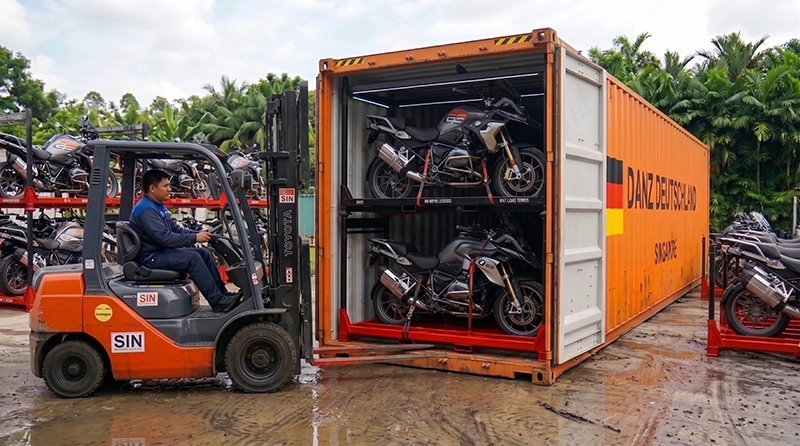
For Mtrack planning, a 40HQ may be designed around approximately 72–90 racks, while a 20ft project may fall around 28–56 racks. These are planning ranges, not a fixed product promise or a conversion formula against wooden crates. A documented 40HQ reference at 88 racks sits inside the larger planning band, while other projects can move outside the apparent range when motorcycle dimensions, folded-rack geometry, loading sequence, or protection requirements change.
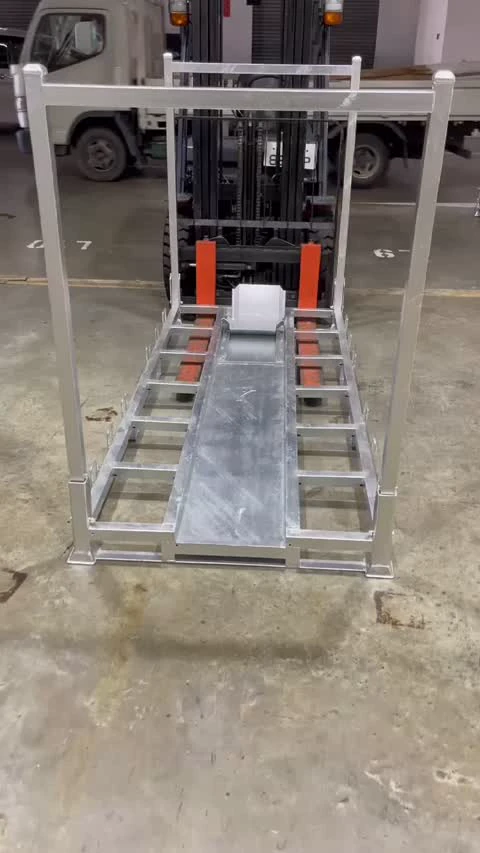
The final count must therefore be confirmed from the actual packing plan. Do not treat “one rack equals one wooden crate” as a universal equivalence. A crate may be built around one motorcycle, while a rack program may use two-level or folded return arrangements. Container internal dimensions, door clearance, forklift access, motorcycle wheelbase, handlebar width, protective materials, and the required lashing sequence all affect the result.
Why the return trip changes the cost model
With a disposable crate, the outbound shipment carries both the motorcycle and its packaging, but the packaging normally does not come back. With Mtrack, the commercial model can include a return loop: loaded racks go out with the motorcycles, empty racks are folded and recovered, and the same rack pool supports later export orders. The saving is not a universal percentage because the return route may be consolidated, may use a different carrier, or may require temporary storage.
The rack is most suitable when the seller has repeat export volume, a predictable destination or distributor network, and a practical method for collecting empty racks. It is less suitable when the shipment is a one-off sale with no recovery plan, when the destination cannot handle steel racks, or when motorcycle variations make one standardized loading design impractical. In those cases, a purpose-built wooden crate or a hybrid protection package may still be the better choice.
What to confirm before replacing the crate
- Shipment pattern: confirm export frequency, destination countries, distributor ownership, and how empty racks will be collected.
- Container plan: compare 20ft and 40HQ loading diagrams using the actual motorcycle dimensions; use the final packing confirmation rather than a fixed rack-to-crate conversion.
- Handling method: confirm forklift access, door clearance, loading order, wheel positioning, tie-down points, and whether destination teams can unload a steel rack safely.
- Cost boundary: compare recurring timber at RMB 90 per square metre with rack purchase, return freight, recovery losses, storage, and the expected number of reuse cycles.
FAQ: foldable motorcycle rack versus wooden crate
Is a foldable rack always cheaper than a wooden crate?
No. A rack is a reusable logistics asset, not an automatic discount. It becomes more compelling when shipments repeat and empty-rack recovery is organized. A one-off shipment, an irregular route, or a destination without a return process may favor a wooden crate or a hybrid solution.
Can I use the 72–90 rack range as my guaranteed container quantity?
No. The 40HQ range, like the 20ft planning range of 28–56, is project-dependent. Confirm the motorcycle model, protection design, folded-rack arrangement, loading method, and container packing plan before placing the quantity in a quotation or shipping instruction.
Planning repeated motorcycle exports? Send your shipment frequency, motorcycle dimensions, destination, and preferred container type. We can compare the recurring wooden-crate basis with an Mtrack foldable-rack loop, including loading quantity and empty-rack recovery assumptions.
Review Mtrack motorcycle shipping rack options See related export logistics guidance
Need a Custom Storage Solution?
Speak directly with our technical engineers. We offer free structural designs, heavy-duty catalog evaluations, and quick B2B price quotations.
Request a Quote Now →