
Flat parking works until the collection outgrows the building. For a collector, club, or motorcycle dealer, putting 200 motorcycles on the floor can leave little room for aisles, forklifts, packing work, or the next delivery. The problem is not only capacity. It is access: bikes become difficult to identify, move, and return without disturbing several others.
The practical answer is to stop treating every motorcycle as a floor-level item. A stackable motorcycle pallet rack creates a defined storage position for each bike, then uses the clear height of the warehouse. When a rack is empty, its folding design can also reduce the space needed for return transport or seasonal recovery. The result is a denser motorcycle pallet storage rack layout without turning the warehouse into an unplanned pile.
Why flat motorcycle storage runs out of space first
Floor storage consumes length and width for every motorcycle, plus the clearance needed to walk or drive around it. As the collection grows, operators often add rows wherever a gap appears. That makes counting and retrieval slower, blocks loading routes, and forces a trade-off between more bikes and safe working space.
A rack-based plan changes the unit of storage. Each motorcycle sits on a dedicated steel pallet with wheel guidance and positioning features, while the rack footprint becomes the repeatable building block for the layout. This is especially useful when the available building is small but has usable vertical clearance. It is not a promise that every warehouse can hold 200 motorcycles: the final count depends on motorcycle dimensions, aisle widths, doors, floor conditions, fire and safety requirements, and the selected rack configuration.
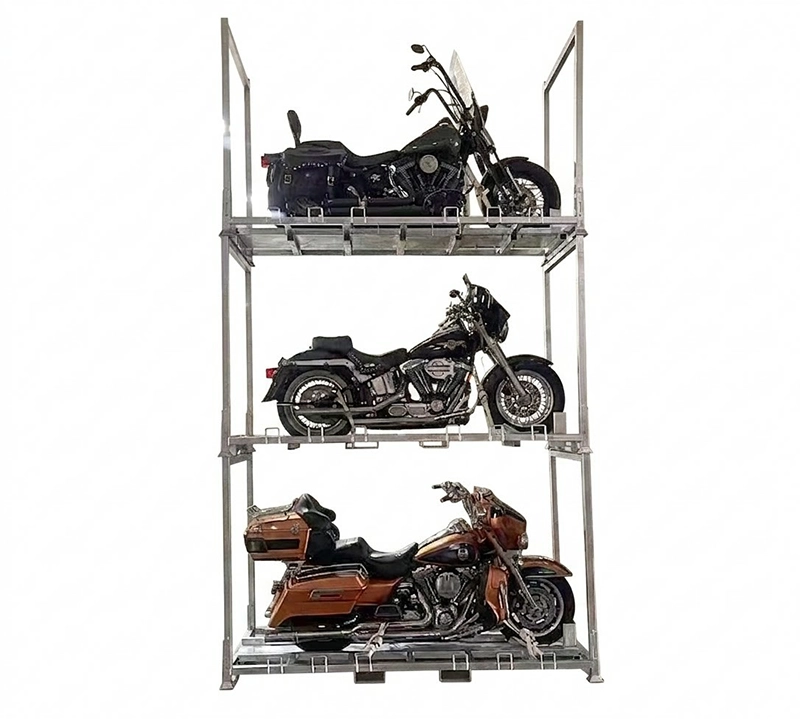
How stackable positioning turns height into storage capacity
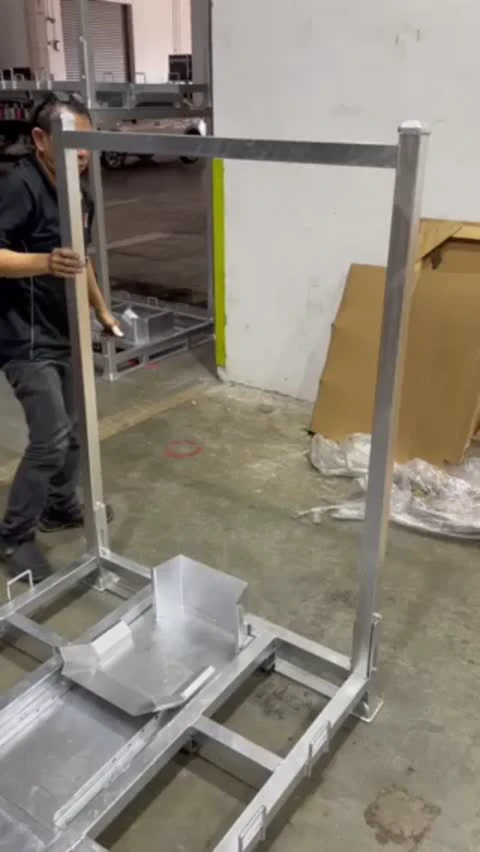
Mtrack uses removable upright posts and locating interfaces to keep stacked units aligned. The operator does not simply place one loose frame on another; the stack is formed through defined positioning points, so the load path and footprint remain organized. Wheel channels, end stops, and tie-down locations help keep a motorcycle in its intended position during handling and transport.
For the documented project of Matthew Stuebe, a general-purpose rack measuring 2320 × 1050 × 1400 mm was used for motorcycles up to 2270 × 850 × 1300 mm. That customer project stored more than 200 motorcycles, and the planning reference included 88 racks in a 40HQ container. These are project facts, not a universal capacity claim or a standard promise for every motorcycle type.
Where the building and handling plan allow it, the recommended stacking concept is four levels with a total stack height no greater than 6 m. The actual number of levels must be confirmed against the rack type, loaded motorcycle dimensions, floor loading, lifting equipment, stability controls, and local operating rules. If those checks do not pass, a lower stack or a different layout is the appropriate solution.
Why folding matters when the rack is empty
Storage density is only half of the operating cost. Empty racks also occupy space when motorcycles are being sold, transferred, or shipped in another direction. With Mtrack, the upright posts can be removed and the empty rack folded for recovery. That makes it easier to consolidate unused equipment instead of leaving a full-height frame in an aisle or paying to move unnecessary air.
This feature is useful for dealers with changing inventory, clubs that store motorcycles seasonally, and collectors who need to reconfigure a limited building. It also supports return logistics after a shipment. Folding does not eliminate the need to plan safe lifting, stacking, and securing procedures; it simply gives the warehouse another configuration when the rack is unloaded.
Which storage approach fits your operation?
- Choose stackable Mtrack racks when vertical clearance is available, motorcycle sizes are known, and forklifts or another approved handling method can access the planned positions.
- Use a lower stack when the roof, floor, fire separation, aisle, or handling limits do not support a four-level arrangement. More floor area may be the safer trade-off.
- Use dedicated floor bays for unusually wide, tall, modified, or frequently serviced motorcycles that cannot be safely positioned within the selected rack envelope.
- Plan a mixed system when the collection includes standard motorcycles for dense stacking and special motorcycles that require individual access or custom supports.
What to confirm before planning 200 motorcycles
Can the building really support the target count?
Start with a measured plan: motorcycle envelope, rack footprint, aisle and turning clearance, door height, floor condition, forklift reach, and required emergency access. The 200-plus result from the Matthew Stuebe project is evidence of one completed application, not a capacity guarantee for a different site.
How should the rack be used day to day?
Define who loads, unloads, inspects, and secures each motorcycle. Confirm the allowed stack height, the locating method, and the condition for folding empty racks. If you want a configuration matched to your count and building, send the number of motorcycles, largest motorcycle dimensions, available length and width, clear height, access points, and handling equipment. We can then discuss a storage plan through the Mtrack motorcycle pallet details, the motorcycle pallet rack options, and the Mtrack storage case.
Flat storage wastes the height you already paid for. Stackable positioning creates order, and folding recovers space when the racks are empty—but the right quantity and stack height must be designed around your site.
Need a Custom Storage Solution?
Speak directly with our technical engineers. We offer free structural designs, heavy-duty catalog evaluations, and quick B2B price quotations.
Request a Quote Now →