
If a motorcycle is only placed on a flat pallet, the real transport problem has not been solved. Braking, forklift acceleration, road vibration, and an uneven loading surface can let the wheels creep. A tall motorcycle can then become difficult to control, and an improvised tie-down arrangement may put pressure on painted parts or the wheel rim.
Mtrack approaches the question—“Will the motorcycle roll or tip?”—as a three-part loading sequence: locate and clamp the front wheel, connect straps to U-shaped hooks on both sides, and push the motorcycle up the ramp into its defined position. That combination supports controlled handling, but it is not a universal zero-movement guarantee. The clamp, strap specification, and wheel-contact geometry must be confirmed against the motorcycle’s weight and wheel diameter.
1. Start with the front wheel: locate it, then clamp it
The first restraint is the front-wheel locating and clamping arrangement. The motorcycle is pushed into the pallet along the ramp until the front wheel reaches its designed position. The operator then turns the handwheel to tighten the clamp; turning it back releases the wheel during unloading. This is different from relying on a side stand or hoping that a flat deck will keep the motorcycle in place.
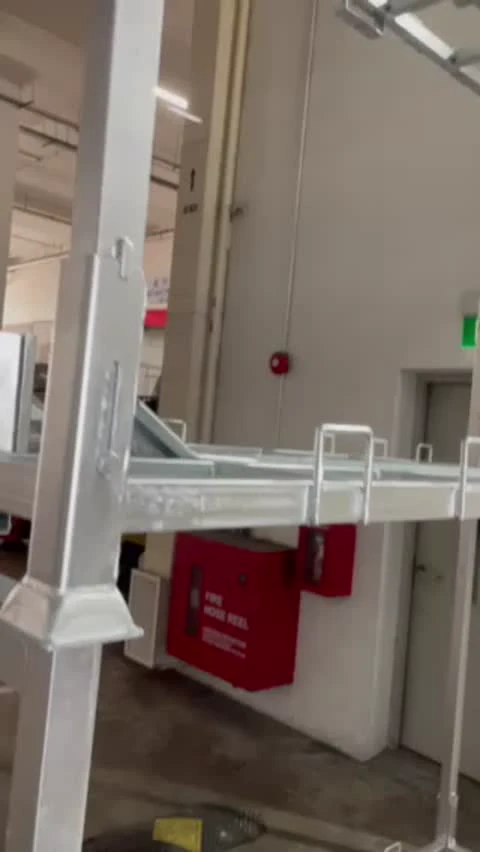
The ramp makes the push-in motion repeatable, while the wheel groove, front locating structure, and clamp are selected as a project combination. A narrow wheel, a wide wheel, a long wheelbase, or a tall motorcycle can change the required position and clearances. For that reason, the handwheel mechanism should be set by the vehicle drawing or confirmed measurements—not assumed to fit every motorcycle. The operator should also check that the wheel is seated correctly before adding the straps.
2. Use both side U-hooks for the tie-down straps
The front clamp controls the wheel position; it does not replace tie-downs. Mtrack can use U-shaped strap hooks on the left and right sides so that the restraint is connected to the pallet frame rather than improvised around a vulnerable component. In the documented motorcycle-club reference, the hooks are part of the loading discussion. A separate motorcycle logistics project also shows the practical role of straps in keeping the palletized motorcycle controlled during handling.
Use the two sides as a balanced restraint path, and select strap width, working load, length, and attachment angle from the motorcycle weight and the handling method. The final tie-down specification is project-confirmed. Do not pull a strap across a brake line, painted panel, sharp edge, or a wheel position that could cause rim damage. If the motorcycle is unusually tall, wide, heavy, or fitted with non-standard tires, the hook position and clamp clearance should be reviewed before production.
3. Push in on the ramp, then verify before lifting
The loading order matters: align the motorcycle with the ramp, push it into the front-wheel locating area, tighten the handwheel, attach the left and right straps, and inspect the seating of every restraint. Only then should the unit be moved by forklift or positioned for stacking. This workflow turns a loose motorcycle into a fork-handled logistics unit and helps operators repeat the same check at the factory, warehouse, trailer, or container.
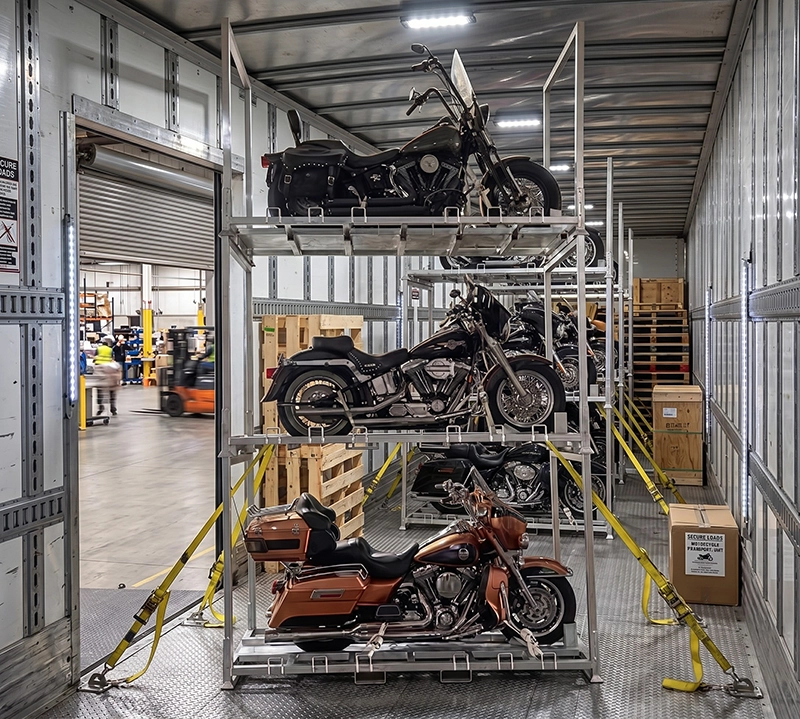
The Mtrack frame can be configured for floor storage, rack placement, trailer transfer, or container loading. Reference working loads include 250, 350, and 500 kg per pallet, but these are project values rather than one universal Mtrack rating. Fork openings, stacking levels, posts, pallet dimensions, and vehicle envelope must be checked together. A restraint system that is suitable for one motorcycle program should not automatically be transferred to another.
Where this three-part restraint method fits
- Factory dispatch: locate, clamp, and strap complete motorcycles before forklift movement to a trailer or shipping container.
- Dealer and distribution storage: use the defined wheel position and side hooks instead of leaving motorcycles loose on the floor.
- Racing, touring, and event transport: review mixed vehicle dimensions and confirm the restraint path for each model before loading.
- Stacking programs: combine wheel restraint with the specified posts and stack height; never infer stacking suitability from the pallet footprint alone.
Frequently asked questions
Will the motorcycle be unable to move at all?
No. The front-wheel clamp, two side U-hooks, straps, and loading sequence reduce movement when correctly designed and operated, but Mtrack is not advertised as a zero-movement system for every model. Clamp force, strap grade, hook location, wheel diameter, motorcycle weight, and transport conditions must be confirmed for the project.
Can the same rack carry any motorcycle?
No. Mtrack is configurable, not universal. Before quotation, provide the motorcycle length, width, height, weight, wheel and tire dimensions, handling direction, forklift requirements, trailer or container limits, stacking policy, and any rim or bodywork clearance concerns. The selected front clamp and strap arrangement can then be matched to the actual vehicle envelope.
Need a different fixed arrangement for your motorcycle model? Send the vehicle dimensions and handling requirements for a reviewed Mtrack configuration. See the Mtrack product detail, CASE-02 project reference, and SOCIAL-01 loading demonstration for the next step.
Need a Custom Storage Solution?
Speak directly with our technical engineers. We offer free structural designs, heavy-duty catalog evaluations, and quick B2B price quotations.
Request a Quote Now →