
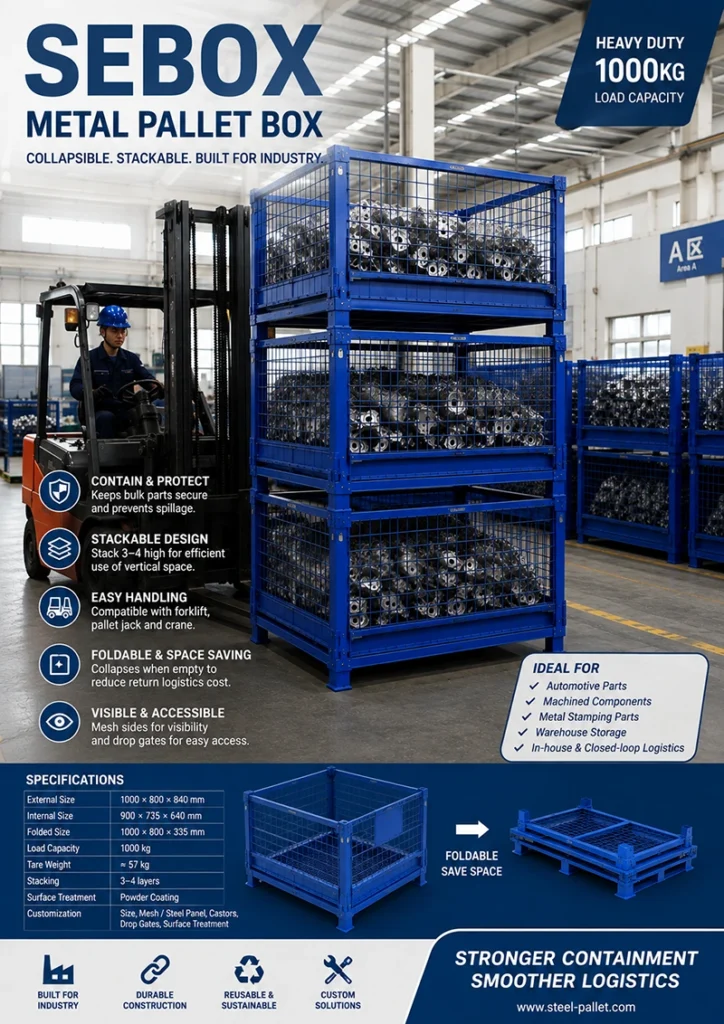
Stamping and assembly rarely fail because the forklift is slow. They fail because the two departments do not agree on what a “unit of parts” is. The press shop loads a wire basket, the buffer stores a stack of bins, the line side receives parts in a tote, and the warehouse counts a pallet. Every one of those conversions is a manual step, and every manual step is where a batch gets mixed, a corner gets dented, or a part ends up on the floor.
A collapsible steel stillage such as Sebox is a way to remove those conversions. It is a rigid, palletized metal pallet box with mesh or solid panel sides, forklift-compatible base feet, a stackable frame and an access gate. When one stillage becomes the packaging unit at the press, the handling unit in the buffer and the picking unit at the line, a move stops being a repack job and becomes a transport event. This article covers the sequence for automotive parts plants, what the container does and does not solve, which parameters your own site has to lock, and why no customer-specific savings figures appear here.
Why the Packaging Unit Must Be Fixed Before Handling Is Optimised
Handling efficiency is a function of how many times a part is touched, not of how fast the truck moves. If the press shop discharges into a wire basket and the assembly line consumes from a small tote, then a forklift trip between them still contains a manual unload, a count, a reload and a second label. Buying a faster forklift or adding a conveyor leaves that repack step untouched. Fixing the packaging unit removes it.
Once the unit is fixed, the rest of the flow becomes measurable. A stillage released at the end of a stamping cell can be weighed, labelled, stacked and delivered to a line-side position without opening. Fleet demand becomes a count of units in circulation rather than a calculation of mixed containers. The same number of units then supports the buffer, the internal transport and the dispatch stage, which is what makes a closed-loop return scheme possible.
The unit also has to match the equipment that already exists. A collapsible steel pallet box is only useful if its footprint lands on your rack beams, its base feet are reachable by the forklift you actually run, and its loaded height fits under your lowest obstruction. Documented Sebox configurations include a 1000 x 800 mm footprint with 840 mm body height, a 1220 x 1015 x 950 mm build and a 1240 x 835 x 870 mm build. These are different footprints for different layouts, not interchangeable sizes, and the footprint is normally the first thing a plant has to accept or change.
Reducing Manual Touchpoints and Spill Risk at the Same Time
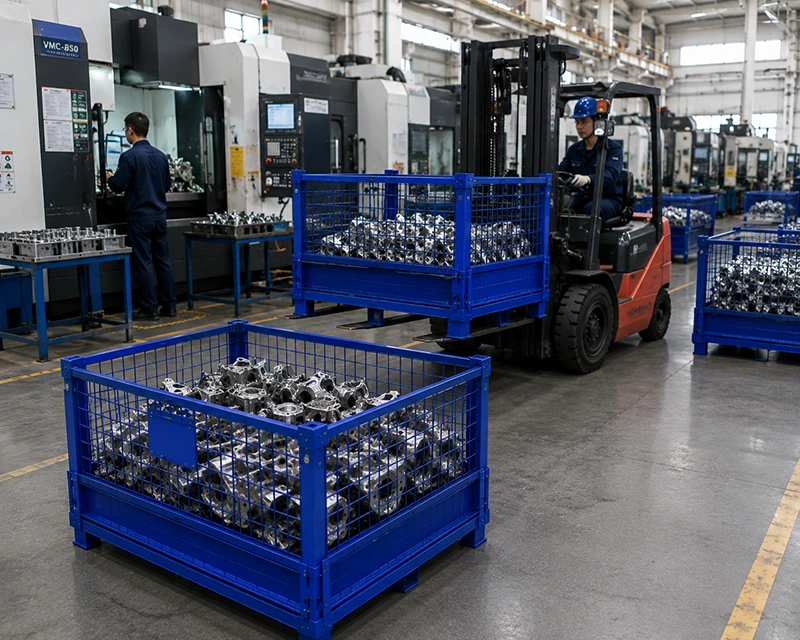
On an open pallet, loose metal parts are held by stretch wrap and gravity. Wrap is cut at the line, parts are picked out, and the remainder is re-wrapped or left open. Every cut and every re-wrap is a manual touchpoint, and the loose remainder is the part of the batch most likely to scatter. A steel stillage replaces that with a rigid enclosure: mesh or steel-sheet sides, a welded frame and a base that carries the load through defined members.
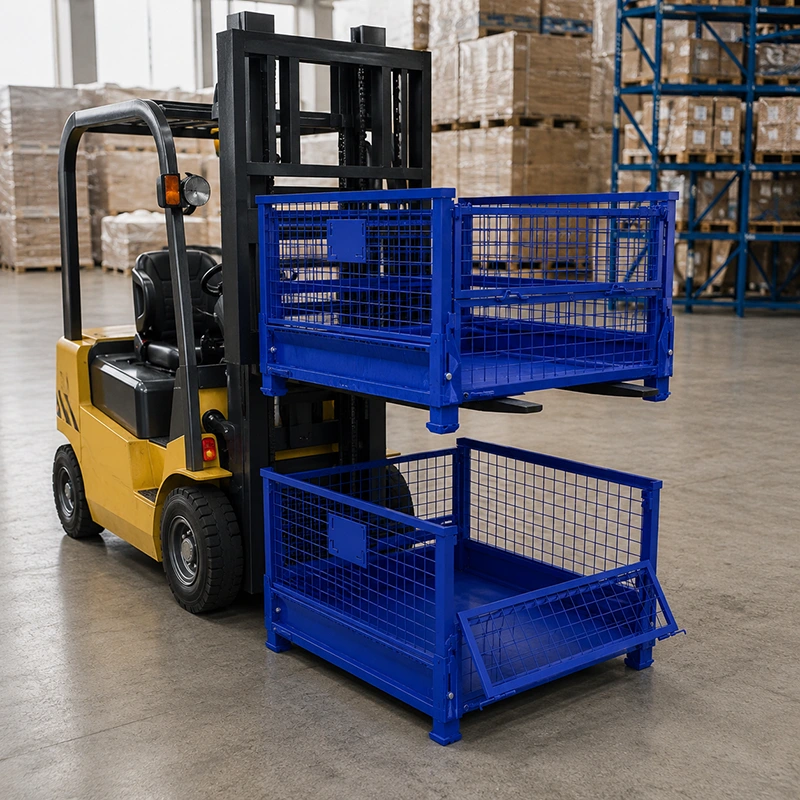
The access gate is the detail that decides whether containment becomes a nuisance. A half-drop or front gate lets an operator reach the lower layer of a stack without unloading the tiers above, so the unit can stay in the flow while parts are drawn from it. Without that gate, the cheapest-looking option forces the plant back into manual destacking every time the line needs the bottom box. Gate position, hinge arrangement and latch type therefore belong in the requirement list, not in the optional extras.
Spill risk falls in two different ways. Side containment stops parts leaving the unit during transport, and a panel choice matched to the smallest part stops them leaving through the wall. Mesh gives visual inventory access, so a planner can see level and mix without opening a container; solid panels suit small components or parts that must be shielded from light, dust or contact. The mesh opening is not a figure to be assumed, because it is not documented as a single series value. It has to be agreed against the smallest part, the smallest fragment and any sharp protrusion that could pass through or catch.
Closing the Loop: Stacked Loads In, Folded Units Back
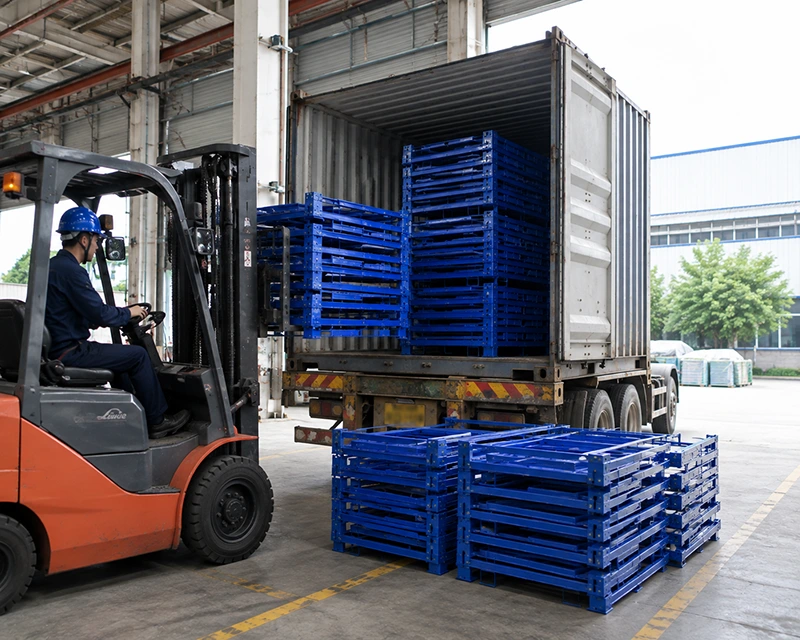
A closed loop only works if the empty leg is cheaper than the loaded leg. Filled stillages stack, so buffer space is used vertically instead of by floor area. Empties fold to a compact profile, which is the reason a rigid steel container can be used in a return scheme at all. One model-specific folded height in the Sebox documentation is 335 mm on the 1000 x 800 mm and 1220 x 1015 mm builds, and one source describes a 60 to 80 percent space saving when units are folded. Those are recorded figures for specific builds, not a promise for every configuration.
The loop design question is where the fold happens. If units are folded inside the plant, you need a trained folding step and an empty-storage position. If they travel folded, you need to know the folded block dimensions, the bundle weight and the container count, because folded height rather than assembled size sets the freight plan. One further point decides whether the loop survives: whoever receives the empty unit has to be able to unfold it, latch the gates and refuse a damaged frame, or the return stream degrades into unusable stock.
Optional casters and tow arms change the loop again. A castered unit can be moved short distances by hand at the line, but it occupies floor space, needs a clear path and adds wheel maintenance. Where the plant already runs forklifts to every station, pallet-style base feet and forklift pockets are the simpler handling interface.
Parameters Your Site Has to Lock Before a Drawing Is Released
Nothing in this article should be read as a series rating. The Sebox documentation holds at least three parameter sets that differ in load, footprint and weight, and the same product name covers mesh and solid-panel versions with different gate arrangements. The table below presents them as recorded build records, not as one specification.
| Recorded build | External size | Stated load | Approximate weight | Folded size |
|---|---|---|---|---|
| Build with internal 900 x 735 x 640 mm | 1000 x 800 x 840 mm | 1000 kg design load, 3 to 4 stack layers recommended | about 57 kg | 1000 x 800 x 335 mm |
| Build A | 1220 x 1015 x 950 mm | 1300 kg uniformly distributed load | about 70 kg | 1220 x 1015 x 335 mm |
| Build B | 1240 x 835 x 870 mm | 1500 kg uniformly distributed load | about 67 kg | not stated in this record |
The checks a plant has to complete, in this order:
- Part envelope and internal clearance. Longest part, diagonal, stack height inside the unit and the clearance needed to load it through the gate, not just to fit it inside.
- Load definition. Uniformly distributed load is not the same as a point load or an off-centre load. State the real batch weight, how it concentrates, and whether the unit is ever lifted or set down partly supported.
- Stack plan and floor condition. Number of loaded layers, the combined payload of the stack, the floor or rack the bottom unit stands on, and the aisle width available for the truck that services it. One record states 3 to 4 recommended layers; another mentions a maximum stack height of 5 m. Those are conflicting, variant-level statements and both have to be confirmed against a load chart and the actual site.
- Panel and gate configuration. Mesh for visual checks, solid panels for small or shielded parts, half-drop or full front gate, side door option, latch type and whether the gate can be operated with the unit in the bottom tier.
- Handling interface. Forklift, pallet jack, overhead crane or casters; base feet or pockets; entry from two or four sides; the truck model and its fork length.
- Finish and environment. Electrostatic powder coating as standard, with cold galvanising, hot galvanising or stainless options depending on indoor, covered or open-yard exposure. Zinc thickness and test method have to be written into the order if corrosion matters.
- Return logistics inputs. Folded height, bundle pattern, units per bundle, and the container type used for any export leg.
- Identification and inspection rules. Label position that stays readable when stacked, a damage threshold that removes a unit from service, and the person responsible for deciding it.
Why This Article Carries No Customer Savings Figures
A real plant’s result comes from its own part mix, batch weight, truck fleet, floor plan and shift pattern. Two plants running the same stillage can end up with different circulations, different buffer depths and different costs, so a single percentage borrowed from someone else’s project would mislead a planner rather than help them. We do not have a verified, attributed record that would let us publish a savings number as our own result, and we are not going to convert a public search result or an assumed calculation into a case reference.
The same rule applies to stack depth, load rating and folded volume: the figures in this article are documented build parameters and recommended conditions, not certified capacities, and they are valid only for the confirmed configuration and site. If a supplier quotes a saving before seeing your line layout and parts list, that number is an assumption being presented as a fact.
What the alternative offers is a decision sequence you control. When the unit is fixed, the parts are enumerated and the stack plan is confirmed, the quantities follow from your own data instead of ours. That is also the point where a proposal becomes useful: send the line layout and the parts list, and the stillage configuration, gate position, stack plan and folded shipping estimate can be worked back from your numbers.
Where a Steel Stillage Fits, and Where It Does Not
- Fits: loose or irregular metal parts that need side containment between a stamping or machining cell and an assembly position, where a flat pallet plus wrap keeps needing manual rewrapping.
- Fits: buffered work in progress that has to be stacked and accessed without dismantling the stack, using a half-drop front gate.
- Fits: closed-loop internal transport where the empty leg has to fold down, and export shipments where units travel folded in a container.
- Does not fit: parts that need weatherproof sealed storage, precision surfaces that cannot tolerate metal-to-metal contact, loads outside the confirmed rating, or a flow where a plastic tote or a cardboard box is already the right sized unit and reuse counts are low.
Frequently Asked Questions
Can one stillage size serve both stamping and assembly?
Only when the binding constraint in both departments is the same. If the press shop is limited by part length and the line is limited by rack beam spacing, one footprint can work. If the line side has narrower positions or a lower overhead clearance, the shared unit will be oversized at one end, and it is better to fix the line side first and let the press accept the smaller unit than to run two incompatible containers.
How many loaded layers can be stacked?
One Sebox build record recommends 3 to 4 layers, and another statement gives a maximum stack height of 5 m. Neither can be applied to a new site without confirmation. Ask for the load chart, state the floor or rack condition, state the combined payload of the full stack, and require the answer in writing on the approved drawing.
Will a mesh container stop small parts from falling out?
Only if the mesh opening is smaller than the smallest part or fragment in the batch. The opening is not recorded as a single series value, so it has to be specified against your part list. Where parts are very small, mixed with swarf, or need shielding, solid steel panels are the appropriate side wall instead of mesh.
Need a Custom Storage Solution?
Speak directly with our technical engineers. We offer free structural designs, heavy-duty catalog evaluations, and quick B2B price quotations.
Request a Quote Now →