
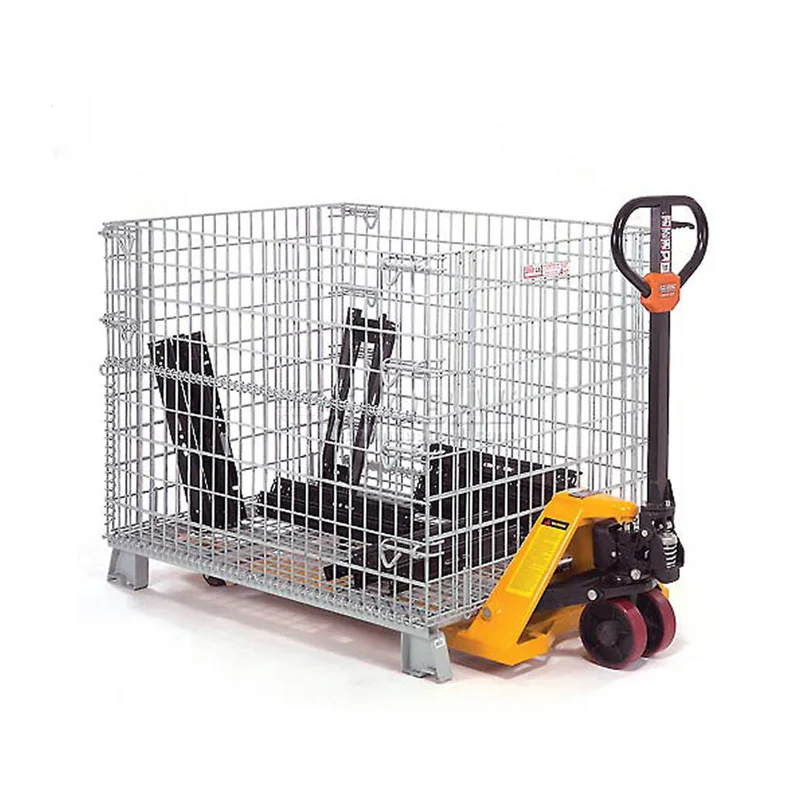
On a tight loading dock, the container is rarely the problem. The problem is the approach. If a loaded wire mesh container can only be accessed from one side, the forklift must swing around the end of the row, back up, and reposition before the forks are even near the base. Every additional maneuver costs time, and in a bay with a wall, a trailer, or a second row behind it, the swing clearance may not exist at all.
A four-way accessible base eliminates this limitation. On a collapsible steel wire mesh container, the entry is not a slot cut into the bin – it is the clearance created by the base frame and the formed feet beneath the mesh body. This is precisely what allows the forks or the wheels of a pallet truck to enter from any open side. It is a property of the handling interface, and like any interface, it must be verified against the drawing and the floor on which it is actually used.
How four-way accessibility is integrated into the base
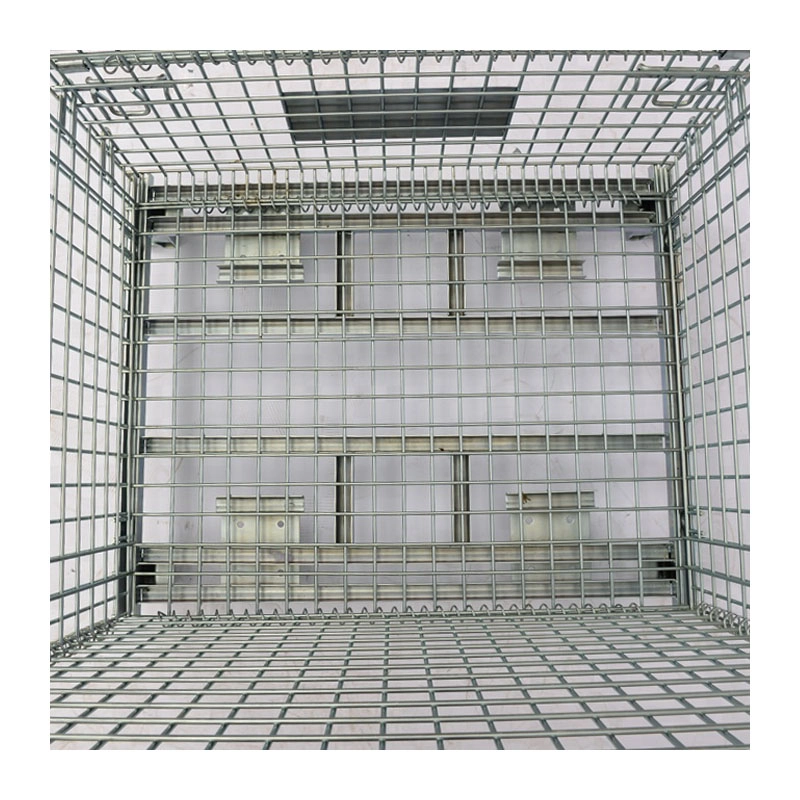
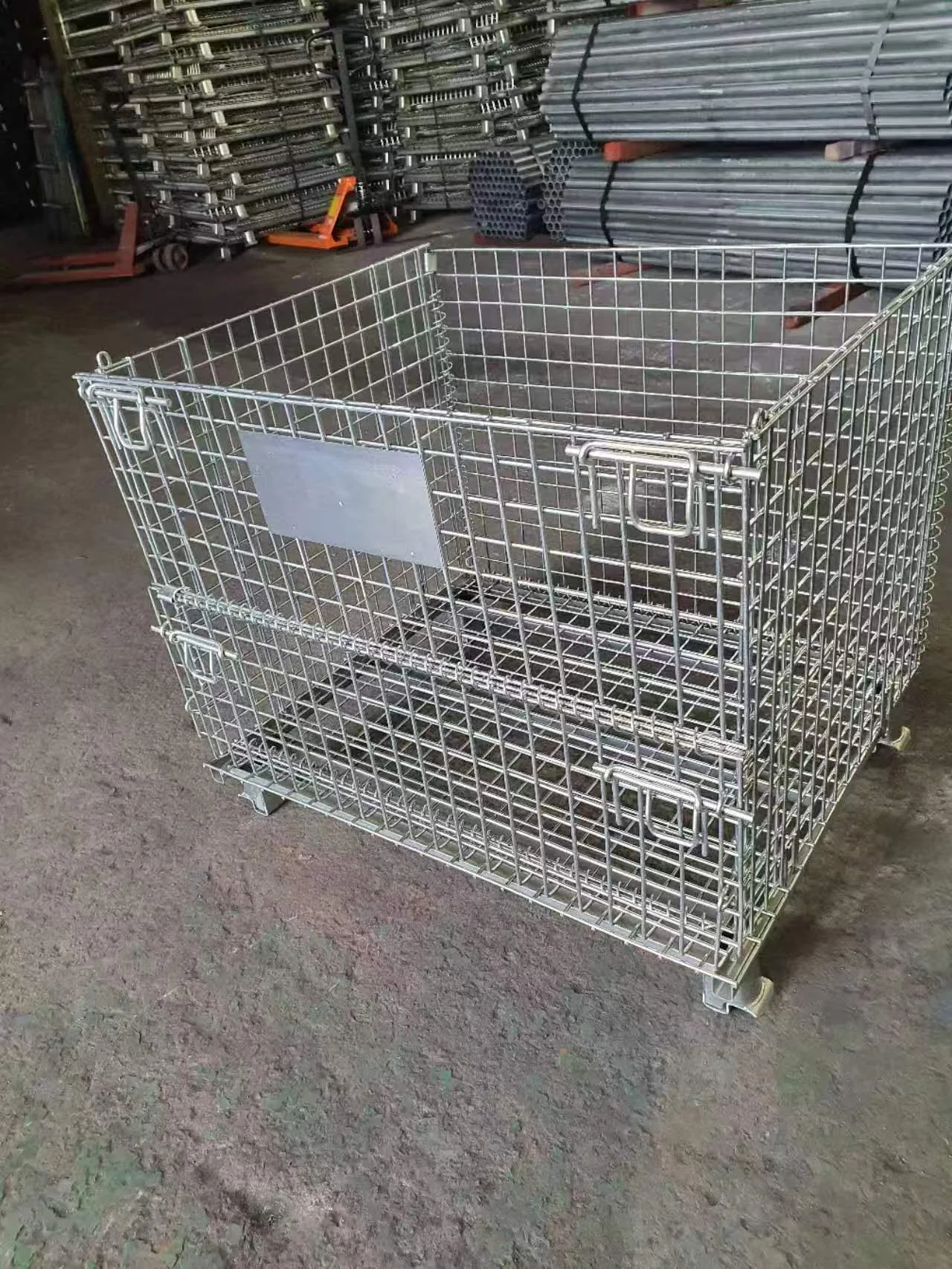
The mesh body of an Stbox container sits on a base made of U-profile steel. A structural U-profile runs beneath the floor plate, and the formed feet at the corners lift the base off the ground. The gap between the underside of the base and the ground runs continuously from front to back and from side to side, so there is no pair of "front" and "rear" entry pockets – there are four open approaches to the same base.
Nothing on the container blocks these approaches. The half-height flap, the fixed mesh walls, and the hinges all begin above the base line, so the flap side is just as accessible as the other three sides. The indexed image documentation for this product shows the lower profile reinforcement and the formed stacking feet and documents the four-way pallet truck entry at the base; at the dock, this is the difference between turning the forklift and simply turning the forks.
What the base frame and feet must do for this to work
Four-way accessibility is only as good as the base beneath it. Three requirements matter when reading a drawing or inspecting a delivered unit. First, the profile reinforcement must run continuously through the base, not just at its edge: a fork inserted from an unexpected side lifts a central area of the floor plate, and a base that is stiff only at the perimeter will deflect there. Second, the underside must be flat and free of protrusions along the entire entry path, since anything projecting below the base becomes a stop for the fork tip or the load wheel.
Third, the feet serve a dual function. They establish the entry clearance and at the same time serve as stacking positioners that lock a container into the frame of the container beneath it. A bent, broken, or missing foot changes both – it can close off entry on that side and prevent the stack from seating properly. This is why pre-shift inspection covers base, mesh, welds, and feet together, and why forks should be inserted evenly and straight at constant speed, not pushed in at an angle. Make sure the feet are fully engaged before releasing a stack.
Can a pallet truck access the same base?
Yes, provided the base opening and the pallet truck are matched. The indexed documentation for this container shows a manual hydraulic pallet truck lifting, and the entry clearance is documented as four-way. A pallet truck is a lower, narrower interface than a forklift, so two checks matter before planning a route over it: the lowered fork height of the specific pallet truck must clear the base opening, and the load wheels must roll in without lifting the container on entry.
Two limitations should be stated clearly. A pallet truck is a manual device – it is suitable for short, flat, level moves within a bay or along an aisle, not for yard transport or long inclines, where a forklift belongs. And the effort of starting a loaded container with a manual pallet truck increases with the load, so the pallet truck's capacity must be checked against the actual load and must not be derived from the container's own load rating. Container load ratings and stacking limits are documented per project variant, and four-way accessibility describes how the container is handled, not how much it may carry.
Floors and conditions where four-way accessibility cannot be relied upon
Four-way accessibility answers the question "from which side can I approach." It does not answer "is this floor suitable." The base needs a continuous, hard, level surface on which it can slide, and the following conditions break that assumption. Where they apply, no entry direction compensates – the solution is a different floor, a different handling point, or a different container.
- Uneven or damaged concrete with lips, steps, or chipped edges, where the fork tip or the load wheel has no continuous running surface.
- Soft or loose ground – gravel, dirt, sand, or yard crushed stone – where the base and wheels sink in instead of sitting level.
- Slopes, ramps, and loading docks or leveling platforms that are not level beneath the container.
- Abflussroste, Dehnungsfugen, eingelassene Schienen und Bodentaschen, die breit genug sind, um ein Rad oder eine Gabelspitze aufzunehmen.
- Nasse, ölige oder vereiste Böden, auf denen schlicht die Traktion fehlt, die die Räder benötigen.
Where this is particularly important in a plant
- Narrow bay layouts where the forklift cannot turn at the end of the row to reach a single fixed entry side.
- Loading and unloading a trailer or container, where the trailer wall determines the side from which the forks can approach.
- Parts storage and buffering of semi-finished products on level workshop floors, where a pallet truck must reach the container from the respectively open side.
- Machining or assembly stations where the load is presented facing the removal side and the half-height flap must face the operator without the container having to be repositioned.
Fragen, die Käufer vor der Bestellung stellen
Is four-way access standard at every size of this container?
Consider this as a configuration point to be confirmed, not as a blanket commitment. The documented record for this product shows a base made of U-steel with formed feet and four-way pallet truck access, but the documented project records cover different footprints and different base details. Request the released drawing for your size and check the entry clearance and the positions of the feet on it before the batch is manufactured.
Do I need a special pallet truck?
No special type is required, but the pallet truck must match the base. Check the lowered fork height, the load wheel diameter and the load capacity of the pallet truck against the base opening and against the actual load. Then train the approach: drive in straight and evenly, at a constant speed, without inserting the forks diagonally into the base.
Can I use it on a sloped or rough loading ramp?
No – a hard, level and continuous surface is the prerequisite for the base to be inserted cleanly. On a slope, loose gravel or a damaged ramp, instead plan a level transfer point and keep the container on level ground. Check the actual handling path before ordering, because the floor matters just as much as the base.
If your bottleneck is the turning space at the ramp and not the floor quality, the entry side is the part you can define. Look at the current Stbox wire mesh container configurations, gate options and surfaces on the product page for wire mesh containers and confirm the entry clearance of the base for your footprint using the drawing before ordering.
Benötigen Sie eine individuelle Lagerlösung?
Sprechen Sie direkt mit unseren technischen Ingenieuren. Wir bieten kostenlose Strukturplanungen, Bewertungen von Hochlast-Katalogen und schnelle B2B-Preisangebote.
Jetzt Angebot anfordern →